
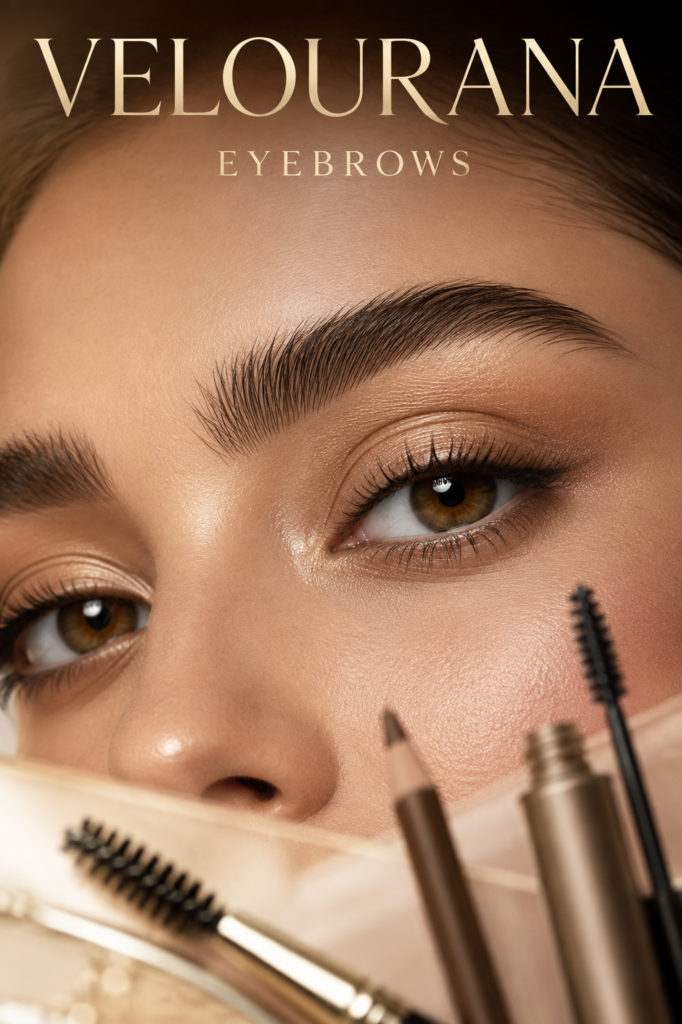
CATEGORY: Brow Filling
Brow filling is one of the most transformative techniques in eyebrow makeup because it can change the appearance of density, proportion, symmetry, and definition without altering the actual hair. A few carefully placed strokes can make sparse areas appear fuller, extend an incomplete tail, soften uneven growth, or give an otherwise pale eyebrow enough contrast to frame the eyes. The technique can be almost invisible or deliberately polished, depending on the products used and the way they are applied.
The most convincing brow filling does not simply color the empty skin inside an eyebrow outline. Natural brows are complex structures composed of individual hairs growing at different angles, areas of varying density, subtle changes in color, and irregular boundaries. When filling reproduces some of this complexity, the result becomes difficult to distinguish from genuine fullness. When every section receives identical pigment and definition, the brow can lose dimension and begin to resemble a solid shape placed over the skin.
This distinction explains why brow filling is better understood as visual reconstruction than simple coloring. The objective is to identify what already exists, determine where support is needed, and introduce pigment selectively. Some brows need only two or three sparse areas corrected. Others may require substantial reconstruction because the natural hairs are very fine, light, uneven, or widely spaced.
Successful filling begins with observation. The natural brow provides information about its appropriate width, direction, texture, and color. Rather than replacing these characteristics with an artificial template, makeup can extend them. This approach allows the eyebrow to remain individual while gaining the structure necessary to frame the face.
Understanding What Brow Filling Actually Changes
Brow filling can influence several aspects of appearance simultaneously. Density is the most obvious. Pigment placed between hairs reduces the amount of visible skin, making the eyebrow appear fuller. Yet the same technique can also alter shape because adding color along a particular boundary changes where the eye perceives the brow to begin or end.
A sparse underside can be filled to make an eyebrow appear thicker. A weak upper edge can be strengthened to create greater structure. A short tail can be visually extended. Uneven arches can be balanced by adding pigment rather than removing additional hair. This makes filling one of the most flexible approaches to eyebrow correction.
The technique also affects contrast. Very light brows may contain plenty of hair but still appear sparse because the hairs blend into the skin. A tinted product can increase visibility without substantially changing the physical dimensions of the brow. Darker brows may require almost no additional color and instead benefit from tiny corrections where skin is unusually visible.
Texture is equally important. Natural eyebrows are not uniformly opaque. Skin remains visible between hairs, especially near the inner brow. Filling that preserves these small spaces tends to look more realistic than completely covering the underlying skin.
The location of pigment determines how the shape changes. Filling beneath the arch can soften its elevation. Adding slightly above a low outer brow can create lift. Extending the tail outward can make the eye area appear wider. Increasing density near the inner brow can strengthen the central facial frame.
Because these changes are optical rather than permanent, brow filling offers an opportunity to experiment with proportion before making grooming decisions. A person considering a thicker, straighter, longer, or more arched shape can explore it temporarily with makeup.
Reading Natural Hair Growth Before Applying Product
The direction of eyebrow hair changes as it travels across the face. Understanding these changes is fundamental to realistic filling.
Near the inner brow, hairs commonly grow upward or diagonally. Through the central body, they begin to angle outward. Around the arch, the direction becomes increasingly horizontal, and near the tail, hairs may point sideways or slightly downward.
Hairlike cosmetic strokes become more believable when they follow these existing directions. Drawing every stroke vertically can create an exaggerated feathered effect, while drawing every stroke horizontally can make the inner brow look unnatural.
Density also changes naturally. The brow head is frequently more open and textured, with visible spaces between hairs. The central section often contains the greatest concentration, while the tail gradually narrows. Filling should usually respect this progression.
Before applying makeup, brushing the brows into their natural position reveals where actual gaps exist. Some apparent sparsity disappears once longer hairs are arranged correctly. Other areas become more obvious. This simple observation can prevent unnecessary product application.
It is also useful to view the brow from normal conversational distance rather than only through a magnifying mirror. Tiny gaps that appear significant at close range may be invisible when the face is viewed as a whole. Filling every microscopic space can result in excessive density.
The natural perimeter deserves similar attention. Brows rarely have perfectly straight edges. Small irregularities contribute to realism. Makeup does not need to erase all of them. Instead, it can establish enough continuity that the eyebrow appears intentional while preserving its organic character.
Building Density Without Creating a Solid Block
One of the central challenges of brow filling is increasing fullness without eliminating texture.
A solid layer of pigment may successfully hide skin, but it also removes the visual distinction between individual hairs. The eyebrow becomes flatter because the eye sees one continuous color rather than overlapping strands.
Layering offers a more dimensional approach. Light shading can first reduce the contrast between skin and hair in sparse areas. Individual strokes can then be added where greater definition is needed. Existing hairs remain visible above the cosmetic base, creating depth.
The amount of product should vary across the brow. The inner section generally benefits from less pigment, while the middle can carry more density. The tail may require additional definition because natural hairs become finer there, but it should still taper.
Pressure is one of the simplest ways to control intensity. A pencil used lightly produces a softer mark than the same pencil pressed firmly against the skin. Building color gradually allows corrections to remain subtle.
Brushes can also diffuse excessive pigment. A spoolie moved through freshly applied product distributes color among the hairs and removes obvious lines. This is especially effective with pencils and powders.
The objective is not necessarily to make every part of the eyebrow equally full. Natural density variation gives brows dimension. A convincing filled brow can still contain small gaps and lighter areas.
Filling the Brow Head With Restraint
The inner brow is one of the easiest areas to overfill because it is visually prominent and positioned close to the center of the face.
A heavily defined rectangular brow head can make the entire eyebrow appear artificial even when the rest of the filling is subtle. Natural front hairs are usually more separated than those farther outward, which allows more skin to remain visible.
Hairlike strokes are particularly effective here. They can be placed between existing hairs rather than underneath the entire section. Their direction should generally follow natural growth, often moving upward or diagonally outward.
Powder can also be used, but the application should remain diffused. A brush carrying only a small amount of remaining product can create enough shadow to increase density without producing a hard edge.
The lower portion of the brow head may need slightly more structure than the upper portion. This creates a gentle foundation while allowing the top to remain irregular and soft.
Color intensity should increase gradually as the brow moves outward. This transition prevents the inner edge from becoming the darkest portion of the eyebrow.
The distance between the brow heads should also be respected. Extending pigment too far inward can make the brows appear closer together, while leaving excessive space can weaken the central frame. Natural growth offers a useful starting point, with minor adjustments made according to facial proportions.
Reconstructing Sparse Areas Through the Brow Body
The central body of the eyebrow usually carries much of its visual weight. When this area is sparse, the brow may appear interrupted even if the head and tail are relatively full.
Filling the body often requires a combination of background density and directional detail. Powder or a soft pencil can reduce the visibility of skin, while finer strokes can connect isolated hairs.
Large gaps should not necessarily be covered with one dark patch. Gradually building pigment around existing hairs produces a more natural transition.
The lower boundary can be defined slightly more clearly because it contributes strongly to the perceived shape. The upper edge generally benefits from greater softness, especially in natural makeup.
When one eyebrow contains a sparse patch that the other does not, filling can improve balance without requiring hair removal from the fuller brow. This is one of the major advantages of additive correction.
Scarred areas can present a particular challenge because cosmetic products may behave differently on scar tissue than on normal skin. Thin layers and products designed for precise adherence can provide greater control than attempting to deposit a large amount of pigment at once.
The body should still show texture after filling. If the natural hairs disappear visually beneath the makeup, the application has probably become heavier than necessary for a natural effect.
Defining the Arch Without Making It Severe
The arch is often treated as the defining feature of an eyebrow, but excessive filling can make it disproportionately sharp.
When greater definition is desired, pigment can be concentrated beneath the arch rather than drawing an exaggerated point above it. This reinforces the natural structure while maintaining believable proportions.
A sparse arch may require individual strokes to connect the brow body with the tail. These strokes should follow the changing direction of the natural hairs rather than forming a single diagonal line.
People with uneven arches can use filling to create greater visual balance. The lower arch of one brow can be subtly elevated with pigment, or the higher brow can be softened by adding density beneath its peak.
This does not require exact symmetry. Facial anatomy naturally differs from side to side, and attempting to make the arches mathematically identical can produce excessive makeup.
Soft transitions are particularly important. The arch should emerge from the brow body rather than appearing as an isolated angular point.
Rebuilding and Extending the Brow Tail
The tail is frequently the sparsest part of the eyebrow. Hair may naturally thin toward the temple, or years of grooming may have reduced its density.
Because the tail is narrow, even small amounts of pigment can create a substantial difference. Precision is therefore more important than volume.
A fine pencil or pen can extend the existing direction through several small strokes. These marks should gradually converge as the brow narrows.
Drawing one uninterrupted line often appears less realistic because natural tails contain individual hairs rather than a single solid edge.
The length of the extension should remain proportionate to the eye and face. A tail that extends too far can visually pull the brow outward, while one that ends abruptly may make the eyebrow appear shortened.
Direction also affects expression. A strongly descending tail can create a heavier appearance around the outer eye. A more outward extension may appear elongated and balanced. The natural anatomy should still guide the final placement.
Color can be slightly more concentrated at the tail than at the brow head, but excessive darkness can make the outer section look detached. The transition from body to tail should remain continuous.
Pencil, Powder, Pen, and Pomade as Filling Tools
Different products produce different kinds of fullness.
Pencils are among the most versatile because they can create both shading and individual strokes. Fine pencils offer precision, while softer or broader formulas can fill larger areas quickly.
Powders create diffused density. They are particularly effective when natural hairs are present but the skin underneath remains visible. Their soft finish can make the eyebrow appear fuller without producing obvious lines.
Brow pens are designed for hairlike detail. They are useful for sparse areas where individual strokes need to imitate missing hairs. Their success depends heavily on pressure and direction.
Pomades provide stronger pigmentation and can create highly defined brows. Because they are often more opaque, small quantities are usually sufficient. Applying too much can conceal natural texture.
Many successful applications combine products rather than relying on only one. Powder may establish density while a pencil defines the tail. A pen may reconstruct sparse front hairs while gel adds color and holds the natural hairs in position.
Product choice should correspond with what the brow actually needs rather than simply following a trend.
Color Selection and Natural Dimension
Choosing an appropriate brow shade involves more than matching the darkest hair on the head.
Natural eyebrows contain multiple tones because hairs overlap, catch light differently, and cast small shadows. A single cosmetic shade can still look natural when applied with varying intensity.
Very dark products can make sparse filling obvious, especially when placed directly on visible skin. A slightly softer shade often integrates more easily.
Undertone matters as well. Brow colors can lean warm, cool, or neutral. A shade that conflicts strongly with the natural hair may remain noticeable even when its depth is correct.
People with very light hair may prefer enough contrast to define the brow without making it dramatically darker. Those with deep hair colors may use a slightly softer product to preserve dimension.
Gray or silver hair can work with neutral, taupe, ash, or deeper tones depending on the natural brow color and desired contrast.
The objective is visual harmony rather than an exact formula.
Blending as Part of the Filling Process
Blending is not merely a final correction. It is an integral part of brow filling.
Running a spoolie through the brow after applying pencil can soften obvious marks and distribute pigment. This creates a more natural relationship between cosmetic color and real hair.
Blending also reveals where additional product is genuinely necessary. An area that initially appears too dark may become balanced after brushing.
The direction of blending matters. Brushing randomly can disturb the intended shape. Following the natural growth pattern maintains structure while softening pigment.
With powder, a clean brush can diffuse edges that have become too sharp. With pomade, blending should occur before the product sets fully.
The goal is not to remove all definition. Instead, blending ensures that no single cosmetic mark becomes more noticeable than the eyebrow itself.
Filling Brows for Different Levels of Makeup
The appropriate intensity of brow filling depends partly on the rest of the makeup.
With minimal makeup, preserving natural texture is particularly important because heavily sculpted brows can dominate an otherwise bare face. Selective filling and clear or lightly tinted gel may provide sufficient definition.
Medium-intensity makeup allows slightly stronger boundaries and more uniform density. The brow can become polished while retaining visible hairs.
Dramatic eye makeup may require additional brow definition to maintain visual balance. Strong lashes, eyeliner, or eyeshadow can make lightly filled brows appear comparatively weak.
Even in dramatic makeup, however, density does not need to become completely uniform. Texture can remain visible while the overall shape becomes more defined.
Brow filling therefore exists on a continuum. The same natural eyebrow can be styled differently depending on the surrounding makeup without changing its fundamental structure.
Preserving Individuality Through Brow Filling
Perhaps the most important principle of brow filling is that fullness should not erase individuality.
Eyebrows differ in thickness, length, growth direction, density, arch placement, and asymmetry. These variations contribute to facial identity.
Filling becomes most convincing when it supports these characteristics rather than replacing them with a standardized outline.
A sparse eyebrow does not need to become exceptionally thick. A naturally straight brow does not need an artificial arch. A rounded brow does not require a sharp peak simply because a particular shape is fashionable.
The flexibility of makeup makes subtle enhancement possible. Density can be added exactly where it is missing, while natural areas remain largely untouched.
This selective approach also reduces the amount of product required and makes maintenance easier throughout the day.
Brow filling is ultimately an exercise in balance. Pigment must be visible enough to create improvement yet subtle enough to coexist with real hair. Structure should become clearer without appearing imposed. Symmetry can improve without eliminating natural differences.
When these elements work together, the eyebrow looks fuller rather than simply more made up.
THE END VELOURANA
 Discover More From Our Family of Websites
 ZodiacBearing (Astrology, Tarot, Numerology, Angel Numbers & Spiritual Guidance)
 Velourana (Beauty, Makeup, Hair Care, Skincare & Beauty Tips)
 HavenBearing (Home, Living, Organization, Décor & Everyday Inspiration)
 PawBearing (Pet Care, Dog Breeds, Animal Health, Training & Pet Products)
 PsyCatherine (Notes From the Journal of a Psychologist on Real Life)

