
CATEGORY: Broad-Spectrum Protection
Broad-spectrum sunscreen is often associated with beach holidays, swimming pools, and very hot summer days. In reality, one of its greatest strengths is how easily it can become part of ordinary daily skincare.
Ultraviolet exposure does not occur only during dramatic outdoor events. It can happen while walking, commuting, driving, sitting at an outdoor café, exercising, gardening, shopping, or spending time near windows.
This does not mean that every moment outdoors should be approached with anxiety.
It means that broad-spectrum protection works best when it becomes familiar, practical, and easy to use rather than something remembered only after the sun already feels intense.
The central idea is simple.
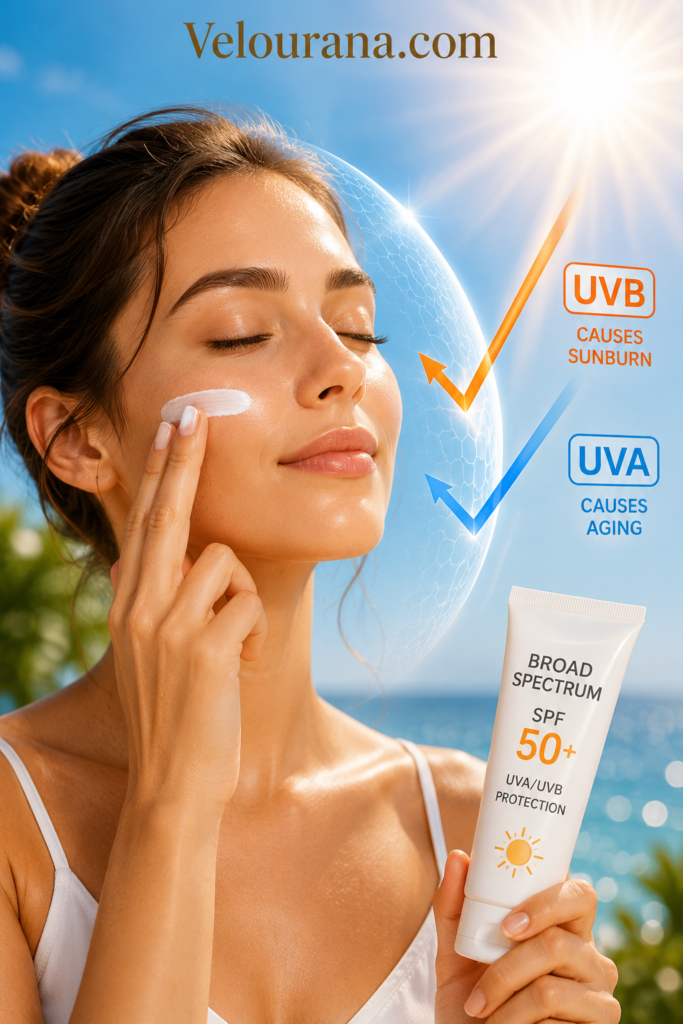
Broad-spectrum sunscreen helps protect the skin against both UVA and UVB radiation.
UVB is strongly associated with sunburn.
UVA penetrates more deeply and contributes significantly to photoaging and cumulative skin damage.
A complete everyday sun-protection routine therefore needs to consider both.
Why Everyday Protection Is Different From Holiday Protection
Beach sunscreen routines are usually obvious.
You know you will be outdoors.
You know you may swim.
You know the shoulders, arms, chest, legs, and face will be exposed.
Everyday exposure is less noticeable.
You may leave home expecting to spend only ten minutes outside and later discover that the day included a long walk, lunch outdoors, driving, errands, and an unexpected hour in the sun.
Because daily exposure can accumulate in small amounts, routine protection becomes valuable.
Broad-Spectrum Sunscreen Should Feel Normal
A sunscreen habit is easier to maintain when the product fits naturally into the rest of the skincare routine.
If sunscreen always feels like a special event product, it is easy to forget.
If it sits beside the moisturizer and becomes the final morning skincare step, it becomes easier to use consistently.
This is one reason cosmetic texture matters so much.
The product should be protective, but it should also be comfortable enough that you are willing to apply an adequate amount.
UVA Makes Daily Use Particularly Relevant
UVB intensity can vary strongly with season, time of day, and other environmental factors.
UVA is more consistently present throughout daylight hours and can penetrate window glass more effectively than UVB.
This helps explain why broad-spectrum sunscreen is frequently discussed as part of long-term skincare rather than simply sunburn prevention.
Someone who rarely burns may still receive meaningful UVA exposure.
Sunburn Is Not the Only Measure of Exposure
Many people decide whether they need sunscreen based on whether they expect to burn.
This is understandable because sunburn is visible and uncomfortable.
However, the absence of redness does not mean there has been no ultraviolet exposure.
UVA in particular can contribute to cumulative effects without producing the same immediate warning.
This is one of the strongest reasons to understand broad-spectrum protection rather than focusing only on burn prevention.
Start With the Morning Routine
A practical morning routine does not need many steps.
Cleanse if needed.
Apply any serum or treatment that belongs in the routine.
Use moisturizer if necessary.
Apply broad-spectrum sunscreen as the final skincare step before makeup.
This simple sequence works for many people.
Not Everyone Needs a Separate Moisturizer
Some broad-spectrum sunscreens are sufficiently moisturizing on their own.
Dry skin may still prefer a separate cream underneath.
Oily skin may find that sunscreen alone provides enough moisture.
Combination skin may use moisturizer only on drier areas.
There is no rule requiring identical layering for every skin type.
The goal is to create a base that allows sunscreen to spread evenly and remain comfortable.
Too Many Morning Layers Can Create Problems
An elaborate skincare routine may include toner, essence, several serums, eye cream, moisturizer, facial oil, and sunscreen.
Each product may be excellent individually.
Together, they may create pilling, heaviness, or an unstable surface beneath sunscreen.
If sunscreen repeatedly pills or feels difficult to spread, simplifying the layers underneath can help.
Protection should remain the priority.
Allow Products to Settle
Applying sunscreen immediately over several wet skincare layers can create mixing or pilling.
Allow previous products to settle sufficiently.
This does not require waiting an excessive amount of time.
A practical routine should remain efficient.
Sunscreen Comes Before Makeup
In a typical routine, broad-spectrum sunscreen is applied before makeup.
Allow it to settle according to product directions.
Then apply foundation, concealer, blush, or other cosmetics gently.
Avoid excessive rubbing that could disturb the sunscreen layer.
Makeup Does Not Replace Broad-Spectrum Sunscreen Automatically
Some foundations, powders, and tinted moisturizers display SPF.
This can be useful.
The challenge is quantity.
Most people apply makeup much more thinly than sunscreen is applied during standardized testing.
For this reason, a dedicated broad-spectrum sunscreen beneath makeup often provides a more reliable base of protection.
Tinted Broad-Spectrum Sunscreen
Tinted sunscreen can combine protection with cosmetic coverage.
For some people, this makes daily use easier because one product can reduce visible white cast and create a more even complexion.
Tinted formulations may be particularly attractive for people with medium to deeper skin tones who dislike the appearance of some untinted mineral sunscreens.
The key remains adequate application.
Choosing the Right Texture for Oily Skin
Oily skin often prefers sunscreen fluids, gels, lightweight emulsions, or matte lotions.
The goal is to find a product that feels comfortable in sufficient quantity.
Applying half the needed amount simply because the sunscreen feels heavy is not a good solution.
A better solution is finding a more suitable formula.
Choosing the Right Texture for Dry Skin
Dry skin may prefer richer creams or moisturizing lotions.
A hydrating broad-spectrum sunscreen can sometimes replace the daytime moisturizer.
Another option is to apply a thin moisturizer first, then sunscreen.
The routine should leave the skin comfortable without making sunscreen difficult to spread.
Choosing the Right Texture for Combination Skin
Combination skin often benefits from lighter textures.
A fluid or gel sunscreen can work across the entire face.
Moisturizer can be added selectively beneath it on dry areas.
This avoids making the T-zone feel unnecessarily heavy.
Choosing the Right Texture for Sensitive Skin
Sensitive skin may require more trial and error.
Some people react to fragrance.
Others dislike certain UV filters, preservatives, or alcohol-rich formulas.
The ideal product is one that provides appropriate broad-spectrum protection while remaining comfortable enough for consistent use.
Persistent irritation may warrant professional dermatological advice.
Mineral Broad-Spectrum Sunscreens
Mineral sunscreens generally use zinc oxide, titanium dioxide, or a combination of the two as UV filters.
Depending on formulation, they can provide broad-spectrum protection.
They are available in creams, lotions, sticks, and tinted formats.
One common challenge is white cast.
Modern formulations attempt to reduce this through particle technology, tinting, and improved cosmetic bases.
Organic Filter Sunscreens
Organic UV filters absorb ultraviolet radiation.
Different filters cover different portions of the UVA and UVB spectrum.
Formulators combine filters to create broad-spectrum protection.
Available UV filters differ between regulatory markets.
This is why sunscreens sold in Europe, Asia, Australia, and the United States may have noticeably different ingredient lists.
Hybrid Sunscreens
Hybrid products combine mineral and organic filters.
They may aim to balance texture, cosmetic finish, and protection.
The consumer does not need to choose a sunscreen based only on filter category.
The most important questions remain whether the product provides appropriate broad-spectrum protection and whether it can be used comfortably and correctly.
Application Quantity Matters Every Day
Broad-spectrum sunscreen is tested using standardized application amounts.
In real life, many people use less.
This matters because applying too little generally reduces the protection achieved.
Follow the manufacturer's directions and make sure exposed areas are covered evenly.
The Face Is Only One Area
Daily sunscreen discussions often focus almost entirely on the face.
The neck, ears, hands, upper chest, and arms may also receive repeated exposure.
If these areas are uncovered, include them in the protection routine.
Do Not Forget the Ears
Ears are easy to miss.
Short hairstyles, tied-back hair, and outdoor activity can leave them exposed.
Sunscreen or appropriate headwear can help protect them.
Do Not Forget the Neck
The neck is frequently exposed during everyday life.
Apply sunscreen to exposed areas rather than stopping at the jawline.
The back and sides of the neck can also receive sunlight.
Do Not Forget the Hands
Hands experience regular sun exposure and frequent washing.
This combination can make reapplication particularly relevant.
If you wash your hands and continue spending time outdoors, consider restoring protection.
The Upper Chest Is Often Exposed
Open-neck clothing leaves the upper chest exposed.
This area can receive substantial cumulative sunlight.
Broad-spectrum sunscreen should extend to whatever skin is visible.
Scalp Protection
People with shaved heads, thinning hair, or exposed hair parts should consider scalp protection.
Hats are particularly useful.
Suitable sunscreen can also be applied to exposed areas according to product instructions.
Lip Protection
The lips also receive sunlight.
Lip balms or lip products with appropriate SPF can be useful during outdoor exposure.
Reapply after eating, drinking, swimming, or wiping the lips.
Daily Sunscreen During the Commute
A commute can involve walking, cycling, driving, waiting for public transport, or sitting near vehicle windows.
Each situation creates different exposure patterns.
Someone who spends twenty minutes outdoors in the morning and another twenty minutes in the afternoon may receive more cumulative exposure than they realize.
A morning broad-spectrum sunscreen routine provides a practical baseline.
Driving and Broad-Spectrum Protection
UVA can pass through ordinary vehicle glass more effectively than UVB.
Long-term drivers may therefore consider protection for the face, hands, and arms.
Window properties vary, but the broader principle remains useful: glass does not automatically eliminate all ultraviolet exposure.
Office Workers Near Windows
An indoor job does not always mean zero UVA exposure.
Someone sitting directly beside a bright window for hours may experience more UVA than someone working deep inside a building.
Broad-spectrum sunscreen can be relevant depending on the specific environment.
Outdoor Lunches Add Up
A short lunch outside can seem insignificant.
Yet repeated throughout the week, these exposures accumulate.
This is another example of why sunscreen as a routine habit can be easier than trying to calculate every small exposure separately.
Gardening and Home Activities
Gardening, washing the car, cleaning a balcony, walking a pet, or doing outdoor maintenance can all involve meaningful UV exposure.
These activities often occur spontaneously.
Keeping sunscreen easily accessible can help make protection automatic.
Outdoor Exercise
Running, cycling, tennis, football, hiking, and other outdoor sports combine exposure with perspiration.
Choose a sunscreen appropriate to the activity.
Water-resistant formulations may be useful.
Reapply according to instructions, particularly after heavy sweating or wiping the skin.
Sweat Can Disturb Sunscreen
Perspiration can affect the sunscreen film.
Wiping sweat away can remove product as well.
During extended outdoor exercise, protection needs more attention than during a brief walk.
Swimming Requires Water Resistance
For swimming, use a water-resistant broad-spectrum sunscreen.
Water-resistant does not mean permanent.
Reapply as directed after swimming and towel drying.
Towel Drying Physically Removes Sunscreen
Even if a sunscreen remains partly present after swimming, rubbing the skin with a towel can remove a significant amount.
This is why reapplication after toweling is important when continued exposure is expected.
Beach Days Require More Than Daily Sunscreen Habits
A daily morning sunscreen may work perfectly for ordinary city exposure.
A full beach day requires a more deliberate strategy.
Use sufficient product.
Reapply.
Seek shade.
Wear protective clothing where practical.
Use hats and sunglasses.
Sunscreen should not carry the entire protective burden alone.
Shade Is an Excellent Partner
Shade reduces direct sunlight.
Trees, umbrellas, buildings, canopies, and covered areas can all help.
Reflected ultraviolet radiation can still reach the skin, particularly around water, sand, snow, or bright surfaces.
Shade and sunscreen therefore complement each other.
Protective Clothing Makes Daily Protection Easier
Clothing can cover large areas without needing repeated sunscreen application.
Long sleeves, trousers, and tightly woven fabrics can be useful when prolonged exposure is expected.
Purpose-designed UPF clothing provides another option.
Hats Protect Difficult Areas
A broad-brimmed hat shades the scalp, face, ears, and neck more effectively than a narrow cap.
Caps can still be useful, but they leave more areas exposed.
Choose according to the activity.
Sunglasses Protect the Eyes
Broad-spectrum skincare focuses on the skin, but the eyes also need protection from ultraviolet radiation.
Choose sunglasses designed to provide suitable UV protection.
Cloudy Weather Does Not Eliminate UV
Clouds can reduce UV exposure, but they do not necessarily eliminate it.
This is why UV conditions should not be judged solely by whether the sky looks bright.
The UV Index Is More Useful Than Temperature
A hot day is not automatically a high-UV day, and a cool day is not automatically low UV.
The UV Index provides information specifically about ultraviolet radiation levels.
It can therefore be more informative than temperature when planning sun protection.
Broad-Spectrum Sunscreen in Winter
Winter sunlight still contains UVA and UVB.
Snow can reflect ultraviolet radiation.
High-altitude winter sports can create particularly intense exposure.
This makes broad-spectrum protection relevant beyond summer.
Broad-Spectrum Sunscreen in Spring
Spring temperatures may feel mild while UV levels rise.
People can underestimate exposure because the weather does not yet feel hot.
This is a classic example of why ultraviolet protection should not be based on temperature alone.
Broad-Spectrum Sunscreen in Autumn
Autumn does not immediately eliminate UV exposure either.
Depending on location and weather, meaningful exposure can continue.
A sunscreen routine can therefore remain relevant well beyond peak summer.
Broad-Spectrum Protection for Deeper Skin Tones
Deeper skin tones contain more melanin and may burn less readily.
However, ultraviolet exposure still contributes to skin damage and pigmentation changes.
The main cosmetic challenge may be finding a broad-spectrum sunscreen without an obvious white cast.
Tinted, transparent, or carefully formulated options can help.
Broad-Spectrum Protection for Very Fair Skin
Very fair skin may burn more quickly.
High protection, careful application, shade, clothing, and reapplication are particularly important during substantial exposure.
However, UVA protection remains relevant even when the immediate concern is UVB-associated burning.
Broad-Spectrum Protection and Hyperpigmentation
People managing uneven pigmentation often pay particular attention to daily sunscreen.
Broad-spectrum protection reduces UVA and UVB exposure that can contribute to pigmentation changes.
Certain tinted sunscreens may also provide additional visible-light protection depending on formulation.
Broad-Spectrum Protection and Anti-Aging
For people concerned about visible aging, sunscreen is one of the most logical preventive steps.
A moisturizer can improve hydration.
A retinoid can influence skin renewal.
An antioxidant serum can provide complementary benefits.
None replaces broad-spectrum protection from ultraviolet radiation.
Consistency Beats Occasional Perfection
Using sunscreen perfectly on one beach holiday and ignoring it during months of ordinary exposure is not an ideal long-term strategy.
Consistency matters.
A sunscreen that fits comfortably into daily life is therefore extremely valuable.
A Comfortable Sunscreen Is More Useful Than an Unused Perfect One
Consumers sometimes search endlessly for the highest possible protection, newest filter combination, or most sophisticated formulation.
Technical quality matters.
But practicality matters too.
If a product feels so unpleasant that it is used sparingly or rarely, its real-world value is reduced.
Choose a sunscreen you are willing to use correctly.
Reapplication During an Ordinary Day
Not every indoor day requires constant sunscreen reapplication.
Reapplication becomes especially important when spending extended periods outdoors, swimming, perspiring, or physically removing sunscreen.
The product instructions and actual exposure should guide the decision.
Reapplication Over Makeup
This is one of the most difficult practical aspects of daily sunscreen use.
Options include carefully reapplying fluid sunscreen, using sticks, cushions, sprays, or other formats designed for touch-ups.
The challenge is always achieving enough even coverage.
Convenience should not replace adequate protection.
Sunscreen Sticks
Sticks can be useful for areas such as the nose, cheekbones, ears, and hands.
They can also be convenient during travel.
A single light swipe may not deposit enough product.
Use according to directions.
Sunscreen Sprays
Sprays can be practical for body reapplication.
Make sure the skin receives enough product and that coverage is even.
A quick cloud of mist may not be sufficient.
Powder Sunscreens
Powder sunscreen can be useful as supplementary protection.
However, achieving the same uniform tested coverage as a lotion may be difficult.
It should not automatically replace a well-applied primary sunscreen layer.
Broad-Spectrum Sunscreen and Facial Hair
Beards and facial hair can complicate sunscreen application.
Exposed skin between hairs may still receive sunlight.
Application technique may need adjustment.
Hats and shade can provide additional protection.
Sunscreen and Hairline
The hairline is frequently missed.
Apply carefully around exposed forehead areas.
People with thinning hair may also need scalp protection.
Sunscreen Around the Eyes
The eye area can be sensitive.
Use a product appropriate for application around the eyes according to instructions.
Sunglasses provide an additional protective measure and reduce glare.
Avoid Mixing Sunscreen With Other Products
Mixing sunscreen directly with moisturizer, facial oil, foundation, or serum can interfere with its intended film formation.
Apply each product separately unless the manufacturer specifically instructs otherwise.
Do Not Dilute Sunscreen
Mixing SPF 50 with moisturizer does not create a reliable SPF 25 product.
The resulting protection is unpredictable.
Use sunscreen as formulated.
DIY Sunscreen Is Not Appropriate
Broad-spectrum sunscreen requires careful formulation and testing.
Homemade mixtures cannot reliably guarantee SPF, UVA protection, stability, or even distribution of filters.
Use legitimate, tested products.
Authenticity Matters
Counterfeit sunscreen can look convincing.
The problem is that protection cannot be judged visually.
Purchase from reputable retailers and suppliers.
This is particularly important for imported products and high-demand brands.
Storage Matters
Follow the storage instructions.
Avoid leaving sunscreen in extreme heat unnecessarily.
Cars, direct sunlight, and hot bags can expose products to temperatures much higher than typical room conditions.
Expiration Matters
Check expiration dates and period-after-opening information.
Do not assume an old sunscreen remains reliable indefinitely.
A functional protective product deserves the same attention to shelf life as any other important skincare item.
Broad-Spectrum Sunscreen Should Not Create False Confidence
Perhaps the greatest danger of sunscreen is not the product itself but the belief that applying it removes all limits.
It does not.
No sunscreen blocks all ultraviolet radiation.
A high SPF should not encourage deliberately extended exposure.
Sunscreen Is One Layer of a Larger Strategy
Think of sun protection as several overlapping layers.
Broad-spectrum sunscreen.
Shade.
Clothing.
Hats.
Sunglasses.
Behavior.
Together, they reduce exposure more effectively than any single measure.
Avoid Intentional Overexposure
Applying sunscreen should not become a way to stay in intense sunlight indefinitely.
Reducing unnecessary exposure remains important.
Sun protection works best when it supports sensible behavior.
A Simple Workday Routine
For an ordinary workday, the morning routine may be enough to establish a strong baseline.
Apply broad-spectrum sunscreen properly before leaving home.
Protect exposed areas.
Reapply if the day turns into prolonged outdoor exposure.
This is practical without becoming obsessive.
A Simple Weekend Routine
Weekend activities can be unpredictable.
Keep sunscreen available in a bag or near the door.
If the day includes gardening, walking, sport, outdoor dining, or travel, reapply as needed.
A Simple Beach Routine
Apply broad-spectrum sunscreen before exposure according to directions.
Cover all exposed areas.
Reapply after swimming, heavy perspiration, towel drying, and as directed.
Use shade and protective clothing.
Do not depend on sunscreen alone.
A Simple Travel Routine
Travel can involve long walks, airports, driving, outdoor sightseeing, and changing climates.
Carry a facial sunscreen and a body product if necessary.
A stick can be useful for targeted reapplication.
The simpler the system, the easier it is to maintain.
Make Sunscreen Easy to Find
Habits are easier when products are visible.
Keep the daily facial sunscreen with morning skincare.
Keep body sunscreen near outdoor essentials.
Carry a smaller product when prolonged exposure is likely.
Reducing friction improves consistency.
Do Not Save Sunscreen for Special Occasions
Sunscreen is not perfume.
There is little benefit in preserving a favorite bottle while using too little.
Use it as intended and replace it when needed.
Broad-Spectrum Protection Should Feel Routine, Not Dramatic
The goal is not to spend the day thinking constantly about ultraviolet radiation.
The goal is to create habits that quietly reduce exposure.
Apply sunscreen.
Use shade.
Wear protective clothing when appropriate.
Reapply during substantial exposure.
Then continue with the day.
Know When Medical Advice Is Appropriate
People with a history of skin cancer, photosensitive conditions, medication-related photosensitivity, or other medical concerns may need more specific protection advice.
A dermatologist or other qualified healthcare professional can provide individualized guidance.
Sunburn Requires More Than Cosmetic Thinking
Mild post-sun dryness can be managed with skincare.
Severe sunburn is different.
Blistering, severe pain, marked swelling, extensive burns, or other concerning symptoms may require medical attention.
Broad-spectrum protection is preventive precisely because treatment after excessive exposure is not equivalent to avoiding the exposure in the first place.
Everyday Protection Is an Investment in Consistency
One application will not determine the long-term appearance or health of the skin.
Repeated habits matter more.
Broad-spectrum sunscreen is most useful when it becomes a consistent part of a wider sun-protection strategy.
The Best Routine Is the One That Fits Real Life
Some people enjoy sophisticated skincare.
Others want three morning steps.
Both approaches can work.
The broad-spectrum sunscreen only needs to fit correctly into the routine and be applied appropriately.
There is no prize for making sun protection unnecessarily complicated.
Choose Based on Protection First
When comparing products, begin with protection.
Appropriate SPF.
Broad-spectrum UVA and UVB coverage.
Water resistance when necessary.
Then consider texture.
Finish.
Fragrance.
Tint.
Packaging.
Price.
Cosmetic preferences matter, but they come after the core protective function.
Learn From Your Own Routine
If sunscreen pills, simplify the products underneath.
If it stings the eyes, try another formulation.
If it feels too greasy, choose a lighter texture.
If it leaves a strong white cast, explore tinted or more transparent options.
If you constantly forget to reapply, carry a convenient format.
Small adjustments can turn sunscreen from an annoying obligation into a manageable habit.
Broad-Spectrum Protection Does Not Need to Be Perfect to Be Valuable
Real life is imperfect.
People miss areas.
They forget reapplication.
They spend longer outside than expected.
This is not a reason to give up.
Better protection is still valuable.
The goal is improving habits, not achieving impossible perfection.
A Daily Broad-Spectrum Routine in Practice
Imagine a typical morning.
You cleanse the face.
Apply one lightweight serum.
Use moisturizer where needed.
Apply broad-spectrum sunscreen to the face, ears, neck, and exposed chest.
You apply sunscreen to exposed hands.
Makeup follows after the sunscreen settles.
You leave home.
At lunch, you spend twenty minutes outside.
Later, you walk home.
If the day becomes unexpectedly outdoor-heavy, you reapply.
This is not complicated.
It is simply a routine designed around realistic exposure.
Why Broad-Spectrum Protection Belongs in Skincare Education
Many skincare discussions focus on repairing problems.
Pigmentation.
Fine lines.
Dryness.
Texture.
Redness.
Broad-spectrum protection takes a different approach.
It reduces one of the environmental factors that contributes to several of these concerns.
That preventive role makes sunscreen unusually important.
The Final Principle
Everyday broad-spectrum protection is not about avoiding the outdoors.
It is about enjoying ordinary life while reducing unnecessary UVA and UVB exposure.
Choose a sunscreen with appropriate broad-spectrum protection.
Apply enough.
Cover all exposed areas.
Reapply when activity and exposure require it.
Use clothing, shade, hats, and sunglasses as additional protection.
Choose a texture that makes correct use easy.
Do not rely on sunburn as the only warning signal.
Do not assume glass, clouds, wind, or cooler temperatures eliminate ultraviolet exposure.
Most importantly, turn sunscreen into a habit rather than an emergency response.
When broad-spectrum protection becomes a natural final step in the morning routine, sun care becomes simpler, more consistent, and far more effective over time.
The End
Velourana.
 Discover More From Our Family of Websites
 ZodiacBearing (Astrology, Tarot, Numerology, Angel Numbers & Spiritual Guidance)
 Velourana (Beauty, Makeup, Hair Care, Skincare & Beauty Tips)
 HavenBearing (Home, Living, Organization, Décor & Everyday Inspiration)
 PawBearing (Pet Care, Dog Breeds, Animal Health, Training & Pet Products)
 PsyCatherine (Notes From the Journal of a Psychologist on Real Life)

