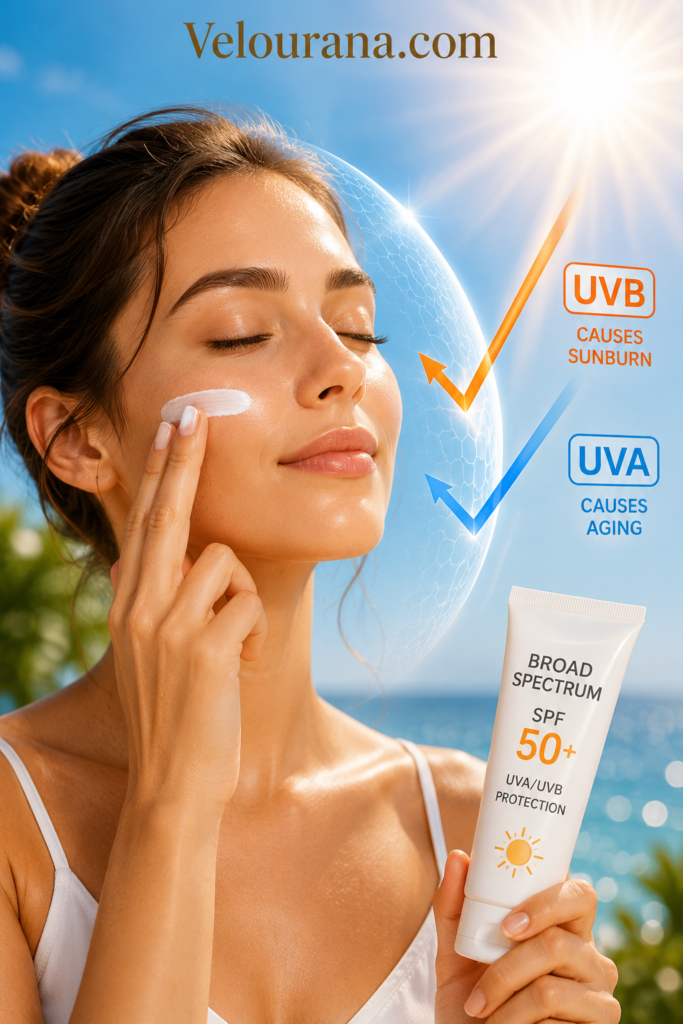
CATEGORY: Broad-Spectrum Protection
Choosing sunscreen can appear simple until you begin reading the label. SPF numbers, UVA symbols, UVB protection, broad-spectrum claims, water-resistance statements, application instructions, and different sunscreen formats can quickly turn a basic purchase into something that feels unnecessarily complicated.
Among all these terms, broad-spectrum protection is one of the most important to understand.
Broad-spectrum sunscreen is designed to provide protection against both major types of ultraviolet radiation that affect the skin: UVA and UVB. These forms of ultraviolet radiation behave differently, penetrate the skin differently, and contribute to different types of damage. Effective sun protection therefore requires more than simply looking for a high SPF number.
Understanding what broad-spectrum protection means allows you to read sunscreen labels more intelligently and choose products according to the protection they actually provide.
Understanding Ultraviolet Radiation
Sunlight contains different forms of electromagnetic radiation.
The portion most relevant to everyday sunscreen use is ultraviolet radiation, usually abbreviated as UV.
Ultraviolet radiation that reaches the Earth's surface is primarily divided into UVA and UVB.
Both matter.
They do not affect the skin in exactly the same way, which is why modern sun protection should address both.
What Is UVA?
UVA represents a large proportion of the ultraviolet radiation reaching the Earth's surface.
UVA wavelengths penetrate more deeply into the skin than UVB.
They are strongly associated with photoaging and contribute to cumulative skin damage.
Repeated UVA exposure is therefore relevant not only during obvious beach holidays but throughout ordinary daily life.
UVA and Premature Skin Aging
One of the best-known effects associated with UVA exposure is photoaging.
Photoaging refers to visible skin changes caused by repeated ultraviolet exposure over time.
These changes can include uneven pigmentation, changes in skin texture, reduced elasticity, and the development of visible lines and wrinkles.
Natural aging and photoaging are not identical.
Sun exposure can accelerate visible changes beyond those produced by chronological aging alone.
UVA Can Reach You Without Obvious Sunburn
One reason UVA deserves particular attention is that exposure does not necessarily produce the immediate warning signal of sunburn.
You can therefore receive meaningful UVA exposure without noticing dramatic redness.
This makes relying on the sensation of burning an unreliable approach to sun protection.
Skin can be exposed even when it does not feel as though it is burning.
UVA and Window Glass
UVA can penetrate ordinary window glass more effectively than UVB.
This is relevant for people who spend long periods close to sunny windows or travelling in vehicles.
The exact amount of exposure depends on factors such as the type of glass and environment, but the general principle is important: being indoors behind glass does not always mean UVA exposure is completely absent.
What Is UVB?
UVB wavelengths behave differently.
They are strongly associated with sunburn and play an important role in ultraviolet-related skin damage.
UVB intensity varies according to factors such as season, time of day, latitude, altitude, and atmospheric conditions.
This is the radiation people often associate most immediately with a painful day in the sun.
UVB and Sunburn
Sunburn is one of the clearest signs of excessive ultraviolet exposure.
Redness, warmth, tenderness, and more severe symptoms can develop after excessive exposure.
Avoiding sunburn is important.
However, preventing visible burning alone does not represent complete sun protection because UVA exposure also matters.
This is precisely why broad-spectrum sunscreen is so important.
UVA and UVB Are Both Relevant to Skin Cancer
Both UVA and UVB contribute to ultraviolet-related skin damage, and ultraviolet radiation is a major preventable risk factor for skin cancer.
Sunscreen should therefore be understood as part of a health-protection strategy rather than simply an anti-aging cosmetic.
Its value extends far beyond preventing redness or preserving an even complexion.
What Does Broad-Spectrum Mean?
Broad-spectrum sunscreen is formulated and tested to provide protection across both UVA and UVB portions of the ultraviolet spectrum according to the regulatory requirements applicable to the product.
The exact labeling systems and testing standards vary between regions.
This is why consumers may encounter different symbols or terminology on sunscreen packaging depending on where the product is sold.
The essential concept remains the same.
Broad-spectrum protection aims to cover both UVA and UVB rather than focusing predominantly on one.
SPF Does Not Tell the Whole Story
SPF stands for Sun Protection Factor.
The SPF value primarily relates to protection against UVB-associated sunburn under standardized testing conditions.
This means that looking only at the SPF number does not provide a complete picture of UVA protection.
A sunscreen should therefore be evaluated for both its SPF and its broad-spectrum or UVA protection information.
Why High SPF Alone Is Not Enough
Imagine two sunscreens both displaying a high SPF number.
If you look only at that number, they may appear equivalent.
But complete sun protection requires consideration of UVA coverage as well.
This is why broad-spectrum labeling matters.
The goal is not simply to maximize the number printed most prominently on the bottle.
The goal is balanced ultraviolet protection.
What SPF 30 Means
SPF should not be interpreted as the number of minutes you can safely remain in the sun.
The relationship is more complicated because actual exposure varies with UV intensity, application quantity, perspiration, swimming, rubbing, and many other factors.
SPF 30 provides a high level of UVB protection when tested and applied appropriately.
It should still be reapplied according to product directions and circumstances.
What SPF 50 Means
SPF 50 provides a higher tested level of UVB protection than SPF 30.
The numerical increase from 30 to 50 should not be interpreted as meaning that SPF 50 allows almost twice as much time in the sun.
Sunscreen should never be used as a timer for extending exposure.
Its purpose is protection during unavoidable or chosen outdoor activity.
SPF 50+
Some regulatory systems permit the designation SPF 50+ for products exceeding specified testing thresholds.
The exact labeling rules depend on the market.
Again, the most important practical point is that very high SPF does not eliminate the need for correct application, reapplication, shade, clothing, and other protective measures.
No Sunscreen Blocks 100 Percent of UV
Terms such as "sunblock" can create the misleading impression that a product forms an absolute barrier.
No sunscreen should be treated as providing complete protection from all ultraviolet radiation.
This is why sun protection works best as a combination of measures.
Broad-Spectrum Protection and Photoaging
For people interested primarily in maintaining the appearance of their skin, UVA protection deserves particular attention.
A sophisticated anti-aging routine can include expensive serums, moisturizers, retinoids, antioxidants, and professional treatments.
But repeated unprotected ultraviolet exposure works against the objective of preserving even tone and texture.
Daily broad-spectrum sunscreen therefore has a logical place in a long-term skincare strategy.
Broad-Spectrum Protection and Hyperpigmentation
Ultraviolet exposure can contribute to pigmentation changes.
People concerned about uneven tone, dark marks, or other pigmentation issues may therefore benefit from taking sun protection seriously.
The appropriate approach can vary according to the specific pigmentation concern and individual skin characteristics.
Broad-spectrum protection remains a fundamental preventive measure.
Broad-Spectrum Sunscreen Is Relevant to Every Skin Tone
Darker skin contains more melanin and may burn less readily than lighter skin.
That does not mean ultraviolet protection is unnecessary.
People of all skin tones can experience UV-related skin damage.
Sunscreen selection should therefore focus on protection, comfort, and cosmetic suitability rather than assuming certain complexions do not require it.
Why Cosmetic Elegance Matters
A sunscreen can have excellent theoretical protection but still fail in practice if someone dislikes using it.
Texture matters.
Finish matters.
Compatibility with makeup matters.
White cast matters.
Comfort around the eyes matters.
A sunscreen that you can apply adequately and reapply consistently may be more useful in daily life than one you avoid because you dislike its texture.
Sunscreen Comes in Many Textures
Modern broad-spectrum sunscreens are available as creams, lotions, fluids, gels, sticks, sprays, and other formats.
Each has advantages and limitations.
The best format depends on the area of application and how reliably the user can achieve adequate, even coverage.
Facial Sunscreen
Facial sunscreens often emphasize cosmetic elegance.
They may be designed to work beneath makeup, control shine, provide hydration, or leave a more invisible finish.
These additional features are useful, but protection remains the primary purpose.
Choose the cosmetic qualities that make consistent use easier.
Body Sunscreen
Body sunscreen often comes in larger packaging and textures designed for spreading across substantial surface areas.
Do not reserve sunscreen only for the face.
Exposed shoulders, arms, chest, legs, ears, neck, and hands also require consideration.
Sunscreen Sticks
Sticks are convenient for targeted application and reapplication.
However, achieving adequate coverage requires careful application.
A quick single swipe may not deposit enough product uniformly.
Follow the product instructions and make sure the area is covered properly.
Sunscreen Sprays
Sprays can be convenient for body application.
Their convenience can also make it easy to apply too little or miss areas.
Follow the manufacturer's directions carefully.
Avoid assuming that a brief mist automatically creates complete coverage.
Water-Resistant Sunscreen
Water resistance is particularly important for swimming and heavy perspiration.
A sunscreen labeled water resistant has been tested according to relevant standards for a specified period under water-exposure conditions.
Water resistant does not mean waterproof.
Reapplication remains necessary.
There Is No Truly Permanent Sunscreen Layer
Sunscreen moves.
It can be affected by perspiration, water, towels, clothing, touching the face, and normal activity.
This is why reapplication matters.
A perfect morning application does not necessarily remain unchanged throughout an entire outdoor day.
How Much Sunscreen Should You Apply?
Adequate application is essential to achieving the labeled protection.
Laboratory testing uses standardized application amounts.
In everyday life, many people apply less than the amount used during testing.
Follow the directions supplied with the sunscreen and ensure complete, even coverage of exposed skin.
Do Not Stretch a Small Amount Too Far
Trying to make a tiny quantity cover the entire face, neck, ears, and chest may result in inadequate coverage.
Sunscreen should form a sufficiently uniform protective layer.
Areas that receive very little product may not receive the expected protection.
Apply Sunscreen Before Exposure
Follow the timing instructions provided with the product.
Many sunscreens are intended to be applied before sun exposure rather than after someone has already spent substantial time outside.
Sun protection should be proactive.
Reapply Regularly
Reapplication frequency depends on the sunscreen instructions and circumstances.
Swimming, heavy perspiration, towel drying, and prolonged outdoor exposure make reapplication particularly important.
Do not assume a morning application automatically covers an entire beach day.
Reapply After Swimming
Even water-resistant sunscreen requires reapplication according to its directions.
Water resistance is limited.
After swimming and drying off, restore protection as instructed.
Reapply After Toweling
Towels can physically remove sunscreen.
This is another reason reapplication is important after swimming.
Even if the sunscreen claims water resistance, rubbing with a towel can disturb the protective film.
Reapply During Outdoor Exercise
Perspiration and wiping the face can affect sunscreen coverage.
For outdoor exercise, choose a product suitable for the activity and reapply according to instructions.
Do You Need Sunscreen on Cloudy Days?
Cloud cover does not eliminate ultraviolet exposure.
UV can still reach the Earth's surface when the sky is cloudy.
Sun protection should therefore be based on exposure conditions and UV risk rather than simply whether the sun looks bright.
Shade Helps but Is Not Absolute Protection
Shade can substantially reduce direct sun exposure.
It should be used whenever practical.
However, ultraviolet radiation can be reflected from surrounding surfaces and reach the skin indirectly.
Shade works best as part of a broader strategy.
Clothing Is an Important Protective Tool
Clothing can reduce the amount of skin directly exposed to sunlight.
Long sleeves, trousers, and garments designed for sun protection can be particularly useful during prolonged outdoor activity.
This reduces reliance on sunscreen alone.
Hats Protect Important Areas
A broad-brimmed hat can provide shade for the face, ears, and neck.
A baseball cap provides less coverage to the ears and neck.
Choose according to the activity and expected exposure.
Sunglasses Matter Too
Ultraviolet protection is not only about skin.
Appropriate sunglasses help protect the eyes from UV exposure.
Choose sunglasses designed to provide suitable ultraviolet protection.
Sunscreen and Makeup
Sunscreen generally belongs beneath makeup unless a particular product is designed differently.
Allow the sunscreen to settle according to its directions before applying makeup.
Avoid rubbing excessively during makeup application, as this can disturb the sunscreen layer.
Makeup With SPF
Foundation, tinted moisturizer, and other makeup products may include SPF.
These can contribute to protection.
However, people often apply makeup in smaller quantities than would be required to achieve the labeled sunscreen protection.
A dedicated sunscreen beneath makeup is therefore often the more reliable approach.
Moisturizer With SPF
Some moisturizers provide tested sun protection.
If the product offers appropriate broad-spectrum protection and is applied adequately according to directions, it can function as a sunscreen.
The word "moisturizer" does not prevent a properly tested SPF product from providing protection.
Sunscreen and Skincare Layering
A typical morning routine may include cleanser, serum, moisturizer, and sunscreen.
Not everyone needs every step.
If sunscreen itself is sufficiently moisturizing, a separate moisturizer may be unnecessary for some skin types.
The important goal is creating a routine that allows sunscreen to be applied comfortably and evenly.
Allow Skincare to Settle
Applying many wet skincare layers immediately beneath sunscreen can sometimes cause pilling or uneven application.
Keep the morning routine practical.
Allow products to settle when necessary.
If sunscreen consistently pills, simplify the products underneath.
Broad-Spectrum Sunscreen for Oily Skin
Oily skin may prefer fluid, gel, or lightweight lotion textures.
Matte or semi-matte finishes can also be appealing.
The protection requirements remain the same.
Choose a texture that encourages adequate application rather than trying to use extremely small amounts to avoid shine.
Broad-Spectrum Sunscreen for Dry Skin
Dry skin may prefer creamier sunscreen.
Hydrating formulas can combine sun protection with moisturizing ingredients.
A separate moisturizer can also be applied underneath if needed.
Broad-Spectrum Sunscreen for Combination Skin
Combination skin may enjoy lightweight lotions or fluids.
Moisturizer can be applied selectively to dry areas underneath.
This allows sunscreen to remain the consistent final protective layer across the face.
Broad-Spectrum Sunscreen for Sensitive Skin
Sensitive skin may require more experimentation.
Fragrance, alcohol, particular UV filters, or other formulation components may affect individual tolerance.
Patch testing and professional advice may be useful for people with significant sensitivity or diagnosed skin conditions.
Mineral Sunscreens
Mineral sunscreens use mineral UV filters such as zinc oxide and titanium dioxide.
Depending on formulation and regulatory environment, these products can provide broad-spectrum protection.
Modern mineral sunscreens vary significantly in texture and appearance.
Some leave a visible cast, while others are tinted or formulated to minimize it.
Organic or Chemical UV Filters
Sunscreens may also use organic UV filters, often colloquially called chemical filters.
Different filters absorb different portions of ultraviolet radiation.
Formulators combine filters to achieve the desired protection profile.
The exact filters available vary between regulatory regions.
Hybrid Sunscreens
Some formulations combine mineral and organic UV filters.
The important consumer question remains whether the finished product provides the desired tested broad-spectrum protection.
There is no need to judge sunscreen quality solely by whether it belongs to one filter category.
The Best Sunscreen Is Not Defined by Filter Type Alone
A sunscreen's effectiveness in real life depends on many factors.
Protection level.
UVA coverage.
Application quantity.
Uniformity.
Reapplication.
Water resistance when necessary.
Texture.
User tolerance.
A theoretically impressive sunscreen provides little benefit if it remains unused in a drawer.
Understanding UVA Symbols
Depending on the country, UVA protection may be communicated through different systems.
European products may use a UVA symbol within a circle.
Other markets may use different ratings or broad-spectrum terminology.
Consumers should become familiar with the labeling system used where they purchase sunscreen.
PA Ratings
Some Asian sunscreens use the PA rating system to communicate UVA protection.
Consumers may see labels such as PA+, PA++, PA+++, or PA++++.
The meaning relates to tested UVA protection under the relevant system.
This is another example of how UVA information can appear differently from the SPF number.
Broad-Spectrum Labeling in Different Markets
Regulations are not identical worldwide.
A sunscreen sold in Europe may display protection information differently from one sold in the United States, Japan, Korea, or Australia.
Avoid assuming that the absence of a familiar symbol automatically means a product lacks UVA protection.
Check the regulatory labeling used for that market.
Why Buying Legitimate Sunscreen Matters
Sunscreen is a functional protective product.
Purchase from reputable retailers and suppliers.
Counterfeit, improperly stored, expired, or unregulated products may not provide the protection expected from the label.
Authenticity matters particularly for products whose performance cannot be judged simply by appearance.
Check the Expiration Information
Use sunscreen within its appropriate shelf life.
Follow the packaging information regarding expiration and period after opening.
Do not rely indefinitely on a bottle that has been sitting in extreme heat or stored improperly.
Storage Matters
Follow manufacturer storage instructions.
Leaving sunscreen for prolonged periods in extreme heat may not be ideal.
Beach bags, cars, and direct sunlight can become very hot.
Treat sunscreen as a functional skincare product that deserves appropriate storage.
Do Not Mix Sunscreen With Moisturizer
Mixing sunscreen in your hand with moisturizer, foundation, oil, or another skincare product can interfere with the uniform film the sunscreen is designed to create.
Apply products in separate layers unless the manufacturer specifically instructs otherwise.
Do Not Dilute Sunscreen
Diluting a high-SPF sunscreen with another product does not create a predictable lower-SPF moisturizer.
It creates an untested mixture.
Use the sunscreen as formulated.
Do Not Rely on DIY Sunscreen
Homemade sunscreen recipes cannot reliably reproduce standardized sunscreen formulation and testing.
Sunscreen performance depends on formulation science, uniform distribution of UV filters, stability, and testing.
Use properly formulated and regulated products.
Sunscreen Is Not a Reason to Seek More Sun
A high SPF should never be interpreted as permission to deliberately extend exposure indefinitely.
Sunscreen reduces exposure when used correctly.
It does not eliminate it.
Shade and protective behavior remain important.
Broad-Spectrum Protection at the Beach
Beach conditions can involve intense exposure from direct sunlight and reflection from water and sand.
Use broad-spectrum sunscreen generously.
Reapply appropriately.
Use shade.
Wear protective clothing where practical.
A beach umbrella should complement rather than replace sunscreen.
Broad-Spectrum Protection Around Water
Water can create a false sense of coolness.
You may not feel as hot while swimming, but ultraviolet exposure continues.
Use water-resistant sunscreen appropriate for the activity and reapply as directed.
Broad-Spectrum Protection in the Mountains
Altitude can increase UV exposure.
Snow can also reflect ultraviolet radiation.
Sun protection therefore matters during mountain activities as well as tropical holidays.
Sunscreen is not exclusively a beach product.
Broad-Spectrum Protection in the City
Daily exposure occurs while walking, commuting, eating outdoors, shopping, driving, and sitting near windows.
People concerned about cumulative photoaging often incorporate broad-spectrum sunscreen into their everyday morning routine for this reason.
Broad-Spectrum Protection While Driving
UVA exposure through vehicle windows can be relevant, particularly during prolonged driving.
Hands, arms, and the side of the face may receive repeated exposure.
Sunscreen and other protective measures can be considered depending on circumstances.
Broad-Spectrum Protection for the Hands
Hands are frequently forgotten.
They receive regular exposure and are washed repeatedly throughout the day.
Apply sunscreen to exposed hands and consider reapplication after washing when ongoing exposure is expected.
Broad-Spectrum Protection for the Ears
Ears are another commonly missed area.
When not covered by hair or a hat, they should be included in sunscreen application.
Broad-Spectrum Protection for the Neck
Apply sunscreen beyond the face.
The front, sides, and exposed back of the neck can all receive sunlight.
A broad-brimmed hat can provide additional protection.
Broad-Spectrum Protection for the Chest
The upper chest often receives substantial exposure from open-neck clothing.
Extend sunscreen to exposed areas rather than stopping at the jawline.
Broad-Spectrum Protection for the Scalp
People with thinning hair, exposed parts, shaved heads, or uncovered scalps should consider scalp sun protection.
Hats can provide an especially practical solution.
Suitable sunscreen formats can also be used on exposed areas according to product directions.
Broad-Spectrum Protection for the Lips
The lips also require consideration.
Lip products formulated with appropriate SPF can provide protection during outdoor activity.
Reapply according to instructions, particularly after eating, drinking, or swimming.
Reapplication Over Makeup
Reapplying sunscreen over makeup can be challenging.
Different formats, including sunscreen sticks, cushions, powders, sprays, or fluid products, may be marketed for this purpose.
The central challenge is achieving adequate, uniform coverage.
Convenience should not distract from the amount required for meaningful protection.
Sunscreen Powders
Powder SPF products can be useful as supplementary products in certain situations.
However, achieving the tested application quantity uniformly may be difficult.
They should not automatically be assumed to replace a properly applied base layer of sunscreen.
Broad-Spectrum Protection and Tanning
A tan is a biological response to ultraviolet exposure.
Sunscreen should not be used simply to make intentional tanning safer.
There is no way to turn deliberate UV tanning into a completely risk-free activity through sunscreen alone.
Artificial Tanning Devices
Tanning beds expose the skin to ultraviolet radiation and are not a safe substitute for sunlight.
People seeking a tanned appearance can consider cosmetic self-tanning products instead.
Self-tanner, however, generally does not replace sunscreen unless the specific product also provides tested sun protection.
Sunscreen and Vitamin D
Questions about vitamin D sometimes create unnecessary fear around sunscreen.
Individual vitamin D needs can be addressed through appropriate medical guidance, diet, supplementation when advised, and other strategies.
Deliberately accumulating excessive ultraviolet exposure is not a sensible substitute for medical management of vitamin D deficiency.
Children and Sun Protection
Children require particularly careful sun protection.
Product selection and exposure recommendations vary according to age.
Parents and caregivers should follow pediatric and public-health guidance appropriate to the child's age and circumstances.
Protective clothing and shade are especially important.
Medication and Photosensitivity
Some medications and medical treatments can increase sensitivity to sunlight.
People taking such medications should follow the advice provided by their healthcare professional and medication information.
Sunscreen may form part of a broader protective strategy.
Skin Conditions and Sunscreen
People with certain dermatological conditions may need specific sunscreen recommendations.
A dermatologist can help identify appropriate formulations and protection strategies.
This is especially useful when ordinary sunscreen repeatedly causes irritation or when strict photoprotection is medically necessary.
Sunscreen Is Preventive Skincare
Many beauty routines focus on correcting problems after they appear.
Sunscreen represents a different philosophy.
It is preventive.
Rather than waiting for uneven pigmentation, premature photoaging, or sunburn and then trying to address them cosmetically, broad-spectrum protection reduces avoidable ultraviolet exposure in the first place.
Expensive Skincare Cannot Replace Sunscreen
A sophisticated nighttime routine does not compensate for poor daytime sun protection.
Serums and moisturizers can serve valuable cosmetic functions.
They cannot reproduce the protective role of sunscreen.
For anyone investing significantly in skincare, sunscreen is one of the most logical foundations.
A Simple Morning Sun-Protection Routine
A morning routine does not need to contain numerous layers.
Cleanse if needed.
Apply any desired lightweight skincare.
Use moisturizer if necessary.
Finish with appropriate broad-spectrum sunscreen.
Allow it to settle before makeup.
The simplicity of the routine can make consistent application easier.
A Simple Outdoor Reapplication Strategy
Carry sunscreen when prolonged exposure is expected.
Reapply according to product instructions.
Pay attention after swimming, heavy perspiration, or towel drying.
Remember commonly missed areas.
Combine sunscreen with shade and clothing.
Learn to Read the Label
Before purchasing sunscreen, look beyond the front design.
Check the SPF.
Look for broad-spectrum or UVA protection information appropriate to your region.
Check water resistance if relevant.
Read application and reapplication directions.
Check expiration and storage guidance.
A few seconds spent reading the label can provide much more useful information than marketing claims alone.
Broad-Spectrum Protection Is About Balance
The central lesson is simple.
UVB matters because of its strong association with sunburn and skin damage.
UVA matters because it penetrates more deeply and contributes substantially to photoaging and cumulative skin damage.
A complete sunscreen strategy should therefore address both.
That is the purpose of broad-spectrum protection.
Make Protection Part of Everyday Skincare
Sunscreen does not need to be reserved for dramatic summer weather.
It can become a routine final step on mornings when meaningful exposure is expected.
When the product texture works well with your skin and lifestyle, consistent use becomes much easier.
Protection Works Best in Layers
Broad-spectrum sunscreen is powerful, but it should not carry the entire burden.
Shade reduces direct exposure.
Clothing covers the skin.
Hats protect vulnerable areas.
Sunglasses protect the eyes.
Behavior determines how much time is spent in intense sunlight.
Sunscreen fills the exposed gaps.
Together, these measures create a far more complete strategy than relying on any single one.
The Meaning of Broad-Spectrum Protection
Broad-spectrum protection is ultimately a simple concept hidden behind complicated terminology.
The sun exposes skin to more than one type of ultraviolet radiation.
SPF primarily communicates protection associated with UVB-related sunburn.
UVA deserves attention as well.
Broad-spectrum sunscreen brings these requirements together.
Choose a product offering appropriate broad-spectrum protection, apply it adequately, reapply according to instructions, and combine it with other sensible protective measures.
A sunscreen should not be viewed as permission to spend unlimited time in direct sunlight. It should be viewed as one component of a thoughtful strategy designed to reduce ultraviolet exposure.
Once that principle is understood, sunscreen labels become easier to interpret and sun care becomes less about chasing the highest number on the bottle and more about achieving balanced, reliable protection against both UVA and UVB.
The End
Velourana.
 Discover More From Our Family of Websites
 ZodiacBearing (Astrology, Tarot, Numerology, Angel Numbers & Spiritual Guidance)
 Velourana (Beauty, Makeup, Hair Care, Skincare & Beauty Tips)
 HavenBearing (Home, Living, Organization, Décor & Everyday Inspiration)
 PawBearing (Pet Care, Dog Breeds, Animal Health, Training & Pet Products)
 PsyCatherine (Notes From the Journal of a Psychologist on Real Life)