
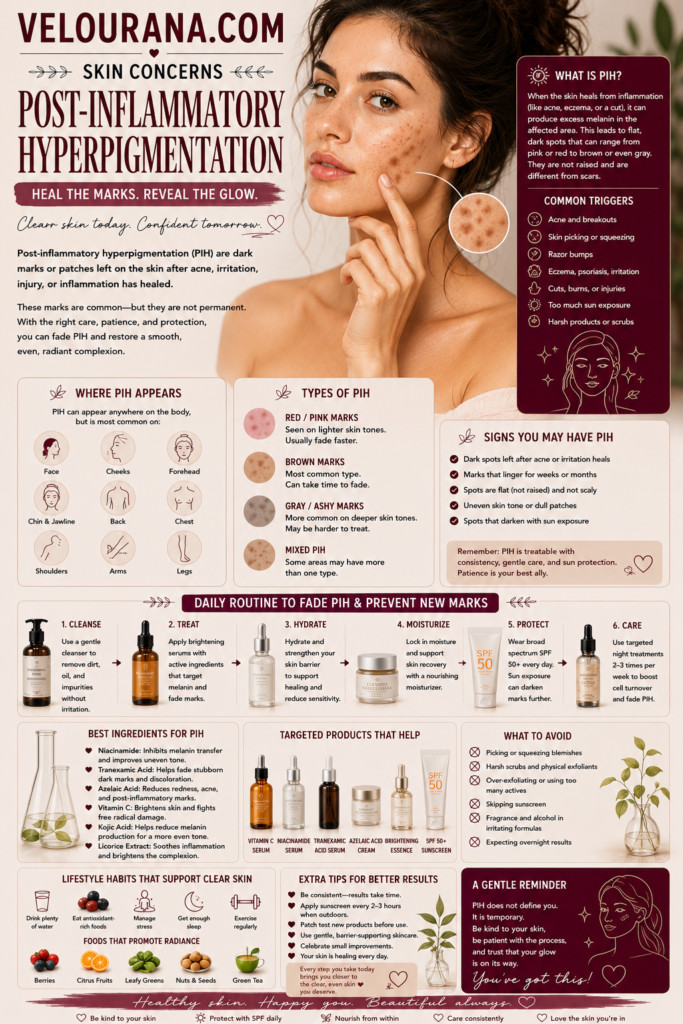
CATEGORY: Post-Inflammatory Hyperpigmentation
Post-inflammatory hyperpigmentation can create the strange impression that the skin is never truly progressing.
One dark mark begins to fade, but another appears nearby.
An older patch softens, yet a fresh blemish leaves a deeper brown trace.
A routine seems to be working, but the complexion as a whole still looks uneven because new pigmentation is being created almost as quickly as existing pigmentation is disappearing.
This is the central challenge of PIH.
Fading is only half the problem.
The other half is prevention.
Post-inflammatory hyperpigmentation is not usually an isolated pigment disorder appearing without context. It is the visible consequence of inflammation. Acne, dermatitis, scratching, friction, burns, follicular irritation, cosmetic reactions and other inflammatory events can all leave pigment behind after the original disturbance has settled.
That means a successful strategy cannot focus exclusively on the marks already visible.
It must also reduce the number of inflammatory events capable of creating the next generation of marks.
This changes the way pigmentation care should be designed.
Instead of asking only which brightening ingredient is strongest, the more valuable questions become broader.
What keeps inflaming the skin?
Can that trigger be controlled?
Is the routine itself creating irritation?
Are blemishes being manipulated?
Is ultraviolet exposure intensifying existing pigmentation?
Is the barrier sufficiently stable to tolerate treatment?
Are new marks appearing more slowly than old marks are fading?
Once those questions become part of the strategy, PIH stops being a collection of individual spots to attack.
It becomes a cycle that can be interrupted.
Every Dark Mark Begins Earlier Than It Appears
By the time PIH becomes visible, the important biological event has already happened.
Inflammation came first.
During an inflammatory response, chemical mediators influence melanocyte activity. Melanin production may increase, and pigment may become distributed differently within the epidermis. If inflammation is sufficiently intense or deep, pigment can also become deposited more deeply within the skin.
The dark mark appears afterward.
This sequence is crucial because prevention is most effective before the pigment becomes established.
Consider an inflammatory acne lesion.
There is a period when the blemish is swollen, red and tender. During this stage, the skin is actively inflamed. What happens during those days can influence what remains after the lesion resolves.
If the blemish is repeatedly squeezed, scratched or aggressively treated, inflammation may increase.
If the surrounding skin becomes irritated by several strong products, the inflammatory footprint may expand.
If the lesion is allowed to settle with minimal additional trauma, the skin experiences a different recovery environment.
PIH prevention therefore begins while the original problem is still active.
By the time the mark is flat and brown, part of the opportunity has already passed.
This does not mean pigmentation cannot be treated later.
It means the most efficient strategy acts at both stages.
Calm the inflammatory event.
Then support the pigmentary aftermath.
Why Treating Existing Pigment Alone Can Feel Like Running in Place
Imagine a complexion with twenty visible areas of PIH.
A carefully chosen routine successfully lightens four of them over several weeks.
During the same period, six new inflammatory lesions develop and five leave dark marks.
The routine may genuinely be working.
Yet visually, the complexion may appear unchanged or even more uneven than before.
This is the arithmetic of PIH.
The rate of new mark formation can exceed the rate of fading.
Until that balance changes, progress remains difficult to see.
This is why active acne often needs to be addressed before or alongside pigmentation.
A person may be understandably focused on the brown marks because they remain visible longer than the pimples that created them. But every untreated inflammatory breakout represents a possible future area of PIH.
Preventing one inflammatory lesion can therefore have two benefits.
There is one less blemish.
And potentially one less dark mark afterward.
Over several months, this becomes enormously important.
If new pigmentation slows dramatically while older pigmentation continues fading, the complexion finally begins moving in one direction.
The difference may initially be subtle.
The skin does not suddenly become even.
Instead, the accumulation stops.
Only then does fading have a chance to catch up.
Acne Control Is Often Pigmentation Treatment in Disguise
When PIH follows acne, treating acne is not separate from treating pigmentation.
It is one of the most important forms of pigmentation prevention.
This is particularly true for inflammatory acne.
Blackheads and closed comedones may cause cosmetic concern, but inflamed papules, pustules and deeper nodules carry greater potential for post-inflammatory colour changes.
Reducing their frequency changes the future appearance of the complexion.
This is why ingredients that can influence both acne and pigmentation are often strategically useful.
Retinoids, for example, can contribute to acne management while also supporting gradual improvement in uneven pigmentation.
Azelaic acid is another ingredient that can be relevant where inflammatory acne and PIH coexist.
But the larger principle matters more than any individual ingredient.
Do not treat pigmentation while ignoring the machine that keeps producing it.
If someone is developing ten inflammatory blemishes every month, adding a fourth brightening serum may accomplish less than improving acne control.
The same logic applies when acne has a hormonal, medical or severe inflammatory component.
Persistent or scarring acne may justify dermatological assessment because preventing further lesions can protect not only texture but also future pigmentation.
Once acne improves, the skin often enters a different phase.
The focus can gradually shift from stopping new inflammatory events toward clearing the visible history they left behind.
Picking Can Turn a Short-Lived Blemish Into a Long-Lived Mark
Some PIH is probably unavoidable.
A deeply inflamed lesion can leave pigment even when handled perfectly.
But picking is one of the most avoidable ways of increasing risk.
The logic is straightforward.
A pimple is already inflamed.
Squeezing adds pressure.
Fingernails add trauma.
Repeated attempts can rupture the surface.
Surrounding tissue becomes involved.
The lesion may swell more.
A crust forms.
The crust is removed.
The skin has to begin repairing again.
By the end of the process, the inflammatory episode has become much larger than the original blemish.
The eventual mark reflects that full history.
This is why the darkest pigmentation sometimes follows lesions that were initially insignificant.
The skin did not respond only to the pimple.
It responded to the pimple plus the extraction attempts plus the surface injury plus the repeated disturbance of healing tissue.
For someone highly prone to PIH, reducing this behaviour can have a more visible long-term effect than adding another active ingredient.
The same principle applies to picking body acne, ingrown hairs, mosquito bites, crusts and flaky patches.
Every additional injury can extend the inflammatory event.
The skin cannot distinguish between inflammation created by disease and inflammation created by impatience.
Both can stimulate pigment.
Scratching Creates Its Own Pigmentary History
PIH is not only an acne problem.
Eczema, allergic reactions, insect bites and other itchy conditions can create extensive pigmentation because scratching prolongs inflammation.
An itchy patch may initially be small.
Repeated scratching damages the surface and expands the affected area.
The skin becomes thicker, more irritated and more inflamed.
Eventually the original rash settles, but darkening remains.
At that point, treating pigmentation without controlling the itch is unlikely to succeed.
The cycle continues because scratching continues.
This illustrates one of the fundamental rules of PIH management:
The trigger has priority.
If the trigger is dermatitis, treat the dermatitis.
If the trigger is an ingrown hair pattern, address the hair-removal process.
If the trigger is friction, reduce friction.
If the trigger is acne, manage acne.
If the trigger is an irritating cosmetic, remove the irritant.
The dark mark may be the most visible concern.
But the invisible cause determines whether more marks are coming.
Friction Can Produce Pigment Without a Dramatic Rash
Not every inflammatory event looks dramatic.
Friction can create repeated low-level irritation that gradually becomes visible as discoloration.
This is especially common on the body.
Tight clothing, straps, collars, repetitive shaving, waxing, scratching and habitual rubbing can all create mechanical stress.
The resulting inflammation may be mild enough that the person never thinks of the area as “injured.”
Yet the pigment response accumulates.
The neck becomes darker where fabric constantly rubs.
The inner thighs become uneven in areas exposed to repeated friction.
The bikini line develops pigmentation following shaving and ingrown hairs.
The underarms remain darker after recurrent irritation.
The shoulders develop marks where acne, clothing and friction overlap.
The mistake is to see only the colour.
A brightening treatment can be added, but if the mechanical trigger remains unchanged, the skin continues receiving the same inflammatory message.
This is why pigmentation treatment sometimes fails despite excellent products.
The environment has not changed.
Prevention requires looking beyond skincare bottles.
Clothing, shaving habits, scratching, sports equipment and repetitive contact can all matter.
The Routine Itself Can Become the Inflammatory Trigger
One of the cruelest PIH cycles occurs when pigmentation treatment creates more pigmentation.
It often begins with a reasonable goal.
The person wants faster fading.
A strong exfoliant is added.
Then a retinoid.
Then a vitamin C serum.
Then an acid mask once weekly.
Then another brightening treatment because the results still feel too slow.
Individually, these products may all have legitimate uses.
Collectively, they may overwhelm the skin.
The barrier becomes compromised.
Burning begins.
Flaking appears.
Redness becomes persistent.
The person sees the uneven surface and exfoliates more aggressively.
Eventually, irritated areas heal with new discoloration.
The pigmentation routine has become part of the pigmentation problem.
This is why prevention requires respecting tolerability.
A product that causes chronic irritation is not successfully treating PIH simply because it contains an ingredient associated with brightening.
The total biological effect matters more than the ingredient list.
A calmer routine can sometimes produce better long-term results precisely because it generates fewer inflammatory setbacks.
Why Barrier Stability Changes the Entire Strategy
The skin barrier influences how easily irritants penetrate and how well the skin retains water.
When the barrier is compromised, products that once felt comfortable may sting.
The skin becomes more reactive.
Small exposures can generate larger inflammatory responses.
This matters for PIH because treatment usually requires consistency.
If the barrier repeatedly collapses under an aggressive routine, treatment becomes stop-start.
Three strong nights are followed by a week of recovery.
Then the actives are restarted.
Irritation returns.
The cycle repeats.
There is very little sustained progress.
A stable barrier creates something more valuable than comfort.
It creates treatment continuity.
The skin can receive a targeted active regularly.
Sunscreen becomes easier to wear.
Moisturiser no longer burns.
Cleansing becomes predictable.
The routine stops producing its own emergencies.
This stability gives fading a chance to become cumulative rather than constantly interrupted.
Sunscreen Changes the Conditions Under Which Pigment Fades
Once PIH exists, ultraviolet exposure becomes an important part of the story.
Ultraviolet radiation stimulates melanogenesis.
That means existing pigmentation can become darker or more persistent when repeatedly exposed without adequate protection.
This does not mean sunlight created the original mark.
Acne, dermatitis or another inflammatory event may have done that.
But ultraviolet exposure can influence what happens afterward.
This is why sunscreen should not be treated as an optional extra in a pigmentation routine.
It changes the environment.
Without consistent photoprotection, corrective treatment is attempting to reduce uneven pigmentation while ultraviolet exposure continues encouraging pigment production.
The two processes oppose each other.
With regular sunscreen use, one major source of pigment stimulation is reduced.
This does not produce instant fading.
But PIH is built from cumulative biology.
Removing one repeated pigment signal can matter significantly over time.
Why Prevention Does Not Mean Avoiding Life
Pigmentation advice can become unnecessarily restrictive.
Avoid the sun.
Avoid every active.
Avoid exercise because of friction.
Avoid shaving.
Avoid makeup.
Avoid touching the face.
This turns skincare into surveillance.
The objective should not be to eliminate every possible inflammatory stimulus from ordinary life.
That is unrealistic.
The better goal is to identify repeated, avoidable triggers that have meaningful consequences.
Wear sunscreen rather than fear daylight.
Improve shaving technique rather than never removing hair.
Use active ingredients thoughtfully rather than abandoning them.
Avoid squeezing inflamed lesions rather than becoming anxious about every accidental touch.
Choose clothing adjustments where persistent rubbing clearly causes a problem.
Treat underlying dermatitis rather than simply tolerating repeated flares.
Good prevention is targeted.
It removes unnecessary inflammation without making normal life impossible.
The Difference Between Preventing PIH and Treating PIH
Prevention and correction overlap, but they are not identical.
Prevention focuses on reducing inflammation and pigment stimulation before a new mark becomes established.
Correction focuses on gradually improving pigmentation that already exists.
A complete routine needs both.
For prevention, the priorities may include acne control, gentle treatment of inflammatory conditions, avoiding manipulation, reducing friction, maintaining barrier stability and using consistent photoprotection.
For correction, targeted ingredients can be introduced depending on the skin's needs and tolerance.
Retinoids may support epidermal turnover and acne control.
Azelaic acid may help in situations where acne and pigmentation coexist.
Niacinamide, vitamin C derivatives, alpha hydroxy acids and other pigment-focused ingredients can have roles in selected routines.
Prescription options may be considered by dermatologists for more persistent pigmentation.
But correction should never overpower prevention.
A routine capable of fading five old marks while creating five new irritated areas has achieved very little.
Why Adding More Brighteners Has Diminishing Returns
There is a point at which adding another brightening product does not meaningfully improve the strategy.
Perhaps the routine already contains a retinoid.
It already includes azelaic acid.
Sunscreen is consistent.
The barrier is comfortable.
Acne is controlled.
At that point, introducing two additional acids and another pigment serum may increase complexity more than benefit.
The danger is not only irritation.
Complex routines make cause and effect harder to interpret.
If the skin becomes inflamed, which product is responsible?
If breakouts increase, which formulation caused them?
If the skin improves, which steps are actually necessary?
PIH benefits from clarity.
Every product should have a defined purpose.
If several products perform nearly identical roles, simplification may improve both tolerance and adherence.
The strongest routine is not necessarily the one with the largest number of pigment ingredients.
It is the one in which every component contributes without destabilising the skin.
The Importance of Treating the Whole Pattern
PIH encourages spot treatment.
The dark mark is visible, so the instinct is to apply product directly to that spot.
Sometimes targeted treatment is appropriate.
But the overall pattern often matters more.
If acne is appearing across the lower face, treating only existing brown marks ignores the larger inflammatory field.
If shaving causes folliculitis along an entire jawline, applying brightener to individual spots misses the recurring trigger.
If eczema repeatedly flares across the hands, fading one area while inflammation continues elsewhere is unlikely to change the long-term picture.
The skin should therefore be evaluated as a system.
Where is inflammation happening?
How often?
What precedes it?
What behaviours make it worse?
Where does pigmentation accumulate?
Which areas are repeatedly traumatised?
Patterns reveal causes.
Causes reveal prevention opportunities.
Why Old Marks Often Become Easier to Fade Once New Ones Stop Appearing
There is a visual reason prevention can feel transformative even before older pigmentation has fully disappeared.
New PIH is usually darker and more noticeable.
When fresh marks stop appearing, the complexion stops receiving new high-contrast areas.
Older marks may still be present, but they gradually soften.
The overall visual noise decreases.
This can create the impression that fading has accelerated dramatically even when the actual pigment-removal rate has not changed.
What changed was the absence of replacement marks.
This is one of the most encouraging stages in PIH management.
For months, it can feel as though nothing is happening because new marks continually appear.
Then acne becomes controlled.
Picking decreases.
The routine becomes gentler.
Sunscreen becomes consistent.
Suddenly the complexion begins looking more even.
The fading was already happening.
It was simply hidden beneath continuous accumulation.
How to Know Whether the Cycle Is Actually Breaking
Complete disappearance is not the only sign of success.
There are earlier indicators.
Inflammatory lesions occur less frequently.
New marks are lighter than previous ones.
Fewer blemishes leave pigmentation at all.
Existing marks develop softer borders.
The contrast between marks and surrounding skin decreases.
The skin tolerates treatment without repeated episodes of burning and peeling.
Photographs taken weeks apart show gradual improvement.
The complexion requires less concealer.
One or two stubborn marks remain, but the overall pattern is clearly calmer.
These changes suggest that the balance is shifting.
That is more important than whether every mark has vanished.
Why a Fresh Mark Does Not Mean the Routine Has Failed
Even excellent prevention cannot guarantee zero PIH.
Some inflammatory events are strong enough to leave pigment despite careful treatment.
A deep acne lesion can still produce discoloration.
An unavoidable dermatitis flare can still leave a mark.
An insect bite can still become inflamed.
This is important psychologically because perfection is an unrealistic standard.
One new dark mark does not mean the entire strategy failed.
The better measure is frequency and severity.
Perhaps almost every blemish once left deep pigmentation.
Now only occasional lesions do.
Perhaps marks once remained extremely dark.
Now they tend to be lighter.
Perhaps ten new areas appeared each month.
Now there are two.
That is meaningful progress.
Why Patience Becomes Easier Once the Source Is Controlled
Waiting for PIH to fade is much harder when new marks keep appearing.
There is no sense of completion.
Every week creates another problem.
Once the trigger is controlled, patience changes character.
The person is no longer waiting while the damage continues.
They are waiting while the skin moves toward a clearer endpoint.
This psychological difference matters.
A stable complexion makes it easier to resist unnecessary product changes.
There is less urgency.
Older marks can be given time.
The routine can remain consistent.
Progress becomes easier to measure.
In many ways, controlling the source is what makes patience possible.
The Role of Professional Treatment in Breaking a Persistent Cycle
There are situations where over-the-counter skincare is not enough.
Persistent inflammatory acne may require prescription treatment.
Chronic eczema or dermatitis may need medical management.
Recurrent folliculitis can have causes that cannot be solved simply by changing a cleanser.
Severe or widespread PIH may benefit from professional evaluation.
A dermatologist can help distinguish pigmentation from post-inflammatory redness, melasma, scarring and other conditions that may look similar.
This matters because incorrect self-diagnosis can lead to months of ineffective treatment.
Professional care may also allow access to prescription depigmenting agents or carefully selected procedures where appropriate.
Chemical peels, lasers and other technologies can sometimes improve PIH, but they require particular caution because excessive inflammation can worsen the condition.
The more pigment-prone the skin, the more important experienced treatment becomes.
Escalation should occur because there is a clear therapeutic reason, not because frustration has reached a certain level.
Why Procedures Cannot Compensate for an Active Trigger
A professional treatment may improve existing pigmentation.
But if inflammatory acne remains uncontrolled, new marks can continue appearing afterward.
A peel may brighten the complexion temporarily.
But if aggressive shaving continues causing follicular inflammation, the bikini line may darken again.
A laser may target pigmentation.
But if dermatitis is still active, the skin remains vulnerable to new discoloration.
This is why procedures work best within a larger strategy.
Technology can address the consequence.
It cannot always remove the cause.
The trigger still matters.
A Good PIH Routine Should Become Less Exciting Over Time
At the beginning, pigmentation care often involves experimentation.
Products are changed.
Techniques are adjusted.
The trigger is identified.
Treatment frequency is refined.
Eventually, however, a good routine should become predictable.
The cleanser works.
The moisturiser keeps the skin comfortable.
Sunscreen is automatic.
One or two targeted treatments are used consistently.
Acne or another inflammatory condition is under better control.
There are fewer surprises.
This stage can feel boring.
That is often a good sign.
Predictability allows cumulative improvement.
The skin no longer spends every month recovering from a new experiment.
The Long-Term Advantage of Preventing Even One Mark at a Time
Prevention can feel insignificant because the result is invisible.
A mark that never formed cannot be photographed.
There is no dramatic before-and-after comparison.
Yet preventing one area of PIH can save months of later treatment.
Prevent ten marks and the cumulative advantage becomes obvious.
This is why simple behaviours matter.
Leaving one blemish alone.
Using sunscreen consistently.
Stopping an irritating product early.
Managing an eczema flare properly.
Changing a shaving technique.
Reducing repetitive friction.
Each intervention may prevent only a small amount of pigment.
Together, they reshape the future complexion.
PIH Is Easier to Manage When the Goal Changes
If the goal is “erase every dark mark immediately,” almost every routine will feel disappointing.
If the goal becomes “create fewer new marks while steadily fading the existing ones,” progress becomes easier to see.
This is not lowering expectations.
It is aligning them with the biology of the condition.
PIH resolves through accumulation.
Fewer inflammatory events.
Less trauma.
Less ultraviolet stimulation.
Better barrier stability.
More consistent treatment.
Gradual pigment clearance.
None of these is dramatic in isolation.
Together, they create transformation.
The Point Where the Skin Stops Remembering Everything
Post-inflammatory hyperpigmentation is often described as the skin remembering inflammation.
The metaphor is useful because every mark preserves evidence of something that happened earlier.
A blemish.
A rash.
A scratch.
A burn.
An extraction attempt.
A shaving reaction.
An irritated barrier.
The goal is not simply to erase those records one by one.
It is to give the skin fewer events worth recording.
When inflammation becomes less frequent, fewer marks are written into the complexion.
When ultraviolet exposure is controlled, old records are not continually darkened.
When the barrier remains stable, treatment stops creating new disturbances.
When targeted ingredients are used consistently, existing pigment gradually becomes less visible.
Eventually, the balance changes.
The skin is fading more history than it is creating.
That is the turning point.
Prevention Is the Part of PIH Treatment That Cannot Be Bottled
Brightening products can be useful.
Professional treatments can be useful.
Prescription therapies can be useful.
But some of the most important work in PIH management does not come in a bottle.
It is the decision not to squeeze the blemish.
The recognition that a cleanser is too harsh.
The choice to stop an exfoliant when irritation appears.
The consistent use of sunscreen.
The treatment of the inflammatory condition beneath the pigmentation.
The reduction of friction.
The willingness to give a stable routine enough time.
These actions do not have dramatic product names.
They do not promise instant transformation.
But they directly influence the process that creates PIH.
That makes them extraordinarily powerful.
Fading Becomes Much Easier Once the Skin Stops Creating New Problems
The most frustrating stage of post-inflammatory hyperpigmentation is the stage where the complexion is trying to heal while simultaneously accumulating new marks.
Correction and injury occur together.
The skin moves forward and backward at the same time.
Breaking that pattern changes everything.
The objective becomes clear.
Control inflammation.
Prevent unnecessary trauma.
Reduce irritation.
Support the barrier.
Protect against ultraviolet exposure.
Use targeted pigment treatments within the limits of tolerance.
Allow enough time to judge progress accurately.
Seek professional guidance when the trigger is persistent, the diagnosis is uncertain or the pigmentation is unusually resistant.
This approach may sound less dramatic than chasing the strongest fading treatment available.
But it addresses the real structure of PIH.
Pigment appears because something happened before it.
If that earlier event keeps repeating, pigmentation will keep repeating too.
Once the trigger is controlled, old marks finally have the opportunity to become old in the truest sense.
They stop being replaced.
They become lighter.
Their edges soften.
The complexion begins to look less like a record of repeated inflammation and more like skin that has been allowed to recover.
That is the real objective of PIH care.
Not simply to fade what already exists.
But to reach the point where the skin has less and less new inflammation to remember.
The End Velourana.
 Discover More From Our Family of Websites
 ZodiacBearing (Astrology, Tarot, Numerology, Angel Numbers & Spiritual Guidance)
 Velourana (Beauty, Makeup, Hair Care, Skincare & Beauty Tips)
 HavenBearing (Home, Living, Organization, Décor & Everyday Inspiration)
 PawBearing (Pet Care, Dog Breeds, Animal Health, Training & Pet Products)
 PsyCatherine (Notes From the Journal of a Psychologist on Real Life)

