
CATEGORY: Ponytails
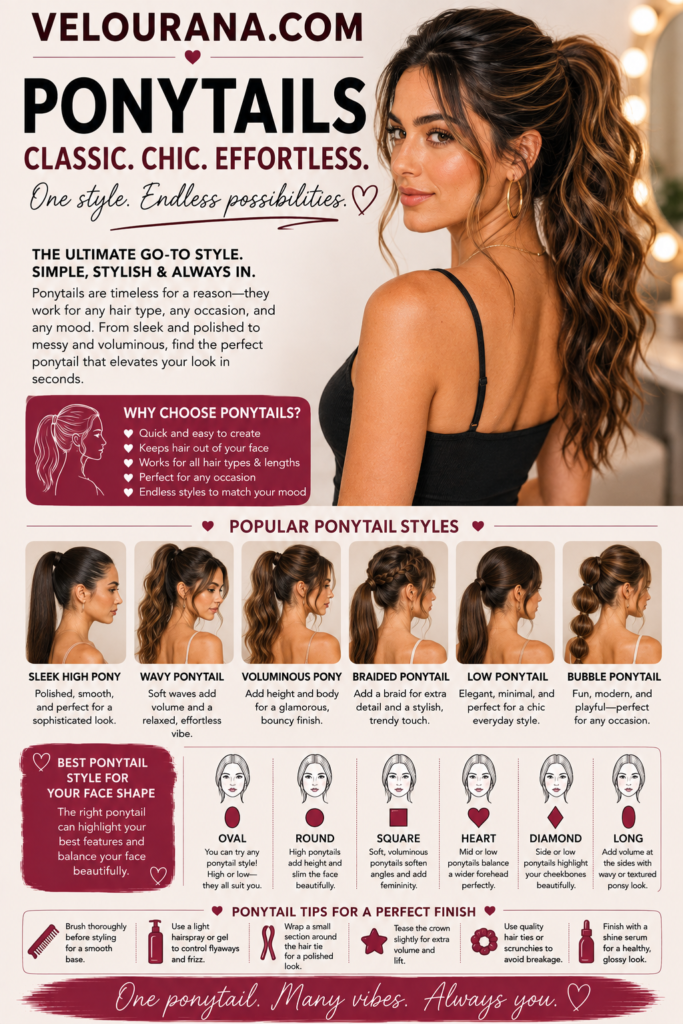
A braided ponytail combines two of hairstyling’s most familiar structures in a way that can be remarkably versatile. The ponytail provides the foundation: the hair is gathered into one clear point, removing much of the length from around the face and shoulders. The braid then changes what happens after that point, transforming loose strands into a visible woven pattern.
The result can be simple enough for an everyday hairstyle or developed into something far more elaborate.
A sleek high ponytail can continue into one long three-strand braid, creating a clean, athletic silhouette with strong vertical movement. A low ponytail can become a loose fishtail, producing a softer and more detailed finish. Several braids can be created within one ponytail, or small braids can travel toward the base before the remaining hair is gathered. Waves, curls and natural texture can remain visible around the roots or be incorporated directly into the braid.
This flexibility is what makes the braided ponytail interesting.
It does not require the entire hairstyle to become intricate. One section of weaving may be enough to transform a basic ponytail. At the same time, someone who enjoys more detailed styling can combine braiding techniques, vary section sizes, change the placement of the base and introduce accessories without losing the recognizable ponytail silhouette.
The strongest versions usually begin with a clear idea of what should dominate.
Sometimes the ponytail itself is the main structure and the braid simply organizes its length. Sometimes the braid is the decorative feature and the ponytail exists mainly to provide a secure foundation. In other styles, braids through the scalp guide the eye toward the ponytail, making the gathering point feel like the conclusion of the entire design.
Understanding that relationship makes it easier to create a braided ponytail that feels coherent rather than overloaded.
The Ponytail Base Determines the Character Before the Braid Begins
The height of the ponytail establishes the first major part of the hairstyle.
A high braided ponytail creates lift and strong vertical movement. The sides travel upward, the face becomes more exposed and the braid begins from an elevated point. Long hair can make this particularly dramatic because the braid descends from the crown and continues down the back.
A mid-height version feels more balanced. The braid remains visible without dominating the entire upper silhouette. This position can be especially practical for dense or long hair because the weight does not sit as high.
A low braided ponytail creates a very different mood. The roots move backward toward the nape, and the braid begins close to the natural fall of the hair. The result can feel understated, romantic or polished depending on the surface and braid type.
The same basic three-strand braid therefore changes personality according to nothing more than the position of the elastic.
This is why placement should be decided first.
The braid cannot compensate completely for a base that does not suit the intended silhouette.
A high ponytail works beautifully when height and visibility are wanted. A low one is more appropriate when the front should remain calm and the braid should provide detail mainly through the back or over one shoulder.
Comfort also matters. Very long or dense hair becomes heavier once braided because the strands are gathered into one concentrated structure. Suspending that weight very high can feel significantly different from allowing it to begin near the nape.
The strongest hairstyle is therefore not necessarily the highest or most dramatic.
It is the one in which appearance and wearability support each other.
The Classic Three-Strand Braided Ponytail
The most straightforward version begins with an ordinary ponytail.
Once the hair is secured, the loose length is divided into three sections and braided toward the ends.
This simplicity is one of its advantages.
The upper hair can remain sleek while the braid creates the texture. The base can be wrapped with a small strand to conceal the elastic. The braid can remain compact or be gently widened after completion. The end can be secured close to the tips for a structured appearance or slightly higher when a softer loose tail is preferred.
Straight hair makes the pattern particularly clear.
Each section crosses visibly over the next, and the braid creates one clean vertical line beneath the ponytail base.
Wavy hair produces a softer surface. The sections do not lie as uniformly, and small bends may remain visible around the edges.
Curly hair creates an even more dimensional braid because the texture remains present inside the woven structure rather than disappearing entirely.
The braid does not need to be made tighter simply to look polished.
Consistency matters more than force.
Keeping the three sections reasonably balanced creates an even pattern. Maintaining controlled tension prevents the braid from loosening unpredictably. Neither requires aggressive pulling.
A sleek base paired with a neat braid can look exceptionally refined because the hairstyle contains only two major elements: a smooth upper structure and one clearly defined woven tail.
Nothing else may be necessary.
Loosening the Braid Changes Its Scale
A braided ponytail can look dramatically different after the outer sections are gently widened.
The technique increases apparent width without changing the amount of hair.
A narrow braid becomes broader.
The individual crossings become easier to see.
The surface feels softer and less compact.
This can be particularly useful for fine or medium-density hair, where a tightly woven braid may appear smaller than desired.
The key is gradual adjustment.
Pulling strongly at one section can make the braid uneven or allow shorter layers to escape. Working slowly from one end to the other creates more consistent width.
The braid should also remain secure enough underneath the softness.
A hairstyle that looks relaxed can still have a stable internal structure.
Dense hair may need far less widening because the braid already contains substantial volume. In some cases, loosening only selected areas creates a more natural result than expanding the entire braid equally.
The objective is not simply maximum size.
It is proportion.
A braid should look appropriate relative to the head, ponytail base and overall amount of hair.
Fishtail Ponytails Create Finer, More Intricate Texture
Replacing a three-strand braid with a fishtail changes the surface considerably.
The hair is divided into two main sections, and smaller pieces repeatedly cross from one side to the other. The result is a finer woven pattern that can look elaborate even when the upper ponytail remains completely simple.
A low fishtail ponytail can feel particularly soft and elegant.
The roots can remain slightly loose.
Face-framing pieces can stay free.
The fishtail begins at the nape and moves gradually down the length.
When the edges are loosened, the braid becomes broad and textured.
A high fishtail creates a stronger contrast. The elevated base gives the hairstyle energy, while the detailed braid introduces refinement.
Section size influences the appearance substantially.
Small pieces create a fine, tightly woven pattern.
Larger pieces produce a more relaxed structure.
Neither is necessarily more sophisticated.
The choice simply determines whether the braid should look precise or soft.
Multidimensional hair color can make a fishtail particularly striking because highlighted strands repeatedly move from one side to the other. Balayage creates changing tones through the braid. Natural gray strands can appear like fine ribbons within darker hair.
The hairstyle becomes detailed without needing accessories because the hair itself provides the pattern.
Rope Braided Ponytails Create a Clean Spiral
A rope braid is another useful alternative.
Instead of weaving three sections or transferring small pieces between two sides, two sections are twisted and wrapped around one another.
The resulting ponytail has a continuous spiral rather than a traditional braided pattern.
This can look exceptionally clean on straight hair because the direction remains easy to read.
A high rope ponytail feels streamlined and modern.
A low rope ponytail can look softer, particularly when some volume remains around the crown.
The amount of twisting determines the compactness.
A tighter rope creates a narrower structure.
A looser one creates more width and visible movement.
The technique can also be useful when time is limited because it produces a strong visual result without requiring the repeated section changes of a fishtail.
The spiral itself becomes the focal point.
Braids Can Lead Into the Ponytail Instead of Existing Only Inside It
A braided ponytail does not need to begin after the elastic.
Braids can travel toward the gathering point from the scalp.
This changes the hairstyle substantially because the upper hair now contains visible structure.
A French braid can begin near the forehead or crown and travel backward until it meets the ponytail base. The remaining lengths then stay loose or become another braid.
Dutch braids create a stronger raised effect because the woven pattern sits more prominently on the surface.
Two braids can approach the ponytail from opposite sides.
Smaller accent braids can travel from the temples.
A single asymmetrical braid can create direction toward a centered base.
This type of construction works particularly well when the ponytail should feel like part of a larger hairstyle rather than simply a tied length.
The braid creates a pathway.
The gathering point becomes the destination.
The tail then determines whether the style remains soft or continues into even more structure.
Double Dutch Braids Can Merge Into One Ponytail
Two Dutch braids beginning near the front can travel backward symmetrically and meet at a central ponytail.
This creates strong structure through the scalp while leaving the tail free.
The hairstyle can feel athletic when the braids are compact and the tail is straight.
Loosen the braids, allow some natural crown softness and add waves through the ponytail, and the result becomes much more relaxed.
The same basic construction therefore supports very different moods.
Dense hair can create substantial braids naturally.
Fine hair may benefit from using narrower sections so enough density remains in the ponytail.
The division should always consider what needs to remain after the braids are created.
A beautiful upper structure is less useful if the tail becomes unnecessarily sparse.
Balance matters across the entire hairstyle.
Small Accent Braids Can Transform a Basic Ponytail
Not every braided ponytail needs substantial scalp braiding.
One narrow braid near the temple can be enough.
It can disappear into a high ponytail.
A second braid can mirror it on the opposite side.
Several tiny braids can be incorporated through the sides while most of the upper hair remains smooth.
These small details work especially well when the ponytail itself contains waves or curls.
The braid provides one concentrated texture.
The loose tail provides another.
Because relatively little hair is used, fine hair can adopt this approach without sacrificing much density.
It is also useful for someone who wants visible detail without spending significant time creating a large braided structure.
The Ponytail Can Contain Several Braids
Once the hair is gathered, the tail does not need to become one single braid.
It can be divided into several sections.
Two or three braids can hang from one base.
Several narrow braids can appear among otherwise loose hair.
A mixture of braid sizes can create texture.
This allows the ponytail to retain some movement while still containing woven details.
A tail containing one narrow braid among loose waves can look especially interesting because the braid functions almost like an accessory.
Several full braids create a much stronger structural appearance.
The amount of detail should reflect the desired result.
Too many unrelated textures can make the hairstyle difficult to read.
The strongest design usually has one dominant idea.
Fine Hair Needs the Braid Size Chosen Carefully
Fine hair can create beautiful braided ponytails, but proportion matters more than attempting to imitate the size of a braid created from exceptionally dense hair.
A narrow three-strand braid can look elegant and deliberate.
A fishtail can provide intricate detail even when it is relatively small.
Gentle widening can increase apparent volume.
Waves before braiding can create additional texture.
What matters is preserving enough density for the braid to remain visually strong.
Pulling too many sections out around the face or allocating large amounts of hair to scalp braids may reduce the tail unnecessarily.
Fine hair often benefits from simplicity.
A clean ponytail base and one beautifully constructed braid can be more effective than several competing elements.
Thick Hair Can Create Powerful Braided Shapes
Dense hair gives braided ponytails natural scale.
A single braid can be substantial.
Fishtails can become broad.
Several braids can be created without making the overall tail appear thin.
The challenge is often physical rather than visual.
Long dense hair can become heavy once gathered and braided.
The braid concentrates the length into one structure, and a high base must support that weight.
A slightly lower position may improve comfort substantially.
The elastic and securing method should provide stability without relying on excessive tightness.
Dense hair offers dramatic possibilities, but the hairstyle should remain wearable.
Straight Hair Gives the Braid Maximum Definition
Straight hair allows the woven pattern to remain exceptionally clear.
A sleek ponytail can transition into a precise braid with almost no visual interruption.
The upper surface reflects light smoothly.
The braid introduces repeated texture.
The contrast can be particularly effective.
A straight tail also allows the braid to remain compact without disappearing visually.
Every crossing remains visible.
This makes straight hair suitable for minimalist braided ponytails where there are few additional details.
Wavy Hair Makes the Braid Softer
Waves introduce texture before the braid begins.
The sections may not lie perfectly flat against one another.
Small bends remain visible.
The braid appears more relaxed.
The upper hair can retain natural movement rather than being smoothed completely.
This creates continuity from roots to tail.
A low braided ponytail can look particularly natural on wavy hair because the entire hairstyle shares the same softness.
Curly Hair Creates Rich Dimension
Curly hair transforms the surface of the braid.
The sections remain textured.
The braid can appear substantial without being excessively widened.
Loose curls around the face can soften the gathered upper hair.
The roots may remain naturally full.
There is no requirement to smooth the entire curl pattern before braiding.
The hairstyle can organize the curls while allowing their texture to remain visible.
This often creates a more harmonious result than forcing the hair into a surface completely unlike its natural state.
Coily Hair Supports Strong Braided Structures
Coily and tightly textured hair can hold braided shapes beautifully and has deep cultural relationships with braiding traditions across many styles.
Within a ponytail structure, the hair can be braided before the base, through the tail, or both.
The tail may contain twists, braids or natural volume.
The upper hair can remain textured or be organized more closely depending on the chosen style.
As always, secure styling should not depend on painful tension.
The hairline and scalp remain part of the hairstyle's success.
The Front Determines Whether the Style Feels Sleek or Soft
Because the braid often sits behind the head, the front styling influences the first impression significantly.
A brushed-back high ponytail creates openness.
A center part creates symmetry.
A side part introduces direction.
Curtain bangs create softness.
A few face-framing pieces can change the entire mood.
This means the same braid can belong to several different styles.
A tight three-strand braid beneath a slick center part feels highly controlled.
The same braid beneath a soft crown with loose front pieces becomes more relaxed.
The tail has not changed.
The context around it has.
Wrapped Bases Create a More Finished Transition
A small section of hair can be wound around the ponytail base to conceal the elastic.
This works particularly well in braided ponytails because it creates a clean transition between the gathered upper hair and the woven length.
The wrap can be narrow and subtle.
A wider section creates a more substantial base.
The end is secured discreetly underneath.
When the hairstyle is minimalist, this small detail can make a noticeable difference.
It removes the practical appearance of the elastic and allows the hair itself to define the structure.
Accessories Can Follow the Braid Instead of Competing With It
Braided ponytails already contain visual interest, so accessories do not need to be excessive.
A ribbon can be tied at the base.
Another can be woven through the braid.
Small decorative elements can sit along selected crossings.
A bow can mark the gathering point.
Hair jewelry can emphasize particular sections.
The most effective choice depends on whether the braid or accessory should dominate.
If the braid is already wide and intricate, minimal decoration may be enough.
A simple three-strand braid can support a stronger accessory without becoming visually crowded.
Ribbons Can Become Part of the Weave
A ribbon incorporated directly into the braid introduces another visible line.
It moves through the hair rather than simply sitting on top of it.
The result can be subtle when the ribbon is close in tone to the hair or more decorative when there is greater contrast.
The ponytail base can remain extremely simple.
The woven ribbon provides the focal point.
This is one example of how accessories can become structural rather than merely decorative.
Bubble Sections and Braids Can Be Combined
A ponytail can contain more than one repeated technique.
The upper portion can begin as a braid and later transition into bubbles.
Several bubbles can contain smaller braids within them.
A single braid can run alongside a bubble ponytail.
These combinations can create striking results, but they benefit from restraint.
The more structures introduced, the more important visual hierarchy becomes.
The hairstyle should still have one dominant idea.
Otherwise, the tail can begin looking like a collection of techniques rather than one coherent design.
Heatless Texture Can Make a Braided Ponytail More Dimensional
Hair that has been braided, twisted or wrapped previously may already contain waves before the ponytail is created.
This texture can make scalp braids appear softer and give the ponytail more volume before the final braid begins.
A slightly waved ponytail that is then loosely braided often produces a fuller, less compact structure than completely straight hair.
This is useful for second-day styling.
The previous texture does not need to be removed.
It can become part of the new hairstyle.
Braided Ponytails Work Particularly Well as Second-Day Hairstyles
Hair does not always need to be freshly washed or completely restyled to create a strong braided ponytail.
Previous waves can remain in the lengths.
The upper hair can be gathered and organized.
The braid can contain any softened texture.
The hairstyle creates a new shape from an existing one.
This makes the braided ponytail practical as well as decorative.
Instead of resetting the entire hair, the structure changes around what is already present.
Layered Hair Gives the Braid a Softer Surface
Layers create shorter pieces that may emerge from the braid.
In polished styles, they can be controlled carefully.
In relaxed styles, some can remain visible.
The braid becomes less uniform.
The surface gains texture.
Long layers usually integrate easily into the structure.
Shorter face-framing layers may remain free around the front.
The haircut therefore influences the character of the braid rather than preventing it from working.
The Ends Should Look Deliberate
The braid usually stops before the final tips.
The amount of loose hair remaining affects the finish.
A short tail beneath the final elastic creates a structured ending.
Leaving more length free creates softness.
The ends can remain straight, waved or curled.
They should feel connected to the rest of the hairstyle.
A polished braid with sharply bent or poorly arranged ends can look unfinished even when the weaving itself is excellent.
The Final Elastic Can Disappear
A small clear or hair-colored elastic keeps attention on the braid.
The securing point becomes almost invisible.
For a more refined finish, a narrow section of hair can wrap around the end elastic as well.
This creates a braid apparently held together by the hair itself.
The effect is subtle but particularly attractive in sleek styles.
Hair Color Becomes More Visible Through Braiding
Braids reorganize color continuously.
Highlights cross from one section into another.
Balayage ends move through different sides of the braid.
Natural gray strands become visible against darker hair.
The ponytail base concentrates the hair before the braid redistributes it again.
This can make dimensional color look especially rich.
A simple three-strand braid may appear far more intricate when several tones are moving through it.
Highlights Can Make the Braid Pattern Easier to Read
On very dark or very uniform hair, some braid detail may become less visible in low light.
Highlights create contrast.
A lighter strand crossing a darker section makes the structure more obvious.
The hair color effectively outlines the movement.
This means a basic braid can appear more complex without any additional technique.
Natural Gray and Silver Hair Can Create Beautiful Woven Contrast
Gray hair often contains several tones rather than one uniform silver.
Braiding brings those differences together repeatedly.
Bright strands can form lines through darker sections.
The woven structure changes how light reflects across them.
The result can be exceptionally dimensional.
The braid provides the architecture.
The natural color provides much of the decoration.
A Braided Ponytail Should Remain Comfortable
The combination of ponytail tension and braid weight can create discomfort if the structure is too tight.
The ponytail base should be secure enough to hold its position.
The braid should remain controlled.
Neither requires painful pulling.
High braided ponytails deserve particular attention because the entire weight of the braid hangs from an elevated point.
Dense, very long hair may feel significantly more comfortable at mid or low height.
The hairstyle should be designed for the period it will actually be worn.
The Hairline Should Not Carry the Entire Structure
A common mistake is trying to make a ponytail feel more secure by pulling the front increasingly tighter.
This does not necessarily improve the base.
A suitable elastic and well-positioned gathering point provide more useful support.
The temples and front hairline should not need to endure unnecessary strain.
Small pieces can remain soft when appropriate.
Polish and comfort can coexist.
A Braided Ponytail Can Change During the Day
A compact braid may gradually soften.
Fine hairs can emerge.
The roots may gain movement.
The braid can widen slightly.
For relaxed styles, this evolution may improve the appearance.
The hairstyle begins looking less freshly constructed.
A highly polished version requires more controlled preparation when the exact finish needs to remain consistent for many hours.
The intended mood should determine how much natural change is acceptable.
The Braid Can Be Released Without Removing the Ponytail
One of the most useful qualities of the style is how easily it can transform.
The elastic at the end of the braid can be removed.
The weave is released.
The ponytail base remains.
The hairstyle becomes a conventional ponytail with newly textured lengths.
A three-strand braid may leave waves.
A fishtail can leave finer bends.
The hair effectively moves from one style to another without rebuilding the roots.
The Ponytail Can Later Become a Bun
The braid can also be wrapped around the base.
A braided ponytail becomes a braided bun.
The woven texture remains partly visible within the new shape.
This makes the original hairstyle a useful foundation for a more contained updo later in the day.
High braided ponytails can become high braided buns.
Low versions can transform into chignon-like shapes.
The hair does not need to be restarted from the beginning.
A Braided Ponytail Can Be Minimal or Elaborate Without Losing Its Identity
At the simplest end, the hairstyle may consist of one elastic and one braid.
At the other end, scalp braids can travel toward the base, the elastic can be wrapped, several braids can form the tail and accessories can be incorporated.
Both remain recognizably braided ponytails.
This is possible because the underlying structure is so clear.
The hair gathers.
The braid follows.
Everything else modifies those two movements.
The Strongest Version Usually Has One Main Idea
When planning a more decorative braided ponytail, it is useful to decide what the viewer should notice first.
If the long fishtail is the main feature, the roots can remain simple.
If Dutch braids through the crown create the drama, the tail may only need a basic three-strand braid.
If a decorative ribbon is central, the braid can provide a clean pathway for it.
When every element competes, none of them receives enough visual space.
Restraint can make a hairstyle feel more sophisticated than technical complexity.
Why Braided Ponytails Remain So Adaptable
The style combines two structures that already work extremely well independently.
The ponytail controls the hair through placement.
The braid controls the hair through weaving.
Together they create a hairstyle that can remain practical while gaining visible detail.
Fine hair can create a delicate braid.
Thick hair can produce dramatic scale.
Straight hair makes every crossing precise.
Waves soften the structure.
Curls and coils add dimension.
The base can move high for lift, lower for comfort or to the side for asymmetry.
The tail can be braided tightly, widened, divided into several sections or later released entirely.
When a Simple Ponytail Becomes a Woven Shape
A ponytail normally takes many individual strands and asks them to move together from one point.
A braid goes one step further.
It organizes those strands into pattern.
That is the transformation at the heart of the braided ponytail.
The hair first gathers.
Then it weaves.
A high base can create energy before the braid descends. A low base can keep the upper silhouette quiet while the woven tail provides the detail. A fishtail can make the pattern intricate. A rope braid can make it spiral. A traditional braid can keep everything beautifully simple.
There is no need to make the hairstyle complicated simply because more techniques are available.
Sometimes one long braid beneath a beautifully positioned ponytail is enough.
The pattern provides interest.
The ponytail provides shape.
And together they create a hairstyle that can feel polished, practical and expressive without losing the clarity that makes both structures so enduring.
The End
Velourana.
 Discover More From Our Family of Websites
 ZodiacBearing (Astrology, Tarot, Numerology, Angel Numbers & Spiritual Guidance)
 Velourana (Beauty, Makeup, Hair Care, Skincare & Beauty Tips)
 HavenBearing (Home, Living, Organization, Décor & Everyday Inspiration)
 PawBearing (Pet Care, Dog Breeds, Animal Health, Training & Pet Products)
 PsyCatherine (Notes From the Journal of a Psychologist on Real Life)

