CATEGORY: Braids
Braids are among the rare hairstyles that can be immediately recognizable while still offering almost unlimited variation. Three simple sections crossing over one another can create the familiar foundation, yet a small change in placement, tension, section size or direction can completely alter the finished appearance. A braid can be polished and controlled, loose and romantic, sculptural and dramatic, or almost hidden within otherwise free-flowing hair.
That versatility explains why braiding continues to feel relevant regardless of changing hairstyle trends.
Braids can organize long hair without simply pulling it into a ponytail. They can introduce detail into medium lengths, create structure through textured hair, transform an updo, frame the face, or become the central feature of an elaborate style. Some braided hairstyles are designed primarily for practicality, keeping the hair contained and away from the face. Others are decorative, using the hair almost like fabric that can be woven into visible patterns.
The beauty of a braid lies partly in this combination of function and design.
Unlike many hairstyles that depend heavily on heat to create their shape, braids use the hair's existing length and flexibility. Straight hair produces clear woven lines. Wavy hair adds natural softness. Curly and coily textures introduce volume, dimension and their own distinctive relationship between the sections. Fine hair can create delicate detail, while dense hair can produce substantial braids with considerable visual presence.
The result depends not only on which braid is chosen but on how it belongs to the entire hairstyle.
The Structure Behind a Beautiful Braid
At its simplest, braiding involves organizing hair into sections and repeatedly crossing those sections in a controlled sequence. What makes the technique so adaptable is that almost every element of that sequence can change.
The braid can begin at the hairline or several inches away from the scalp. It can travel vertically, diagonally or around the head. It can remain narrow or gradually incorporate additional hair. It can sit tightly against the scalp or hang freely. The sections can remain neat and clearly defined or be loosened afterward to create a softer finish.
Even a traditional three-strand braid changes character depending on these choices.
Placed low at the nape, it can feel understated and practical. Moved to one side, it becomes more visible from the front. Loosened gently through the woven sections, it gains width and softness. Combined with face-framing pieces, the hairstyle feels more relaxed. Kept sleek from the roots to the ends, it becomes much more controlled.
The underlying technique may remain almost unchanged while the overall impression becomes completely different.
The Classic Three-Strand Braid
The traditional three-strand braid is often the first braiding technique people learn, and its familiarity can make its versatility easy to underestimate.
The hair is divided into three sections. The outer sections alternately cross over the center, creating a repeated woven pattern that continues toward the ends.
The simplicity of the technique allows other details to become more important.
A centered braid down the back creates symmetry. A side braid introduces asymmetry and brings the detail forward where it can be seen more easily. Two braids create a completely different balance. A low braid beginning at the nape leaves the upper hair relatively untouched, while one incorporated into another hairstyle becomes decorative rather than purely functional.
The classic braid also provides the foundation for understanding many more complex braided styles. Once the relationship between tension, section size and consistency becomes familiar, other techniques become easier to control.
French Braids Create Structure From the Scalp
A French braid changes the relationship between the braid and the head because new hair is incorporated gradually as the weaving progresses.
Instead of beginning with the entire length already divided into three sections, the braid starts with a smaller area. Additional hair is collected from each side and added as the sections cross.
This allows the braid to follow the shape of the head.
A single French braid traveling from the crown toward the nape creates a continuous central structure. Two French braids divide the hair symmetrically. A diagonal version changes the direction completely, while smaller French-braided sections can become details within a larger hairstyle.
The technique can look highly polished when the sections are controlled carefully.
Looser tension produces a softer result.
The placement of the starting point also matters. Beginning close to the front hairline makes the braid visible immediately. Starting farther back leaves more natural volume around the face.
French braiding is therefore not one hairstyle but a technique capable of producing many different silhouettes.
Dutch Braids Bring the Weave Forward
Dutch braiding uses a closely related structure but changes the crossing direction so that the braid appears to sit more prominently on top of the surrounding hair.
This creates a raised, dimensional effect.
The woven pattern becomes highly visible, which can make Dutch braids particularly effective when the braid itself is intended to be the main feature.
A single Dutch braid can create a strong line from the crown downward. Two braids produce a balanced, athletic-looking structure when worn tightly, or a much softer style when the sections are gently loosened.
The technique can also be used on smaller areas.
A narrow Dutch braid near the temple can add detail without containing the entire head of hair. Several braided sections can be incorporated into ponytails, buns or partially loose hairstyles.
Because the braid sits visibly above the surrounding hair, its width and texture become especially important parts of the finished design.
Loosening a Braid Changes Its Entire Personality
One of the simplest ways to transform a braid happens after the weaving is complete.
Gently widening the outer edges of each braided section can make the braid appear broader and softer. This is sometimes described as pancaking the braid.
The technique reduces the compact appearance created by tight weaving.
A narrow braid can become visually substantial.
The pattern becomes easier to see.
Small irregularities may blend into the softer finish.
This can be particularly useful when creating relaxed braided hairstyles where a perfectly tight structure would feel too formal.
The process should be controlled rather than aggressive.
Pulling too strongly can disturb the braid or cause shorter sections to escape. Gradual adjustment allows the width to build while the underlying structure remains secure.
The difference can be dramatic.
A braid that initially looked practical and compact can become one of the main visual features of the hairstyle.
Side Braids Bring the Detail Into View
A braid hanging directly down the back may be beautiful, but much of its detail is invisible to the person wearing it and less noticeable from the front.
Moving the braid to one side changes this.
The woven length appears beside the shoulder.
The hairstyle becomes asymmetrical.
The front can be shaped to complement the direction of the braid.
A side part can reinforce the movement, while loose face-framing sections create softness.
The braid itself can remain traditional, fishtail, French-influenced or deliberately loose.
Because the hair is directed across the head before entering the braid, the roots also become part of the design.
A sleek side braid creates a very different impression from one beginning with loose volume around the crown.
Fishtail Braids Create Intricate Detail From a Simple Repetition
A fishtail braid appears considerably more intricate than a conventional three-strand braid, yet its visual complexity comes from repeating relatively small crossings.
The hair is generally divided into two main sections. Smaller pieces are transferred from the outside of one section toward the opposite side, gradually creating the characteristic woven pattern.
Section size changes the appearance.
Very small pieces produce fine, detailed weaving.
Larger sections create a more relaxed and visible pattern.
A tightly constructed fishtail can appear highly controlled, while gently loosening it produces a broader, almost textured effect.
The technique is especially striking on longer hair because there is enough distance for the repeated pattern to develop.
Subtle differences in hair color can become more noticeable as strands cross repeatedly between the two sides.
Rope Braids Create Shape Through Twisting
Not every braid depends on three sections.
A rope braid typically uses two sections that are twisted individually and then wrapped around each other.
The resulting structure has a spiraling appearance.
It can be sleek and compact or larger and softer depending on the amount of hair and tension.
Rope braids can work beautifully within ponytails because the hair is already gathered into a controlled base. They can also become smaller decorative sections near the face or part of an updo.
The visual effect differs from traditional weaving.
Instead of an interlocking pattern, the eye follows a continuous spiral.
This makes rope braids useful when a hairstyle needs texture without the more familiar appearance of a three-strand braid.
Waterfall Braids Combine Woven Structure With Loose Hair
A waterfall braid uses braiding to create a visible pathway across the hair while allowing selected sections to fall freely through it.
The result combines containment and movement.
Rather than gathering the entire length, the braid becomes an architectural detail within loose hair.
This can be especially effective on hair with waves because the released sections continue downward with natural movement beneath the woven structure.
Straight hair creates a cleaner contrast between the braid and the falling strands.
The braid can travel around the back of the head, begin near one temple or form part of a half-up hairstyle.
Its appeal comes from the fact that the hair remains visibly long and loose while still containing a clearly constructed detail.
Crown Braids Change the Direction Completely
Most everyday braids travel downward.
A crown braid redirects the structure around the head.
This creates a completely different silhouette.
The braid may wrap across the top, follow the hairline or circle around the head more fully depending on the technique and available length.
Because the braid occupies a prominent position, it becomes part of the hairstyle from almost every viewing angle.
The neck can remain exposed.
The lengths are contained.
The woven structure frames the head rather than simply hanging beneath it.
Crown braids can look polished and sculptural when tightly controlled or soft and romantic when gently loosened.
The direction alone demonstrates how dramatically braid placement can change the appearance of the same hair.
Half-Up Braids Preserve the Movement of Loose Hair
Braiding does not require gathering the entire head.
A half-up braided style can control only the upper sections while leaving the majority of the length free.
This creates an effective balance.
The hair is moved away from parts of the face.
The braid provides visible detail.
The lower lengths retain their natural movement.
Two small side braids can meet at the back.
A larger braid can travel across the crown.
Several narrow braids can disappear into loose waves.
Because much of the hair remains down, the style still displays length and texture.
This makes half-up braiding particularly useful when the objective is decoration rather than complete containment.
Braids Can Transform a Ponytail
A ponytail already provides a practical foundation for numerous braided styles.
The entire ponytail can be braided, immediately changing its texture and movement.
A small section can be braided and wrapped around the base.
Several braids can be created within the ponytail.
A French or Dutch braid can travel toward the point where the ponytail begins.
These combinations allow the secure simplicity of a ponytail to remain while making the hairstyle considerably more detailed.
Placement again changes the result.
A high braided ponytail creates a different silhouette from one beginning low at the nape.
The same braiding technique can therefore appear sporty, polished or dramatic depending on the foundation beneath it.
Braided Buns Combine Texture With Compact Shape
A braid can also become the material from which a bun is formed.
Once braided, the length can be wrapped around its base and secured.
The woven pattern remains partially visible within the finished shape.
This gives the bun more texture than simply twisting loose hair.
A low braided bun can appear elegant and controlled.
A higher placement creates more visual prominence.
Smaller braids can be incorporated around the bun rather than forming the entire structure.
Because the hair is contained in several stages, braided buns can feel particularly secure when constructed carefully.
Fine Hair Can Create Beautiful Braids
Large braids are frequently used as the visual ideal in hairstyle photographs, which can make people with fine or lower-density hair assume that braiding will not work for them.
It can.
The character simply changes.
Fine hair can produce delicate, detailed weaving.
Smaller braids can look intentional rather than undersized.
Gently widening the sections after braiding can increase apparent fullness.
Texture through the lengths can also prevent the hair from collapsing too tightly into the braid.
The important thing is not forcing the hair to imitate the proportions of much denser hair.
A refined narrow braid can be just as visually effective as an extremely thick one when it belongs naturally to the overall hairstyle.
Thick Hair Gives Braids Substantial Presence
Dense hair can create large, highly visible braids.
A traditional braid may already have considerable width without being loosened.
Dutch braids can become strongly dimensional.
Fishtail patterns have enough material to display their detail clearly.
The challenge is often physical management rather than visual fullness.
Large sections can become heavy.
Very long dense hair may produce substantial tension if all of it is concentrated into one tightly secured braid.
Dividing the hair into multiple braids or using slightly looser structures can redistribute some of that weight.
The finished style can retain its impressive density without requiring unnecessary tightness.
Straight Hair Makes the Pattern Easy to Read
Straight hair often produces particularly clear braid definition.
Individual sections lie relatively smoothly against one another.
The crossing pattern is visible.
Small flyaways may be more noticeable, but the overall geometry can appear exceptionally precise.
This makes straight hair suitable for both highly polished braids and deliberately loosened versions.
When the braid is widened, the structure remains visible while gaining softness.
Hair color variation can also become more apparent because strands repeatedly cross over one another.
Wavy Hair Brings Natural Softness
Waves introduce texture before the braid is even formed.
The sections may not lie completely flat.
Small bends appear around the edges.
Face-framing pieces can develop their own movement.
This can make a relatively simple braid look more elaborate.
A loose side braid works particularly naturally with wavy texture because the upper hair and woven length share the same relaxed character.
The braid does not need to eliminate the wave.
It can contain it while allowing some of its irregularity to remain visible.
Curly Hair Gives Braids Dimension
Curly hair can create beautifully dimensional braided styles because the texture remains present even after sections are woven together.
The roots may retain volume.
Small curls can frame the face.
The braid itself can appear substantial and textured.
Not every curl needs to be smoothed into complete uniformity.
Allowing some natural character to remain can create a more harmonious result than forcing the hair into an unnaturally sleek finish.
The way curls are prepared and handled matters because excessive manipulation can create unnecessary tangling.
The braid should organize the texture rather than fight against it.
Coily Textures Have a Deep Relationship With Braided Styling
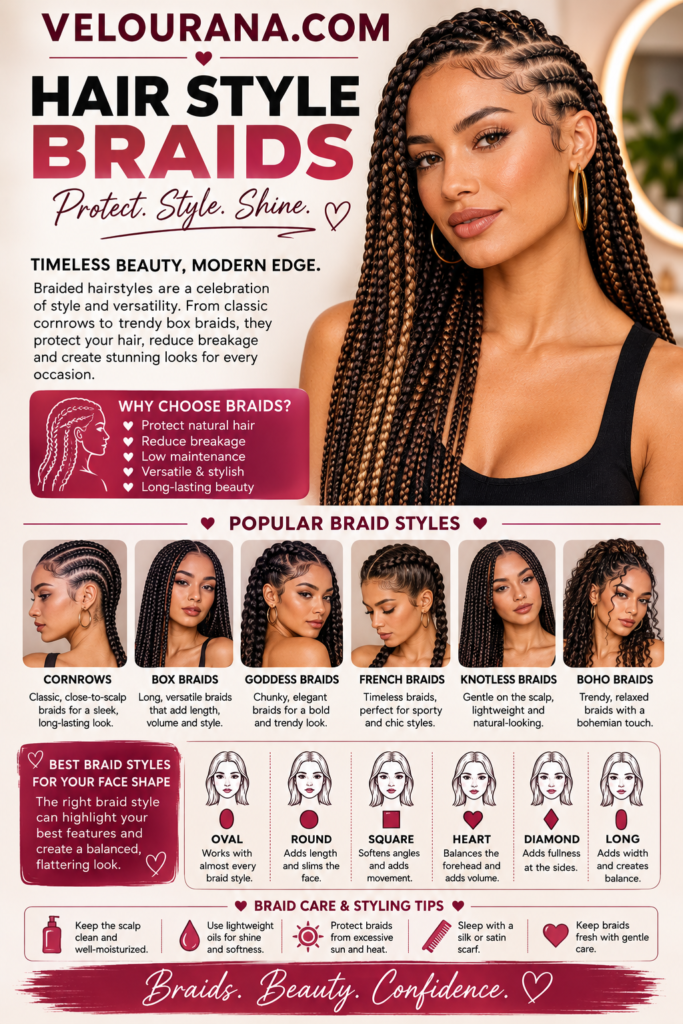
Braiding has an extensive cultural and practical history within Black hair traditions, with numerous techniques developed for coily and tightly textured hair.
Cornrows, box braids and many other braided forms are not simply variations of a general hairstyle trend. They carry cultural histories, technical traditions and forms of personal expression that deserve to be recognized in their own context.
Coily hair can hold intricate braided structures exceptionally well because of its texture.
The range of possible sectioning patterns, braid sizes, directions and finished arrangements is enormous.
Some styles use only natural hair, while others may incorporate additional hair depending on the chosen technique.
The health of the scalp and hairline remains important regardless of style. Secure braiding does not require painful tension.
Tightness Is Not the Same as Security
A braid should feel secure, but excessive tension is not necessary for a style to remain in place.
This distinction is especially important around the hairline.
The strands near the temples and forehead can be more vulnerable to repeated pulling.
A braid that causes persistent discomfort is not simply “well secured.”
Tension should be distributed appropriately.
The hairstyle should allow normal movement without creating unnecessary stress at the roots.
This applies whether the braid is worn for a few hours or as part of a longer-lasting braided style.
Braids Should Respect the Scalp
The appearance of the finished braid is only one part of successful styling.
The scalp underneath still matters.
Repeated tight styling in exactly the same areas can place ongoing stress on the hair.
Very heavy braided structures can add additional pulling.
Changing placement and allowing the hair appropriate rest can therefore be important, particularly for people who braid frequently.
Comfort should not be treated as optional.
A beautiful hairstyle should not depend on pain.
Face-Framing Pieces Can Soften a Structured Braid
A tightly organized braid can be made visually softer by leaving selected pieces free around the face.
These sections can remain straight, follow natural waves or form curls.
Their length determines the effect.
Shorter pieces around the temples create delicate framing.
Longer sections near the cheekbones or jaw become more prominent.
The contrast between the controlled braid and loose front sections can make the hairstyle feel less formal.
This is especially effective with side braids and low braided styles where the front remains clearly visible.
A Sleek Hairline Creates a Different Mood
Leaving pieces loose is only one option.
The front can instead be kept smooth and controlled.
A clean part, sleek roots and tightly organized sections create a much sharper appearance.
The braid then becomes part of a continuous structured hairstyle.
This can work particularly well with a low braid or braided ponytail.
Neither sleekness nor softness is inherently more sophisticated.
They simply create different visual languages.
The Parting Is Part of the Design
A center part introduces symmetry before the braid even begins.
A side part creates directional movement.
No visible part can allow the braid itself to determine the structure.
With multiple braids, sectioning lines may become major elements of the finished hairstyle.
This is particularly true when braids sit close to the scalp.
The spaces between them create patterns.
The scalp becomes part of the visible design.
Careful sectioning therefore contributes as much to some braided hairstyles as the weaving itself.
Braids Can Highlight Hair Color
Braiding repeatedly moves strands over and under one another.
This makes tonal variation more visible.
Highlights that appeared subtle in loose hair may become more prominent when they cross darker sections.
Balayage can create changing tones through the length of a braid.
Natural gray strands may weave visibly through darker hair.
Multidimensional color can therefore make a simple braid appear more intricate without changing the technique.
The hairstyle reveals how the colors interact.
Freshly Washed Hair Is Not Always the Easiest to Braid
Very clean, smooth hair can sometimes slip more easily while being braided, particularly when the texture is naturally straight.
A little natural texture can provide more grip.
This does not mean hair needs to be dirty before braiding.
It simply means preparation can affect how easily the sections remain controlled.
Different textures require different approaches.
Hair that tangles easily may benefit from careful detangling beforehand.
Curly and coily textures may require preparation that preserves moisture and reduces unnecessary manipulation.
The goal is manageable hair, not one universal starting condition.
Sleeping in a Braid Changes the Hair Afterward
A temporary braid does more than contain the hair while it is being worn.
When released, it can leave a visible pattern.
Straight hair may develop waves.
Existing waves can become more pronounced.
The size and tightness of the braid influence the result.
One large loose braid creates broader bends.
Several smaller braids create tighter texture.
This secondary effect is one reason braiding is sometimes used as a heat-free styling technique.
The result will vary according to natural texture, moisture and how long the hair remains braided.
Braids Can Be Practical Without Looking Purely Functional
One of the reasons braids remain useful in everyday styling is their ability to control hair while still appearing intentionally styled.
Long hair can be kept away from the face and neck.
Wind becomes easier to manage.
Lengths remain contained during parts of the day.
Yet the hairstyle can still have visible detail.
A ponytail accomplishes many of the same practical goals, but a braid introduces structure through the length.
This combination makes braiding useful far beyond formal occasions.
Small Braids Can Change Loose Hair Without Controlling It
Not every braid needs to contain a large section.
A single narrow braid near the temple can introduce a subtle detail.
Two small braids can frame the face.
Tiny braids can be scattered through long loose hair.
A narrow braid can be hidden underneath and become visible only as the hair moves.
These approaches treat braiding almost like an accessory.
The overall hairstyle remains loose, but the woven sections create points of interest.
Multiple Braids Create Rhythm
When several braids appear within one hairstyle, repetition becomes part of the design.
Two symmetrical braids create balance.
Several narrow braids create more intricate texture.
Different braid sizes can introduce contrast.
The placement can follow a strict pattern or appear deliberately irregular.
The result depends on how those repeated elements relate to one another.
Too many unrelated details can compete.
A coherent arrangement makes even a complicated braided hairstyle easy for the eye to understand.
Accessories Can Become Part of the Weave
Braids naturally provide places where accessories can be incorporated.
Ribbons can follow the woven structure.
Small decorative elements can be positioned along the braid.
Hair jewelry can emphasize selected sections.
A simple elastic can remain almost invisible when the braid itself is intended to dominate.
The amount of decoration should reflect the desired result.
A highly intricate braid may need very little additional detail.
A simple braid can become more decorative through carefully chosen accessories.
Braids Change as the Day Continues
A freshly completed braid often appears tighter and more defined.
As the hair moves, the structure may soften.
Small strands escape.
The braid can widen slightly.
Natural texture begins appearing around the edges.
This evolution is not necessarily a problem.
For relaxed styles, the braid may actually become more attractive as it loses some initial precision.
A highly polished style requires more control.
The expected duration and desired finish should therefore influence how the braid is constructed at the beginning.
A Braid Does Not Need to Be Perfect to Be Beautiful
Perfectly identical sections can create impressive technical precision, but many attractive braided hairstyles depend on controlled imperfection.
A few soft pieces around the face can create movement.
Slight variation in the width of a loosened braid can make it feel natural.
Wavy texture can prevent every crossing from appearing identical.
The distinction is between intentional softness and a structure that is actually falling apart.
The braid still needs enough integrity to maintain its shape.
Within that structure, variation can make the hairstyle feel more personal.
Learning to Braid Is Largely About Hand Memory
Braiding can initially feel surprisingly confusing because the hands need to manage several sections while maintaining tension and direction.
With repetition, the sequence becomes increasingly automatic.
The fingers begin remembering where each section needs to move.
This is why practicing one fundamental braid can be more useful than attempting many complex techniques immediately.
Once the basic movements become familiar, attention can shift toward neatness, placement and creative variation.
Technique becomes a foundation rather than the entire focus.
The Best Braid Is the One That Fits the Hairstyle
Complexity alone does not make a braid more successful.
A simple three-strand side braid may complement an outfit and natural texture better than an elaborate multi-section design.
A narrow braid may be exactly what loose waves need.
A substantial Dutch braid may become the appropriate focal point when the hairstyle is intended to be dramatic.
The braid should have a reason for being there.
It may provide control.
It may introduce texture.
It may create symmetry or deliberately break it.
It may transform a ponytail or build an updo.
When the purpose is clear, the hairstyle feels cohesive.
When Hair Becomes Its Own Decoration
Braiding is remarkable because it creates ornament from the hair itself.
There is no requirement for an elaborate accessory or dramatic change in length. The same strands that normally fall freely can be reorganized into lines, spirals, woven patterns and sculptural shapes.
A braid can travel across the crown, descend through the center of the back, frame one side of the face or disappear into a bun. It can contain almost every strand or involve only a tiny section. It can be precise enough for every crossing to be visible or loosened until the structure becomes soft and expansive.
Through all these variations, the basic appeal remains remarkably consistent.
Braiding gives structure to movement.
It allows hair to remain recognizably itself while temporarily becoming something more architectural.
Straight hair displays the pattern with clarity. Waves bring softness. Curls add dimension. Coily textures support an extraordinary range of braided traditions and designs. Fine hair can create delicate detail, while dense hair can give the braid impressive scale.
There is no single braid that represents the category because the category is defined by transformation.
A few sections of hair cross.
Then they cross again.
With each repetition, loose strands become a pattern.
And from one of hairstyling's simplest ideas comes an almost endless collection of possibilities.
The End
Velourana.
 Discover More From Our Family of Websites
 ZodiacBearing (Astrology, Tarot, Numerology, Angel Numbers & Spiritual Guidance)
 Velourana (Beauty, Makeup, Hair Care, Skincare & Beauty Tips)
 HavenBearing (Home, Living, Organization, Décor & Everyday Inspiration)
 PawBearing (Pet Care, Dog Breeds, Animal Health, Training & Pet Products)
 PsyCatherine (Notes From the Journal of a Psychologist on Real Life)