
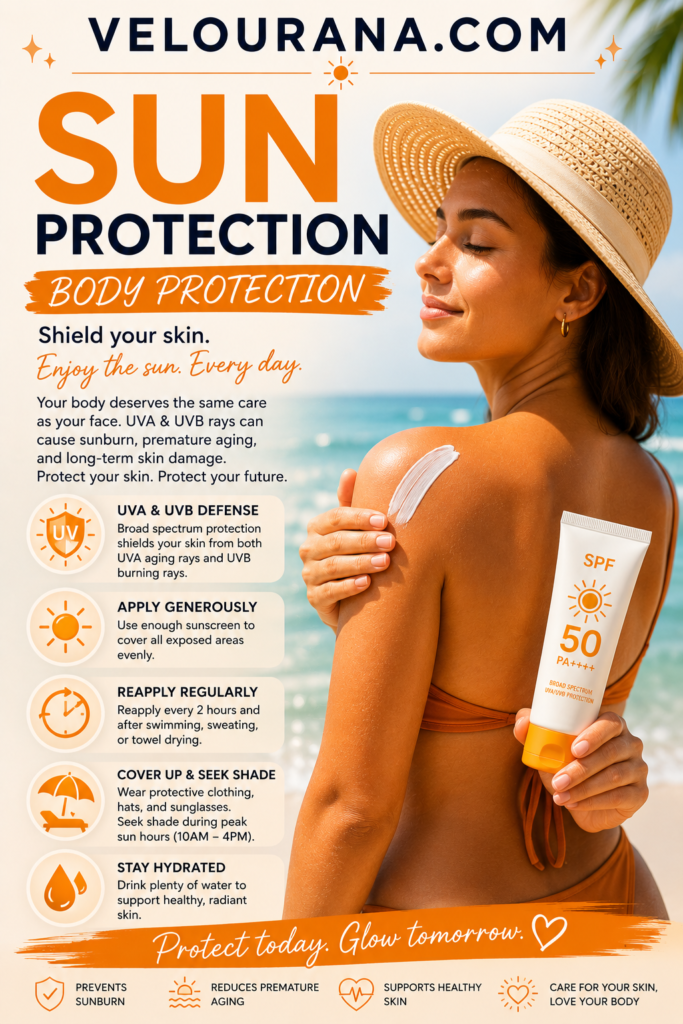
CATEGORY: Body Protection
Facial sunscreen has become one of the most familiar steps in modern skincare. People carefully compare textures, finishes, SPF ratings and formulas designed to sit beautifully beneath makeup. They remember the forehead, cheeks and nose, and many have become accustomed to applying sunscreen as the final step of their morning facial routine.
Then they stop at the jawline.
The neck, chest, shoulders, arms, hands and legs may spend the same day exposed to ultraviolet radiation with little or no protection at all.
This creates a strange imbalance in the way we think about sun care. The face receives sophisticated daily protection because it is associated with skincare and visible aging, while the rest of the body is often protected only during holidays or beach visits. Yet ultraviolet radiation does not distinguish between facial skin and the skin on the shoulders, hands or chest.
Body protection therefore deserves to be treated as more than something we remember when putting on swimwear.
The amount of protection the body needs naturally changes according to clothing, season, activity and UV conditions. Someone wearing trousers and a long-sleeved shirt has far less exposed skin than someone spending an afternoon outdoors in shorts and a sleeveless top. A short journey to work is different from six hours of sightseeing. Swimming creates different demands from sitting indoors.
The goal is not to cover the entire body with sunscreen every morning regardless of circumstances. It is to recognize which areas are actually exposed and protect them appropriately.
That simple change can make body sun protection both more effective and much easier to maintain.
Why the Face Receives So Much More Attention
The beauty industry has helped make facial sunscreen desirable.
Modern facial formulas can be lightweight, moisturizing, mattifying, tinted or designed specifically to work beneath makeup. Sunscreen is discussed alongside serums and moisturizers, and people interested in pigmentation or photoaging are frequently reminded that daily facial protection matters.
Body sunscreen occupies a very different cultural space.
Large bottles are associated with swimming pools, beaches and family holidays. They appear beside towels and swimwear rather than beside everyday skincare. Once the holiday ends, the bottle may remain unused until the following summer.
This distinction is artificial.
If your forearms are exposed during a long outdoor lunch, they are receiving sunlight.
If the backs of your hands remain uncovered while walking around a city, they are exposed.
If your shirt leaves the upper chest uncovered, that skin is exposed.
If sandals expose the tops of the feet during several hours outside, those areas can receive enough ultraviolet radiation to burn.
The American Academy of Dermatology recommends broad-spectrum, water-resistant sunscreen with SPF 30 or higher and emphasizes applying it to skin not covered by clothing. :contentReference[oaicite:0]{index=0}
Thinking in terms of exposed skin rather than “face sunscreen” and “beach sunscreen” immediately makes the routine more logical.
The Neck and Chest Deserve More Attention
The neck is probably one of the most frequently neglected areas in everyday sun protection.
Someone can spend several minutes applying skincare carefully across the face and then finish exactly at the jaw. The result is a protected face sitting directly above an exposed neck.
The front, sides and back of the neck can all receive sunlight depending on hairstyle, clothing and activity.
The upper chest presents a similar problem. Shirts, dresses and tops with open necklines can expose the same area repeatedly throughout spring and summer. Over years, cumulative ultraviolet exposure can contribute to changes in pigmentation, texture and other visible signs of photodamage.
Extending sunscreen from the face onto the neck and exposed upper chest is therefore a simple improvement.
This does not necessarily require using an expensive facial sunscreen across the entire area.
If a particular facial product is costly, a comfortable body sunscreen can be used on the neck and chest instead. What matters is appropriate protection and consistent application, not whether every exposed area receives the same cosmetic formula.
Comfort still matters, particularly around shirt collars. A very greasy sunscreen may transfer onto clothing or feel unpleasant in warm weather. A lighter body lotion or fluid may be easier to use consistently.
As with facial sunscreen, a formula you are willing to apply properly is more useful than one you continually ration or avoid.
Shoulders and Upper Arms Can Receive Intense Exposure
Shoulders are particularly vulnerable during summer because they can move rapidly between completely covered and completely exposed depending on clothing.
A T-shirt provides significant physical coverage. A sleeveless top exposes much more skin. Swimwear may leave almost the entire shoulder uncovered.
This creates another common sunscreen mistake: applying product according to where clothing sits initially without considering movement.
Straps shift.
Sleeves move.
Swimwear changes position.
A narrow area that appeared covered during application can become exposed once the person begins moving.
This helps explain the familiar strips of sunburn that sometimes appear along the edge of a swimsuit or top.
When prolonged outdoor exposure is expected, sunscreen can be applied slightly beneath the edges of clothing so ordinary movement does not immediately reveal unprotected skin.
Shoulders also receive considerable direct sunlight because of their position on the body. During beach days, hiking, gardening and outdoor sport, they can remain exposed for hours.
Protective clothing offers an easy solution when sunscreen becomes inconvenient. A lightweight shirt can cover both shoulders and much of the upper body continuously, reducing the amount of skin requiring repeated sunscreen application.
At the beach, protective swimwear can serve the same purpose.
The less exposed skin there is, the easier reliable body protection becomes.
Arms and Hands Are Exposed During Ordinary Life
People often associate body sunscreen with large expanses of exposed skin, but the arms and hands can accumulate exposure during extremely ordinary activities.
Walking.
Driving.
Shopping.
Gardening.
Eating outside.
Cycling.
Waiting for public transport.
Working outdoors.
The hands are particularly interesting because they are both frequently exposed and frequently washed.
Even someone who applies sunscreen carefully in the morning may wash their hands several times before midday. The protective product applied to the backs of the hands can therefore disappear much faster than sunscreen elsewhere on the body.
For extended outdoor exposure, restoring sunscreen to the hands after repeated washing can be useful.
Keeping a sunscreen somewhere convenient makes this much easier. A product beside the door, in a bag or at work can be used when meaningful exposure is expected rather than relying entirely on the original morning application.
The forearms are similarly easy to protect.
If they will remain exposed for hours, sunscreen can be applied. If long sleeves are comfortable and appropriate, clothing may be even easier.
This illustrates one of the central principles of body sun care: sunscreen does not always need to be the first solution.
Sometimes covering the skin is simpler.
Legs, Ankles and Feet Are Often Forgotten Until They Burn
The lower body receives relatively little attention during everyday skincare, which makes it easy to forget when clothing changes.
In winter, trousers and closed shoes provide substantial physical coverage. As temperatures rise, shorts, skirts, dresses and sandals suddenly expose areas that may not have seen much sunlight for months.
The fronts and backs of the legs may then remain exposed for hours during sightseeing, outdoor dining or recreational activities.
Ankles and feet are even easier to overlook.
Anyone who has experienced sunburn across the tops of the feet knows how uncomfortable this mistake can become. Shoes then rub against irritated skin, making walking unpleasant long after the outdoor activity has ended.
When sandals or open footwear are being worn during prolonged exposure, sunscreen should follow the exposed skin all the way down.
At the beach, remember that sunscreen on the feet can be disturbed quickly by water, sand and towels. Reapplication becomes important according to the sunscreen directions and activity.
The FDA similarly identifies frequently forgotten areas including the hands, tops of the feet, ears, back of the neck and exposed scalp. :contentReference[oaicite:1]{index=1}
A simple visual check before leaving for a long outdoor day can prevent many of these missed areas.
Your Back Presents a Practical Problem
The back is difficult for one obvious reason: much of it is hard to reach.
During ordinary life this may not matter because clothing usually covers it. At the beach, pool or during certain outdoor activities, however, large areas can suddenly become exposed.
Trying to apply sunscreen independently can leave gaps.
When possible, asking someone to help provides more reliable coverage. The AAD specifically recommends assistance for hard-to-reach areas such as the back. :contentReference[oaicite:2]{index=2}
Spray formulations may appear to solve the problem, but application still needs to provide adequate and even coverage. Convenience should not create a false sense that a quick mist automatically produces the labeled protection.
Protective clothing offers another solution.
A swimming shirt or rash guard can cover much of the back and shoulders continuously, eliminating the need to maintain sunscreen across such a large and difficult-to-reach area.
For people who spend substantial amounts of time swimming, sailing or participating in water sports, this can make protection dramatically easier.
Body Sunscreen Needs to Be Used in Realistic Quantities
One reason body protection fails is simply that people underestimate how much product is needed.
The body has a large surface area.
A small facial sunscreen tube may last for weeks when used only on the face but disappear extremely quickly when used across exposed arms, legs, shoulders, chest and back.
The AAD notes that most adults need roughly one ounce—approximately enough to fill a shot glass—to cover skin not protected by clothing, although individual body size affects the amount required. :contentReference[oaicite:3]{index=3}
This has an important practical implication.
Body sunscreen should usually be purchased in a format and quantity that allows generous use without making every application feel financially painful.
There is nothing wrong with using an elegant, relatively expensive sunscreen on the face and a larger, economical formula on the body.
In fact, this can be a much more sensible strategy.
If an expensive product causes you to spread an inadequate amount across the arms because you do not want to finish the bottle, it is not serving the purpose particularly well.
Body sunscreen should be affordable enough, comfortable enough and available in enough quantity that proper application feels normal.
Water Resistance Matters When the Body Gets Wet
Swimming places body sunscreen under considerable stress.
No sunscreen should be regarded as permanently waterproof. FDA labeling distinguishes water-resistant sunscreens according to tested periods of water resistance, and users still need to follow the reapplication directions on the product. :contentReference[oaicite:4]{index=4}
This is particularly important for the body because swimming is often followed by towel drying.
A towel does not merely remove water. It creates friction across the skin and can remove sunscreen.
Sand adds another layer of physical disruption. Sunscreen-covered skin collects sand, which is then brushed or rubbed away.
For long beach or pool days, protection therefore needs to be maintained rather than assumed to survive indefinitely from the morning application.
Water-resistant sunscreen is the logical choice for swimming and heavy perspiration. After water exposure and towel drying, follow the product's reapplication instructions.
Physical protection can make this considerably easier.
A swimming top reduces the amount of exposed torso. Shade gives the body periods away from direct sunlight. A hat protects areas that would otherwise require additional sunscreen.
The best body protection strategy usually combines these methods rather than depending on an enormous quantity of sunscreen alone.
Clothing Is One of the Most Useful Forms of Body Protection
Sunscreen dominates sun-care advertising because it is a product, but clothing can be one of the simplest ways to protect large areas of the body.
A shirt can cover the shoulders, back, chest and much of the arms simultaneously.
Trousers cover the legs.
A broad-brimmed hat provides coverage for the scalp while shading areas of the face, ears and neck.
Clothing designed with a stated ultraviolet protection factor, or UPF, can provide more specific information about its UV-protective performance.
For long outdoor activities, clothing can dramatically reduce the amount of sunscreen required.
Imagine a six-hour sightseeing day.
Wearing shorts and a sleeveless top leaves large areas of the arms, shoulders and legs requiring sunscreen and potentially reapplication.
A lightweight long-sleeved shirt and longer trousers reduce that exposed area substantially.
Neither clothing choice is inherently right or wrong. The point is simply that clothing can be used strategically when convenient.
The FDA likewise recommends combining sunscreen with protective clothing, broad-brimmed hats, sunglasses and other sun-protection measures rather than relying on sunscreen alone. :contentReference[oaicite:5]{index=5}
For people who dislike the sensation of sunscreen across large areas of the body, this can be particularly useful.
Body Protection Should Change With the Day
Not every day requires full-body sunscreen.
That would be unnecessarily burdensome for many people.
If your arms and legs are completely covered and you will spend most of the day indoors, applying sunscreen underneath those clothes offers little practical benefit for ordinary sun protection.
If tomorrow involves a summer festival, outdoor market, beach or long hike, the situation changes.
This is where looking at the day ahead becomes useful.
What will you be wearing?
Which areas will remain exposed?
How long will you be outside?
Will you be swimming?
Will you perspire heavily?
Will shade be available?
Will you be able to reapply sunscreen?
These questions can determine the routine in seconds.
On one day, body protection may mean nothing more than sunscreen on the hands and neck.
On another, it may involve the arms, shoulders, chest and legs.
At the beach, almost the entire exposed body may require protection.
This adaptive approach is easier to maintain because it connects sunscreen with actual exposure rather than forcing the same routine onto every day.
Body Protection Is Also Part of Long-Term Skincare
The cosmetic consequences of ultraviolet exposure are frequently discussed only in relation to the face.
Yet visible photodamage can appear on the neck, chest, shoulders, arms and hands too.
Uneven pigmentation, changes in texture and other signs of cumulative sun exposure do not respect the jawline.
This becomes increasingly obvious when someone has protected their face consistently for years but largely ignored the neck and chest. The difference in exposure history can eventually become visible.
If maintaining the appearance of the skin is part of your motivation for using sunscreen, extending that thinking beyond the face makes sense.
It does not require applying facial serums from head to toe.
Body skincare can remain much simpler.
Moisturize when the skin needs moisture.
Use targeted treatments where there is a genuine reason.
Protect exposed areas from excessive ultraviolet exposure.
For many people, those fundamentals are enough.
A Better Way to Think About Full-Body Sun Care
Body protection becomes much easier once it is separated from the idea of covering every centimeter of skin with sunscreen every morning.
The real objective is protecting exposed skin appropriately.
Clothing already protects much of the body on many days.
Sunscreen fills the gaps.
During prolonged outdoor exposure, additional measures strengthen the system.
Shade reduces direct exposure.
Clothing covers large areas.
A hat protects the head and provides shade.
Sunglasses protect the eyes.
Broad-spectrum sunscreen protects the skin that remains exposed.
Water-resistant formulas help during swimming and heavy perspiration.
Reapplication maintains coverage when time, water, sweat or friction have disturbed the original sunscreen layer. The AAD recommends reapplying during continued outdoor exposure and after swimming or sweating. :contentReference[oaicite:6]{index=6}
This approach is both more practical and more comprehensive than treating sunscreen as facial skincare for most of the year and suddenly turning it into full-body protection during a summer holiday.
Protect the Skin You Actually Expose
Before going outside for a substantial period, one simple question can guide the entire routine:
What skin is exposed today?
Perhaps it is only your face, neck and hands.
Perhaps your forearms are uncovered.
Perhaps an open neckline exposes the upper chest.
Perhaps shorts expose the legs.
Perhaps sandals expose the feet.
Perhaps swimwear leaves almost everything uncovered.
Once you identify those areas, body protection becomes straightforward.
Apply an appropriate broad-spectrum sunscreen generously to exposed skin. Choose water resistance when swimming or sweating. Maintain protection according to the product directions. Cover areas with clothing when that is easier. Use shade and hats to reduce unnecessary exposure.
Do not allow the face to receive all the attention simply because it has the most elaborate skincare routine.
Your shoulders do not know that they are not part of your facial routine.
Your hands do not know that you only intended to walk outside for an hour.
Your chest does not know that sunscreen is normally something you associate with beaches.
Skin responds to the ultraviolet radiation it receives, wherever that skin happens to be.
Body sun protection simply recognizes that reality.
Once it becomes normal to protect the skin below the jawline as thoughtfully as the skin above it, sun care becomes more complete without becoming more complicated.
The End
Velourana.
 Discover More From Our Family of Websites
 ZodiacBearing (Astrology, Tarot, Numerology, Angel Numbers & Spiritual Guidance)
 Velourana (Beauty, Makeup, Hair Care, Skincare & Beauty Tips)
 HavenBearing (Home, Living, Organization, Décor & Everyday Inspiration)
 PawBearing (Pet Care, Dog Breeds, Animal Health, Training & Pet Products)
 PsyCatherine (Notes From the Journal of a Psychologist on Real Life)

