
CATEGORY: Blow-Drying
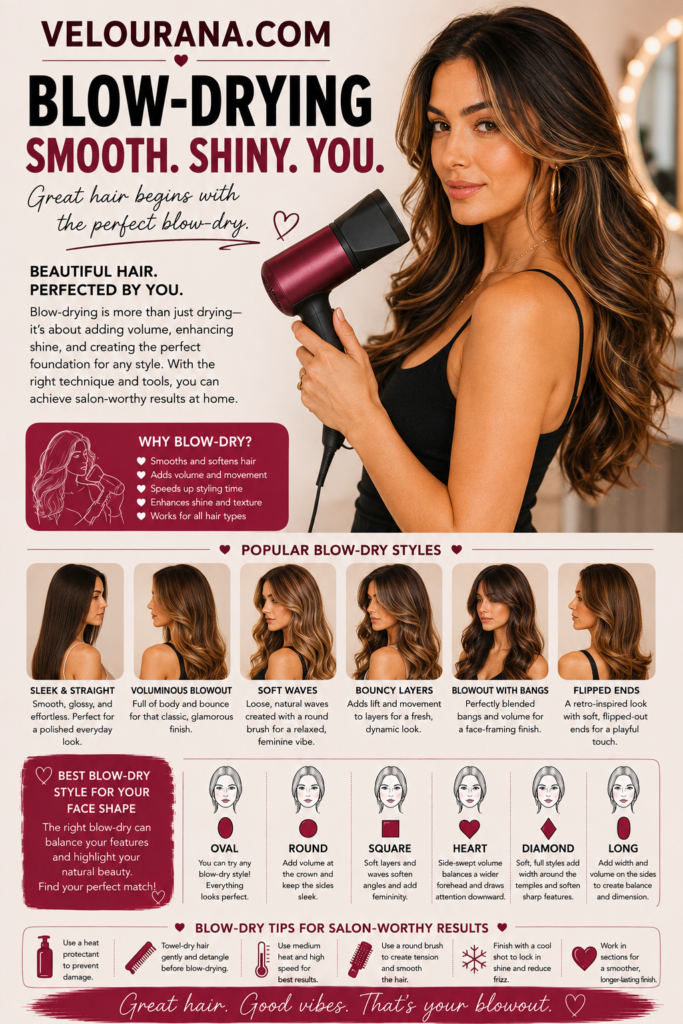
Blow-drying can look deceptively simple. Wet hair, warm air and a brush appear to be all that is required, yet the difference between merely drying the hair and deliberately styling it can be substantial.
A blow-dryer does more than remove water.
Used thoughtfully, it can influence root direction, volume, smoothness, movement through the lengths and the way the ends sit. The same haircut can appear sleek and controlled, full and bouncy, softly curved or deliberately textured depending on how the air is directed and how the hair is handled while it dries.
The process also involves heat, airflow and mechanical tension at a time when wet hair requires careful handling. More temperature and more pulling do not automatically produce a better finish. In many cases, technique matters more than intensity.
Good blow-drying therefore begins before the brush ever reaches the hair.
The amount of water remaining matters. Section size matters. Air direction matters. The relationship between the dryer and brush matters. Hair texture, density and length determine how much work each section needs.
Once these elements are understood, blow-drying becomes less about repeatedly attacking wet hair with hot air and more about controlling moisture, direction and shape in a logical sequence.
Blow-Drying Begins With Water Removal
Hair does not usually need detailed brush styling while it is still dripping wet.
At that stage, a large part of the task is simply removing moisture.
Trying to create a finished shape too early can make the process unnecessarily long because the hair is still carrying so much water that repeated brushing produces little lasting result.
A more efficient approach is to remove excess water gently before detailed styling begins.
The hair should still contain moisture.
It simply should not be saturated.
Gentle Towel Drying Is Different From Aggressive Rubbing
Rubbing wet hair vigorously between towel surfaces can create unnecessary friction and tangling.
A gentler approach is to press or squeeze moisture from the lengths.
The objective is absorption rather than scrubbing.
Hair can then be separated carefully before the dryer is introduced.
This preparation can make later sectioning much easier.
The Hair Does Not Need to Be Completely Air-Dried First
There is no requirement to wait until the hair is almost dry before using a blow-dryer.
The useful starting point depends on the desired style and hair type.
If the objective is a carefully shaped blowout, enough moisture should remain for the hair to be redirected while drying.
If the objective is simply drying the hair efficiently, more moisture can be removed before detailed work begins.
The important principle is avoiding unnecessary time under concentrated heat.
Detangling Before Sectioning Makes the Process Easier
A brush should not need to fight through knots while simultaneously controlling a blow-drying section.
Detangling beforehand separates those two jobs.
The hair can be worked through gently, beginning where tangles are easiest to release and progressing carefully.
Once the lengths move freely, sectioning becomes more precise.
The brush can then focus on tension and shape rather than knot removal.
Heat Protection Belongs in the Preparation Stage
When heat styling is planned, an appropriate heat-protective product can be distributed according to its directions before concentrated styling begins.
The exact product format can vary.
Some are lightweight sprays.
Others are creams, lotions or serums.
The amount should suit the hair rather than leaving it unnecessarily saturated with product.
Fine hair may prefer lighter formulas.
Coarser or very dry-feeling lengths may tolerate richer textures.
The objective is preparation without overwhelming the hair.
Product Distribution Should Be Even
Applying a large amount to one area and almost none to another defeats the purpose of preparation.
The product should be distributed through the areas that will receive styling heat, following the manufacturer's instructions.
Combining careful application with sensible temperature and technique is more useful than assuming a product makes unlimited heat harmless.
The Dryer Settings Have Different Jobs
A blow-dryer may offer several temperature and airflow combinations.
These controls should not automatically be pushed to maximum.
Heat influences drying speed and styling.
Airflow physically moves moisture and hair.
The most appropriate combination depends on what is happening at that moment.
Removing general moisture can benefit from efficient airflow.
Detailed brush work requires enough control that the section does not fly in every direction.
Finishing may use lower heat or a cool setting depending on the desired result.
Maximum Heat Is Not the Definition of Professional Blow-Drying
Very high temperature may seem faster, but speed alone is not the objective.
If the section becomes excessively hot, the dryer is too close or the same area is being repeatedly exposed, the process is not becoming more sophisticated.
A controlled setting that dries and shapes the hair effectively is preferable to using more heat than necessary.
Technique should do part of the work.
Airflow Direction Is One of the Most Important Principles
The dryer should not simply blow randomly around the head.
The direction of the air influences the surface and movement of the hair.
For smooth styling through the lengths, airflow is commonly directed from the root area toward the ends rather than repeatedly blasting upward against the hair.
The nozzle attachment can make this direction easier to control.
The air becomes more concentrated.
The stylist can decide exactly where it travels.
The Concentrator Nozzle Is a Precision Tool
Without a concentrator, air spreads over a wider area.
That can be useful for general drying.
During detailed brush styling, however, concentrated airflow provides greater control.
The nozzle can follow the brush.
The air reaches the section being styled instead of disturbing surrounding hair.
This is especially useful when creating a smooth blowout.
The Nozzle Should Not Be Pressed Against the Hair
Concentration does not mean contact.
The dryer can remain at a sensible distance while the nozzle directs airflow toward the section.
The goal is controlled air, not placing the hottest part of the appliance directly against the strands or scalp.
Rough-Drying Can Remove Much of the Initial Moisture
Before detailed sectioning, the hair can often be partially dried using the hands.
This is sometimes called rough-drying.
The fingers lift and separate the hair while the dryer removes general moisture.
At this stage, the objective is not creating a perfect finish.
It is reducing the amount of water so that detailed brush work becomes more efficient.
Rough-Drying Should Still Have Direction
The term does not require chaotic movement.
If smoothness is the goal, repeatedly blowing the hair upward and in every direction can work against the final result.
The hair can still be guided broadly in the direction it will eventually sit.
For volume, roots can be lifted.
For a smoother finish, the air can generally follow the lengths.
Roots and Ends Do Not Always Need Equal Attention
The roots may retain moisture differently from exposed ends.
Longer or more porous-feeling ends may dry relatively quickly.
Repeatedly directing heat toward already-dry ends while waiting for another area to finish is unnecessary.
The dryer should follow the actual moisture level of the hair.
This is another reason sectioning is useful.
Sectioning Turns One Large Job Into Several Controlled Ones
Trying to style the entire head simultaneously usually creates inconsistent results.
Some areas dry before they are shaped.
Others remain damp.
The brush catches unrelated strands.
Finished sections mix with unfinished ones.
Dividing the hair creates order.
Each section can be dried deliberately before moving to the next.
Section Size Should Match Hair Density
Dense hair generally benefits from smaller sections because the airflow needs to reach the interior.
A very thick section may feel dry on the outside while remaining damp underneath.
Fine hair may be manageable in somewhat larger sections.
The section should still be small enough for the brush and dryer to control it evenly.
The Brush Should Be Able to Manage the Entire Section
If hair continually spills away from the brush, the section may be too large.
If the brush becomes buried inside dense hair, the section may also need to be reduced.
Good sectioning allows the brush to create consistent tension from roots through ends.
Clips Keep Finished and Unfinished Hair Separate
Sectioning clips are practical rather than merely professional-looking accessories.
They keep wet hair away from areas already styled.
They prevent unnecessary reheating.
They make the working section visible.
This can reduce repeated passes and make the entire process more organized.
Starting at the Lower Sections Often Creates Order
One common method is to begin around the lower back of the head and progress upward.
The upper hair remains clipped away.
A lower section is dried.
Another section is released.
The process continues toward the crown.
This prevents the unfinished hair above from constantly falling into the working area.
The Front Can Be Styled According to Its Own Needs
Bangs and face-framing sections often behave differently from the rest of the hair.
They may dry quickly because they are shorter and more exposed.
Waiting until the very end can allow them to dry in an unwanted direction.
For this reason, the front may deserve attention earlier in the process.
Bangs Can Establish the Front Shape
A fringe has a major influence on the finished hairstyle.
Full bangs may need to sit forward.
Curtain bangs need separation and outward movement.
Side bangs require direction across the forehead.
These sections can be shaped while they still retain enough moisture to respond easily.
Curtain Bangs Depend on Direction
Curtain bangs are designed to open around the center and move outward.
Blow-drying can reinforce that movement.
The sections can be directed so that the roots do not simply fall flat against the forehead.
The ends can curve away from the face.
The amount of bend determines whether the result feels subtle or dramatic.
Full Bangs Usually Need Controlled Movement Rather Than Excessive Volume
A full fringe can become awkward if the root is lifted too aggressively.
The objective is usually creating enough movement for the bangs to sit naturally without producing an exaggerated bump.
The brush and airflow should therefore support the intended haircut rather than applying the same technique used at the crown.
Root Direction Determines Much of the Finished Volume
Volume begins before the lengths are curled or shaped.
If roots are dried completely flat in their natural downward position, creating substantial lift afterward becomes more difficult.
If they are elevated while drying, the finished style can retain more height.
This is particularly important around the crown.
Overdirection Can Create Root Lift
Hair can be temporarily directed away from the position where it will eventually fall.
For example, a crown section can be lifted upward or moved slightly opposite its natural resting direction while drying.
When released, it returns with additional root movement.
This technique creates volume through direction rather than simply using higher heat.
Root Volume Does Not Require Teasing
Blow-drying can create lift during the drying stage.
This reduces the need to rely entirely on backcombing afterward.
The root is shaped while moisture is being removed.
The resulting volume can look softer and more integrated with the rest of the hairstyle.
The Crown Often Benefits From Different Treatment Than the Sides
The crown usually contributes to height.
The sides may need smoother direction.
Applying identical elevation everywhere can create unnecessary width.
The hairstyle becomes more balanced when volume is placed selectively.
A Round Brush Can Create Both Smoothness and Shape
The round brush is closely associated with blowouts because it performs several jobs simultaneously.
It provides tension.
It can lift roots.
It creates a curved surface.
It can bend the ends.
Different brush sizes create different degrees of curvature.
The technique can range from relatively straight and smooth to full and bouncy.
Larger Round Brushes Create Broader Curves
A large barrel generally produces a more gradual bend.
Long hair can gain broad movement.
The ends can curve without forming tight shapes.
The result often resembles a smooth blowout rather than a curled hairstyle.
Smaller Round Brushes Create More Pronounced Bend
A smaller barrel can create stronger curvature.
This can be useful on shorter hair, bangs or sections where more obvious shape is desired.
The brush size should also suit the hair length.
Trying to wrap very short hair around an excessively large barrel provides little control.
Brush Size Should Relate to the Haircut
Shorter layers may need a smaller brush than long lengths.
The crown may benefit from one size while bangs use another.
There is no requirement to use the same brush across every section.
The tool should match the shape being created.
Tension Helps Create a Smooth Surface
The brush provides controlled tension while the dryer follows.
This allows the section to remain organized as it dries.
Tension should be firm enough to control the hair but not so aggressive that the scalp or strands are being pulled unnecessarily.
Smoothness comes from consistent technique rather than maximum force.
The Dryer and Brush Should Work Together
One of the most common difficulties in blow-drying is coordinating both hands.
The brush should lead the section.
The dryer follows its movement.
If the dryer stays in one place while the brush continues moving, heat becomes concentrated unnecessarily.
If the brush remains stationary while the dryer moves randomly, the section receives inconsistent shaping.
The two tools should travel as a pair.
Airflow Should Follow the Brush Down the Section
For a smooth finish, the nozzle can follow the brush from the upper part of the section toward the ends.
This repeated directional movement organizes the strands.
The brush controls tension and curvature.
The dryer removes the remaining moisture and supports the shape.
Repeated Passes Should Have a Purpose
Passing over the same section endlessly does not necessarily improve it.
A section should be worked until it is dry and shaped.
Once that has happened, continuing to apply heat provides diminishing benefit.
Efficiency includes knowing when to stop.
The Section Should Actually Be Dry Before It Is Released
Releasing a section while it remains damp can cause the intended shape to fall quickly.
The surface may look finished while moisture remains inside.
This is particularly relevant with dense hair.
The section should be checked rather than assumed dry simply because the outside feels warm.
Warm Hair and Wet Hair Can Feel Confusingly Similar
Heat can temporarily make it difficult to judge moisture accurately.
Allowing a moment to assess the section can help.
If necessary, the hair can be checked away from direct airflow before deciding that it is finished.
Cooling Can Help Preserve the Created Shape
Many dryers include a cool-shot function.
Once a section has been shaped and dried, cooler air can be used as part of the finishing process.
The section can remain around the brush briefly while it cools.
This is particularly useful when creating curved ends or volume.
A Blowout Is Built Section by Section
The finished hairstyle may look continuous, but it is constructed from individual areas.
Each section contributes a small part.
One creates crown lift.
Another creates side movement.
Another shapes the ends.
When those pieces are consistent, the entire hairstyle appears cohesive.
Smooth Blow-Drying Uses Controlled Direction
For a straighter finish, the emphasis shifts away from creating strong curvature.
The brush maintains tension.
The dryer follows downward.
The ends may receive only a slight bend.
The result can be smooth without becoming completely flat.
Straight Does Not Have to Mean Lifeless
Even a smooth blow-dry can preserve root movement.
The crown can be elevated slightly.
The lengths can remain relatively straight.
The ends can curve minimally.
This creates a polished result while avoiding a completely collapsed silhouette.
The Ends Determine Much of the Final Personality
Ends can turn inward.
They can flick outward.
They can remain almost straight.
They can form broad curves.
These small differences dramatically change the finished hairstyle.
The brush should therefore not simply leave the section once it reaches the ends.
The final movement deserves deliberate attention.
Inward-Turned Ends Create a Rounded Finish
The brush can guide the ends toward the face or underneath the hairstyle.
This creates a contained silhouette.
It can work particularly well with bobs, medium cuts and long layered styles.
Outward Movement Creates a More Open Shape
The ends can also be directed away from the face.
Face-framing layers become more visible.
The hairstyle gains width and movement around the sides.
This is common in bouncy layered blowouts.
Alternating Direction Can Create Natural Movement
Not every section needs to curve identically.
Some movement can turn inward.
Other sections can move outward.
This variation can make long hair appear more natural and dimensional.
The overall style should still maintain a clear direction around the face.
Layered Hair Responds Especially Well to Blow-Drying
Layers are designed to create different lengths and therefore different opportunities for movement.
A blowout can make those distinctions more visible.
Shorter layers can lift.
Face-framing sections can sweep outward.
Longer lengths create the foundation beneath them.
The haircut becomes more dimensional.
Blow-Drying Can Reveal a Layered Haircut Without Adding Curls
The hair does not need to become curly for layers to show.
Even gentle bends can separate the lengths visually.
The shortest pieces move independently.
The ends sit at different levels.
The haircut becomes easier to read.
Long Hair Requires Efficient Moisture Management
Long lengths contain a large surface area.
Trying to round-brush them from soaking wet can make the process unnecessarily slow.
Removing a significant amount of moisture first can reduce styling time.
Detailed work can then focus on the final portion of drying where shape is actually being established.
Long Hair Can Use Larger Sections Only When Density Allows
Length alone does not determine section size.
Long fine hair may be manageable in broader sections.
Long dense hair may still require small ones.
The airflow must be able to reach through the section.
Long Ends Can Dry Before the Roots
The ends have often been exposed to air longer and may contain less moisture by the time the root area is finished.
The dryer should not repeatedly heat them simply because another area is still damp.
Attention can be concentrated where moisture remains.
Medium Hair Is Particularly Adaptable to Blowouts
Medium lengths are long enough to create visible movement but short enough to remain relatively manageable.
A round brush can produce broad curves.
Layers can gain bounce.
The ends can turn inward or outward.
The finished result can change dramatically with relatively small adjustments.
Short Hair Depends Heavily on Root Direction
When there is less length, the way the roots are dried becomes even more important.
The hair cannot rely on long curved sections to create movement.
Volume, direction and separation at the roots define much of the style.
A smaller brush may provide greater control.
Bobs Can Change Completely With the Ends
A bob blow-dried under creates a rounded shape.
The same haircut with straighter ends feels sharper.
An outward flick creates a more playful silhouette.
The cut remains unchanged.
Only the drying direction changes.
Pixie Cuts Can Use Fingers as Styling Tools
Very short hair may not require a round brush throughout.
Fingers can lift sections.
The airflow can establish direction.
A smaller brush can refine longer areas or fringe.
The technique should suit the available length.
Fine Hair Often Benefits From Root-Focused Styling
Fine hair can lose volume when heavy products or excessive tension flatten the roots.
The blow-dry can instead prioritize lift at the scalp.
The lengths can remain relatively simple.
This places the available volume where it has the greatest visual effect.
Fine Hair Does Not Need Excessive Product
More styling product does not automatically create more volume.
Heavy application can weigh the hair down.
A lighter approach may preserve movement more effectively.
Products should be selected and used according to their intended purpose and the needs of the hair.
Smaller Sections Can Still Help Fine Hair
Although fine hair may be less dense, smaller sections can provide greater control when creating a polished blowout.
The important difference is that the process may require fewer total sections than very dense hair.
Thick Hair Requires Patience With Internal Moisture
Dense hair can feel dry on the surface while remaining damp underneath.
This is where rushed blow-drying often becomes inefficient.
Smaller sections allow air to reach the interior.
The style lasts better when each section is genuinely dry before moving on.
Thick Hair May Benefit From Removing More Moisture Before Brush Styling
Because there is more hair to process, spending the entire drying period with a round brush can be exhausting.
Initial moisture removal can do much of the basic drying.
Detailed brush work then shapes the hair during the later stage.
Coarse Hair Can Require Deliberate Section Control
Larger individual strands and substantial density can make oversized sections difficult to smooth consistently.
Working methodically helps the brush maintain control.
The dryer can then follow the entire section rather than affecting only its outer surface.
Wavy Hair Can Be Smoothed or Enhanced
Blow-drying does not have one mandatory objective for wavy hair.
The natural wave can be stretched into a smoother blowout.
Alternatively, the dryer can be used in a way that preserves and supports the existing pattern.
The desired result determines the attachment and technique.
A Diffuser Changes the Nature of Blow-Drying
A diffuser spreads airflow over a wider area.
Instead of concentrating a narrow stream along a brush, it reduces the direct force hitting one small section.
This makes it useful when the objective is preserving natural waves or curls rather than stretching them into a smooth blowout.
Diffusing Is Still Heat Styling
Using a diffuser does not eliminate the need for sensible temperature and technique.
The dryer is still applying moving air and potentially heat.
Settings should suit the hair and desired result.
The attachment changes airflow distribution, not the fundamental nature of the appliance.
Wavy Hair Can Be Diffused for Definition
Natural waves can be supported rather than brushed out.
The hair is prepared according to the intended routine.
The diffuser helps dry the pattern while limiting the amount of direct airflow that might otherwise disturb it.
The result differs completely from round-brush styling even though the same dryer is being used.
Curly Hair Can Be Blow-Dried in Different Ways
Curls can be diffused to preserve their natural pattern.
They can also be stretched and smoothed with controlled brush techniques when a blowout is desired.
These are different styling objectives.
Neither should be treated as the universal method for curly hair.
Diffusing Preserves More of the Curl Structure
When the objective is definition, excessive brushing during drying would work against the curl pattern.
The diffuser allows the hair to dry while remaining closer to its naturally grouped shape.
Movement should be controlled so the curls are not constantly disturbed.
Curly Roots Can Be Lifted for Volume
Volume does not need to come only from the lengths.
Root positioning can influence the final silhouette.
The hair can be arranged so the roots are not dried completely flat against the scalp.
The amount of lift should suit the desired shape.
Coily Hair Can Also Be Diffused or Stretched
Coily textures offer several possibilities.
The natural pattern can be dried with a diffuser.
The hair can be stretched through controlled tension when a different finish is desired.
The appropriate technique depends on the hairstyle rather than an assumption that every texture should be blow-dried toward straightness.
Stretching Requires Controlled Tension
When textured hair is being elongated during blow-drying, pulling harder is not necessarily better.
The hair should be controlled without excessive force.
Sectioning and airflow do much of the work.
The objective is consistent direction.
The Scalp Should Not Be Forgotten
Drying the lengths while leaving the roots damp creates an incomplete result.
Dense hair in particular can retain moisture close to the scalp.
Sections should allow airflow to reach the root area without holding concentrated heat uncomfortably close to the skin.
The Dryer Should Remain in Motion
Holding concentrated hot air over one spot for an unnecessarily long period can create excessive heat.
Movement distributes the drying action.
The dryer follows the working section.
This is useful whether the hair is being rough-dried or styled with a brush.
The Brush Should Not Become Tangled Inside the Hair
Round brushes can become difficult to remove if too much hair is wrapped around them repeatedly.
The brush does not need to roll all the way to the scalp with the entire length wrapped around it.
Controlled movement is safer and easier.
The section should remain manageable throughout.
A Round Brush Is Not a Curling Iron
Although it can create curvature, the technique is different.
The hair should not simply be wound tightly around the barrel and held under concentrated heat indefinitely.
The brush is used to provide movement, tension and shape while the dryer follows.
The tools work continuously rather than remaining stationary for long periods.
Paddle Brushes Create a Different Finish
A paddle brush can be useful when the objective is smoother, straighter movement rather than pronounced curves.
It controls a broader section.
The dryer follows the brush.
The ends can remain relatively straight.
This creates a different type of blow-dry from the classic round-brush blowout.
Vent Brushes Can Support Fast Drying and Root Movement
A vented brush allows airflow to move through the tool more easily.
It can be useful during less detailed stages of drying.
The hair can be lifted and directed without creating the pronounced curvature of a round brush.
Fingers Are Often Underrated
The hands can perform much of the early work.
They can lift roots.
Separate sections.
Guide direction.
Assess moisture.
This reduces the amount of time the hair spends under brush tension.
Detailed tools can then be introduced only where they provide a clear styling benefit.
Blow-Drying Upside Down Can Create Volume but Less Precision
Flipping the hair forward can encourage root lift because the roots dry away from their normal resting position.
However, this method provides less precise control over the final direction.
It can be useful for general volume before refinement.
The hair may still need to be reorganized afterward.
Targeted Root Lift Offers More Control
Instead of elevating every root equally, specific crown or upper sections can be lifted.
This creates volume where it contributes most to the silhouette.
The sides can remain smoother.
The result often looks more intentional.
The Back of the Head Deserves Equal Attention
It is easy to concentrate on the visible front and sides.
The back can remain damp, flat or inconsistently shaped.
Working systematically prevents this.
Mirrors can help assess the final silhouette, but good sectioning already reduces the likelihood of forgotten areas.
A Finished Blowout Should Be Checked for Damp Sections
Before finishing products are applied, the hair should be assessed.
The roots should be dry.
Dense interior sections should be checked.
The back should not remain damp.
If moisture remains, the shape may change as the hair continues drying naturally.
Finishing Product Should Match the Desired Result
A smooth blowout may benefit from a small amount of an appropriate finishing product.
A voluminous style may need something lighter.
A textured blow-dry may require a different finish entirely.
The product should support the result rather than conceal the movement created during drying.
More Shine Product Does Not Always Mean More Shine
Overapplication can make some hair look heavy or separated.
A small amount distributed appropriately may be sufficient.
Fine hair often needs particular restraint.
The objective is enhancing the finish without sacrificing movement.
The Roots and Ends May Need Different Products
The entire head does not necessarily require identical treatment.
A root-focused volumizing product may serve one purpose.
A lightweight smoothing product through the ends may serve another.
Product placement can be as deliberate as heat placement.
Humidity Can Influence the Finished Blow-Dry
Hair does not exist in a controlled environment after styling.
Humidity and moisture in the air can affect the finish.
The degree varies with hair characteristics and styling.
A blowout that looks extremely smooth indoors may gain movement later.
This does not necessarily mean the blow-drying technique failed.
A Style Should Work With Realistic Movement
Hair moves.
It touches clothing.
It encounters weather.
It is exposed to moisture.
A successful blow-dry does not need to remain frozen in exactly the same position.
The objective is creating a strong starting shape that can move naturally.
Repeated Daily Heat Is Not Required for Every Hairstyle
A blowout can sometimes be refreshed rather than recreated completely.
Roots can be adjusted selectively.
Bangs can be reshaped.
Ends can be reorganized.
The entire head does not always need another full high-heat session.
Preserving the Style Overnight Can Reduce Restyling
The exact method depends on hair length, texture and the finished style, but protecting the shape overnight can reduce the amount of work needed the following day.
The goal is limiting unnecessary friction and crushing of the styled sections.
A refreshed blowout may need much less intervention than a completely new one.
Bangs May Need More Frequent Attention Than the Lengths
Because bangs touch the forehead and are exposed to movement, they can lose their shape faster.
Refreshing only the fringe can restore much of the appearance of the hairstyle.
This is far more efficient than automatically restyling every section.
The Ends Can Often Be Refreshed Selectively
If the roots still look good but the ends have lost their curve, only those areas may need attention.
Targeted styling reduces unnecessary repetition.
This principle applies throughout heat styling: work where the hairstyle actually needs work.
The Best Temperature Is the One That Accomplishes the Job Effectively
There is no prize for using the hottest setting.
The required temperature varies according to the dryer, hair characteristics, moisture level and technique.
The practical objective is effective drying and styling with no more heat than needed.
Airflow, section size and preparation can improve efficiency without simply increasing temperature.
Distance Matters Along With Temperature
A moderately hot dryer held extremely close can create concentrated heat.
A hotter setting used with controlled movement and appropriate distance behaves differently.
Heat exposure depends on the entire technique, not one dial alone.
This is why copying a temperature recommendation without considering usage can be misleading.
Time Matters Too
Temperature is only part of exposure.
Repeatedly heating the same already-dry section increases total exposure.
Efficient sectioning helps reduce this.
Once a section is finished, move on.
Heat Protection Is Not Permission for Unlimited Heat
A heat-protective product is part of a broader styling routine.
It does not make temperature, distance, repetition and technique irrelevant.
The strongest approach combines appropriate product use with sensible handling.
Blow-Drying Skill Reduces Unnecessary Heat
As coordination improves, fewer passes may be needed.
Sections become more consistent.
The dryer follows the brush more accurately.
Finished areas are not repeatedly reheated.
Technique therefore contributes directly to efficiency.
Practicing With Lower Heat Can Improve Coordination
Learning brush-and-dryer coordination at maximum temperature can create unnecessary pressure.
A more manageable setting can allow attention to focus on hand movement and section control.
Speed can develop later.
The finished result depends heavily on coordination.
A Good Blow-Dry Has a Plan Before It Begins
The desired result should determine the process.
For sleekness, prioritize controlled downward airflow and consistent tension.
For volume, prioritize root direction and crown lift.
For a bouncy blowout, combine root movement with broad curves through the lengths.
For natural waves or curls, use techniques that preserve rather than brush out the pattern.
For a smooth stretched finish on textured hair, work systematically in controlled sections.
The tool is the same.
The strategy changes.
Volume Should Be Placed Rather Than Added Everywhere
A hairstyle can become wider rather than more flattering if every section is lifted identically.
Crown volume creates height.
Face-framing movement creates openness.
Excessive side volume may change the silhouette in an unwanted way.
Blow-drying allows precise placement.
Smoothness Should Not Remove All Movement
A polished surface can still have body.
The roots can lift.
The ends can bend.
Layers can separate.
Smoothness describes the finish of the strands, not necessarily a completely flat hairstyle.
Bounce Comes From Curvature and Movement
A bouncy blowout is not simply a very voluminous one.
The sections need broad curves.
The ends move.
Layers separate.
The hair responds when the head moves.
Round-brush styling can create this by shaping sections rather than merely drying them straight.
The Haircut Sets the Limits and Opportunities
Blow-drying cannot create layers that do not exist.
It can reveal the layers that are already there.
It cannot permanently change hair texture.
It can temporarily redirect and shape it.
Understanding the haircut prevents unrealistic styling expectations.
Face-Framing Layers Deserve Individual Attention
These sections strongly influence the front appearance.
They can be curved toward the face for a contained shape.
They can sweep outward for openness.
They can remain relatively straight for a sharper finish.
Styling them separately often produces a more deliberate result.
The Crown Determines Much of the Side Silhouette
A beautiful front can still look flat from the side if the crown has no movement.
Conversely, excessive crown height can overwhelm the rest of the style.
The blow-dry should be evaluated from several angles.
The Back Determines Whether the Blowout Looks Complete
A hairstyle that is polished only around the face can appear unfinished.
The back should have consistent dryness, movement and shape.
This is where systematic sectioning becomes especially valuable.
Blow-Drying Is Ultimately Controlled Evaporation Plus Shape
At its simplest, the dryer removes water.
Styling begins when that drying process is combined with deliberate direction.
The roots are positioned.
The lengths are tensioned or allowed to retain texture.
The ends are curved.
The crown is lifted.
The surface is smoothed.
Each decision happens while moisture leaves the hair.
That is what separates drying from blow-drying as a styling technique.
When Technique Does More Work Than Temperature
The most effective blow-drying routines do not depend on endlessly increasing heat.
They depend on preparation and control.
Excess water is removed before detailed work begins.
The hair is detangled.
Sections are sized according to density.
Finished hair is kept separate from wet hair.
Airflow follows a clear direction.
The brush and dryer move together.
Roots receive attention before they become completely set in an unwanted position.
Ends are shaped intentionally rather than overheated automatically.
Each section is finished and then left alone.
These principles work because they make the process more efficient.
Straight hair can become sleek or voluminous.
Wavy hair can be smoothed or encouraged.
Curls can be diffused or stretched.
Coils can retain their natural structure or be redirected according to the intended style.
Fine hair can gain lift without being overloaded.
Dense hair can be managed through smaller, more controlled sections.
Long hair can be dried efficiently by separating basic moisture removal from detailed styling.
Short hair can use root direction to create shape without relying on length.
The dryer itself is only one part of the result.
The real styling happens through decisions about moisture, airflow, tension, direction, sectioning and time.
When those decisions are deliberate, blow-drying stops being a race to make wet hair dry.
It becomes a controlled way of shaping the haircut while the hair transitions from wet to dry—and doing so with greater precision, less unnecessary repetition and a finish designed for the hair that is actually being styled.
The End
Velourana.
 Discover More From Our Family of Websites
 ZodiacBearing (Astrology, Tarot, Numerology, Angel Numbers & Spiritual Guidance)
 Velourana (Beauty, Makeup, Hair Care, Skincare & Beauty Tips)
 HavenBearing (Home, Living, Organization, Décor & Everyday Inspiration)
 PawBearing (Pet Care, Dog Breeds, Animal Health, Training & Pet Products)
 PsyCatherine (Notes From the Journal of a Psychologist on Real Life)

