
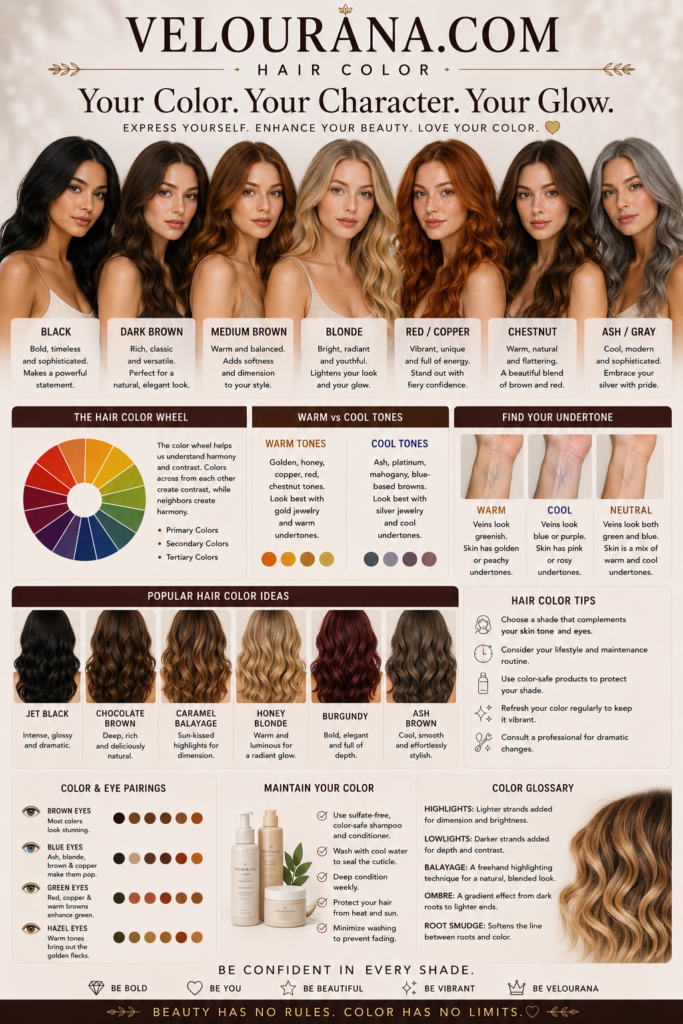
CATEGORY: Blonde Hair
Blonde hair is often spoken about as though it were a single color. In reality, blonde is an unusually broad visual spectrum, stretching from deep beige and muted dark blonde through honey, wheat, champagne, pearl, icy platinum, and almost-white tones. Two people can both be described as blonde while their hair shares very little in terms of depth, warmth, reflectivity, contrast, or overall character. What connects these colors is not one precise shade but a relationship between relatively light hair, visible underlying pigment, and the way the finished color interacts with light.
This complexity is part of blonde hair's enduring fascination. Light hair exposes subtleties that deeper shades can sometimes conceal. A small shift toward gold can transform a neutral blonde into something warmer and sunnier. A trace of violet or blue can make yellow appear quieter and cooler. A slightly deeper root can change the entire perception of brightness through contrast, even when the lengths have not become lighter at all. Texture, porosity, shine, density, and styling further influence whether blonde appears luminous, creamy, smoky, dimensional, soft, dramatic, natural, or highly processed.
Understanding blonde therefore requires more than choosing between warm and cool. The most convincing blonde colors are built around relationships: lightness against depth, warmth against neutrality, brightness against shadow, and tonal intention against the natural characteristics of the hair. Blonde becomes particularly beautiful when those relationships are considered together rather than treating the color as a single flat destination.
Blonde Is a Spectrum of Lightness Rather Than a Single Shade
The first defining characteristic of blonde hair is its relative lightness, but even this apparently simple quality contains considerable variation. Dark blonde can approach light brown so closely that the boundary between the two becomes subjective. At the opposite end, very pale platinum blonde may contain so little visible warmth that it appears almost silver or white under certain lighting. Between these extremes lies an enormous range of colors that can all legitimately be called blonde.
Depth matters because it changes the way undertone is perceived. A deeper blonde may carry brown, beige, caramel, or muted golden influences that give it visual density. Medium blonde often reveals yellow-gold pigment more clearly, while very light blonde exposes pale yellow as the principal underlying warmth. The same tonal family therefore behaves differently depending on how light the hair is.
This explains why a shade name alone is rarely enough to describe a blonde accurately. "Ash blonde," for example, can refer to a relatively deep smoky blonde or a pale cool blonde. "Golden blonde" might describe a rich honeyed shade or a much lighter buttery tone. The adjective describes tonal direction, while depth determines how that direction is actually experienced.
Perception also depends heavily on surrounding colors. A medium blonde beside black clothing may appear considerably brighter than the same hair beside cream or beige. Blonde lengths emerging from a darker root can look lighter because the contrast intensifies their brightness. When roots, mid-lengths, and ends are nearly identical in depth, the same overall level can appear softer and more uniform.
This relative quality is one reason professional color evaluation usually considers levels rather than relying entirely on descriptive names. Words such as wheat, sand, vanilla, champagne, honey, pearl, and butter are evocative, but they are not universal measurements. Their usefulness lies in communicating mood and visual direction rather than defining an exact technical formula.
Blonde is therefore best understood as a continuum. Its identity emerges from how light the hair is, what pigment remains visible, what tone modifies that pigment, and how neighboring areas of depth alter the eye's interpretation of the finished color.
The Hidden Warmth Beneath Blonde Hair
One of the most important principles behind blonde color is that lightening exposes underlying warm pigment. Hair that becomes lighter does not simply lose darkness and arrive automatically at a neutral blonde. As darker natural pigment is reduced, increasingly visible warm stages emerge. Depending on the starting depth and the amount of lift achieved, the hair may reveal red, orange, orange-yellow, yellow, or pale yellow undertones.
This underlying warmth is not automatically a flaw. It is part of the biology and chemistry of hair color. The question is whether that warmth supports the intended blonde or competes with it.
Warm blonde deliberately works with some of this underlying character. Honey, golden, buttery, amber, and certain beige blondes depend on controlled warmth for richness and luminosity. Removing every visible trace of yellow from these colors could make them duller rather than more sophisticated. A beautiful warm blonde is not simply untoned lightened hair; its warmth has direction, balance, and visual coherence.
Cool blonde takes a different approach. Ash, pearl, icy, smoky, and some champagne blondes rely on complementary tonal influences to reduce the visual dominance of yellow or orange. This does not necessarily mean the warm pigment physically disappears. Toners and color deposits alter how the eye perceives the remaining warmth by introducing balancing pigments.
Neutral blonde occupies an especially interesting position because it often contains both warm and cool influences. A believable neutral blonde rarely looks completely devoid of temperature. Instead, warmth is sufficiently controlled that it does not dominate, while cool pigment remains restrained enough to prevent the color from becoming visibly gray or violet.
The condition of the hair affects this balance as well. Highly porous areas may absorb toner more intensely than healthier sections, causing ends to appear cooler or darker. Less porous areas may resist deposit, allowing more warmth to remain visible. A head of hair that has been lightened repeatedly can therefore develop multiple tonal zones even when one formula is applied throughout.
Blonde color becomes more predictable when underlying pigment is treated as part of the design rather than an inconvenience to be erased. A successful result considers what warmth is present, how much should remain visible, and what tonal family can interact with it without producing a muddy or artificial effect.
Warm, Cool, and Neutral Blonde as Visual Personalities
Temperature has enormous influence over the emotional character of blonde hair. Warm blondes often appear radiant, energetic, rich, and sunlit because golden reflection reinforces the visual association between blonde hair and light. Honey and caramel-inflected blondes can feel particularly dimensional because deeper warmth creates variation between illuminated and shadowed areas.
Cool blondes create a different impression. Pearl, ash, icy, and silvered blonde tones can appear crisp, polished, modern, or ethereal. Because cool pigments suppress some of the yellow reflection associated with naturally lightened hair, these colors may look cleaner and more controlled. At very pale levels, cool toning can create the almost translucent appearance frequently associated with platinum blonde.
Neither temperature is inherently more sophisticated. The quality of the result depends on whether the tone is intentional and balanced. Excessive uncontrolled yellow can make a cool blonde appear unfinished, but excessive ash can make blonde look flat, gray, khaki, or darker than expected. Warmth can create extraordinary richness when deliberately preserved, just as coolness can create exceptional clarity when appropriately balanced.
Neutral and beige blondes often bridge these extremes. Beige is particularly versatile because it can contain muted warmth without becoming strongly golden. Some beige blondes lean sandy and cool; others have a creamy warmth. Their appeal often comes from this ambiguity. They do not announce themselves immediately as either warm or cool, allowing dimension and texture to become more visually prominent.
Champagne blonde behaves similarly. Depending on formulation and lighting, it can carry subtle gold, beige, pearl, or pinkish nuances. The term is less important than the balance it represents: a luminous blonde whose tonal complexity prevents it from appearing stark.
The most flattering temperature is also not determined by rigid complexion rules. Skin undertone, eye color, natural hair depth, personal contrast, makeup, clothing, and individual preference all affect the relationship. Someone with warm skin may enjoy the deliberate contrast of a cooler blonde, while another person may prefer warmth that echoes the complexion. Personal coloring provides useful information, but it should not become a restrictive formula.
What matters most is harmony of intention. Blonde can blend gently with someone's natural coloring or deliberately create contrast against it. Both approaches can succeed when the relationship appears purposeful.
Dimension Gives Blonde Hair Its Architecture
Blonde color is especially sensitive to dimension because very light hair can lose visual depth when every strand reaches the same level and tone. Uniformity is not necessarily undesirable, particularly in graphic platinum looks, but many natural-looking blondes depend on subtle differences in brightness and shadow.
Dimension can come from several sources. Natural roots may remain slightly deeper. Fine highlights may create ribbons of brightness against a darker base. Lowlights can restore depth to hair that has become excessively light. Balayage may concentrate brightness through the mid-lengths and ends while preserving shadow closer to the scalp. Even naturally blonde hair usually contains variation because sun exposure, growth patterns, individual strand pigment, and environmental factors prevent every fiber from reflecting identically.
These differences give the eye reference points. A pale blonde strand appears brighter beside a slightly deeper beige strand than it would surrounded entirely by equally pale hair. This is why adding a modest amount of depth can sometimes make blonde appear lighter overall. Brightness is partly relational.
Root depth is particularly influential. A softly shadowed root can create transition and make lighter lengths appear more luminous. It can also reduce the visual severity of regrowth, allowing the color to evolve more gracefully between appointments. In contrast, blonde taken close to the scalp with minimal root contrast can produce a more uniform, high-impact effect.
Dimension also interacts with haircut and movement. Layered hair exposes multiple surfaces, allowing highlights and lowlights to appear and disappear as the hair moves. Straight, blunt hair may display tonal placement more graphically, while curls can break color into shifting pockets of brightness and shadow.
The most successful dimensional blonde does not necessarily require dramatic contrast. Tiny variations may be enough to prevent flatness. Cream against pale gold, beige against champagne, or a natural dark-blonde root against lighter lengths can create sophisticated depth without obvious striping.
This architectural quality is one reason blonde should be considered in three dimensions. Hair is not a flat color swatch. It moves around the head, bends away from light, overlaps itself, reveals deeper interior sections, and changes constantly with styling. Dimensional color works with that movement.
Texture Changes the Way Blonde Is Seen
Hair texture profoundly influences the visual experience of blonde because color is inseparable from the surface on which light falls. Straight hair tends to create broader, more continuous planes of reflection. When the cuticle is smooth, blonde straight hair may produce long bands of shine that make the color appear polished and glassy. Tonal transitions can also be highly visible because strands lie in relatively predictable directions.
Wavy hair fragments those reflections. Curves create alternating areas of brightness and shadow, giving even relatively uniform blonde more apparent dimension. Highlights can become especially expressive because they follow the movement of the wave, appearing brighter on raised sections and deeper where the hair bends away from the light.
Curly and coily textures create an even more complex relationship between color and illumination. Individual bends and coils expose multiple angles, so blonde may appear as countless small points, ribbons, or sections of brightness rather than one continuous reflective surface. Strategic placement can emphasize curl shape, while highly uniform lightening can create a dramatically different visual effect.
Texture also matters because different hair structures may respond differently to chemical processing and moisture loss. Lightening can increase porosity, and hair that already experiences dryness or mechanical vulnerability may require especially careful processing. The visual success of blonde depends partly on preserving enough structural quality for the hair to reflect light attractively.
A pale blonde on severely roughened hair can appear dull even when the toner is technically correct. The same tonal formula on a smoother surface may look brighter because reflected light is more organized. Shine therefore becomes part of color perception rather than merely a separate condition issue.
Styling reinforces this relationship. Sleek styling emphasizes reflective uniformity, while tousled styling emphasizes tonal separation. Curls reveal depth through movement. Braids juxtapose different strands and can make subtle highlights suddenly obvious. An updo may expose darker interior hair that is barely visible when the hair is worn loose.
Blonde should consequently be evaluated in the way the hair is actually worn, not only while it is sectioned under salon lighting. The finished color lives through texture and movement.
Natural Blonde and Lightened Blonde Have Different Histories
Natural blonde hair and chemically lightened blonde hair may look similar from a distance, but their histories can be fundamentally different. Natural blonde develops with relatively low concentrations of eumelanin and varying amounts of pheomelanin. Its color may deepen with age, shift seasonally, or become brighter through sun exposure. Individual strands frequently contain subtle pigment differences that create naturally occurring dimension.
Lightened blonde begins with a different process. Existing pigment is oxidized and reduced to reveal a lighter underlying stage. The hair fiber has therefore undergone a chemical transformation that can affect porosity, strength, moisture behavior, and tonal stability.
This difference becomes important in maintenance. Naturally blonde hair can certainly experience dryness, environmental discoloration, mineral buildup, ultraviolet effects, and tonal changes, but it has not necessarily undergone the structural stress associated with bleaching. Lightened blonde requires care that reflects both its desired color and its processing history.
Previously colored hair adds another layer of complexity. Artificial pigment can influence how evenly hair lifts, while repeated lightening may create different levels of porosity from roots to ends. A blonde result that appears visually seamless may therefore contain sections with very different chemical histories.
Understanding this history is essential because blonde maintenance is not only about keeping a certain shade. It is also about protecting the material carrying that shade. Hair can be toned repeatedly, but if the fiber becomes increasingly compromised, the visual quality of the blonde eventually suffers.
This is why healthy-looking blonde often appears more luxurious than simply extremely light blonde. Smoothness, elasticity, movement, and shine allow color to perform visually. Lightness without structural integrity can lose the luminosity that made the shade desirable in the first place.
Why Blonde Changes Between Indoor Light and Daylight
Few hair colors demonstrate the instability of visual perception as dramatically as blonde. The same hair can appear creamy beside a window, golden in afternoon sun, beige under neutral indoor illumination, and considerably warmer beneath yellow artificial lighting.
This is not evidence that the color itself is changing from moment to moment. The spectrum of the light source determines which wavelengths are available to reflect from the hair. Because blonde contains relatively little dark pigment to dominate the visual impression, subtle differences in illumination become particularly noticeable.
Cool LED lighting may emphasize ash or violet influences. Warm household lighting can intensify gold. Direct sunlight can reveal warmth that seemed almost absent indoors while simultaneously increasing overall brightness. Overcast daylight often provides a softer, more neutral environment that exposes tonal balance without the extreme warmth of sunset or the intensity of direct sun.
Photography introduces further complications. Cameras adjust exposure and white balance, while screens alter brightness and color temperature. A reference image showing a perfect champagne blonde may not represent exactly what that color looked like in person. Filters and post-processing can widen the difference further.
For this reason, blonde is best evaluated across several lighting conditions. A color that looks beautifully neutral under one salon lamp but unexpectedly yellow in daylight may not match the intended result. Conversely, a warm blonde that seems subdued indoors may become exceptionally luminous outdoors.
This variability is not a weakness of blonde. It is one of its most compelling characteristics. Blonde is highly responsive to its environment, and that responsiveness gives it visual movement even when the hair itself is still.
The Relationship Between Blonde Hair and Porosity
Porosity has a powerful effect on both the appearance and longevity of blonde. When the cuticle becomes more raised or the internal structure more porous, hair can absorb and release water and color molecules differently. Lightening itself can increase porosity, particularly when hair undergoes repeated or aggressive processing.
Uneven porosity can produce uneven toning. Ends that have been lightened several times may absorb cool pigment quickly, while newer growth or healthier mid-lengths remain warmer. This can create a result in which one formula produces several apparent shades.
Porous blonde may also lose toner more quickly. A freshly balanced beige or pearl color can gradually reveal more underlying yellow as deposited pigment fades. This does not necessarily mean the lightening has reversed. Rather, the temporary tonal layer has changed while the underlying lightened base remains.
Surface condition also changes shine. When cuticles lie more smoothly, light reflects more coherently, enhancing brightness. A rougher surface scatters light and can make blonde appear less luminous. This is why conditioning and structural care have a direct visual relationship with color.
The challenge is balance. Heavy coatings may temporarily smooth the surface but can overwhelm fine blonde hair or contribute to buildup. Insufficient conditioning may leave processed lengths rough and difficult to manage. Care must respond to the actual fiber rather than assuming all blonde hair requires identical treatment.
Blonde therefore reveals an important principle of hair color: shade and condition cannot be completely separated. The same toner, level, and placement can appear substantially different depending on the physical state of the strand.
Blonde Maintenance Is the Preservation of Balance
Maintaining blonde is often reduced to fighting brassiness, but successful maintenance is broader than that. The goal is to preserve the relationship among tone, brightness, condition, dimension, and shine.
Cleansing affects this relationship because water quality, product residue, minerals, environmental particles, and frequency of washing can influence both color and surface appearance. Some deposits can make blonde appear dull or discolored even when the underlying color has not fundamentally changed.
Toning products can help control unwanted warmth, but more is not automatically better. Purple pigment is useful because violet visually counteracts yellow, yet excessive use can leave very porous blonde looking muted, lavender, grayish, or dull. Blue-based products may influence orange tones but can behave differently on very pale yellow hair. Color correction should correspond to the actual unwanted undertone rather than becoming an automatic ritual.
Heat and ultraviolet exposure can also affect blonde's appearance. Excessive heat may contribute to dryness and structural stress, while environmental exposure can influence fading and oxidation. Protective care therefore supports both the physical hair and the visual longevity of the color.
Regular trimming can improve the appearance of blonde when ends have become weathered, translucent, or prone to splitting. Again, this is partly a color issue because damaged ends reflect light differently and can make an otherwise beautiful blonde look less polished.
Maintenance works best when it preserves rather than constantly corrects. Blonde should not require endless aggressive intervention to remain attractive. A thoughtfully designed shade, appropriate processing strategy, and realistic maintenance plan allow the color to evolve gracefully.
Blonde Hair as an Individual Color Identity
Perhaps the most important way to understand blonde is to stop treating it as a fixed ideal. There is no universally perfect blonde, no single level that represents successful lightening, and no rule that says blonde must be cool, bright, pale, or completely free from warmth.
For one person, the most compelling blonde may be a deep sandy shade that sits close to light brown. For another, it may be luminous honey with obvious gold. Someone else may prefer pale beige, pearl, or dramatic platinum. The color can be soft and naturalistic or intentionally artificial. It can preserve a darker root or begin almost seamlessly at the scalp. It can whisper through fine highlights or dominate the entire visual identity.
What makes blonde convincing is coherence. Depth, tone, dimension, texture, condition, and personal style should feel as though they belong to the same visual idea.
Blonde hair is ultimately an interaction with light. Its relative lack of dark pigment allows subtle tonal differences to become visible, while its reflective potential gives it extraordinary range. It can appear warm or cool, soft or graphic, creamy or translucent, understated or transformative.
That complexity is why blonde remains much more than a color name. It is a spectrum shaped by pigment, chemistry, surface condition, texture, illumination, and individual taste. The most beautiful blonde is not necessarily the lightest or coolest version. It is the one whose many elements remain in balance, allowing the hair to look intentional from root to end and from one kind of light to another.
THE END VELOURANA
 Discover More From Our Family of Websites
 ZodiacBearing (Astrology, Tarot, Numerology, Angel Numbers & Spiritual Guidance)
 Velourana (Beauty, Makeup, Hair Care, Skincare & Beauty Tips)
 HavenBearing (Home, Living, Organization, Décor & Everyday Inspiration)
 PawBearing (Pet Care, Dog Breeds, Animal Health, Training & Pet Products)
 PsyCatherine (Notes From the Journal of a Psychologist on Real Life)

