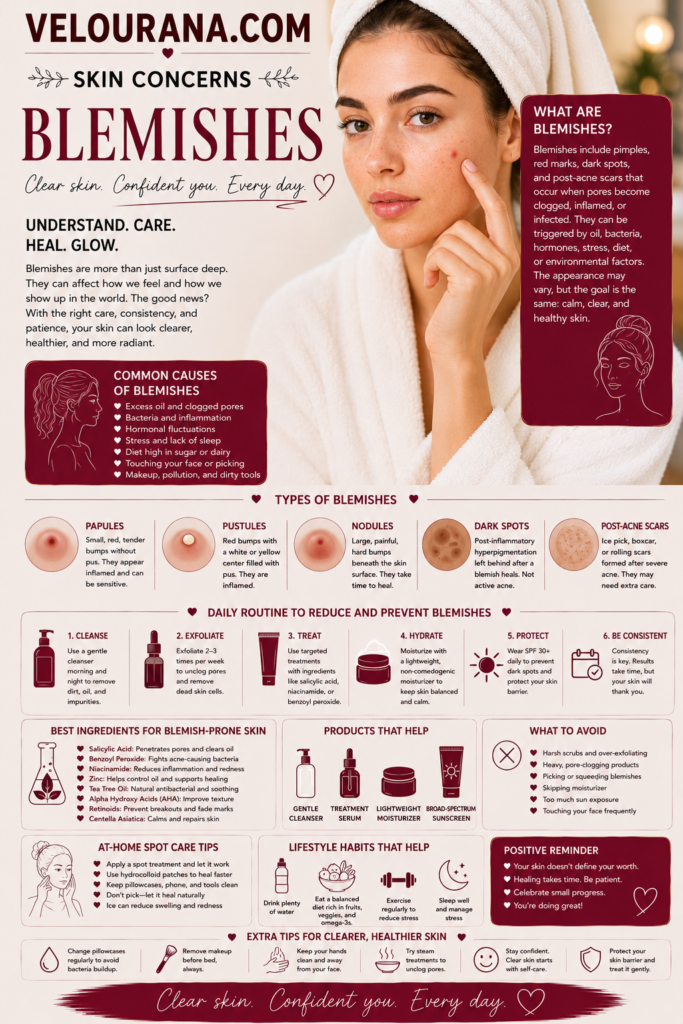
CATEGORY: Blemishes
Few words in skincare are used as broadly as blemish. It can describe a newly inflamed pimple, a cluster of clogged pores, a red mark left after acne, a dark patch that remains long after a spot has healed, or simply an area of skin that looks different from the smooth, even surface someone expected to see in the mirror. Beauty language tends to gather all of these experiences beneath one convenient term, creating the impression that blemishes are a single problem waiting for a single solution.
The skin is considerably more complicated.
What appears as an imperfection on the surface may represent active inflammation, follicular congestion, residual pigmentation, vascular redness or, in some cases, something unrelated to acne altogether. Two marks that look similar from a distance may therefore require entirely different approaches. A product capable of helping a clogged follicle cannot necessarily erase pigmentation left behind after that follicle has healed. An aggressive exfoliant applied to an already irritated red mark may make it more noticeable rather than less. A spot repeatedly treated as acne may not even be acne.
This is why successful blemish care begins before the first serum is applied. It begins with interpretation.
The useful question is not simply, "How do I get rid of this mark?" It is, "What process created it, and is that process still active?"
That distinction separates treatment from reaction. It also explains why some blemish routines seem permanently busy yet achieve surprisingly little. When every visible irregularity is treated as though it were the same thing, the skin receives more intervention but not necessarily more appropriate care.
A more intelligent strategy follows the life of a blemish from its beginning inside the follicle through inflammation, healing and the residual changes that may remain afterward. Once those stages are understood, skincare becomes less about attacking imperfections and more about responding accurately to what the skin is doing.
A Blemish Is a Description, Not a Diagnosis
In ordinary beauty language, blemish sounds almost medical. In reality, it is an imprecise descriptive term.
A dermatologist is more interested in the type of lesion.
Acne can involve comedones such as blackheads and whiteheads, inflammatory papules and pustules, and deeper nodules or cyst-like lesions. After active acne resolves, the skin may retain red or darker marks. Scarring can produce changes in texture rather than simply colour.
These distinctions are not semantic details. They determine what treatment is attempting to accomplish.
A blackhead involves an open comedo. A whitehead represents a closed comedonal lesion. An inflamed red bump reflects a different stage of acne activity. A flat brown mark remaining after the bump has disappeared is no longer an active clogged pore, even though someone may continue calling it a blemish.
This is one of the most common sources of confusion in home skincare.
Someone sees a dark mark where a pimple existed three months earlier and continues applying acne spot treatment to it. But if there is no longer an active acne lesion, repeatedly treating the area as though the follicle remains infected or clogged may accomplish little.
The visible evidence has outlasted the original event.
Conversely, someone may focus entirely on fading old marks while new inflammatory acne continues forming every week. In that situation, brightening the aftermath without controlling the ongoing acne is like continually repairing damage without addressing what keeps creating it.
Effective blemish care therefore requires two perspectives simultaneously: what exists now and what keeps producing it.
Once those questions are separated, treatment becomes much more coherent.
How an Ordinary Follicle Becomes an Inflamed Spot
Acne begins within the pilosebaceous unit—the hair follicle and its associated sebaceous gland.
Sebum is produced naturally by sebaceous glands and contributes to the skin's surface environment. Cells lining the follicular canal also undergo continual turnover. When the normal movement and shedding of this material becomes disrupted, sebum and keratinous material can accumulate within the follicle.
This creates the foundation of a comedo.
If the obstruction remains relatively non-inflammatory, the result may appear as a blackhead or whitehead. But acne can progress beyond simple congestion.
The follicular environment can support proliferation of Cutibacterium acnes, a bacterium naturally associated with human skin. The immune system responds to changes within the follicle, inflammation develops, and what began invisibly beneath the surface can become a red, swollen lesion.
This explains why a pimple can seem to appear overnight even though the process began earlier.
The visible inflammation is the moment at which the lesion becomes obvious, not necessarily the moment at which it began.
It also explains why washing the face repeatedly after a spot appears cannot simply reverse the process.
The problem is not a piece of surface dirt sitting on top of the skin.
By the time an inflammatory lesion is visible, biological events are occurring within and around the follicle.
This understanding immediately changes the logic of blemish care. Cleansing remains important, but it cannot carry the entire burden of acne treatment. Prevention becomes as significant as reacting to the lesion already visible.
Why Inflammation Changes Everything
A blackhead can exist with relatively little surrounding inflammation. A red pimple is different.
Once the immune response becomes involved, the surrounding tissue participates in the lesion. Blood flow changes. Inflammatory mediators contribute to redness, swelling, tenderness and sometimes pain.
This is why an inflamed blemish should not be treated simply as a blackhead that needs more force.
Squeezing a tender red lesion can intensify tissue trauma. Even when material is expressed, the mechanical pressure may increase inflammation and damage surrounding skin.
The aftermath can become more troublesome than the original pimple.
Inflammation also influences what happens after the active lesion resolves. The skin may retain redness or develop increased pigmentation at the site, particularly in individuals prone to post-inflammatory pigment changes.
A single blemish can therefore have several lives.
First comes the developing lesion.
Then comes visible inflammation.
Then comes healing.
Finally, a residual mark may remain.
A skincare strategy focused exclusively on making the pimple disappear as quickly as possible can neglect the later stages entirely.
Gentler management during the inflammatory phase may help reduce unnecessary trauma and therefore reduce one avoidable contributor to lingering marks.
This does not mean active acne should simply be ignored.
It means treatment and manipulation are not the same thing.
The Seduction of Squeezing
Few skincare habits are as understandable as squeezing a blemish.
The lesion is visible. It feels physically present. If it contains material, removing that material seems like the most direct possible solution.
Sometimes squeezing produces immediate flattening, which reinforces the behaviour.
But the apparent success can be misleading.
Mechanical pressure may rupture the follicular structure and increase inflammation in the surrounding tissue. Fingernails can injure the surface. Repeated manipulation can create scabs, prolong redness and increase the likelihood of post-inflammatory marks.
There is also the familiar problem of the lesion that is not ready to release.
A person presses gently.
Nothing happens.
More pressure follows.
Still nothing.
Eventually the original small bump is surrounded by a much larger area of red, traumatized skin.
The attempt to remove the blemish has created a second blemish around it.
This is particularly common with deeper inflammatory lesions, which cannot simply be emptied from the surface.
The most difficult skill in blemish care may therefore be learning when not to touch.
That restraint becomes easier when the lesion is understood as an inflammatory process rather than an object trapped beneath the skin.
Oiliness and Blemishes Are Related but Not Identical
Oily skin and acne frequently occur together, but the relationship is often simplified into the idea that oil itself is the problem.
This encourages aggressive degreasing.
Strong cleansers, alcohol-heavy toners, frequent washing and mattifying products are combined in an attempt to keep the face permanently oil-free.
The strategy misunderstands both sebum and acne.
Sebum is a normal skin secretion. Acne develops through an interaction involving follicular keratinization, sebaceous activity, microorganisms and inflammation. Removing visible surface oil does not permanently alter all of those processes.
A person can therefore wash until the skin feels extremely tight and still develop blemishes.
This is not evidence that the face needs even stronger cleansing.
It may indicate that cleansing has reached the limit of what cleansing can reasonably accomplish.
Excessively stripping the skin can also create another difficulty: irritation.
A face that is simultaneously oily, blemish-prone and irritated can be challenging to manage because treatments that might help acne become harder to tolerate.
The goal should therefore be balanced oil management rather than eradication.
A cleanser should remove excess oil and daily accumulation without making discomfort the proof that it worked.
Blemish-prone skin still deserves a functioning barrier.
Why Over-Cleansing Can Turn One Problem Into Two
The emotional logic of over-cleansing is powerful.
If blemishes are associated with oil and clogged follicles, a freshly washed face feels like progress. Washing again after several hours of shine can feel like maintaining that progress.
But cleansing has diminishing returns.
Once sweat, cosmetics, sunscreen, environmental residue and excess surface oil have been adequately removed, additional cleansing does not continue extracting acne from deeper within the follicle.
Instead, repeated exposure to cleansing agents can increase dryness and irritation.
The skin may begin feeling tight after washing. Flaking appears around the nose or mouth. Active treatments sting more than before. Moisturizer suddenly feels essential but is avoided because of fear that it will cause more breakouts.
A routine designed to control acne has now created barrier discomfort alongside it.
This is a recurring pattern in blemish care.
One problem is treated so aggressively that a second problem develops, and then the second problem makes the first harder to treat.
The solution is not necessarily a weaker overall acne strategy.
It is better allocation of effort.
Cleansing should cleanse.
Acne treatments should treat acne.
Moisturizer should support the barrier.
When one step is expected to perform every function, it is usually pushed beyond its useful role.
Salicylic Acid and the Logic of Treating Congestion
Salicylic acid has become one of the most familiar ingredients in blemish-focused skincare because it addresses an important part of acne formation: clogged follicles.
Its exfoliating action makes it particularly useful for comedonal acne involving blackheads and whiteheads.
But familiarity can create excess.
Salicylic acid may appear in the cleanser, toner, serum, pads and mask of the same routine. Because every product is marketed toward blemish-prone skin, the duplication can initially seem sensible.
The skin experiences something different.
It experiences repeated exfoliation.
For some people, a single salicylic-acid product used consistently may be sufficient. Others may combine it with different acne treatments under an appropriate routine.
What matters is not maximizing exposure.
It is finding an effective level the skin can tolerate.
This distinction is particularly important because irritation can mimic the appearance of worsening skin. Redness, rough texture and small irritated bumps may be interpreted as more acne, leading to still more exfoliation.
The routine then accelerates in precisely the wrong direction.
A useful active ingredient becomes less useful when it is used without restraint.
Benzoyl Peroxide Addresses a Different Part of Acne
Not all blemish treatments work in the same way.
Benzoyl peroxide is widely used for acne because of its antimicrobial activity against Cutibacterium acnes and its usefulness in inflammatory acne.
This makes it conceptually different from a treatment focused primarily on exfoliation or comedonal obstruction.
Understanding those differences matters because skincare should be built around mechanisms rather than ingredient collecting.
Someone experiencing predominantly inflammatory pimples may have different treatment needs from someone whose primary concern is blackheads and closed comedones.
Benzoyl peroxide can also cause dryness and irritation, especially when introduced aggressively.
Again, the broader routine determines whether an effective ingredient remains usable.
A strong acne treatment surrounded by harsh cleansing, repeated exfoliation and inadequate moisturization may become intolerable.
The solution is not always to abandon the active ingredient.
Sometimes the supporting routine needs to become gentler.
Retinoids and the Importance of Prevention
Reactive blemish care begins when the pimple appears.
Preventive blemish care begins earlier.
Topical retinoids are important in acne treatment partly because they help address the processes involved in comedone formation. Rather than treating only the spot that has already become visible, they can form part of a broader strategy intended to reduce future lesions.
This represents a fundamental shift.
Instead of asking which product should be placed on today's pimple, the question becomes how the overall acne pattern can be changed over the coming months.
That is a less emotionally satisfying approach because prevention is difficult to see.
A pimple disappearing overnight is obvious.
A pimple that never formed cannot be photographed.
Yet preventing future lesions may ultimately have greater value than repeatedly treating each lesion after inflammation has already developed.
Retinoids require patience and can cause irritation during introduction. Frequency and formulation matter, and professional guidance can be useful when acne is significant or the skin is sensitive.
Pregnancy and plans for pregnancy require particular caution because certain retinoids should not be used.
This is one of many areas in which "blemish treatment" is too broad a phrase.
The correct treatment depends on the person, the lesion and the circumstances.
Moisturizer Can Make Acne Treatment More Successful
One of the most persistent contradictions in blemish-prone skincare is the fear of moisturizer.
The skin is oily.
Pores become clogged.
Therefore adding moisture seems dangerous.
But moisturization and sebaceous oil production are not the same process.
A moisturizer supports hydration and barrier function through a formulation applied to the surface. Whether it feels suitable for acne-prone skin depends on its composition, texture and the individual using it.
This becomes especially important when acne treatments cause dryness.
If the skin becomes so uncomfortable that the active treatment must repeatedly be stopped, the overall strategy becomes less effective.
A suitable moisturizer can improve tolerance.
For oily skin, that may mean a lightweight lotion or gel-cream. For skin made dry by treatment, a more substantial formulation may be needed.
There is no prize for using the lightest moisturizer possible.
The objective is comfort without unwanted heaviness or obvious worsening of congestion.
In this sense, moisturizer can contribute indirectly to clearer skin.
It allows the treatments doing the direct work to remain sustainable.
When the Pimple Is Gone but the Blemish Remains
One of the most important moments in blemish care occurs when active acne has already healed.
The bump is gone.
There is no tenderness.
No material remains to extract.
Yet the site is still visible.
Depending on the skin and the inflammatory process, the residual mark may appear red, pink, brown, greyish or darker than the surrounding skin.
At this stage, continuing to attack the area with conventional spot treatments may confuse two different problems.
The active acne lesion has ended.
What remains is its aftermath.
Post-inflammatory hyperpigmentation occurs when inflammation stimulates excess pigment production, leaving a darker mark after the original lesion resolves. Other individuals may experience persistent post-inflammatory redness.
These marks can make acne appear much more extensive than it currently is.
Someone may look in the mirror and see twenty "blemishes," even though only three are active pimples and the rest are residual marks from previous breakouts.
This distinction is psychologically and therapeutically important.
The acne may actually be improving.
The evidence of previous acne simply takes longer to disappear.
Why Dark Marks Can Persist Long After Acne Improves
Post-inflammatory hyperpigmentation can be remarkably persistent.
The original pimple may last a week, while the mark it leaves behind remains visible for months.
This delayed recovery can create the impression that treatment is failing even when fewer new lesions are forming.
Pigment takes time to normalize.
Sun exposure can also make pigmentation more persistent or more noticeable, which is one reason sun protection belongs in a blemish routine.
This is particularly important for people who focus so intensely on acne treatments that sunscreen becomes an afterthought.
Preventing new blemishes while allowing ultraviolet exposure to deepen their residual marks creates an incomplete strategy.
The skin needs both acne control and protection during recovery.
Several topical ingredients are used in approaches to post-inflammatory pigmentation, but the most important principle is often overlooked: stop creating new inflammation.
Every new pimple has the potential to leave another mark.
Every squeezed lesion has the potential to create additional trauma.
Pigmentation treatment becomes much more efficient when the source of new marks is being controlled simultaneously.
Red Marks and Brown Marks Are Not the Same Thing
Residual blemish marks are often grouped together as "acne scars," but this can be inaccurate.
A flat red or brown mark is not necessarily a scar.
True scarring involves structural changes in the skin and may appear as depressions, raised areas or alterations in texture.
Post-inflammatory colour changes involve a different process.
This matters because the treatments are different.
A topical product capable of gradually improving pigmentation cannot rebuild a deep atrophic acne scar.
Likewise, a procedure designed to improve scar texture may be unnecessary for someone whose primary issue is flat post-inflammatory colour.
Using precise language prevents unrealistic expectations.
It also prevents people from concluding that a product has failed when it was never designed to treat the condition they actually have.
Blemish care improves dramatically when colour and texture are evaluated separately.
The Role of Sunscreen Is Larger Than It First Appears
Sunscreen does not unclog follicles.
It does not kill acne-associated bacteria.
It does not flatten a pimple overnight.
For those reasons, it can seem peripheral to blemish care.
But blemish-prone skin is not concerned only with today's active lesion.
It is also concerned with what remains after that lesion heals.
Ultraviolet exposure can contribute to persistent pigmentation and broader skin damage. Protecting the skin therefore supports a more complete approach to the appearance of blemishes.
Sunscreen selection can be challenging for oily or acne-prone skin because some formulations feel heavy.
The answer is not necessarily to avoid sunscreen.
It is to find a formulation that fits comfortably into the routine.
Fluid, gel and lighter lotion textures may appeal to oily skin, while drier skin may prefer more moisturizing formulas.
Consistency matters more than theoretical perfection.
A sunscreen that looks ideal on an ingredient list but feels so unpleasant that it is rarely applied is not serving the routine particularly well.
Makeup Does Not Automatically Cause Blemishes
Makeup and acne have a complicated cultural relationship.
When someone develops blemishes, foundation is often blamed immediately.
Cosmetics can contribute to congestion in susceptible individuals, particularly when formulations are heavy or poorly tolerated. But the idea that makeup automatically causes acne is too simplistic.
Many people with acne use makeup successfully.
Formulation, removal and individual skin response matter.
Non-comedogenic products may be preferable for acne-prone skin, although no label can guarantee identical results for everyone.
Thorough removal at the end of the day is also important.
The objective is not aggressive scrubbing.
It is complete, comfortable cleansing.
Someone wearing long-wear foundation and water-resistant sunscreen may require a more effective evening cleansing strategy than someone wearing no cosmetics.
The routine should respond to what is actually on the skin.
Hair Products Can Create Blemishes Where Skincare Is Blamed
Sometimes the most important product affecting facial blemishes is not technically a facial product.
Hair oils, pomades, leave-in conditioners and styling creams can contact the forehead, temples and sides of the face.
When breakouts cluster around the hairline, it can be useful to consider what repeatedly touches that region.
This illustrates a broader principle.
The skin does not care which aisle a product came from.
Anything repeatedly contacting the face becomes part of its environment.
Pillowcases, helmets, hats, phones, hands and occupational equipment can also interact with the skin.
Not every contact causes acne, and hygiene should not become obsessive.
But distribution patterns can provide clues.
A blemish routine becomes more intelligent when it looks beyond the serum bottle.
Stress Is Not an Imaginary Skin Concern
People often report that their skin worsens during stressful periods.
This observation can be dismissed as anecdotal or exaggerated, yet stress can interact with physiological processes relevant to acne.
The relationship is not as simple as "stress causes pimples," because acne is multifactorial.
But the body and skin are not separate systems.
Stress can also alter behaviour.
Sleep changes.
People touch their faces more frequently.
Skincare routines become inconsistent.
Food patterns may change.
Existing blemishes may be picked absent-mindedly.
The combined effect can become visible on the skin.
This does not mean relaxation is an acne treatment.
It means blemishes should not always be interpreted through products alone.
Diet Requires More Nuance Than Simple Blame
Few acne topics generate more confident claims than food.
Chocolate is blamed.
Dairy is blamed.
Sugar is blamed.
Greasy food is blamed.
Then another source claims diet has nothing to do with acne whatsoever.
The evidence is more nuanced.
Research has explored associations between acne and dietary patterns, including high-glycaemic diets and certain dairy consumption, but individual responses vary and diet is only one part of a multifactorial condition.
Extreme elimination diets based solely on a few blemishes are therefore difficult to justify without a clearer reason.
A more sensible approach is observation.
If someone consistently notices a pattern, discussing it with an appropriate healthcare professional may be useful.
Nutrition should support overall health rather than becoming another arena in which acne creates unnecessary restriction and anxiety.
Why Constantly Changing Products Can Hide Improvement
Blemishes create urgency.
A new pimple appears and the routine suddenly feels inadequate.
A product that seemed promising last week is abandoned.
Another is ordered.
Three days later, a third treatment is added.
This constant movement makes it almost impossible to know what is working.
Acne treatments generally need time.
Existing lesions do not vanish immediately, and the prevention of new lesions becomes visible only gradually.
Changing several variables every week destroys the ability to evaluate cause and effect.
It can also increase irritation because the skin is continually adapting to new formulations.
Consistency is therefore not merely convenient.
It produces information.
A stable routine reveals whether the acne pattern is actually improving.
Without stability, every breakout becomes a new experiment.
When Blemishes Need a Dermatologist Rather Than Another Serum
Mild blemishes can often be managed successfully with appropriate over-the-counter skincare.
But acne exists on a spectrum.
Painful deep lesions, nodules, significant inflammatory acne, persistent breakouts and scarring deserve professional assessment.
Acne that is affecting confidence or quality of life is also worthy of medical attention even if someone else might describe it as moderate.
There is no requirement to wait until acne becomes severe before asking for help.
A dermatologist can determine the type and severity of acne, prescribe treatments unavailable in ordinary cosmetics and design combinations that address both comedonal and inflammatory components.
Professional care is also important when something assumed to be acne behaves unusually.
Not every red bump is a pimple.
Persistent, atypical or rapidly changing lesions should not be repeatedly treated at home simply because they fall under the broad visual category of a blemish.
The Most Effective Blemish Strategy Treats Time as Part of the Process
A blemish exists within time.
Before it becomes visible, changes are already occurring within the follicle.
Then inflammation may develop.
The lesion becomes obvious.
Eventually it resolves.
Afterward, colour may remain.
Sometimes texture changes remain as well.
A skincare routine that responds only to the moment when the pimple is largest sees only one part of this sequence.
The better strategy begins earlier and continues later.
Prevention aims to reduce new lesions.
Appropriate treatment manages active acne.
Restraint reduces unnecessary trauma.
Barrier support keeps treatment tolerable.
Sun protection supports the skin while residual marks recover.
Professional care becomes available when the condition exceeds what ordinary skincare can reasonably manage.
Seen this way, blemish care is not really about finding the fastest way to erase a spot.
It is about reducing the number of spots that form, limiting the inflammation and damage associated with those that do, and helping the skin recover afterward.
Clearer Skin Is Not Skin That Never Changes
The word blemish carries an implicit judgment.
Something has appeared that should not be there.
For active acne, treatment is entirely reasonable. Persistent or severe acne deserves effective care, and no one needs to pretend that a painful breakout is simply an aesthetic variation to be ignored.
But there is also value in maintaining realistic expectations.
Human skin changes.
Follicles become temporarily congested.
Hormonal fluctuations affect oil production.
An occasional pimple can appear even in otherwise healthy skin.
Marks take time to fade.
Pores remain visible.
Texture exists.
The objective of skincare is not to make the face incapable of displaying biology.
It is to keep that biology as balanced and healthy as reasonably possible.
For blemish-prone skin, success may mean that breakouts occur less frequently and resolve more calmly. It may mean that inflammatory lesions are smaller, that picking has stopped, that post-inflammatory marks are becoming less numerous because fewer new pimples are forming.
It may mean that the person no longer changes their entire skincare routine every time a spot appears.
These improvements are less dramatic than the promise of overnight perfection.
They are also more meaningful.
Reading the Skin Before Trying to Correct It
The most useful skill in blemish care is not memorizing the largest number of active ingredients.
It is learning to distinguish what the skin is showing.
Is the lesion clogged or inflamed?
Is it active or already healed?
Is the remaining colour red or pigmented?
Is the texture altered?
Is the surrounding skin healthy or irritated?
Are new lesions still forming?
Has the pattern changed suddenly?
Once those questions are answered, skincare becomes more precise.
A clogged follicle can be approached as congestion.
Inflammatory acne can be treated as inflammation and acne rather than something to squeeze.
Residual pigmentation can be treated as an aftermath rather than an active pimple.
Scarring can be recognized as structural change that may require professional procedures rather than endless topical spot treatments.
And normal skin texture can sometimes be left alone.
This is the deeper lesson hidden inside the vague word blemish.
Not everything that looks imperfect represents the same biological event.
The surface of the skin is telling the story of what is happening now, what happened recently and sometimes what happened months ago. Treating all of those chapters identically creates confusion.
Understanding them creates strategy.
The goal is not to attack every visible mark with maximum force.
It is to identify what stage the skin is in, choose an intervention that makes biological sense, protect the surrounding skin from unnecessary damage and allow enough time for healing to occur.
When blemish care is approached this way, clearer skin becomes less dependent on emergency treatment.
The routine becomes quieter.
New lesions are prevented rather than merely chased. Existing blemishes are treated without being repeatedly traumatized. Old marks are allowed to recover without being mistaken for fresh acne. Professional help is sought when the condition requires more than cosmetics can reasonably provide.
The skin will never become a perfectly static surface.
It was never designed to be one.
But understanding the difference between an active blemish, its aftermath and normal skin variation makes it possible to care for imperfections without allowing them to dictate the entire routine.
And that is ultimately the more intelligent definition of blemish control: not a permanent absence of every mark, but skin whose problems are understood well enough that each one receives no more—and no less—treatment than it actually needs.
The End Velourana
 Discover More From Our Family of Websites
 ZodiacBearing (Astrology, Tarot, Numerology, Angel Numbers & Spiritual Guidance)
 Velourana (Beauty, Makeup, Hair Care, Skincare & Beauty Tips)
 HavenBearing (Home, Living, Organization, Décor & Everyday Inspiration)
 PawBearing (Pet Care, Dog Breeds, Animal Health, Training & Pet Products)
 PsyCatherine (Notes From the Journal of a Psychologist on Real Life)