
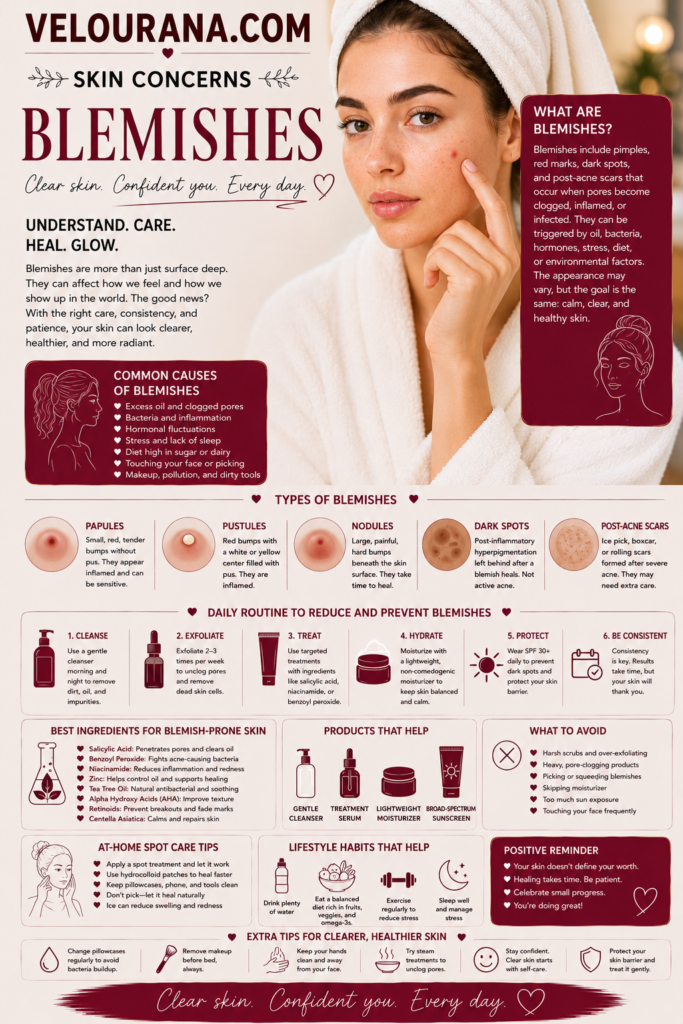
CATEGORY: Blemishes
Blemish-prone skin creates a strong temptation to treat every visible problem as evidence that the routine is not doing enough. A new pimple appears, so another active ingredient is added. Oil returns by midday, so cleansing becomes more aggressive. Texture feels rough, so exfoliation is increased. Red marks remain, so brightening treatments are layered on top of acne treatments that are already drying the skin.
The logic seems reasonable because each step has a specific target.
Yet the skin does not experience those products separately.
It experiences the combined effect of the entire routine.
This is where blemish care can become self-defeating. The original acne may remain only moderate, but the surrounding skin becomes chronically irritated. Tightness develops after cleansing. Moisturizer stings. Sunscreen burns around the nose. Flaking appears beneath makeup. Redness becomes more persistent. Small irritated bumps are mistaken for new acne, leading to even more treatment.
The problem has expanded.
There are now two concerns: the blemishes themselves and the damage created by trying to remove them too aggressively.
This is why the skin barrier deserves a central place in any serious discussion of blemish-prone skin. Barrier health is sometimes treated as an unrelated concern, something associated mainly with dryness or sensitivity. In reality, the barrier influences whether acne treatments can be used consistently, whether the skin remains comfortable enough to avoid constant product switching and whether irritation complicates the appearance of existing blemishes.
A successful routine does not merely contain effective acne ingredients.
It creates conditions in which those ingredients can keep being used.
That difference is more important than it first appears.
The Skin Barrier Is Not a Beauty Trend
The phrase skin barrier has become so common in skincare marketing that it can sound like another temporary beauty concept.
Biologically, however, the barrier is fundamental.
The outermost layer of the epidermis helps regulate water loss and protects the body from environmental exposures. Its structure is often compared to bricks and mortar: cells forming the bricks, surrounding lipids forming the mortar that helps maintain cohesion.
When this barrier is functioning well, the skin retains water more effectively and is better able to tolerate ordinary environmental and cosmetic stress.
When it is disrupted, the skin can become dry, tight, rough, flaky, sensitive and more reactive.
This matters enormously in blemish care because many useful acne treatments can also create dryness or irritation.
The question is therefore not simply whether an ingredient can help acne.
It is whether the total routine allows the skin to tolerate that ingredient long enough for it to help.
Why Blemish-Prone Skin Is Often Over-Treated
Acne creates visible evidence that something is happening inside the skin.
The natural response is intervention.
But the number of interventions can increase rapidly because blemishes involve several different features at once.
There may be excess oil.
There may be blackheads.
There may be closed comedones.
There may be inflammatory pimples.
There may be post-inflammatory marks.
There may be textural irregularity.
The skincare market has a product for each of these concerns.
The result can be a routine in which every step contains an active.
An exfoliating cleanser is followed by an acid toner. A niacinamide serum comes next. Then a retinoid. A benzoyl peroxide spot treatment is added to inflamed areas. Several nights a week, an exfoliating mask is used. In the morning, a brightening serum targets old marks.
Each product has a theoretical rationale.
Together, they may exceed the skin's tolerance.
This is how an intelligent ingredient collection can become an unintelligent routine.
Irritation Can Look Like More Acne
One of the most confusing problems in blemish-prone skin is that irritation can mimic the appearance of worsening breakouts.
The skin may develop small red bumps.
Texture becomes uneven.
Existing blemishes appear more inflamed.
The surface feels rough.
Someone looking only at the mirror may conclude that acne is spreading.
The instinct is to treat harder.
But if irritation is contributing to the problem, increasing acids, scrubs or retinoid frequency can intensify the situation.
This creates a feedback loop.
More irritation looks like more acne.
More apparent acne leads to more treatment.
More treatment creates more irritation.
Breaking that cycle requires attention to sensation as well as appearance.
If the skin is burning, stinging, peeling or feeling persistently tight, those symptoms matter.
The routine should not be judged solely by the number of visible blemishes.
The Feeling of Tightness Is Not Proof of Cleanliness
Strong cleansing has a particularly powerful psychological appeal for blemish-prone skin.
A tight face feels degreased.
Degreased skin feels cleaner.
Clean skin feels less likely to break out.
The logic seems obvious.
But a tight sensation usually reflects significant removal of surface lipids and water rather than a meaningful reduction in deeper acne formation.
Blackheads and inflammatory blemishes develop within follicles.
No cleanser can permanently wash away the biological processes responsible for that tendency.
This is why harsh cleansing can feel highly effective while producing little improvement in the actual acne pattern.
The surface feels dramatically different.
The follicles continue behaving much as they did before.
A good cleanser therefore needs a narrower job description.
It should remove sweat, cosmetics, sunscreen, environmental residue and excess surface oil.
It does not need to leave the skin feeling stripped in order to succeed.
Over-Cleansing Can Make Active Treatments Harder to Use
A harsh cleanser may not create severe irritation immediately.
The problem often appears when it is combined with other treatments.
Suppose someone uses an aggressive foaming cleanser twice daily.
The skin feels slightly tight, but tolerable.
Then salicylic acid is introduced.
A week later, a retinoid is added.
Suddenly the face begins peeling.
The retinoid is blamed.
But the retinoid may not be the only problem.
The baseline routine was already pushing the barrier toward its limit.
The new treatment simply exceeded the remaining tolerance.
This is why supporting products matter.
A gentler cleanser can sometimes make a stronger treatment easier to use.
The acne treatment gets the credit.
The cleanser made the treatment possible.
Moisturizer Is Not a Concession to Dry Skin
People with oily, blemish-prone skin often feel that moisturizer is optional.
If the face already produces oil, adding another layer seems unnecessary.
This assumption confuses oil production with hydration.
Sebum is produced by sebaceous glands.
Hydration refers largely to water content and retention within the skin.
Oily skin can still become dehydrated or barrier-impaired.
This is especially common when acne treatments are involved.
A suitable moisturizer helps reduce water loss and supports comfort.
The correct texture depends on the person.
Very oily skin may prefer a lightweight lotion or gel-cream.
Skin made dry by retinoids or benzoyl peroxide may need something more substantial.
There is no universal formula.
The goal is not to use the lightest product imaginable.
It is to maintain enough comfort that the overall acne strategy remains sustainable.
Why Fear of Moisturizer Can Prolong Irritation
Once someone believes moisturizer causes blemishes, every breakout becomes evidence against using it.
The product is reduced.
The skin becomes drier.
Active treatments sting more.
The barrier becomes less comfortable.
More oil may become noticeable on the surface.
This reinforces the belief that the skin is too oily for moisturizer.
The cycle continues.
The better approach is to evaluate formulation rather than the entire category.
A heavy, occlusive moisturizer may indeed feel unsuitable for some acne-prone skin.
That does not mean all moisturizers behave the same way.
Formulas vary enormously in texture, emollience and occlusivity.
A product that supports hydration without feeling heavy may improve the routine rather than undermine it.
Salicylic Acid Becomes More Useful When the Barrier Can Tolerate It
Salicylic acid can be highly useful for blemish-prone skin, particularly when comedones and clogged pores are prominent.
But the ingredient's usefulness is limited by how often the skin can tolerate it.
Someone may assume that daily use is ideal because the concern is daily.
Another person may use it twice daily because the product label allows it.
But if the result is chronic dryness, the routine may be working too aggressively.
Reducing frequency does not necessarily mean abandoning the treatment.
It may simply bring the routine into a range that can continue.
This principle applies to many active ingredients.
The most effective frequency is not always the highest possible frequency.
It is the highest useful frequency the skin can sustain comfortably.
Retinoids Require Patience From Both the Skin and the Person
Retinoids are among the most important tools in acne care, but they also illustrate the relationship between treatment and tolerance clearly.
During introduction, dryness, flaking and irritation can occur.
The instinctive response sometimes goes in one of two directions.
The person either pushes through severe irritation because they believe discomfort proves effectiveness, or they abandon the treatment entirely after several applications.
Neither extreme is ideal.
A measured introduction allows the skin to adapt.
Frequency can be increased gradually.
Moisturizer can be used strategically.
Other irritating products can be reduced.
The goal is not to prove that the skin can survive retinoid use.
It is to create a routine in which the retinoid can remain part of long-term care.
Pregnancy and plans for pregnancy require special caution because certain retinoids should not be used.
In those circumstances, professional guidance is essential.
Benzoyl Peroxide Can Be Effective Without Being Used Everywhere
Benzoyl peroxide is particularly useful in inflammatory acne because of its antimicrobial activity.
But it can also be drying.
This creates an important distinction between effective use and indiscriminate use.
Someone with a few inflammatory lesions may not need to cover the entire face in a strong benzoyl peroxide formulation.
Someone with widespread inflammatory acne may use it more broadly under appropriate guidance.
The correct application pattern depends on the condition.
The common mistake is assuming that a useful ingredient becomes more useful when applied in greater quantity.
Skincare rarely works according to that logic.
The skin has a finite tolerance.
Once that threshold is exceeded, the routine becomes increasingly difficult to maintain.
Combining Active Ingredients Requires Strategy, Not Courage
Modern skincare makes it easy to assemble a powerful routine.
Salicylic acid in the morning.
Benzoyl peroxide as a spot treatment.
Retinoid at night.
Glycolic acid twice weekly.
Vitamin C for marks.
Azelaic acid on alternate nights.
On paper, every concern is covered.
In practice, the skin may struggle to keep up.
Combination therapy can be excellent when designed intelligently.
The problem is stacking treatments without considering cumulative irritation.
Sometimes alternating products makes more sense than layering them.
Sometimes one active should be established before another is introduced.
Sometimes the routine needs fewer actives altogether.
The objective is not to demonstrate maximum tolerance.
It is to achieve maximum useful treatment with minimum unnecessary irritation.
Barrier Damage Can Make Makeup More Difficult
Blemish-prone skin is often judged not only without makeup but also by how makeup behaves over it.
When the barrier becomes dry and flaky, foundation clings to rough areas.
Concealer emphasizes texture around pimples.
Powder catches on peeling skin.
The complexion can look more uneven even when the number of active blemishes has not increased.
This creates another source of frustration.
The person assumes the acne itself looks worse.
But part of the problem is the condition of the surrounding skin.
Improving hydration and reducing irritation can make the face look smoother even before the acne pattern changes dramatically.
This is an important reminder that blemish care should improve the quality of the whole skin surface, not just the lesions.
Fragrance and Sensitizing Ingredients Matter More When the Barrier Is Compromised
Many people tolerate fragranced skincare perfectly well.
Others find that fragranced or highly botanical formulations become irritating, particularly when the barrier is already stressed.
The important point is not that every fragranced product is harmful.
It is that tolerance can change.
A product that once felt comfortable may sting after several weeks of intensive acne treatment.
This is because the surrounding skin has changed.
When the barrier becomes more vulnerable, formulas that were previously innocuous may become uncomfortable.
This is another reason barrier restoration often involves simplification.
A bland routine is not glamorous.
But when the skin is irritated, glamour may be exactly what it does not need.
The Myth of "Purging" Can Encourage People to Ignore Irritation
Purging is one of the most frequently misunderstood concepts in blemish-prone skincare.
Certain treatments that influence cell turnover can temporarily bring existing microcomedones to the surface more quickly.
This can make acne appear worse before it improves.
But not every reaction is a purge.
Burning, intense itching, widespread redness, swelling and rash-like eruptions should not automatically be interpreted as evidence that the product is "working."
Neither should new bumps appearing in areas where the person rarely develops acne.
The purge explanation can become dangerous when it encourages someone to tolerate clear signs of irritation indefinitely.
Skincare should remain responsive to what the skin is actually doing.
Not every worsening is a necessary stage of improvement.
Barrier Repair Does Not Mean Stopping All Acne Treatment Forever
When the skin becomes irritated, simplification can be useful.
But simplification does not necessarily mean abandoning every active ingredient permanently.
The goal is to restore enough comfort that an effective treatment can eventually be used again.
A temporary simplified routine may focus on gentle cleansing, moisturizer and sun protection while the skin settles.
Once irritation has resolved, active products can be reintroduced more cautiously.
This staged approach is often more efficient than continuing a complicated routine at reduced intensity while the skin never fully recovers.
The skin needs a clear signal.
Sometimes that signal is less.
Sunscreen Supports Both the Barrier and the Aftermath of Blemishes
Sunscreen is often viewed as separate from acne care.
But blemish-prone skin frequently deals with post-inflammatory marks, and ultraviolet exposure can make pigmentation more persistent.
Sun protection also supports the broader health of skin that may already be undergoing treatment with retinoids or exfoliating acids.
The challenge is finding a formula that feels compatible with acne-prone skin.
Heavy sunscreens may feel uncomfortable for some people.
Lighter fluids and gels may be more suitable.
Others may prefer a moisturizing sunscreen that reduces the need for a separate morning moisturizer.
The correct choice depends on texture preference and tolerance.
The principle remains consistent: protection should be easy enough to become habitual.
Hydration Can Reduce the Appearance of Texture Without Treating the Acne Directly
Hydrated skin reflects light differently from dehydrated skin.
When the surface is dry and uneven, tiny irregularities become more obvious.
Pores can appear deeper.
Fine flaking catches light.
Post-inflammatory marks look more contrasted.
Improving hydration cannot remove a comedo or cure inflammatory acne.
But it can make the skin look more even while those conditions are being treated.
This is one of the reasons barrier support improves the overall cosmetic result even when it is not directly attacking acne.
The face is a complete visual field.
Blemishes do not exist in isolation from the surrounding surface.
When Oiliness Increases During Barrier Stress
Some people report that their skin feels both dry and oily at the same time.
The face may feel tight after cleansing but become shiny a few hours later.
This combination can be confusing.
It encourages the belief that more cleansing is necessary because oil is still present.
But surface oiliness does not prove that the barrier is adequately hydrated.
The skin can lose water while continuing to produce sebum.
This creates the familiar sensation of a face that feels stripped yet looks shiny.
The answer is not necessarily stronger degreasing.
It may be a gentler routine that reduces water loss while controlling acne through more targeted treatments.
Barrier-Friendly Does Not Mean Inactive
There is sometimes an artificial division between "barrier skincare" and "active skincare."
One is portrayed as gentle but weak.
The other as effective but harsh.
In reality, a good routine can contain both effective treatment and barrier support.
A retinoid can be part of a barrier-conscious routine.
So can salicylic acid.
So can benzoyl peroxide.
The difference lies in frequency, formulation, combination and supporting products.
Barrier-friendly does not mean avoiding treatment.
It means designing treatment intelligently enough that the skin remains functional while receiving it.
A Simple Routine Can Be More Advanced Than a Complicated One
Complexity often looks sophisticated.
A shelf filled with serums creates the impression that every possible pathway has been addressed.
But a genuinely advanced routine is one in which each product has a distinct purpose.
A cleanser removes what should be removed.
An acne treatment addresses the relevant acne mechanism.
A moisturizer supports the barrier.
A sunscreen protects the skin.
Additional products may be added when they solve a specific problem.
This structure may involve four products rather than fourteen.
It can still be more effective.
The sophistication lies in the reasoning, not the quantity.
When to Suspect the Routine Is Causing the Problem
Several clues suggest that treatment itself may be contributing to skin discomfort.
Persistent burning is one.
So is widespread flaking.
Stinging when applying basic moisturizer is another.
Sudden sensitivity to products that were previously comfortable can be significant.
Diffuse redness extending beyond individual blemishes suggests the surrounding skin is involved.
If these symptoms develop after increasing active ingredients or changing cleansers, the routine deserves review.
The important thing is not to panic.
The skin often improves when unnecessary irritation is reduced.
But severe swelling, blistering, significant pain or other concerning symptoms should be evaluated professionally.
The Psychological Appeal of Doing More
Blemishes are visible.
Waiting is difficult.
This makes action emotionally satisfying.
Applying another treatment feels productive.
Doing nothing feels passive.
But skin biology does not reward action simply because it is action.
Sometimes the most effective decision is to maintain the existing routine.
Sometimes it is to reduce frequency.
Sometimes it is to stop picking.
Sometimes it is to allow a red mark to fade rather than placing another acid on top of it.
Restraint is not the absence of skincare.
It is one of its more difficult forms.
Why Barrier Health Can Reduce Product Hopping
When the skin is calm, products can be evaluated more clearly.
If a treatment reduces blemishes, that improvement can be observed.
If a new formulation causes congestion, the change becomes easier to identify.
If the skin is chronically irritated, everything becomes harder to interpret.
Redness fluctuates.
Texture changes.
Products sting inconsistently.
New bumps appear.
The person loses confidence in the routine and begins replacing products.
This constant movement creates even more variables.
A stable barrier therefore improves not only the skin.
It improves the quality of the information the skin provides.
Barrier Support Is Especially Important in Pigment-Prone Skin
People prone to post-inflammatory hyperpigmentation have another reason to avoid unnecessary irritation.
Inflammation itself can stimulate pigmentation.
A routine designed to fade dark marks can therefore backfire if it repeatedly irritates the skin.
This is why aggressive peeling is not always the fastest route to even tone.
The skin needs enough active treatment to support renewal without provoking another inflammatory event.
The balance is delicate.
But it is achievable.
Acne Scarring Raises the Stakes of Inflammation Control
Barrier care cannot prevent every acne scar.
Deep inflammatory acne can damage tissue despite excellent skincare.
But unnecessary irritation and picking can add trauma to an already inflamed lesion.
This makes calm management especially important when acne is severe.
The deeper the lesions, the more important professional treatment becomes.
Topical skincare should not be expected to manage nodules, cystic lesions or scarring acne indefinitely without medical assessment.
Barrier support remains useful.
But it is not a substitute for appropriate treatment.
When a Dermatologist Can Help Simplify the Routine
People often seek dermatological care expecting to receive more products.
Sometimes the greatest benefit is receiving fewer.
A dermatologist can determine which treatments are essential and which may be redundant.
Prescription options may replace several weaker over-the-counter products.
Application frequency can be adjusted.
The person can stop guessing.
This simplification can be especially valuable for someone whose barrier has been damaged by months of product stacking.
Professional care does not always mean a more complicated routine.
It can mean a more coherent one.
Calmer Skin Is Easier to Treat
There is a simple reason barrier support improves blemish routines.
Calmer skin tolerates treatment better.
A comfortable face can accept a retinoid regularly.
A moisturized barrier makes exfoliation easier to manage.
A non-stripping cleanser does not use up part of the skin's tolerance before treatment even begins.
Sunscreen can be applied without burning.
Makeup sits more evenly.
The person feels less compelled to keep changing products.
All of these effects support consistency.
Consistency, in turn, is what allows acne treatments enough time to influence the skin.
The Best Routine Does Not Make the Skin Prove Anything
Skincare culture often rewards sensation.
If the face tingles, the product feels active.
If it peels, renewal seems visible.
If the cleanser leaves the skin tight, it seems thorough.
If a mask draws out oil, it appears powerful.
But the skin does not need to demonstrate suffering to prove that a routine is effective.
A blemish treatment can work quietly.
A moisturizer can support the barrier without feeling rich.
A cleanser can remove sunscreen without stripping the face.
A sunscreen can protect the skin without being part of the acne treatment itself.
These products do not need dramatic sensory effects.
They need to perform their jobs.
A More Sustainable Philosophy for Blemish-Prone Skin
Blemish care is often approached as a battle between the person and the skin.
Oil must be defeated.
Pores must be emptied.
Pimples must be dried.
Marks must be peeled away.
The barrier offers a different philosophy.
The skin is not the enemy of the treatment.
It is the tissue through which the treatment has to work.
If that tissue becomes chronically irritated, every other objective becomes harder.
This does not mean accepting persistent acne without intervention.
It means treating acne in a way that respects the limits of the surrounding skin.
The cleanser should be effective without being punishing.
Active ingredients should be selected according to the acne pattern rather than accumulated indiscriminately.
Moisturizer should support tolerance.
Sunscreen should protect the skin during recovery.
Picking should be minimized.
New products should be introduced slowly enough that their effects can actually be understood.
And when the condition exceeds what ordinary skincare can reasonably manage, professional treatment should replace endless experimentation.
The ideal result is not simply fewer blemishes.
It is a face that is both clearer and calmer.
That distinction matters.
Clear skin that is constantly stinging, peeling and inflamed is not a successful outcome.
Neither is comfortable skin with untreated severe acne.
The goal is balance: enough treatment to meaningfully change the acne pattern, enough barrier support to make that treatment sustainable and enough restraint to avoid creating additional problems along the way.
When blemish-prone skin is approached this way, skincare becomes less dramatic.
There are fewer emergency treatments.
Fewer product changes.
Fewer nights when six active ingredients are layered together in frustration.
Instead, the routine becomes stable.
The skin has time to respond.
Inflammation has time to settle.
Marks have time to fade.
And the person using the routine begins to see something that aggressive blemish care often hides: the skin can improve without being constantly pushed to its limit.
Sometimes the route to clearer skin is not more treatment.
It is better treatment applied to calmer skin.
The End Velourana
 Discover More From Our Family of Websites
 ZodiacBearing (Astrology, Tarot, Numerology, Angel Numbers & Spiritual Guidance)
 Velourana (Beauty, Makeup, Hair Care, Skincare & Beauty Tips)
 HavenBearing (Home, Living, Organization, Décor & Everyday Inspiration)
 PawBearing (Pet Care, Dog Breeds, Animal Health, Training & Pet Products)
 PsyCatherine (Notes From the Journal of a Psychologist on Real Life)

