
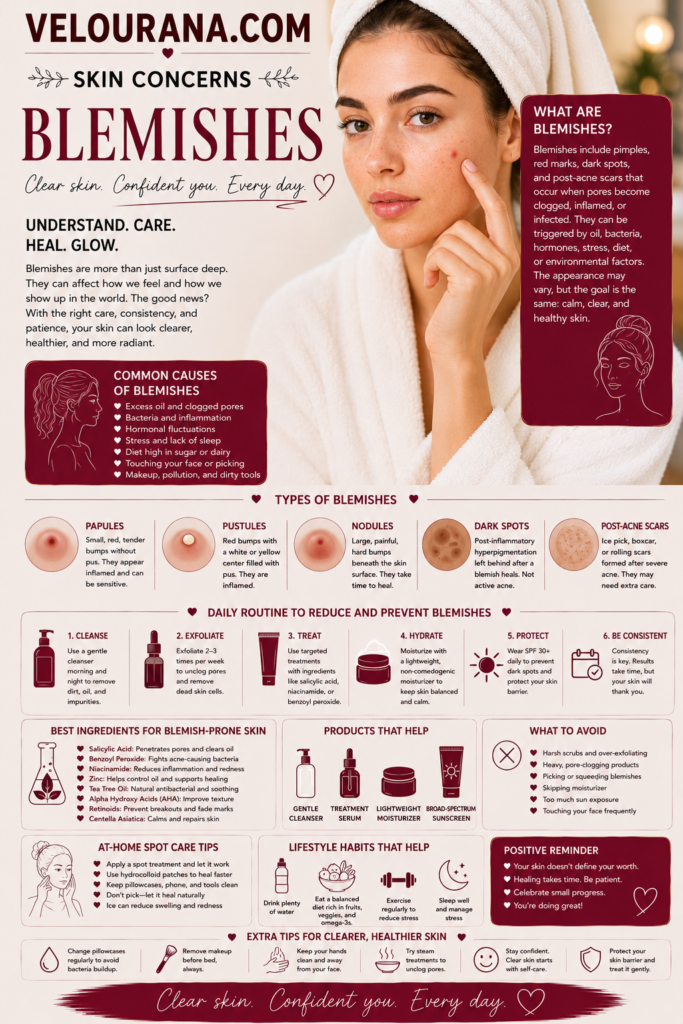
CATEGORY: Blemishes
The most visible stage of a blemish is also the least efficient moment to begin thinking about prevention.
By the time a spot is red, swollen or tender, the process that created it is already well underway. The follicle has become obstructed, inflammatory activity may have increased, and the lesion has moved from an invisible event beneath the surface to something obvious in the mirror.
This is why blemish-prone skincare often feels permanently reactive.
A spot appears.
It is treated.
Another appears nearby.
That one is treated too.
A third develops before the mark from the first has faded.
The routine becomes a sequence of local emergencies.
Prevention changes the structure of the problem.
Instead of asking how to make one blemish disappear as quickly as possible, it asks why new lesions keep forming and which parts of that process can be influenced before they become visible.
That shift is important because the burden of acne is not created only by the pimples themselves.
Every inflammatory lesion creates the possibility of redness, pigmentation, picking, scabbing and scarring. Every new breakout can prolong the visual appearance of acne even when older lesions are healing well.
Reducing the number of new blemishes therefore has a compounding effect.
There are fewer active lesions.
Fewer marks are created.
Fewer opportunities arise for squeezing.
The face begins to spend more time recovering and less time generating new inflammation.
This is where blemish management becomes more strategic.
The goal is not perfect immunity from every future spot. Human skin is too biologically variable for that promise to be realistic.
The goal is to make recurring breakouts less frequent, less severe and less disruptive.
Prevention Begins Before Anything Is Visible
The earliest stages of acne can develop invisibly.
Inside the follicle, keratinous material and sebum can begin accumulating before the surface shows a recognizable lesion.
This is one reason spot treatment alone has limitations.
A product placed only on visible pimples is treating lesions that have already announced themselves.
Meanwhile, other follicles may be developing microscopic congestion.
This is why preventive treatments are often applied across acne-prone areas rather than only to individual spots, depending on the product and professional guidance.
The aim is to influence the environment in which lesions form.
This makes prevention less dramatic than spot treatment but potentially more powerful.
A pimple that disappears overnight creates obvious evidence.
A pimple that never formed creates none.
Yet the second outcome is often the more valuable one.
The First Step Is Identifying the Pattern
Not all blemish-prone skin behaves in the same way.
Some people develop mostly blackheads and closed comedones.
Others experience frequent inflammatory papules and pustules.
Some have persistent lower-face breakouts.
Others develop lesions around the hairline or in areas of repeated friction.
The prevention strategy should reflect the pattern.
If congestion dominates, treatments targeting comedone formation become important.
If inflammation dominates, the routine may need ingredients with stronger antimicrobial and anti-inflammatory roles.
If breakouts cluster around the hairline, hair products deserve review.
If lesions appear under sports equipment, helmets or areas of chronic friction, occlusion may be contributing.
Pattern recognition prevents the routine from becoming generic.
Skincare becomes more effective when it responds to the face actually being treated rather than to the abstract category of "blemish-prone skin."
Consistent Cleansing Is More Important Than Aggressive Cleansing
Cleansing supports prevention because it removes sunscreen, makeup, sweat, environmental residue and excess surface oil.
But cleansing has a limit.
It cannot permanently empty follicles.
It cannot stop sebaceous glands from functioning.
It cannot prevent every comedo simply by becoming stronger.
This is why aggressive cleansing often produces diminishing returns.
The face becomes tight and irritated while blemishes continue forming beneath the surface.
The more useful goal is consistency.
Evening cleansing should adequately remove what has accumulated during the day.
Morning cleansing can be adjusted according to oiliness, sensitivity and personal preference.
The cleanser should perform its job without leaving the skin feeling punished.
A simple cleanser used reliably is usually more useful than an aggressive one that makes the rest of the routine harder to tolerate.
Salicylic Acid Helps Prevention When Congestion Is Part of the Problem
Salicylic acid is particularly useful for blemish prevention when blackheads, whiteheads and clogged pores are prominent.
Its ability to exfoliate within oily, congested environments makes it well suited to comedonal acne.
The key is consistency without excess.
A single well-formulated salicylic-acid product may be sufficient for many people.
Adding several products containing the same type of exfoliating activity does not necessarily improve prevention.
It may simply increase irritation.
The objective is to reduce the tendency toward obstruction.
The routine should not create a second problem while solving the first.
Retinoids Shift Prevention Earlier in the Cycle
Topical retinoids are especially important in acne prevention because they influence processes involved in comedone formation.
They work upstream.
Instead of waiting for a follicle to become visibly congested, they help normalize turnover and reduce the development of new comedonal lesions.
This makes them particularly valuable for recurring acne.
The benefit is gradual.
The skin does not suddenly become clear after several applications.
Existing lesions still need time to resolve.
Microscopic lesions already developing may continue to appear initially.
Over time, the pattern can change.
Fewer new comedones form.
Inflammatory lesions may become less frequent.
The routine stops feeling as though it is chasing acne from one location to another.
Retinoids can be irritating, so introduction should be measured.
Pregnancy and plans for pregnancy require special caution because certain retinoids should not be used.
When stronger treatment is needed, professional guidance is appropriate.
Benzoyl Peroxide Can Reduce the Inflammatory Component
Benzoyl peroxide has a different role from salicylic acid or retinoids.
Its antimicrobial activity makes it useful for inflammatory acne.
This can be important for prevention because inflammatory lesions create more visible disruption and a greater risk of post-inflammatory marks.
Reducing the frequency of red, inflamed blemishes changes the entire complexion over time.
As with other active ingredients, more is not automatically better.
Higher strength or broader application may create more dryness without proportionally better results.
The routine needs to balance treatment and tolerance.
Azelaic Acid Can Bridge Active Acne and Residual Marks
Azelaic acid is useful because it can contribute to both acne management and improvement in post-inflammatory pigmentation.
For someone whose blemishes consistently leave marks, this dual role can be particularly valuable.
Prevention is not only about reducing the number of active lesions.
It is also about reducing the number of marks those lesions leave behind.
An ingredient that supports both parts of the cycle can simplify the routine.
Again, the best formulation is the one the skin can tolerate consistently.
Moisturizer Helps Prevention Indirectly
Moisturizer does not prevent acne in the same direct way as a retinoid or benzoyl peroxide.
But it supports prevention by making effective treatment easier to continue.
This is particularly important when active ingredients create dryness.
Without adequate barrier support, the person may stop treatment repeatedly.
The routine becomes intermittent.
Acne continues.
A suitable moisturizer stabilizes the environment around the treatment.
For oily skin, a lightweight formula may be preferable.
For dry or irritated skin, something richer may be needed.
The texture should match the skin rather than an abstract rule.
Sunscreen Protects the Results of Prevention
Preventing new blemishes is only half the visible equation.
Old marks also need time to fade.
Sun exposure can make pigmentation more persistent or more noticeable.
Daily sunscreen therefore protects the gains made by the rest of the routine.
This is especially important for people prone to post-inflammatory hyperpigmentation.
A blemish avoided is one less mark created.
A mark protected from excessive light exposure has a better chance of fading evenly.
Prevention and recovery support each other.
Makeup Can Be Compatible With Prevention
There is no universal requirement to stop wearing makeup simply because the skin is blemish-prone.
The important factors are formulation, tolerance and removal.
Products that feel heavy or repeatedly coincide with breakouts may need reconsideration.
But many people can use foundation, concealer and other cosmetics without significantly worsening acne.
Proper removal at the end of the day matters.
The goal is thorough cleansing, not aggressive scrubbing.
Makeup can also reduce the temptation to pick at visible blemishes by making them less visually dominant.
That can indirectly support prevention of marks.
Hair Products Deserve More Attention Than They Usually Receive
When blemishes cluster along the forehead or temples, the skincare routine is not always the only relevant factor.
Hair oils, pomades, leave-in conditioners and styling creams can contact the face.
Heavy or occlusive formulations may contribute to breakouts in susceptible skin.
The pattern matters.
If the same region repeatedly develops lesions, reviewing what touches that area can be useful.
This is a simple example of prevention working through observation rather than another active ingredient.
Friction and Occlusion Can Create Their Own Blemish Pattern
Masks, helmets, chin straps, athletic equipment and tight clothing can create a combination of friction, heat, sweat and occlusion.
For acne-prone skin, this can contribute to breakouts.
The response should not become obsessive cleansing after every contact.
Instead, practical adjustments can help.
Equipment should be kept reasonably clean.
Sweat should not remain trapped against the skin for prolonged periods.
Occlusive products can be reduced when unnecessary.
The objective is to reduce repeated irritation without turning ordinary life into a hygiene ritual.
Hands Can Become Part of the Acne Cycle
Touching the face does not automatically create acne.
But repeated picking and squeezing clearly adds trauma.
This distinction is important.
People often become anxious about touching their faces at all, while continuing to squeeze every visible blemish.
The second behaviour is usually more relevant.
Prevention therefore includes reducing the habit of manipulating lesions.
This is not simply about avoiding infection.
It is about reducing inflammation, marks and scarring.
Pillowcases and Phones Matter Less Than Most Internet Advice Suggests
Blemish-prone skincare advice often becomes fixated on objects.
Change the pillowcase daily.
Disinfect the phone constantly.
Never touch the face.
Wash towels after every use.
Basic hygiene is sensible.
But acne is not primarily a consequence of ordinary environmental contamination.
Excessive focus on cleanliness can create anxiety without addressing the biological processes driving the acne.
Regular laundering and keeping frequently used items reasonably clean are enough for most people.
The prevention strategy should remain proportional.
The skin does not need a sterile environment.
It needs a balanced one.
Diet Is One Possible Influence, Not the Entire Explanation
Diet may influence acne in some people.
Research has explored relationships involving high-glycaemic dietary patterns and certain forms of dairy consumption.
But the evidence does not justify treating every blemish as proof that a particular food must be eliminated.
Individual responses vary.
The more sensible approach is pattern recognition over time.
If someone notices a consistent relationship between diet and breakouts, professional guidance can help evaluate it without unnecessary restriction.
Food should not become another target of fear in the pursuit of clear skin.
Hormonal Patterns Can Limit What Topical Prevention Can Achieve Alone
Some blemish patterns are strongly influenced by hormones.
In these cases, excellent topical skincare may improve the condition but not fully control it.
This is particularly relevant in persistent adult acne, recurring lower-face breakouts and acne associated with other hormonal symptoms.
Professional assessment can be useful because treatment options may extend beyond topical skincare.
This is an important reminder that prevention has limits.
A well-designed routine cannot control every biological variable.
Stress Can Disrupt Prevention Through Several Pathways
Stress may influence acne directly and indirectly.
It can alter hormonal signalling.
It can reduce sleep quality.
It can change eating patterns.
It can increase face touching and picking.
It can make the skincare routine inconsistent.
The result may be more breakouts even though the products remain unchanged.
Stress reduction is not a replacement for acne treatment.
But it can support the broader environment in which prevention operates.
Sleep Supports Consistency More Than It Acts as a Miracle Cure
There is no magical number of hours of sleep that guarantees clear skin.
But consistent sleep supports general health and can reduce some of the behavioural and physiological disruptions associated with stress.
More importantly, routine itself matters.
People who sleep irregularly often perform skincare irregularly.
Evening cleansing is skipped.
Treatments are applied inconsistently.
Preventive strategies lose rhythm.
Acne thrives in inconsistency because the treatment never has enough time to alter the pattern reliably.
Exercise Is Not the Enemy of Blemish-Prone Skin
Sweat is frequently blamed for acne.
Exercise itself is not a reason to avoid physical activity.
The practical issue is prolonged occlusion and friction combined with sweat.
After exercise, allowing sweaty clothing or equipment to remain against the skin for long periods may contribute to irritation.
Cleansing appropriately afterward can be useful.
The objective is not to scrub the face immediately after every workout.
It is to remove sweat and residue without creating another form of stress.
Seasonal Changes Can Alter the Prevention Strategy
A routine that works beautifully in winter may become too heavy in summer.
Heat and humidity can change the way oil, sweat and products behave on the skin.
Likewise, a routine that feels balanced during summer may become too drying in cold weather.
Prevention therefore benefits from seasonal flexibility.
This does not require rebuilding the entire routine.
Sometimes changing the moisturizer texture or adjusting exfoliation frequency is enough.
The principles remain the same.
The implementation can adapt.
Product Hopping Is One of the Biggest Enemies of Prevention
Preventive skincare needs time.
Constant product changes interfere with that.
If the routine changes every week, it becomes impossible to know what is working.
New irritation may be mistaken for acne.
Improvement may be interrupted before it becomes visible.
The person loses confidence and starts again.
A stable routine provides information.
This is one of the most underrated benefits of consistency.
Introducing One Product at a Time Makes Prevention Easier to Evaluate
When several products begin simultaneously, any change in the skin becomes difficult to interpret.
Improvement could come from any one of them.
Irritation could come from any one of them.
Congestion could be caused by one formulation while another treatment is helping.
Introducing products gradually creates clearer feedback.
This makes troubleshooting easier.
It also reduces the risk of overwhelming the skin.
The Routine Should Have a Purpose for Every Product
A preventive routine does not need to be minimal for ideological reasons.
It simply needs to be coherent.
Each product should have a distinct role.
The cleanser removes what belongs on the surface.
An active treatment addresses acne formation.
Moisturizer supports tolerance.
Sunscreen protects the skin.
Additional products can be added when they solve a real problem.
The routine becomes inefficient when several products are performing the same function.
Duplicate exfoliants are common.
So are multiple brightening serums.
More categories do not automatically create more prevention.
Spot Treatments Still Have a Place
Preventive skincare does not make spot treatment irrelevant.
Individual inflamed blemishes may still benefit from local treatment.
The key is context.
Spot treatment should complement the broader preventive routine rather than replace it.
If new lesions keep appearing weekly, treating each one individually is unlikely to change the overall pattern.
The strategy needs both levels.
Manage the current lesion.
Reduce the next one.
Hydrocolloid Patches Can Help Mainly by Creating Restraint
Hydrocolloid patches have become popular because they can absorb fluid from superficial lesions and physically cover them.
Their greatest value may sometimes be behavioural.
They create a barrier between fingers and the blemish.
For someone prone to picking, this can be useful.
The patch does not cure the underlying tendency toward acne.
But it can reduce one source of additional trauma.
That may mean less redness and fewer marks.
Blemish Prevention Is Also Mark Prevention
Every prevented inflammatory lesion reduces the chance of a post-inflammatory mark.
This connection is crucial.
A person focused on dark marks may be tempted to build a routine around brightening products.
But the most efficient brightening strategy may begin with stronger acne prevention.
Fewer new blemishes mean fewer new pigment events.
Over time, old marks fade without being replaced.
The complexion begins to look dramatically clearer even if no single brightening product produced a dramatic transformation.
Scarring Makes Prevention More Urgent
When acne is deep, painful or scarring, prevention becomes medically important rather than merely cosmetic.
Deep lesions can damage tissue.
Once structural scars form, topical products have limited ability to reverse them.
This is why severe acne should not be managed indefinitely with cosmetic experimentation.
Professional treatment can reduce inflammation and help prevent permanent change.
The sooner the active acne is controlled, the less damage accumulates.
When Professional Treatment Should Enter Earlier
A dermatologist becomes especially valuable when acne is persistent, inflammatory, painful, scarring or resistant to appropriate over-the-counter treatment.
Professional care can also help when the pattern suggests a hormonal component.
Prescription treatments may address mechanisms that ordinary cosmetic products cannot manage adequately.
This is not a failure of prevention.
It is prevention becoming appropriately medical.
Perfection Is a Poor Measure of Prevention
A person can have an excellent preventive routine and still develop an occasional blemish.
Hormones fluctuate.
Stress changes.
Products interact with the skin differently in different seasons.
Sometimes a follicle simply becomes congested.
The appearance of one pimple does not mean the entire routine has failed.
The better measure is frequency and severity.
Are blemishes less common?
Are they smaller?
Do they heal faster?
Are fewer marks being left behind?
Is the skin calmer overall?
This is what prevention looks like in real life.
A Monthly Perspective Is More Useful Than a Daily One
Daily inspection magnifies normal fluctuations.
One morning can look better.
The next looks worse.
A monthly perspective reveals the actual pattern.
If the person used to develop ten inflammatory lesions and now develops four, prevention is working.
If blackheads are less prominent and picking has decreased, prevention is working.
If marks are fading because fewer new ones are being created, prevention is working.
The face does not need to look identical every day for the trend to be positive.
Preventive Skincare Should Reduce the Amount of Attention the Skin Requires
One of the best signs that a routine is working is psychological rather than biological.
The person stops thinking about blemishes constantly.
There are fewer emergencies.
Fewer products need to be changed.
Fewer pores are inspected.
The face becomes less of a project.
This is a meaningful result.
Good preventive skincare should eventually create less work, not more.
A Sustainable Prevention Strategy Is Usually Quiet
The most successful blemish-prevention routine may not feel powerful.
There is no dramatic peeling.
No burning.
No constant extraction.
No weekly overhaul.
The cleanser works quietly.
The treatment is used consistently.
Moisturizer keeps the skin comfortable.
Sunscreen protects the complexion.
New lesions gradually become less frequent.
This kind of routine is easy to underestimate because it lacks spectacle.
But prevention is inherently quiet.
Its greatest successes are the blemishes that never appear.
Preventing Blemishes Means Working With the Skin's Biology
Blemish-prone skin does not need to be treated as though it is constantly failing.
It is responding to a combination of sebum production, follicular behaviour, inflammation, hormones, genetics and environmental influences.
Skincare can influence several parts of that system.
It cannot remove every variable.
That is why prevention should be realistic.
The goal is not to guarantee that the skin will never produce another blemish.
It is to reduce the probability, frequency and severity of breakouts.
This can be achieved through consistent cleansing, appropriate active treatment, barrier support, sun protection, reduced picking and attention to patterns that suggest external or hormonal contributors.
When those elements are balanced, the routine stops behaving like emergency medicine.
It becomes maintenance.
That is a major transformation.
A face that once generated a new problem every few days begins to spend longer periods calm.
Old marks fade.
The skin feels less inflamed.
The person becomes less tempted to squeeze or over-treat.
The routine becomes predictable.
And that is ultimately what successful blemish prevention looks like.
Not a perfectly motionless complexion.
Not a face without pores, oil or occasional variation.
But skin in which breakouts no longer control the schedule.
The blemish becomes the exception rather than the organizing principle of the routine.
That is a more sustainable form of clear skin because it is built not on constant correction, but on reducing how often correction is needed in the first place.
The End Velourana
 Discover More From Our Family of Websites
 ZodiacBearing (Astrology, Tarot, Numerology, Angel Numbers & Spiritual Guidance)
 Velourana (Beauty, Makeup, Hair Care, Skincare & Beauty Tips)
 HavenBearing (Home, Living, Organization, Décor & Everyday Inspiration)
 PawBearing (Pet Care, Dog Breeds, Animal Health, Training & Pet Products)
 PsyCatherine (Notes From the Journal of a Psychologist on Real Life)

