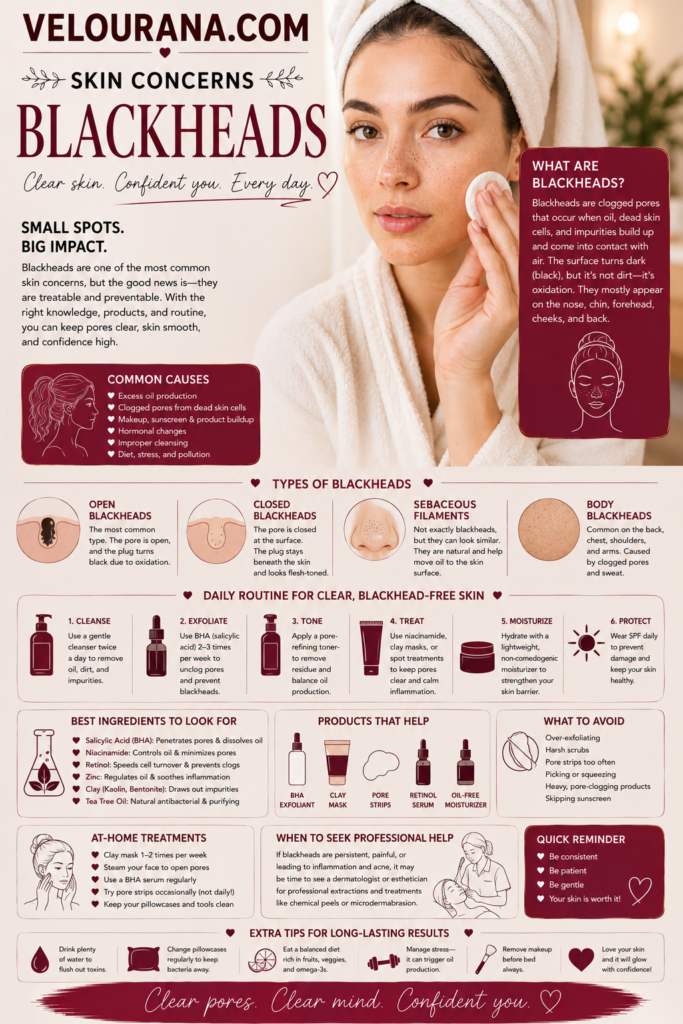
CATEGORY: Blackheads
Blackheads are among the most recognizable skin concerns, yet they are also among the most misunderstood. Their appearance seems straightforward: tiny dark dots concentrated around the nose, chin, forehead, or other oil-prone areas of the face. Because they look as though something dirty has become trapped inside the skin, the instinctive response is often to scrub harder, cleanse more aggressively, squeeze them out, or search for a product capable of stripping the pore completely clean. That interpretation, however, begins with a misconception.
A blackhead is not a miniature pocket of dirt. Dermatologically, it is an open comedo: a follicular opening that has become obstructed by a mixture of sebum and accumulated keratinous material. The visible surface remains exposed to air, and the material at that opening becomes dark. DermNet specifically notes that the black appearance comes from surface pigment rather than dirt, while the American Academy of Dermatology likewise cautions that the dark dots should not be interpreted as evidence of inadequate cleansing.
That distinction changes almost everything about sensible blackhead care. If dirt were the primary problem, stronger cleansing would logically be the solution. If the problem is instead occurring within the follicle—where oil production, shedding skin cells, follicular keratinization and inflammation interact—then successful skincare has to work more intelligently. The objective becomes maintaining clearer follicular openings over time while protecting the surrounding skin barrier.
Blackheads therefore provide a useful lesson in modern skincare. Visible improvement rarely comes from attacking the skin harder. It comes from understanding what the skin is doing, choosing interventions that address the relevant biological process, and giving those interventions enough time to work.
What a Blackhead Actually Is
Every visible blackhead begins inside a pilosebaceous unit, the structure consisting of a hair follicle and its associated sebaceous gland. Sebaceous glands produce sebum, the oily substance that contributes to lubrication of the skin. Meanwhile, cells associated with the follicular lining are continually being produced and shed. Under ordinary circumstances, these materials can move outward without creating an obvious blockage.
Comedones develop when that process becomes disrupted. DermNet describes comedones as arising through increased proliferation or cornification of cells lining the sebaceous duct together with increased sebum production. Debris accumulates and obstructs the sebaceous duct and follicle.
The distinction between a blackhead and a whitehead is largely determined by what happens at the follicular opening. A closed comedo remains covered at the surface and appears as a small skin-coloured or pale bump. An open comedo has a visible opening. Its contents are exposed at the surface, producing the characteristic dark appearance that gives the blackhead its everyday name.
This matters because a blackhead should not be imagined as an empty hole that has somehow been filled from the outside. It is better understood as the visible endpoint of a process developing within the follicle.
It also explains why simply removing the material currently visible inside a pore does not necessarily solve the underlying tendency. Extraction can remove an existing obstruction, but the follicle continues functioning afterward. Sebum production continues. Skin cells continue turning over. If the conditions favouring comedone formation remain, another blockage may eventually develop.
This is why blackhead management is fundamentally different from cleaning a stain. The goal is not merely to remove what can be seen today. It is to influence the environment in which tomorrow's comedones would otherwise form.
Why Blackheads Prefer Certain Parts of the Face
Blackheads rarely distribute themselves evenly across the face. They commonly cluster around the nose and central face, while comedonal acne is also frequently seen on the forehead and chin. DermNet notes that comedones often occur particularly on the forehead and chin.
These patterns are related partly to differences in sebaceous activity. Some regions naturally produce more oil and contain more prominent sebaceous structures than others. A person may therefore have relatively comfortable cheeks while simultaneously experiencing persistent congestion across the nose and forehead.
The pattern can also be influenced by what repeatedly contacts the skin. Rich cosmetics, heavy emollients, hair products reaching the forehead, occlusive sunscreens or other formulations may contribute to congestion in susceptible individuals. DermNet identifies oily cosmetics and certain occlusive products among factors that can aggravate comedonal acne.
Environmental conditions can matter as well. Heat and humidity may change the way the skin feels and how products behave on its surface. Someone whose routine feels perfectly balanced during a cool, dry winter may find the same combination uncomfortably heavy in humid summer weather.
Yet oily skin should not automatically be treated as defective skin. Sebum has physiological functions, and eliminating every trace of oil is neither realistic nor desirable. The more useful objective is balance: reducing conditions that encourage persistent obstruction without turning the face into a dry, irritated surface.
That distinction becomes particularly important because irritated skin can encourage people to enter a damaging cycle. They see oil and blackheads, cleanse aggressively, experience tightness, add heavy moisturization to compensate, then respond to continuing congestion with even stronger exfoliation. A routine intended to simplify the problem becomes increasingly complicated.
Blackhead-prone skin usually benefits more from consistency than escalation.
The Myth of the Dirty Pore
Few skincare misconceptions have been as persistent as the idea that blackheads represent dirt embedded in pores.
The visual resemblance is convincing. A collection of dark points across the nose looks almost exactly like contamination sitting beneath the surface. Yet dermatological descriptions of open comedones explicitly reject that explanation. Their darkness is associated with material at the exposed follicular opening, not ordinary dirt deposited because the face has not been washed properly.
The practical consequence is important. Excessive washing does not address the biological mechanism creating the comedo.
A cleanser can remove sunscreen, cosmetics, environmental residue and excess surface oil. Those are valuable functions. But cleansing cannot simply reach into every follicle and permanently wash away the process of comedone formation.
The American Academy of Dermatology specifically advises against trying to scrub away the dark appearance of blackheads, noting that scrubbing can worsen acne.
This does not mean cleansing is irrelevant. It means cleansing has a defined role rather than an unlimited one.
A well-formulated cleanser should leave the skin prepared for the rest of the routine. It does not need to create a squeaky sensation or leave the face feeling dramatically degreased. That tight feeling sometimes interpreted as proof of cleanliness may simply indicate that the cleansing process has removed more surface lipids than the skin comfortably tolerates.
Once blackheads are understood as follicular lesions rather than dirt, the entire emotional character of treatment can change as well. There is no reason to regard visible blackheads as evidence of poor hygiene. Someone can cleanse carefully and still develop them because comedone formation involves processes occurring within the follicle.
The better question is therefore not, "How can I clean my pores harder?" It is, "How can I help these follicles remain less prone to obstruction?"
Exfoliation and the Difference Between More and Better
Exfoliation has become almost inseparable from discussions about blackheads. The connection makes sense because abnormal accumulation of keratinous material contributes to follicular obstruction. The mistake comes when exfoliation is interpreted as permission to remove as much surface skin as possible.
For blackhead-prone skin, exfoliation should have a purpose rather than becoming a competition in intensity.
Salicylic acid is particularly prominent in acne skincare because of its ability to help unclog pores and exfoliate the skin. The American Academy of Dermatology identifies salicylic acid as an ingredient used to open clogged pores, and its guidance for adult acne specifically describes it as particularly useful for whiteheads and blackheads.
That does not mean every blackhead routine requires multiple salicylic-acid products simultaneously. A salicylic cleanser, toner, serum, exfoliating mask and spot treatment layered together may deliver considerably more irritation than benefit.
The same principle applies to other exfoliating acids. Glycolic acid is also listed by DermNet among topical agents used for comedonal acne. Yet the existence of several potentially useful ingredients does not mean they should all be introduced at once.
The skin barrier places a practical limit on how aggressively any routine can operate. When exfoliation exceeds tolerance, the face may become red, flaky, tight or unusually sensitive. Applying additional active products to already irritated skin can intensify the problem.
A sophisticated routine therefore separates effectiveness from intensity. The strongest routine is not necessarily the one containing the greatest number of acids or the highest concentrations. It is the routine a person's skin can tolerate consistently enough for the relevant ingredients to influence comedone formation over time.
This is also why introducing products gradually can be valuable. When five new treatments begin simultaneously, it becomes difficult to identify which one is helping and which one is responsible if irritation develops.
Skincare becomes easier to evaluate when each product has a clear reason for being present.
Retinoids and the Long-Term Management of Congestion
If blackheads repeatedly return after being removed, prevention becomes at least as important as extraction. This is where topical retinoids occupy an important place in acne treatment.
The American Academy of Dermatology explains that topical retinoids help clear pores and can treat blackheads and whiteheads. It also notes their role in maintenance after acne has been brought under control.
Rather than approaching each blackhead as an isolated object requiring individual removal, retinoid therapy addresses the broader tendency toward follicular blockage. That makes it conceptually different from squeezing, pore strips or occasional intensive treatments.
Retinoids can, however, cause irritation, particularly during introduction. The AAD notes that dermatologists may modify the amount or frequency and may recommend moisturizer to help reduce irritation in appropriate circumstances. This is another reminder that effective skincare is not defined by enduring unnecessary discomfort.
It is also important to distinguish cosmetic retinol products from acne medications and prescription retinoids. Products belonging broadly to the retinoid family vary considerably in formulation, potency, evidence and regulatory status. Consumers should not assume that every product carrying retinoid-related language is interchangeable.
Pregnancy adds another important consideration. The AAD advises people who are pregnant or trying to become pregnant to consult a dermatologist before treating acne themselves because some acne treatments are not appropriate during pregnancy.
The larger lesson extends beyond any individual ingredient. Blackheads are a condition in which patience often produces more meaningful results than dramatic intervention. A treatment capable of reducing the formation of new comedones over weeks and months may be more valuable than something that creates an impressive change for twenty-four hours.
Why Squeezing Feels Successful—and Why It Can Become a Problem
Few skincare actions offer the immediate satisfaction of extracting a blackhead. Pressure is applied, the visible material emerges, and the pore appears clearer within seconds. Compared with a topical treatment that requires weeks of consistent use, extraction can feel overwhelmingly more effective.
The difficulty is that immediate visibility and long-term effectiveness are not the same thing.
Physical extraction removes the contents of an existing comedo. It does not necessarily alter the conditions that allowed that comedo to form. More importantly, uncontrolled squeezing introduces mechanical trauma. DermNet lists follicular rupture caused by injury, including squeezing, among factors associated with comedonal acne, while the AAD warns that picking, popping or squeezing acne can increase the risk of scarring.
The problem becomes greater when a person repeatedly presses the same area, uses fingernails, attempts to extract lesions that are not ready to release, or continues until the skin becomes visibly inflamed.
Professional comedone extraction is different from casual squeezing at home. The AAD identifies comedo extraction as a procedure a dermatologist may use for stubborn blackheads and whiteheads. The distinction is not simply the presence of a metal tool. Professional evaluation can determine what type of lesion is actually present and whether extraction is appropriate.
That point deserves attention because not every dark dot on the face is necessarily an ordinary blackhead. Enlarged pores and other follicular structures can resemble comedones, and DermNet lists several conditions in which comedo-like lesions may appear.
Repeatedly attacking anything dark with an extraction tool can therefore become both ineffective and unnecessarily traumatic.
A better strategy is to regard extraction, when appropriate, as one possible intervention for an existing lesion—not as the foundation of blackhead prevention.
The Skin Barrier Is Part of the Blackhead Strategy
Blackhead routines are often designed entirely around removal: remove oil, remove dead cells, remove plugs, remove shine. What gets less attention is preservation.
The outer skin barrier helps regulate water loss and protects against environmental exposure. A routine that repeatedly leaves the skin raw, stinging or peeling may undermine comfort and make consistent treatment difficult.
This is why moisturization still belongs in many routines for oily or blackhead-prone skin.
The word "moisturizer" is sometimes associated with heavy creams, but formulations vary enormously. Lightweight lotions, gels and fluid emulsions can support hydration without producing the dense feel some oily skins dislike. DermNet advises people with comedonal acne to choose oil-free cosmetics, reflecting the importance of considering formulation when congestion is a concern.
The ideal moisturizer is therefore not necessarily the lightest product imaginable. It is one that provides sufficient comfort for the person's skin without contributing to an unwanted feeling of occlusion.
Barrier awareness also changes the way active ingredients should be combined. If salicylic acid has already produced dryness, adding another exfoliant simply because blackheads remain visible may not accelerate improvement. Sometimes the rational response is to reduce irritation and allow the skin to regain equilibrium.
This can feel counterintuitive in a beauty culture that frequently associates stronger sensations with stronger results. Tingling, burning and peeling can seem like proof that a treatment is "working." In reality, irritation is not a required measure of effectiveness.
The best blackhead routine is not the one the skin survives. It is the one the skin can live with.
Pore Strips, Masks and the Appeal of Instant Results
Blackhead skincare has generated an entire category of visually satisfying products. Pore strips display extracted material after removal. Clay masks temporarily reduce surface oil. Peeling products create an immediate sensation of renewal. Facial tools promise deep cleaning.
These experiences are compelling because they produce something visible.
Yet blackheads are persistent precisely because their biology continues after the cosmetic moment has passed. Removing superficial material does not switch off sebaceous activity or permanently change the way cells behave inside the follicle.
This does not make every instant-result product useless. A clay-based mask, for example, may leave oily skin feeling temporarily fresher. A properly used cosmetic treatment may improve the appearance or feel of the skin. The important question is what claim is being made for that improvement.
Temporary cosmetic refinement should not be confused with permanent pore transformation.
Pores are anatomical structures. Their appearance can change depending on oiliness, congestion, hydration, lighting and surrounding skin texture, but skincare cannot simply erase every follicular opening from the face.
This distinction protects consumers from a frustrating cycle. If the expectation is permanent pore disappearance, normal skin will continually appear to fail. If the expectation is better control of congestion and a smoother overall appearance, progress becomes more realistic.
Blackhead management works best when judged across weeks rather than immediately after a mask is removed.
Building a Routine Around Function Rather Than Product Count
A blackhead-focused skincare routine does not need to be elaborate. What matters is whether each stage performs a useful function.
Cleansing removes accumulated surface material without unnecessarily stripping the skin. A comedolytic or pore-clearing treatment addresses the tendency toward obstruction. Moisturization supports comfort and tolerance. Daytime sun protection protects the skin from ultraviolet exposure and becomes especially important when using treatments that may increase sensitivity or when acne marks are also a concern.
Within that framework, individual products can vary substantially.
Someone with mild congestion might rely primarily on a salicylic-acid product and a simple supporting routine. Another person with persistent comedonal acne may benefit from a retinoid recommended by a clinician. Someone experiencing a combination of blackheads and inflammatory acne may require a broader strategy because different types of acne lesions can occur simultaneously. DermNet notes that acne commonly includes both non-inflammatory comedones and inflammatory lesions such as papules and pustules.
This is why copying another person's routine product for product is often less useful than understanding its logic.
Skin type, sensitivity, climate, other products, medications and the severity of acne all influence what is appropriate. The person using one active ingredient consistently and tolerating it well may ultimately achieve better results than someone cycling through an impressive collection of treatments.
Time must also be built into expectations. The AAD advises giving acne treatment approximately six to eight weeks to work before deciding that persistent blackheads and whiteheads require further evaluation, while DermNet notes that worthwhile improvement in comedonal acne can take weeks to months.
That timeline can feel slow when a blackhead is visible every morning in the mirror. Biologically, however, skincare is influencing ongoing processes rather than repainting a surface.
Consistency is therefore part of the treatment itself.
When Blackheads Deserve Professional Attention
Blackheads are frequently mild enough to be managed with sensible skincare, but persistent congestion should not always be treated as a purely cosmetic inconvenience.
A dermatologist can help when over-the-counter approaches have been used consistently without meaningful improvement, when the diagnosis is uncertain, or when blackheads occur alongside significant inflammatory acne. Large, painful lesions, scarring or extensive breakouts deserve professional assessment rather than repeated experimentation with increasingly aggressive products.
The AAD advises dermatological care for acne involving large, painful, deep lesions or acne that leaves scars. It also suggests professional evaluation when stubborn blackheads and whiteheads fail to improve after an adequate period of treatment.
Sudden or unusual changes can also justify evaluation. Acne-like eruptions can have multiple causes, and not every follicular bump should automatically be diagnosed at home as an ordinary blackhead.
Professional care does not necessarily mean dramatic treatment. Sometimes its greatest value is diagnostic clarity. Knowing whether the problem is predominantly comedonal acne, inflammatory acne, irritation caused by products, or another condition entirely can prevent months of unnecessary experimentation.
It can also help establish a treatment plan that balances effectiveness with tolerability. This is particularly useful for people whose skin becomes irritated whenever they attempt to use common acne ingredients.
The point at which skincare becomes frustrating enough to provoke constant squeezing, scrubbing and product switching may itself be a reasonable point to seek expert guidance.
Clearer Skin Begins With a Different Definition of Success
Blackheads encourage an unusually close relationship with the mirror. Because they are small, people often inspect them from only a few centimetres away, under bright bathroom lighting or magnifying mirrors that reveal details nobody else would normally see.
This can distort expectations.
Human skin contains follicles, texture, tiny variations in colour and visible pores. Successful skincare does not transform it into an airbrushed surface. The aim is healthier-looking, more comfortable skin with congestion managed to a level that feels acceptable—not the elimination of every visible pore.
Once that expectation becomes realistic, blackhead care becomes considerably calmer.
There is less reason to squeeze every dot immediately. Less reason to interpret oil as uncleanliness. Less reason to exfoliate until the skin feels polished. Less temptation to replace a routine after four days because the nose still contains visible pores.
Instead, attention shifts toward the processes that can actually be influenced: maintaining gentle cleansing, selecting evidence-supported ingredients, avoiding unnecessary occlusion where it causes problems, protecting the barrier, allowing treatments sufficient time and seeking professional help when acne is persistent or severe.
Blackheads may be tiny, but they reveal an important principle about skincare as a whole. The visible problem at the surface is not always the place where the real process begins.
An open comedo begins within a follicle. Its dark colour is not proof of dirt. Its removal is not necessarily its prevention. And the most aggressive response is not necessarily the most effective one.
Understanding those distinctions turns blackhead care from a repeated battle against individual pores into a long-term strategy for supporting clearer, more balanced skin.
That is ultimately the more sustainable approach: not trying to force the skin into impossible perfection, but understanding its biology well enough to work with it.
The End Velourana
 Discover More From Our Family of Websites
 ZodiacBearing (Astrology, Tarot, Numerology, Angel Numbers & Spiritual Guidance)
 Velourana (Beauty, Makeup, Hair Care, Skincare & Beauty Tips)
 HavenBearing (Home, Living, Organization, Décor & Everyday Inspiration)
 PawBearing (Pet Care, Dog Breeds, Animal Health, Training & Pet Products)
 PsyCatherine (Notes From the Journal of a Psychologist on Real Life)