CATEGORY: Curling
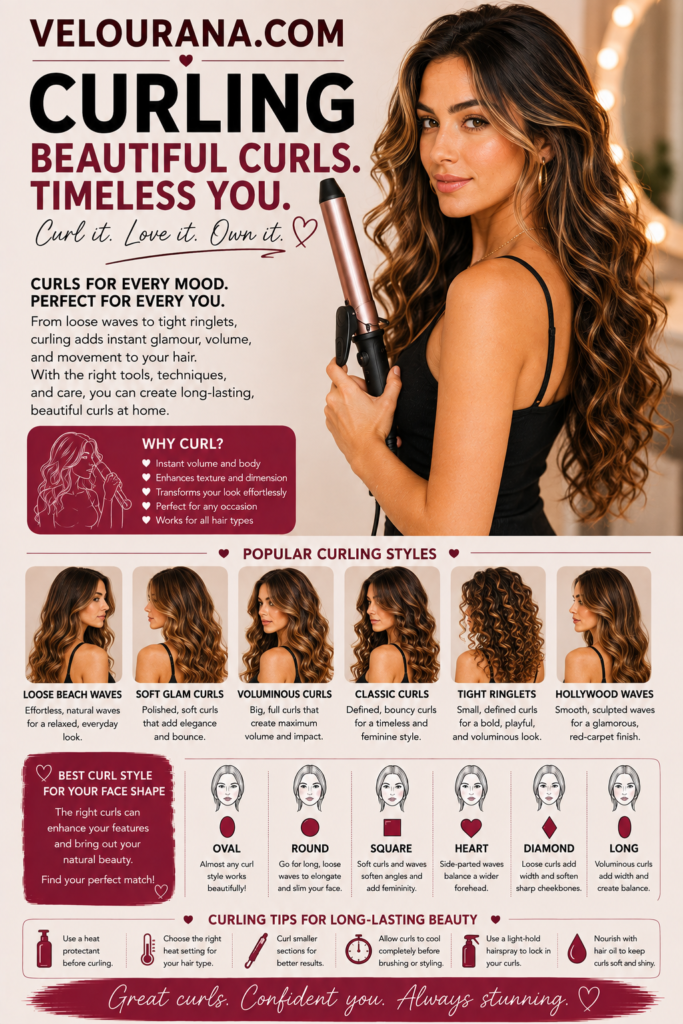
Big, bouncy curls have a particular kind of presence. They create fullness without necessarily looking heavy, give long hair movement that can be seen from every angle, and transform layers into a much more visible part of the haircut. Unlike tight curls, which draw attention to individual spirals, a bouncy curled style is usually appreciated as a complete shape. The crown has lift, the lengths have movement, and the ends seem to spring naturally into place.
The effect can look glamorous, but it does not have to feel formal. Large curls can be brushed into a polished evening finish, loosened into an airy everyday style or allowed to relax gradually into broad waves. What defines the look is not simply the diameter of each curl. It is the relationship between root volume, curvature through the lengths, the direction of the face-framing pieces and the way the curls are blended once they have cooled.
This is also why using a large curling tool does not automatically produce beautiful bouncy hair. If the roots remain completely flat, large curls through the ends can make the hairstyle appear bottom-heavy. If every section is curled identically, the result can become overly uniform. If the curls are brushed before they have settled, much of the shape can disappear before the hairstyle is even finished.
Successful bouncy curls are constructed as a silhouette rather than as a collection of spirals. The hair needs enough structure to hold movement but enough softness to remain fluid. It should rise naturally from the crown, move around the face and continue through the lengths without becoming stiff.
That balance begins before the first curl is made.
Building the Foundation for Full, Moving Curls
Large curls reveal the condition and preparation of the hair differently from smaller, more textured styles. Because the sections eventually blend into broad areas of movement, tangling, uneven dryness and inconsistent preparation can become particularly noticeable.
The hair should therefore begin dry and manageable when conventional curling irons or wands are being used. Detangling before sectioning prevents the curling stage from becoming an exercise in repeatedly stopping to work through knots. If heat styling is involved, an appropriate heat-protective product can be used according to its directions.
Preparation should support movement rather than overwhelm it.
This is especially important with fine hair. A heavily coated foundation can reduce the very bounce the curling is intended to create. Thick or coarse-feeling hair may respond differently, but even then, more product does not automatically mean more control. The finished style needs to move, so the preparation should leave enough flexibility for the curls to fall naturally.
The condition of the roots also deserves attention. Big curls through the lower lengths can create considerable volume, but that does not guarantee a balanced silhouette. If the crown remains completely flat while the lower hair expands outward, the hairstyle can look triangular or disproportionately heavy toward the bottom.
Root lift and curl therefore need to be considered together.
For hair that naturally has volume at the scalp, very little additional work may be necessary. Hair that lies close to the head can benefit from being blow-dried with some elevation before curling begins. The objective is not creating extreme height. A small amount of space at the crown can be enough to connect the upper shape with the fullness that will later appear through the lengths.
The part also influences the final result. A precise center part produces a different distribution of volume from a sweeping side part. A softer part can allow the roots to move more freely, while a strong fixed part creates a more controlled silhouette. This choice is worth making before curling rather than attempting to reorganize the entire crown after the curls are finished.
Once the foundation is ready, sectioning becomes the practical structure behind the style.
Large curls do not necessarily mean enormous sections of hair. A curling tool can only shape what it can control effectively. If a section is too thick, the outside may receive most of the heat while the interior responds less consistently. The resulting curl can appear strong at first and then fall unevenly.
Dense hair generally requires more divisions than fine hair. The exact number is less important than whether each section can be styled cleanly without repeated attempts.
The lower hair can be separated from the upper layers, allowing the style to develop progressively. This also prevents finished curls from becoming mixed repeatedly with unstyled sections.
There is another advantage to working systematically: it becomes easier to see the shape emerging.
If the lower sections already have substantial volume, the upper hair may not need to be curled as strongly. If the crown appears too smooth, the top layers can be given more elevation. Styling becomes responsive rather than mechanical.
Tool diameter strongly influences the character of a bouncy curl, but it should always be considered in relation to hair length. A large barrel on very long hair can create broad, sweeping movement because the section can wrap around it several times. The same barrel on shorter hair may produce little more than a bend.
Medium hair often responds beautifully to moderately large barrels because there is enough length to create a visible curve without excessive weight stretching it afterward. Shorter hair may need a smaller diameter to achieve what visually reads as a large curl relative to the haircut.
This relationship matters more than choosing a tool simply because it is marketed for big curls.
The curl should look large in proportion to the hair.
Temperature also needs to remain appropriate to the hair and the particular tool. More heat is not a substitute for sensible sectioning or controlled technique. If a section repeatedly fails to form because too much hair is being styled at once, increasing the temperature is not necessarily the best answer. Reducing the section can provide more consistent shaping without simply increasing exposure.
The same principle applies to repeated curling. A section that has already formed properly does not need to be heated again merely because another part of the hairstyle requires correction.
Efficient curling means allowing each section to do its job once whenever possible.
Direction then determines how those sections will eventually interact.
For a classic full-bodied style, the front pieces often look particularly flattering when directed away from the face. This opens the hairstyle and allows face-framing layers to sweep backward into the longer hair. The movement can continue through the sides, creating a broad, flowing shape.
The back does not always need identical direction. Depending on the desired finish, sections can alternate slightly to preserve separation, or they can follow a more coordinated pattern so that they eventually blend into large, polished waves.
The important point is that direction should be chosen before the finishing stage.
Brushing cannot completely redesign a curl pattern that was created without considering how the sections would connect.
Creating Bounce Through the Lengths Without Making the Hair Look Rigid
Big curls need structure at first because they will almost always relax.
This is particularly true on long hair. The weight of the lengths begins acting on the curl as soon as it is released. A section that appears stronger than the final desired result may settle into exactly the right amount of movement once it has cooled, blended with neighboring sections and been worn for a while.
Judging a curl immediately can therefore be misleading.
The temptation to pull on a freshly created curl because it looks too strong can remove more movement than intended. It is usually better to allow the entire hairstyle to develop before deciding how much softening is necessary.
Cooling is central to that process.
When a curl leaves a heated tool, it remains warm and relatively easy to reshape. Allowing it to cool in its curled form gives the hairstyle a stronger starting structure. For particularly full or polished styles, a curl can be supported temporarily in its coiled shape while cooling. Once released, it may appear more defined than the eventual hairstyle requires, but that definition provides room for controlled blending later.
The aim is not to preserve a head of perfect ringlets indefinitely.
It is to create enough structure that the final softening does not erase the style.
This distinction is what allows big curls to remain bouncy rather than simply becoming slightly bent hair.
The position at which the curl begins also changes the overall fullness. Starting relatively high creates more movement through the upper lengths and can make the hairstyle appear larger. Beginning farther down leaves the upper hair smoother and concentrates bounce toward the bottom.
Neither approach is inherently superior.
Long layered hair often benefits from movement beginning at different heights because the haircut itself contains different lengths. Shorter upper layers can develop curvature higher in the hairstyle, while the longest sections remain smoother for longer before moving through the ends.
This creates a cascading effect.
The layers do not simply sit on top of one another. They occupy different positions within the curl pattern, producing depth.
One-length hair creates a more unified shape. Because the perimeter carries greater visual weight, large curls can produce a substantial lower silhouette. Root and crown volume become especially useful here because they prevent all of the movement from appearing concentrated at the bottom.
The ends also influence whether bouncy curls look polished, romantic or relaxed.
Fully curved ends create a complete, rounded movement. The curl appears continuous from its starting point through the tip. This can produce the classic soft, glamorous appearance associated with large curls.
Leaving the ends somewhat looser changes the character. The movement becomes more contemporary and less formal. The section curves through the middle and then releases rather than finishing as a complete spiral.
For a truly bouncy style, however, the ends usually need enough direction to participate in the movement. Completely rigid ends beneath large rounded curls can interrupt the flow unless that contrast is deliberate.
The ideal amount of curvature depends on the haircut.
Long layers can tolerate considerable variation. A blunt medium cut may look more coherent when the ends share a similar general direction. Shorter bobs often require even more attention because the perimeter is such a visible part of the hairstyle.
Face-framing sections should again be treated independently.
A shorter layer around the cheekbone does not need the same curl as a section reaching well below the shoulders. Giving both exactly the same amount of wrapping can produce completely different visual results.
The shorter piece may become much stronger.
Instead, the goal should be creating comparable movement rather than identical technique.
Curtain bangs are a good example. They usually need a broad sweep, not a compact curl. Their job is to open around the center and transition into the longer layers. A large, gentle curve supports that purpose and connects naturally with a voluminous curled style.
The crown requires another kind of judgment.
Big curls can become less sophisticated when every upper section is curled aggressively from close to the scalp. The result may create unnecessary roundness rather than elegant lift.
Volume at the crown can come partly from root direction rather than curl.
The roots rise, the upper lengths remain relatively controlled, and the curve develops slightly farther down. This creates height without making the entire top of the head appear curled.
Fine hair often benefits from this distinction. It gains visible fullness while retaining a light appearance.
Dense hair may need even more restraint. Thick hair already contains substantial physical volume, and large curls increase the space occupied by the lengths. The objective may therefore be shaping that fullness rather than maximizing it.
Lower internal sections can sometimes remain softer while the surface layers carry more obvious movement. This keeps the hairstyle from expanding equally in every direction.
Big hair and beautifully voluminous hair are not necessarily the same thing.
The latter has architecture.
How Different Hair Lengths and Textures Change the Character of Big Curls
Long hair is perhaps the most familiar setting for large curls because the length allows movement to unfold gradually. The curl can begin beneath the roots, travel through several broad curves and finish with a soft end.
The resulting motion becomes particularly visible when the hair moves.
Yet long hair also places the greatest demand on the curl because of weight. Very long lengths may relax substantially even when the initial styling is strong.
Rather than fighting this completely, the technique can anticipate it.
A slightly stronger starting curl can be allowed to settle naturally. The finished hairstyle then becomes softer without losing all of its structure.
Layers help because they reduce some of the uniform weight. Shorter sections around the crown and face can retain more bounce, creating movement above the longest hair.
The result is not one continuous mass of curls but a sequence of overlapping shapes.
Medium hair often holds this kind of movement more readily. It has enough length for visible curves but less weight dragging them downward. A shoulder-length layered haircut can become dramatically fuller once the ends and middle lengths are curled.
The style may even require less initial curl because the movement does not relax as quickly.
This is why techniques cannot be copied blindly from very long hair to medium hair.
The same tool, temperature and wrapping pattern can produce a stronger-looking result simply because the physical proportions are different.
Short hair offers another interpretation altogether.
A bob does not need multiple spirals to look bouncy. A rounded bend through the lengths, lift at the crown and controlled movement at the perimeter may create the entire effect.
Longer bobs can support more obvious curls, particularly through the front and upper sections. Short layered cuts can use curved pieces to create texture and fullness without attempting to form traditional long ringlets.
The style should always respect scale.
Fine hair often responds visually to large curls even when the individual curl is relatively soft. The bends separate the strands and create shadows and space, making the hair appear fuller.
The danger lies in trying too hard to preserve that fullness with excessive product or repeated styling. If the hair becomes weighed down, the volume can disappear despite the strength of the original curl.
A lighter finish allows the movement itself to provide much of the apparent density.
Straight fine hair can be particularly striking because the contrast is substantial. Hair that normally hangs close to the head suddenly develops movement through several dimensions.
The crown can gain subtle lift, the layers become more visible and the ends occupy more space.
Thick hair already begins with greater density, so large curls create a different effect. Rather than simply making the hair look fuller, they can organize its volume into recognizable shapes.
Broad curls can prevent dense hair from appearing like one heavy mass. The sections separate into large areas of movement while still retaining enough weight to look polished.
Sectioning is especially important because hidden interior hair needs to be styled consistently if the overall shape is expected to hold.
Naturally wavy hair may require less work than either straight or very curly hair. Existing movement can be incorporated into the style, with a curling tool used primarily to create consistency in the most visible sections.
A natural wave that already has the right scale does not need to be erased and rebuilt.
The front can be refined.
The upper layers can gain a little more bounce.
Straighter pieces can be brought into the general pattern.
This selective approach preserves natural variation, which can make the final style look richer.
Curly hair offers two possibilities. It can be stretched first and then reshaped into broader curls, producing a large, voluminous blowout-style finish. Alternatively, when the natural curl pattern is already being worn, selected sections can be refined without transforming the entire texture.
In the first case, the objective is deliberately changing the scale of the curl. In the second, it is integration.
Either approach benefits from recognizing that natural texture contributes to the final volume.
The hairstyle does not need to be flattened completely before bounce can be created.
Turning Fresh Curls Into a Finished Hairstyle
The most important visual transformation often happens after the curling tool has been put away.
Freshly curled sections can look too individual. Each piece may have a clear spiral, and the hairstyle can resemble the construction process rather than the intended finish.
That is normal.
The curls need to cool before the final shape is established.
Once they have settled, the method used to blend them determines the personality of the hairstyle.
Finger separation preserves more individual definition. The curls remain recognizable but become softer and less rigid. This works well when the desired finish is voluminous and relaxed.
A wide-tooth comb can loosen the pattern more evenly. It allows neighboring sections to interact while preserving substantial movement.
Brushing can create the most polished transformation. Strong curls begin merging into broad waves, and the hairstyle starts behaving as one flowing shape rather than many individual pieces.
For glamorous large curls, this blending stage can be essential.
The fear that brushing will automatically destroy the curl comes largely from timing and starting structure. If the curls were very loose to begin with or are brushed while still warm, much of the movement may disappear. If they were given enough structure and allowed to cool, brushing can reveal the intended shape rather than remove it.
The process should still be gradual.
A few passes may be enough.
There is no advantage in continuing until the hair has lost the very movement that was created.
The front should be blended with particular care. Face-framing pieces often have a deliberately chosen direction, and aggressive brushing can pull them back into the rest of the hair. They can instead be arranged separately so their outward sweep remains visible.
The crown can also be adjusted independently.
If the lengths are full but the top appears flat, gentle root movement can restore balance without disturbing the curls below. If the crown already has sufficient lift, it can be left largely alone.
Finishing products, when used, should support this mobility.
Large curls are visually attractive partly because they move. When the head turns, the sections should shift and return. The ends should swing. Layers should separate and settle again.
A finish that makes the hair excessively rigid undermines that quality.
The objective is not to preserve the exact millimeter position of every curl.
It is to preserve the overall architecture while allowing the hair to behave like hair.
Letting Big Curls Evolve Without Losing Their Beauty
Large curls rarely remain exactly as they appeared immediately after styling, and they do not need to.
In fact, their evolution can be one of their most attractive qualities.
A polished first-day curl may become a broad second-day wave. The strongest sections soften. Layers begin blending more naturally. The hairstyle can develop a relaxed quality that would have been difficult to manufacture deliberately at the beginning.
The important question is whether the overall shape remains balanced.
If the crown still has some lift, the face-framing pieces retain direction and the lengths continue to move, a softer curl can remain extremely attractive.
Refreshing should therefore be selective.
Sleeping may flatten one side more than the other. The front sections may lose movement because they are touched more frequently. A few upper layers may straighten while the lower hair remains curled.
Only those areas need attention.
Re-curling the entire head every time a few pieces relax can make the hairstyle increasingly uniform and exposes already successful sections to unnecessary additional heat.
Selective refreshing also preserves some of the natural variation that develops over time.
A newly curled front piece can sit beside a softer second-day wave. The difference does not necessarily look wrong. It can create the kind of layered texture that makes the style feel less manufactured.
Humidity and natural texture will influence this evolution as well. Naturally straight hair may gradually lose curvature. Wavy hair may develop its own pattern within the styled curls. Curly hair that has been stretched into broader movement may begin returning toward its original texture.
The hairstyle is temporary.
That does not make it unsuccessful.
A well-created curled style should have enough underlying structure to remain attractive as it changes rather than depending on every section remaining frozen in its original form.
This is also why beginning with a balanced silhouette matters so much. When the crown, front, lengths and ends work together, the hairstyle can tolerate considerable relaxation without losing its identity.
The Real Luxury of Big Curls Is Movement
The most compelling big curls are rarely the ones with the greatest number of perfect spirals.
They are the ones that make the hair appear abundant, fluid and alive.
The crown has enough lift to support the volume below. The upper lengths transition naturally into the curls. Layers appear at different heights and move independently. Face-framing sections open around the features rather than becoming lost among the rest of the hair. The ends participate in the shape without looking rigid.
Nothing feels isolated.
This is why big, bouncy curling is ultimately an exercise in proportion.
Long hair needs enough initial structure to withstand its own weight. Medium hair often requires less effort because its curves remain naturally buoyant. Short hair needs movement scaled to the haircut rather than an imitation of long spirals.
Fine hair benefits from the space created between strands. Dense hair benefits from having its existing volume organized into broad shapes. Straight hair gains dimension, while wavy and curly textures can contribute some of their natural movement instead of always being completely reconstructed.
The curling tool is only one part of that process.
Preparation establishes the foundation.
Sectioning creates consistency.
Direction determines flow.
Cooling preserves enough structure for the curls to be softened later.
Blending turns separate sections into one hairstyle.
Then the hair is allowed to move.
That final freedom is essential.
Big curls should not feel like a sculpture that must remain untouched. They should shift when the wearer walks, soften naturally around the shoulders and gradually relax without immediately losing their beauty.
A perfectly preserved ringlet may demonstrate technique, but a broad curl that moves naturally can create something more sophisticated.
It makes the hairstyle look effortless even when its construction was deliberate.
And when volume, softness and movement reach the right balance, big curls stop looking like individual pieces that were created one after another. They become a complete, flowing shape—full enough to make an impact, controlled enough to remain polished and soft enough to look entirely at home in the hair.
The End
Velourana.
 Discover More From Our Family of Websites
 ZodiacBearing (Astrology, Tarot, Numerology, Angel Numbers & Spiritual Guidance)
 Velourana (Beauty, Makeup, Hair Care, Skincare & Beauty Tips)
 HavenBearing (Home, Living, Organization, Décor & Everyday Inspiration)
 PawBearing (Pet Care, Dog Breeds, Animal Health, Training & Pet Products)
 PsyCatherine (Notes From the Journal of a Psychologist on Real Life)