
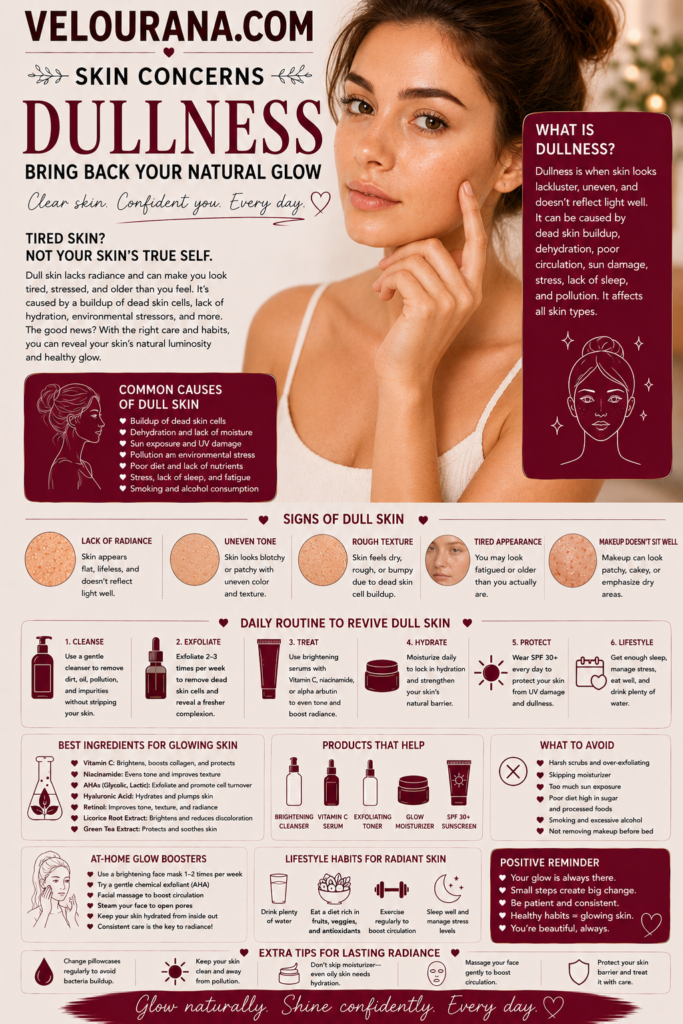
CATEGORY: Dullness
There comes a point in the evolution of the complexion when the usual language of skincare begins to feel insufficient. The skin is not necessarily dry enough to call it severely dehydrated. It may not be visibly damaged. There may be no dramatic pigmentation problem, inflammatory condition, or sudden change demanding medical attention. Yet something about the face appears quieter than it once did. The complexion seems less clear, less responsive to light, less alive.
This is often the moment when people begin searching for glow.
Glow, however, is an imprecise objective. It can mean shine, hydration, evenness, smoothness, translucency, reduced pigmentation, or simply the appearance of having slept well. Beauty marketing takes advantage of this ambiguity by attaching the word to almost anything capable of changing the surface of the skin. Oils promise glow. Acids promise glow. Vitamin C promises glow. Masks promise glow. Highlighters manufacture it immediately.
For mature skin, a more useful goal is clarity.
Clarity does not mean perfectly uniform colour or poreless texture. It describes a complexion in which the different elements of the surface work together rather than competing for attention. Dryness does not interrupt the cheeks. Flaking does not catch around the mouth. Pigmentation does not dominate the entire impression of the face. Redness is not being continually provoked by an overactive routine. Light moves across the skin with enough continuity that the complexion appears dimensional rather than flat.
This kind of clarity cannot usually be created by one product.
It develops through alignment.
The skin must be cleansed without being stripped, moisturised without being overwhelmed, renewed without being chronically irritated, and protected from environmental damage while corrective treatments are given enough time to work. Makeup, if used, should support the surface rather than fight against it. Expectations must also evolve because mature luminosity is not identical to youthful luminosity.
The objective is not to rewind the face.
It is to help the skin express vitality within the biology it has now.
Dullness Is Often a Loss of Visual Coherence
When someone says their skin looks dull, the immediate assumption is that the complexion has become darker or less reflective.
Sometimes that is true.
Often the deeper problem is inconsistency.
One area is dry.
Another is oily.
Pigmentation is stronger across the upper cheeks.
The forehead reflects light differently from the jaw.
The skin beneath the eyes appears shadowed.
Fine lines introduce additional texture.
A few post-blemish marks remain.
None of these characteristics alone necessarily creates a dull complexion. Together, however, they interrupt visual coherence.
The eye perceives the whole face before it analyses individual imperfections.
A complexion with variation but good hydration and relatively calm texture can appear vibrant. Another complexion with similar colour can appear tired because roughness, dryness and uneven pigment break the surface into competing zones.
This is why simply making skin shinier rarely restores true luminosity.
A glossy oil can increase reflectivity while leaving every source of unevenness untouched.
The face becomes shinier without becoming clearer.
Mature skincare becomes more effective when it stops treating dullness as a missing substance called glow and begins treating the conditions that interfere with visual harmony.
Ageing Changes the Surface Gradually Enough That We Often Miss It
One of the difficulties with skin ageing is that the person experiencing it sees the face every day.
Gradual change is therefore difficult to notice.
There is rarely a morning when the skin suddenly announces that renewal has slowed, lipid composition has shifted, or decades of ultraviolet exposure have finally become visible. Instead, small alterations accumulate until an old photograph creates the contrast.
The complexion once looked more uniform.
Foundation once required less preparation.
A moisturiser that used to be sufficient no longer lasts through the day.
The forehead still behaves almost as it always did, yet the cheeks have become drier.
A routine built over years begins fitting the skin less precisely.
This is not evidence that the skin has suddenly deteriorated.
It reflects the natural mismatch that develops when a changing biological system is treated with an unchanging routine.
The answer is not necessarily to replace everything.
It is to reassess assumptions.
Does the cleanser still leave the skin comfortable?
Does the moisturiser still provide enough support?
Is exfoliation being performed because the skin needs it or because the habit has continued unchanged?
Has sunscreen become a daily practice?
Are multiple active ingredients solving distinct problems, or have they accumulated without a clear purpose?
Mature skincare improves when habits are examined rather than merely repeated.
The Idea of Cell Turnover Is Frequently Oversimplified
“Speeding up cell turnover” has become one of the most common explanations for brightening ageing skin.
The concept contains truth but is often reduced to a misleading slogan.
The epidermis continually renews itself. Cells form in deeper layers, move upward, undergo differentiation and eventually become part of the outer protective surface before being shed.
With age, aspects of this process change.
That does not mean the skin contains a useless blanket of old cells that should simply be stripped away as rapidly as possible.
The outer cells are part of the barrier.
They contribute to the organised surface required for water retention and protection.
Successful renewal therefore involves both removal and replacement.
If exfoliation accelerates removal faster than the surface can comfortably maintain its organisation, the complexion may become irritated and dehydrated.
The skin might temporarily feel very smooth.
A week later it may look worse.
This distinction explains why strong resurfacing can produce immediate satisfaction without necessarily creating long-term radiance.
Smoothness obtained through controlled treatment can be beneficial.
Smoothness obtained by repeatedly pushing the skin beyond its tolerance becomes expensive biologically, even when the product itself is inexpensive.
There Is No Universal Exfoliation Schedule for Mature Skin
Beauty routines often become rules.
Exfoliate twice weekly.
Use retinol every night.
Apply vitamin C every morning.
Perform a peel every Sunday.
These schedules are convenient because they remove uncertainty.
Skin is less cooperative.
Tolerance varies enormously.
A person with resilient, oilier mature skin may comfortably use an exfoliating treatment more frequently than someone with dry, reactive skin. Climate changes tolerance. Retinoid use changes tolerance. Hormonal changes can alter tolerance. The strength and formulation of the exfoliant matter.
Even two products containing the same percentage of an acid may behave differently because formulation affects delivery and irritation.
This makes rigid schedules less useful than observation.
Appropriate exfoliation should improve texture while preserving comfort.
If the skin remains calm, hydrated and smooth, the routine may be well balanced.
If persistent flaking, burning or redness develops, the schedule is no longer justified simply because a label or article recommended it.
Mature skin rewards adaptation more than obedience.
Hydration Is the Fastest Route to Better-Looking Texture
Many of the changes associated with dullness require patience.
Pigmentation can take time to improve.
Retinoids work gradually.
Sun protection delivers much of its value through accumulated prevention.
Hydration is different.
Its optical effects can appear quickly.
When the outer layers contain more water, they become more flexible. Fine dehydration lines soften visually. Small flakes lie flatter. Makeup spreads more evenly. Light reflects from a smoother surface.
This does not mean moisturiser has reversed ageing.
It means the complexion is presenting itself under better physical conditions.
The distinction matters because people often undervalue results that are “only hydration.”
If the goal is to make skin look healthier, hydration is not merely cosmetic decoration.
It is fundamental to the appearance of the surface.
The challenge is maintaining it.
A serum that leaves the skin plump for ten minutes but dry by lunchtime is not necessarily solving the problem.
A mature routine should aim for sustained comfort.
That usually requires thinking beyond one humectant and considering the entire moisturising environment.
Humectants, Emollients and Occlusives Solve Different Parts of the Problem
Hydration becomes easier to understand when moisturising ingredients are considered according to function rather than popularity.
Humectants help attract and retain water.
Emollients smooth and soften the surface.
Occlusive ingredients reduce evaporation by forming a protective film.
Many successful moisturisers combine these roles.
This is why a formula can outperform a fashionable single-ingredient serum.
A hyaluronic acid product may attract water effectively, but if the skin continues losing that water rapidly, additional support may be useful.
An oil can soften the surface and reduce some moisture loss, but oil itself does not replace water.
A rich occlusive can reduce evaporation, but if placed over a poorly hydrated surface it may not create the same result as a more balanced routine beneath it.
The different components work together.
Mature skin often benefits from this layered logic because dullness may reflect both insufficient water and insufficient lipid support.
The correct balance varies with skin type and environment.
There is no requirement that mature skin use extremely heavy creams.
There is only a requirement that it receives what it actually needs.
Barrier Health Determines How Ambitious the Routine Can Become
A strong skin barrier expands options.
When the complexion is stable, it may tolerate a retinoid, antioxidant, exfoliating treatment or pigment-focused active more comfortably.
When the barrier is compromised, almost everything becomes difficult.
Products sting.
Sunscreen feels irritating.
Makeup catches.
Moisturiser seems inadequate.
Even water may produce discomfort.
At this point, adding another brightening serum rarely solves the central problem.
The routine has become more ambitious than the surface can support.
This is why barrier health should be considered the operating capacity of the skincare routine.
A stable barrier does not guarantee perfect skin.
It does make effective treatment easier to sustain.
Redness Can Disguise Itself as Dullness
Dullness is usually imagined as grey or flat skin.
But redness can also reduce the impression of clarity.
Persistent irritation creates uneven colour. The complexion may appear patchy rather than luminous, particularly when redness occurs alongside dryness or flaking.
This becomes especially relevant in routines containing multiple active ingredients.
Someone may successfully lighten a few pigmented marks while simultaneously creating diffuse irritation across the surrounding skin.
The individual spots improve.
The face as a whole does not look better.
This illustrates why skincare should be evaluated globally.
A successful ingredient is not genuinely successful if its benefit to one concern is outweighed by deterioration elsewhere.
The entire complexion matters.
Pigmentation Can Make Skin Look Dull Without Making It Less Healthy
Not every pigmented mark represents unhealthy skin.
Freckles may be natural.
Skin tone naturally contains variation.
Moles and other benign pigmentation can be part of the normal landscape of the complexion.
Ageing, however, often brings additional unevenness associated with cumulative ultraviolet exposure and previous inflammation.
These changes can create the visual impression of dullness because light and colour no longer appear evenly distributed.
The desire to improve them is cosmetic, and that is perfectly legitimate.
But the objective should be precision rather than erasure.
Natural skin colour does not need correction.
Unwanted irregular pigmentation can be addressed where appropriate.
That distinction becomes particularly important in deeper skin tones, where aggressive treatments can provoke inflammation and potentially leave additional pigmentation.
The most sophisticated brightening strategy protects the skin's natural colour while reducing unwanted irregularity.
Vitamin C Is Most Useful When It Has a Clear Role
Vitamin C appears in so many brightening products that it can seem mandatory.
It is not.
It can be a useful antioxidant ingredient and may support efforts to address aspects of uneven tone and environmental damage depending on formulation.
But its value depends on why it is being used.
If a person already has an effective morning antioxidant routine and tolerates it well, there may be no need to layer additional vitamin C products merely because dullness remains.
The remaining dullness may be caused by dryness or texture rather than insufficient antioxidants.
This is a broader lesson about ingredients.
A product should solve an identified problem.
Skincare becomes inefficient when the same concern is attacked repeatedly through several products while another contributing factor remains untouched.
Niacinamide Is Versatile, but Versatility Is Not Magic
Niacinamide is another ingredient commonly associated with barrier support, oil regulation, pigmentation and overall skin quality.
Its broad usefulness makes it appealing in mature routines.
But versatility can create unrealistic expectations.
An ingredient capable of supporting several biological processes is not necessarily capable of completely correcting all of them.
A niacinamide serum may fit beautifully into a dullness routine.
It will not compensate for daily unprotected sun exposure.
It cannot replace moisturiser if the skin is severely dry.
It cannot resurface significant textural damage in the way a professional procedure might.
It cannot eliminate structural shadows beneath the eyes.
Good ingredients become more useful when their limits are respected.
Retinoids Offer Long-Term Change at the Price of Patience
For mature skin concerned with several overlapping features—fine lines, uneven texture, pigmentation and photoaging—retinoids can be particularly relevant.
Their strength lies in long-term biological influence rather than immediate cosmetic polish.
This makes them almost the opposite of a glow mask.
The mask may produce instant softness that fades quickly.
A retinoid may produce little visible improvement initially and may even cause temporary dryness during adaptation.
Its value emerges through persistence.
The challenge is introducing it slowly enough that the treatment remains sustainable.
Using too much too quickly can create exactly the kind of roughness and redness that makes a complexion appear dull.
The strongest possible retinoid is therefore not automatically the best choice.
The best choice is the one that delivers meaningful treatment within the skin's tolerance.
The Retinoid–Exfoliant Combination Requires Restraint
Retinoids and exfoliating acids can coexist in some routines.
That does not mean they need to be used together aggressively.
Both can increase dryness and irritation depending on formulation and frequency.
Mature skin that is new to one or both may benefit from separation and gradual introduction.
This is less exciting than stacking active ingredients.
It is also easier to sustain.
A routine does not receive additional credit for difficulty.
If two powerful treatments cause continuous irritation, the combination is not sophisticated simply because both ingredients have evidence behind them.
Evidence-based skincare still requires intelligent application.
Sunscreen Preserves Clarity More Than Any Brightening Serum Can
No strategy for age-related dullness is complete without ultraviolet protection.
The reason goes beyond preventing wrinkles.
Ultraviolet exposure contributes to uneven pigmentation, roughness, loss of elasticity and other features of photoaging that reduce visual clarity.
Correction without protection therefore becomes circular.
A serum works to reduce uneven pigmentation.
Sun exposure stimulates additional pigmentation.
A retinoid improves texture gradually.
Continuing ultraviolet damage contributes to new textural change.
The routine moves forward and backward simultaneously.
Daily broad-spectrum sunscreen changes this dynamic.
It does not erase existing damage.
It reduces one of the major sources of additional damage while other interventions work.
This makes sunscreen an active participant in brightening, even though its greatest accomplishments are invisible.
It protects improvements from being continually undermined.
Daily Sun Protection Does Not Mean Sunscreen Is the Only Defence
Sunscreen works best as part of a broader protection strategy.
Shade matters.
Hats matter.
Clothing matters.
Avoiding unnecessarily prolonged exposure during intense sunlight matters.
Sunglasses protect the eyes and surrounding area while potentially reducing repeated squinting.
These measures are not signs of avoiding life.
They are practical ways of reducing cumulative exposure.
A person can enjoy outdoor living while treating sun protection as routine rather than exceptional.
For ageing skin, this mindset is especially valuable because decades of exposure have already accumulated.
Future exposure still matters.
The Morning Routine Should Protect More Than It Corrects
Morning skincare is often overloaded with corrective products.
Multiple serums are layered before moisturiser, sunscreen and makeup.
But the morning has a different strategic purpose from the evening.
During the day, the skin encounters ultraviolet radiation, pollution, temperature changes, humidity shifts, sweat and repeated facial movement.
Protection therefore deserves priority.
A gentle cleanse where needed, an antioxidant if desired, moisturiser appropriate to the skin and sunscreen create a coherent foundation.
More products can be added when there is a specific reason.
But the routine should remain functional enough that sunscreen can be applied adequately.
If twelve layers cause pilling and lead to using too little sunscreen, the routine has defeated itself.
Evening Care Should Create Recovery, Not Another Assault
Evening is often treated as the moment for serious treatment.
This can lead to overloading.
Makeup is removed.
Then an acid toner appears.
Then a retinoid.
Then another serum.
Then a sleeping mask.
The face goes to bed under a chemical negotiation.
A mature evening routine can be simpler.
Cleanse properly.
Use the chosen corrective treatment according to tolerance.
Moisturise.
Allow the skin to spend the night in a stable state.
Treatment should fit inside recovery rather than replacing it.
Dullness Around the Mouth Often Has a Different Character
The area around the mouth is especially prone to dryness and irritation.
Lip licking, toothpaste, cleansing, weather exposure and movement all affect it.
Retinoids and exfoliating acids may accumulate around the creases beside the nose or migrate toward the lips, producing flaking.
This small region can make the whole complexion appear less polished because foundation catches there so easily.
The solution is rarely more exfoliation.
Often it requires protecting the area.
Moisturiser can be applied carefully.
Strong treatments can be kept slightly farther away where necessary.
A small amount of occlusive product may help particularly vulnerable areas in some routines.
The face does not need identical treatment everywhere.
The Eye Area Should Not Be Forced to Behave Like the Cheeks
The skin around the eyes has its own characteristics.
It is thinner and can be more sensitive.
Applying the same concentration of every facial active directly beneath the eyes may create irritation that exaggerates dryness and fine lines.
This becomes especially noticeable when concealer is applied.
A well-hydrated eye area usually looks more luminous than an over-treated one, even when structural dark circles remain.
The objective should therefore be realistic.
Skincare can support hydration and certain surface concerns.
It cannot eliminate every shadow created by anatomy.
Sometimes a small amount of makeup produces a more immediate and predictable improvement than increasingly aggressive eye treatments.
The Neck Needs Patience Too
The neck is frequently exposed to many of the same environmental conditions as the face but often receives less consistent care.
When people finally extend anti-ageing routines downward, they sometimes introduce strong actives too quickly.
The neck may react more strongly than the face.
Irritation then produces redness and roughness, replacing one cosmetic concern with another.
A slower introduction is more sensible.
Moisturiser and sunscreen provide a foundation.
Corrective treatments can be considered according to tolerance.
The principle is identical to facial care: progress should not require persistent inflammation.
Sleep Changes the Face, but Skincare Cannot Manufacture Rest
A tired night can alter appearance quickly.
The eye area looks heavier.
Puffiness changes shadows.
The face may appear less animated.
No serum fully recreates the appearance of genuine rest.
This is important because the skincare industry frequently converts normal human variation into product problems.
Sometimes the face looks tired because the person is tired.
That does not require a new active ingredient.
It requires perspective.
Persistent dullness deserves a skincare strategy.
Temporary fatigue deserves recovery.
Exercise and Circulation Can Change Appearance Temporarily
Physical activity increases blood flow and can create a temporary flushed vitality that many people interpret as glow.
This is real but transient.
Exercise supports broader health and is worth pursuing for reasons far beyond the complexion.
It should not be marketed as a direct replacement for skincare.
The post-exercise flush does not correct pigmentation, dehydration or photodamage.
It simply demonstrates how strongly vascular changes can affect our perception of vitality.
This helps explain why a complexion can look different within minutes even though its structural condition has not changed.
Smoking Produces the Opposite of a Radiance Strategy
Among lifestyle factors associated with premature visible ageing, smoking deserves particular attention.
It affects health throughout the body and is associated with changes in skin appearance, including accelerated ageing.
A sophisticated skincare routine cannot fully compensate for continuing exposure to a major damaging behaviour.
This is not moral judgement.
It is biological reality.
There is limited value in investing heavily in correction while maintaining an avoidable factor that continually works against the same goal.
Alcohol Can Change Tomorrow Morning More Than Next Decade's Skin
Alcohol can influence appearance acutely through dehydration, sleep disruption and vascular effects.
After heavier intake, the face may appear puffy, dry or tired.
These effects are different from chronic photoaging.
Understanding the distinction prevents exaggerated claims.
Reducing excessive alcohol consumption supports general health and may improve how the complexion appears after drinking.
It is not a standalone treatment for established age-related dullness.
Again, different problems require different solutions.
Diet Should Support Skin Rather Than Become a Cosmetic Obsession
Healthy skin depends on adequate nutrition.
Protein, essential fats, vitamins, minerals and energy all contribute to normal tissue function.
But the pursuit of glow can turn nutrition into anxiety.
Individual foods are labelled inflammatory, anti-ageing, collagen-boosting or detoxifying with far more certainty than evidence often supports.
A balanced dietary pattern is more sensible than searching for a miracle beauty ingredient in the kitchen.
Food supports the body.
Skincare supports the surface.
Medicine treats disease.
These domains overlap, but they are not interchangeable.
Water Is Essential, but Drinking More Is Not the Same as Moisturising
The advice to “drink more water” appears whenever dullness is discussed.
Adequate hydration is obviously important to health.
But once normal hydration needs are met, drinking increasingly large quantities of water does not automatically correct a dry skin barrier.
The outer epidermis depends strongly on local barrier function and environmental conditions.
Someone can be systemically well hydrated and still have very dry skin.
Conversely, moisturiser cannot treat true systemic dehydration.
The two problems exist at different levels.
This distinction protects people from simplistic solutions.
Climate Is One of the Most Underestimated Causes of Temporary Dullness
A routine can perform beautifully for months and then suddenly seem inadequate when the season changes.
Winter air becomes dry.
Indoor heating intensifies water loss.
Wind irritates exposed areas.
Or summer arrives, humidity rises, and the rich winter routine becomes uncomfortable.
The skin did not become unpredictable.
The environment changed.
Mature skin often responds more noticeably because its ability to maintain hydration may already be reduced.
Seasonal adaptation is therefore sensible.
The fundamental strategy remains stable—cleanse gently, moisturise adequately, protect from ultraviolet exposure—but textures and frequency can change.
Flexibility is part of consistency.
Travel Can Make Mature Skin Look Older for Several Days
Long flights, unfamiliar climates, disrupted sleep and changes in routine can temporarily exaggerate dullness.
Cabin environments are dry.
Meals and sleep schedules shift.
Skincare products may be simplified or forgotten.
The face can look noticeably more lined and tired on arrival.
This is rarely evidence of sudden ageing.
Hydration, rest and a return to a familiar routine usually improve the temporary changes.
Knowing this prevents unnecessary aggressive treatment immediately after travel.
The skin often needs recovery, not correction.
Makeup Should Add Dimension Rather Than Hide the Entire Surface
Mature makeup becomes more successful when it stops trying to create a perfectly uniform mask.
Natural faces contain dimension.
Some areas reflect more light.
Others recede.
Heavy coverage can flatten these differences and make the complexion appear dull even when every blemish is concealed.
Lighter layers preserve more natural variation.
Targeted concealer addresses specific contrast.
A subtle luminous finish can restore reflection without turning the entire face glossy.
Blush can reintroduce healthy-looking colour.
The objective is not invisibility of age.
It is visual vitality.
Powder Becomes More Strategic as Skin Becomes Drier
Powder is not forbidden on mature skin.
It simply requires purpose.
Applied heavily across dehydrated areas, it can absorb surface oils and exaggerate fine texture.
Applied selectively where makeup moves or shine becomes excessive, it can improve longevity beautifully.
The difference is placement and quantity.
This principle mirrors mature skincare itself.
More is not necessarily better.
Precision frequently outperforms saturation.
Highlighter Cannot Create Health, but It Can Manipulate Light Beautifully
Highlighter is one of the most literal glow products available.
It contains reflective particles designed to catch light.
Used strategically, it can make mature skin appear more dimensional.
Used indiscriminately over rough texture, it can emphasize the exact areas someone hoped to soften.
This does not make highlighter inappropriate.
It simply demonstrates the importance of surface preparation and placement.
Cosmetics manipulate perception.
They are most effective when the underlying surface has been supported first.
Professional Treatments Begin Where Cosmetic Maintenance Reaches Its Limit
Some dullness reflects changes that topical cosmetics can only partially improve.
Significant sun damage, deeper textural irregularity, pronounced pigmentation or structural changes may respond better to professional treatment.
Chemical peels, lasers, light-based devices and resurfacing procedures can be considered depending on the specific concern.
But “dullness” is too vague a diagnosis for choosing a procedure.
A dermatologist should determine what is actually creating the appearance.
Pigmentation requires one strategy.
Vascular redness may require another.
Texture may require another.
Structural volume changes belong to yet another category.
Professional treatment becomes most effective when the complaint is translated into an identifiable target.
Procedures Do Not Eliminate the Need for Daily Care
A professional treatment can produce substantial improvement.
It does not create permanent immunity from ageing or ultraviolet exposure.
Skin continues living after the procedure.
Barrier support remains necessary.
Sunscreen remains necessary.
The environmental forces responsible for some of the original changes still exist.
Maintenance therefore matters.
The procedure should enhance a good long-term strategy rather than replace one.
Sudden Changes Should Not Automatically Be Treated as Cosmetic
Age-related dullness generally appears gradually.
Sudden dramatic changes deserve more caution.
A complexion that becomes unusually pale, yellow, grey, inflamed or extremely dry without an obvious explanation may reflect something beyond ordinary skincare.
Likewise, a persistent rough patch, changing lesion, area that bleeds repeatedly or unusual pigmentation should not simply be covered or exfoliated indefinitely.
Cosmetic routines have limits.
Medical evaluation matters when skin changes behave outside the pattern of ordinary cosmetic ageing.
Progress Is Easier to See in Photographs Than in the Mirror
Because dullness changes slowly, daily observation can obscure improvement.
Photographs taken under consistent conditions provide a more reliable comparison.
The lighting should be similar.
The distance should be similar.
Makeup should be either consistently present or consistently absent.
Monthly comparisons often reveal changes that daily mirror inspection misses.
Texture looks calmer.
Pigmentation appears less prominent.
The face seems more even.
These improvements may have been invisible day to day because each small change became the new normal immediately.
Progress photography also discourages unnecessary product switching.
A routine can be assessed rather than guessed about.
The Most Useful Question Is Not “Is This Product Working?”
A better question is:
Is the routine working?
One serum may successfully reduce pigmentation while causing enough irritation to worsen overall appearance.
Another product may provide excellent hydration but pill beneath sunscreen, causing sunscreen to be used less consistently.
A retinoid may be theoretically powerful but intolerable at the chosen strength.
Individual product performance matters, but the final result emerges from interactions.
The complexion experiences the entire system.
This is why routine design matters more than accumulating highly rated products.
A Mature Routine Should Be Built Around Priorities
When several concerns are present, trying to correct everything simultaneously is tempting.
Dullness.
Wrinkles.
Pigmentation.
Pores.
Dryness.
Loss of firmness.
Redness.
Each receives a separate serum.
Soon the routine becomes biologically and practically exhausting.
Prioritisation is more effective.
If the barrier is compromised, stabilise it first.
If ultraviolet protection is inconsistent, fix that foundation.
If pigmentation remains the dominant concern afterward, target it.
If rough texture persists, consider carefully controlled renewal.
Priorities can change as improvements occur.
The routine evolves rather than expands indefinitely.
The Skin Does Not Know the Price of the Product
Luxury skincare can provide beautiful textures, packaging and sensory experiences.
Those things have legitimate value if they increase enjoyment and consistency.
But the skin does not recognise branding.
An expensive moisturiser is not automatically more effective than an affordable one.
A costly serum does not compensate for poor formulation or inappropriate use.
This becomes particularly important when dullness encourages constant purchasing.
A person may accumulate hundreds of euros in brightening products while neglecting basic sunscreen or continuing to use an overly harsh cleanser.
Price and strategic importance are not the same thing.
Product Rotation Can Prevent the Routine From Ever Becoming Stable
There is always another launch.
Another ingredient trend.
Another viral treatment.
The temptation to experiment is understandable.
But frequent switching makes it difficult to know what the skin actually responds to.
Mature skin may especially benefit from longer periods of stability because meaningful improvements in pigmentation and texture take time.
Novelty provides excitement.
Consistency provides information.
If a routine is comfortable and rational, boredom is not evidence that it needs replacing.
The Goal Is Not Perfect Skin Days
Even a well-managed mature complexion will vary.
Weather changes.
Hormones change.
Sleep changes.
Stress changes.
The skin may look luminous one morning and ordinary the next.
This does not mean the routine failed overnight.
Healthy skin is dynamic.
The objective is to improve the baseline, not eliminate variation.
A good routine creates more comfortable days, fewer episodes of irritation, greater resilience and gradual improvement in the concerns that are genuinely modifiable.
That is a more realistic measure of success than expecting permanent photographic perfection.
Ageing Does Not Automatically Equal Dullness
This distinction deserves emphasis.
Older skin naturally changes.
Dullness is not an inevitable requirement of ageing.
A mature complexion can be deeply luminous.
Its luminosity simply differs from the visual qualities associated with very young skin.
There may be more texture.
Fine lines remain.
Pigment variation may be greater.
Facial structure changes.
Yet skin can still appear supple, clear and vibrant when it is well hydrated, protected and treated appropriately.
The objective is therefore not anti-ageing in the literal sense.
Age cannot be prevented.
Unnecessary deterioration can.
Clarity Is More Sustainable Than Chasing Glow
The language of glow encourages urgency.
Get glowing overnight.
Reveal radiance instantly.
Transform tired skin.
Clarity encourages a different mindset.
Reduce unnecessary roughness.
Maintain hydration.
Support the barrier.
Correct unwanted pigmentation gradually.
Protect from ultraviolet exposure.
Allow evidence-based treatments time to work.
Use makeup intelligently where optical correction is more appropriate than biological treatment.
This approach does not create a dramatic skincare story.
It creates a reliable one.
When Mature Skin Begins to Look Vital Again
The return of luminosity rarely arrives as a single visible event.
It emerges through accumulation.
The cleanser no longer leaves the face tight.
Moisturiser still feels present hours after application.
Flaking around the mouth disappears.
Foundation requires less correction.
The cheeks appear smoother under daylight.
Pigmentation becomes less visually dominant.
A carefully introduced retinoid becomes part of the routine rather than an ongoing source of irritation.
Sunscreen becomes automatic rather than occasional.
The complexion is no longer being stripped one evening and repaired the next.
It settles.
This settling is easy to underestimate because beauty culture associates effectiveness with transformation.
But stability itself is transformative for skin that has spent months cycling between dryness, exfoliation and recovery.
Once the surface becomes calm, its natural relationship with light changes.
It looks softer.
More even.
More dimensional.
Not glossy.
Not artificially polished.
Alive.
Beyond Glow
Perhaps the most meaningful shift in mature skincare occurs when glow stops being the objective altogether.
Glow is a visual effect.
Health is a condition.
The two often overlap, but they are not identical.
Oil can create glow without hydration.
Highlighter can create glow without changing the skin.
A peel can create temporary smoothness without improving long-term resilience.
Healthy-looking mature skin asks for more.
It requires a surface capable of holding water.
A barrier capable of tolerating appropriate treatment.
Pigmentation managed without provoking unnecessary inflammation.
Renewal encouraged without becoming obsession.
Daily protection against ultraviolet exposure.
An acceptance that some lines, pores, freckles, shadows and textural variation belong to the face rather than representing defects waiting to be removed.
When these ideas come together, dullness becomes easier to understand.
It is not one problem.
It is often the visible consequence of several small imbalances occurring simultaneously.
Correcting those imbalances is less dramatic than chasing an instant glow, but it produces a more believable form of radiance.
The skin does not become younger.
It becomes better supported.
And supported skin behaves differently.
It holds hydration more comfortably.
It tolerates treatment more predictably.
Its surface becomes smoother without being aggressively stripped.
Its pigmentation appears clearer when unnecessary inflammation and ultraviolet exposure are reduced.
Makeup sits more naturally.
Light travels across the complexion with greater continuity.
The face begins to look vital again.
That vitality is not an imitation of youth.
It belongs entirely to mature skin.
Perhaps that is why it is more compelling.
It does not ask the complexion to erase its history.
It simply allows the healthiest version of that history to remain visible.
The End Velourana.
 Discover More From Our Family of Websites
 ZodiacBearing (Astrology, Tarot, Numerology, Angel Numbers & Spiritual Guidance)
 Velourana (Beauty, Makeup, Hair Care, Skincare & Beauty Tips)
 HavenBearing (Home, Living, Organization, Décor & Everyday Inspiration)
 PawBearing (Pet Care, Dog Breeds, Animal Health, Training & Pet Products)
 PsyCatherine (Notes From the Journal of a Psychologist on Real Life)

