CATEGORY: Acne-Prone Skin
The skincare market contains an enormous number of products marketed toward acne-prone skin, but the ingredient list matters more than the promises printed across the front of the bottle. Two products described as “clarifying” or “blemish control” may work in completely different ways, while inexpensive and premium products can contain ingredients targeting the same underlying acne processes.
The challenge is not simply finding ingredients that can help acne. It is understanding what each ingredient does, which type of breakout it is most suited to, and how to build a routine without overwhelming the skin.
Acne can involve clogged follicles, excess sebum, inflammation, and acne-associated bacteria. Different ingredients intervene at different points in that process. This explains why one ingredient may be excellent for blackheads while another is more useful for inflamed pimples.
It also explains why using every famous acne ingredient simultaneously is rarely a sensible starting strategy.
A good routine is not the routine containing the largest number of active ingredients. It is the routine that uses appropriate ingredients consistently while keeping irritation under control.
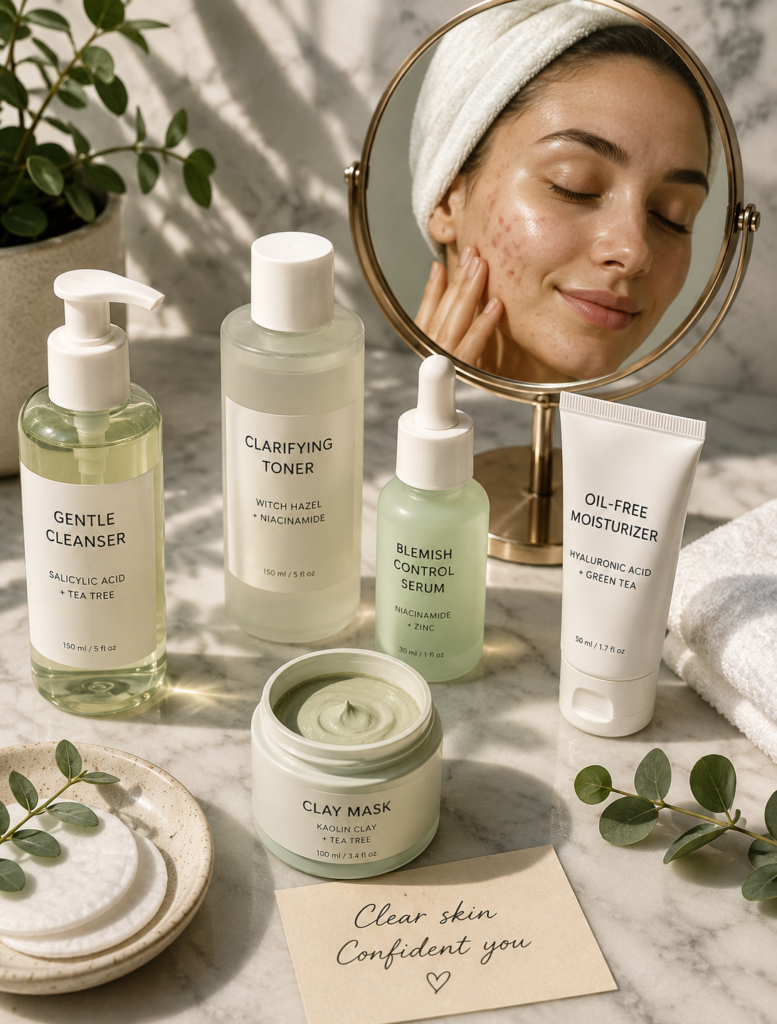
Salicylic Acid: A Classic Ingredient for Clogged Pores
Salicylic acid is one of the most recognizable ingredients in acne skincare.
It is a beta hydroxy acid, commonly abbreviated as BHA, and is particularly useful for helping unclog pores and exfoliate dead skin cells. This makes it especially relevant to blackheads and whiteheads.
Imagine the follicle as a narrow passage where sebum and dead cells are beginning to accumulate. The purpose of salicylic acid is not simply to polish the visible surface of the face. Its value in acne care comes from helping address the material contributing to clogged pores.
This makes it fundamentally different from aggressive physical scrubbing.
A grainy scrub may temporarily make the surface feel smoother, but repeatedly rubbing inflamed skin can create irritation. Salicylic acid offers a more controlled chemical approach to exfoliation.
However, useful does not mean irritation-proof.
Salicylic acid can contribute to dryness, particularly when combined with other active ingredients. Someone beginning an acne routine may therefore benefit from introducing it gradually rather than immediately using multiple salicylic-acid products morning and evening.
More is not automatically better.
Benzoyl Peroxide: Particularly Useful for Inflamed Acne
Benzoyl peroxide is another established acne ingredient, particularly useful for inflammatory acne.
It works partly by reducing acne-associated bacteria and can help with inflammatory lesions. Unlike antibiotics, bacterial resistance is not considered a problem in the same way with benzoyl peroxide, which is one reason it remains important in acne treatment.
It is available in different strengths, but higher concentration does not automatically mean a better experience.
One of the most common mistakes is assuming that stronger percentages must clear acne faster. In reality, stronger products can produce more dryness and irritation, and tolerability matters because an effective treatment is useful only if it can be used consistently.
Benzoyl peroxide also has a practical characteristic that surprises many first-time users: it can bleach fabrics.
Towels, pillowcases, clothing, and bedding can develop pale marks after contact with the ingredient.
This has nothing to do with its effectiveness, but knowing beforehand can save several favorite towels.
Adapalene and the Role of Retinoids
Topical retinoids are among the most important tools used for acne because they influence cell turnover and help prevent follicles from becoming clogged.
Adapalene is a retinoid commonly associated with acne treatment and is available without prescription in some countries, while access varies elsewhere.
Retinoids are particularly interesting because they are not merely emergency treatments for individual visible pimples.
They are commonly used across acne-prone areas to help prevent the formation of new lesions.
This requires a different mindset.
Someone accustomed to spot treatments may look at clear areas of skin and wonder why medication should be applied there. The purpose is preventive. The goal is to reduce the development of future clogged follicles, not simply react after every blemish becomes visible.
Retinoids can cause dryness, peeling, and irritation, especially when first introduced. Starting carefully and supporting the skin with moisturizer can therefore be important.
Pregnancy introduces additional safety considerations around retinoids, so appropriate medical advice should be sought rather than assuming every over-the-counter skincare ingredient is suitable during pregnancy.
Azelaic Acid: A Versatile Option
Azelaic acid deserves more attention than it sometimes receives because it can address several concerns common in acne-prone skin.
It can help with acne while also being useful for the discoloration that sometimes remains after inflammatory lesions heal.
This combination can be particularly appealing to someone who feels that every breakout leaves evidence behind for months.
The acne itself may last days or weeks.
The mark can remain considerably longer.
Azelaic acid may therefore fit routines where both active blemishes and post-acne uneven tone are concerns.
As with other active ingredients, concentration, formulation, frequency, and individual tolerance matter.
An ingredient cannot be judged entirely by its name.
The complete product and the way it is used determine the experience.
Niacinamide: Support Rather Than a Miracle Cure
Niacinamide has become extremely popular in modern skincare and is often marketed for oily or acne-prone complexions.
It is a form of vitamin B3 and can support the skin barrier while offering anti-inflammatory benefits. Some formulations may also help improve the appearance of oiliness and uneven tone.
However, niacinamide should not be transformed into something it is not.
It is not necessarily a replacement for established acne treatments when someone has persistent moderate or severe acne.
Its strength is often supportive.
A well-formulated niacinamide product may fit comfortably into a routine alongside more targeted acne treatment, particularly when maintaining skin comfort and barrier function is important.
The skincare market sometimes promotes very high concentrations because larger numbers appear more powerful.
But concentration should not become a competition.
A product that the skin tolerates comfortably can be more useful than a stronger formula that creates persistent irritation.
Alpha Hydroxy Acids and Surface Exfoliation
Alpha hydroxy acids, or AHAs, include ingredients such as glycolic acid and lactic acid.
Unlike salicylic acid, which is particularly associated with clogged pores and acne care, AHAs are often valued for surface exfoliation, texture, and uneven tone.
They may have a place in some acne-prone routines, especially when post-acne texture or pigmentation is also a concern.
But this is where routine design becomes important.
Someone already using a retinoid and benzoyl peroxide may not benefit from immediately adding a strong glycolic-acid treatment simply because each ingredient is individually popular.
The combined irritation potential matters.
Skin does not experience products as separate marketing categories.
It experiences the total routine.
If that total routine becomes too aggressive, redness, peeling, burning, and sensitivity can make everything harder to tolerate.
Moisturizing Ingredients Matter Too
When discussing “the best ingredients for acne,” conversations often focus entirely on active treatments.
That overlooks an important part of acne care.
Moisturizing ingredients can help maintain comfort while acne treatments are being used.
Humectants such as glycerin and hyaluronic acid help attract and retain water within the outer layers of the skin. Ceramides are important components of the skin barrier and are commonly included in moisturizers designed to support barrier function.
These ingredients do not necessarily treat acne directly in the way benzoyl peroxide or a retinoid does.
But they can make an acne routine more sustainable.
This matters because treatment frequently fails not because the active ingredient was useless, but because irritation became severe enough that the person stopped using it.
Supporting the skin is therefore part of treatment strategy rather than an unrelated cosmetic luxury.
What Does Non-Comedogenic Really Mean?
People with acne-prone skin frequently encounter the term “non-comedogenic.”
In practical terms, it indicates that a product is designed or marketed as being less likely to clog pores.
This can be a useful shopping guide, particularly for moisturizers, sunscreen, and makeup.
However, it is not an absolute guarantee that a product will work perfectly for every acne-prone person.
Formulations are complex, and individual responses differ.
A better way to think about the label is as a useful filter rather than a promise.
If choosing between two otherwise appropriate facial products and one is specifically designed for acne-prone skin and labeled non-comedogenic, that information can reasonably influence the decision.
But personal experience still matters.
The Problem With Combining Too Many Active Ingredients
One of the easiest ways to create a difficult acne routine is to buy several good ingredients and use all of them immediately.
Imagine a morning routine containing an exfoliating cleanser, salicylic-acid toner, high-strength niacinamide serum, benzoyl-peroxide treatment, moisturizer, and sunscreen.
Then imagine an evening routine containing another exfoliating cleanser, glycolic acid, retinoid, and spot treatment.
Every individual product may have a legitimate purpose.
The combined routine may still be far too irritating.
When the skin becomes red and uncomfortable, the person may conclude that they have “sensitive skin” or that every treatment makes their acne worse.
The real problem may be the cumulative load.
Introduce active ingredients strategically.
Give the skin enough stability that you can identify what each change actually does.
Morning Versus Evening Use
Timing can make an acne routine easier to organize.
Some people use benzoyl peroxide during one part of the day and a topical retinoid at another, depending on the specific products and professional recommendations.
Exfoliating ingredients may also be separated rather than layered together.
The exact schedule depends on formulation and individual tolerance, so universal rules are difficult.
What matters is the principle.
You do not have to apply every useful ingredient in the same session.
A weekly routine can distribute active products intelligently.
This often produces a more comfortable experience than treating each morning and evening as an opportunity to use everything in the cabinet.
Spot Treatment Versus Preventive Treatment
Another useful distinction is whether an ingredient is being used reactively or preventively.
Spot treatment targets a blemish that already exists.
Preventive treatment targets the acne-prone area to reduce the likelihood of future lesions.
Many people rely almost entirely on spot treatment because visible pimples create urgency.
But acne begins before a blemish becomes visible.
Ingredients such as topical retinoids are valuable partly because they can be incorporated into a broader preventive strategy.
This changes the goal of skincare.
Instead of asking, “How quickly can I destroy this pimple?” the better question becomes, “How can I reduce the frequency with which these pimples develop?”
Ingredients for Post-Acne Marks
Acne-prone skin often has two simultaneous concerns: active breakouts and the marks left by previous ones.
These should not be confused.
A dark or red mark remaining after a blemish has healed is not necessarily active acne.
Ingredients such as azelaic acid can be useful where discoloration and acne overlap. Retinoids may also contribute to improvements in tone and texture over time.
Sun protection is crucial because ultraviolet exposure can worsen the appearance of pigmentation.
This is one reason sunscreen belongs in a serious acne routine even though it is not usually thought of as an “acne treatment.”
Preventing additional discoloration can be as important cosmetically as treating the original blemish.
What About Tea Tree Oil and Natural Ingredients?
Natural ingredients are often marketed as gentler alternatives to conventional acne treatments.
But “natural” and “gentle” are not synonyms.
Plant-derived substances can irritate skin, trigger allergic reactions, or be used at inappropriate concentrations.
Tea tree oil, for example, has been studied for acne, but essential oils should not simply be applied undiluted to the face because they are natural.
The same principle applies broadly.
Judge an ingredient according to evidence, formulation, concentration, and skin response rather than whether its origin sounds botanical or laboratory-made.
Skin does not recognize marketing categories.
When an Ingredient Seems to Make Acne Worse
A new active ingredient can sometimes coincide with increased breakouts, creating confusion about whether the skin is “purging” or simply reacting badly.
The concept of purging is often overused online.
Certain ingredients that increase cell turnover can temporarily bring existing developing blockages to the surface more quickly. But not every breakout after a new product is purging.
If breakouts appear in unusual areas, irritation becomes severe, or the reaction continues without improvement, the product may simply be unsuitable.
Burning, significant swelling, or severe discomfort should not be treated as proof that an ingredient is “working.”
Effective skincare does not require suffering.
How to Introduce a New Active Ingredient
A controlled introduction provides much better information than changing an entire routine at once.
Keep the basic cleanser, moisturizer, and sunscreen relatively stable.
Introduce one major active product.
Follow its instructions carefully.
Observe how the skin responds over the following weeks.
If irritation develops, consider whether frequency needs adjustment rather than immediately adding another product to repair the problem created by the first.
This approach may feel slow, but it creates clarity.
If the skin improves, you know which change probably contributed.
If it worsens, identifying the likely cause is much easier.
When Over-the-Counter Ingredients Are Not Enough
There is a limit to what a cosmetic routine can reasonably accomplish.
Persistent moderate acne, widespread inflammatory acne, painful nodules, cysts, or acne that is beginning to scar deserves professional dermatologic assessment.
Prescription treatments can target acne more effectively than repeatedly purchasing stronger cosmetic products.
This is especially important with scarring.
A blemish is temporary.
A scar can be permanent.
Early effective treatment can therefore be more valuable than months spent experimenting with increasingly complicated routines.
Choosing Ingredients According to the Problem
The most useful acne ingredient depends on what the skin is actually doing.
Blackheads and whiteheads point toward clogged pores.
Inflamed pimples introduce a stronger inflammatory and bacterial component.
Post-acne discoloration creates another concern.
Dryness from treatment creates another.
Sensitive skin changes the level of intensity that may be tolerated.
This is why there is no single “best acne ingredient” for every person.
The best routine is matched to the pattern of acne rather than assembled from whatever ingredients happen to be trending.
A Smarter Way to Think About Acne Skincare
Acne-prone skin does not need the maximum number of active ingredients.
It needs the right amount of useful intervention.
Salicylic acid can help address clogged pores.
Benzoyl peroxide can be valuable for inflammatory acne.
Retinoids such as adapalene can help prevent pore blockage and future lesions.
Azelaic acid can address acne while also helping with post-acne discoloration.
Niacinamide and well-chosen moisturizing ingredients can support the skin and make the overall routine easier to tolerate.
Sunscreen protects the progress being made.
The real skill lies in combining these tools without turning skincare into chemical overload.
When ingredients are selected according to purpose, introduced thoughtfully, and given enough time to work, an acne routine becomes much easier to understand.
And when you understand why each product is present, you are far less likely to keep adding unnecessary ones.
 Discover More From Our Family of Websites
 ZodiacBearing (Astrology, Tarot, Numerology, Angel Numbers & Spiritual Guidance)
 Velourana (Beauty, Makeup, Hair Care, Skincare & Beauty Tips)
 HavenBearing (Home, Living, Organization, Décor & Everyday Inspiration)
 PawBearing (Pet Care, Dog Breeds, Animal Health, Training & Pet Products)
 PsyCatherine (Notes From the Journal of a Psychologist on Real Life)