CATEGORY: Bangs & Fringes
Few haircut changes can transform the appearance of the face as quickly as bangs. The overall length of the hair may remain almost untouched, yet adding a fringe can alter proportions, emphasize the eyes, soften the forehead, sharpen the cheekbones or give an otherwise familiar haircut an entirely different personality.
That immediate impact is part of the appeal. Bangs can make long hair feel newly styled without sacrificing length, give a bob a stronger identity, or introduce movement around the face when the rest of the haircut is deliberately simple. They can look polished and architectural, soft and romantic, deliberately undone, retro, dramatic or almost invisible depending on how they are cut.
The difficulty is that a fringe occupies some of the most visually important territory in a haircut. It sits directly around the eyes and forehead, where even relatively small differences in length, density and shape become noticeable. A few centimeters can separate a soft curtain fringe from a heavy full bang. Removing too much density can make fine hair appear thinner elsewhere, while leaving too much weight can overwhelm the face or make naturally textured hair difficult to manage.
This is why choosing bangs should involve more than showing a photograph of a hairstyle you like. The photograph is useful inspiration, but the successful version of that fringe needs to work with your own hairline, texture, density, growth patterns, face proportions and willingness to style it.
The best fringe is rarely an exact copy of somebody else's. It is an adaptation that creates the same feeling while belonging naturally to the person wearing it.
Why Bangs Change the Face So Dramatically
Most haircuts frame the face from the sides. Bangs introduce hair directly across or around the forehead, changing the visible shape of the face itself.
A full fringe can visually shorten the forehead because less of it remains visible. A curtain fringe does something different: the center opens while longer pieces travel toward the cheekbones or jaw, creating diagonal lines that guide attention toward the middle of the face. Side-swept bangs create asymmetry and movement, while very short bangs expose more forehead and can make the haircut feel graphic and intentional.
This is why two people with approximately the same hair length can look completely different once their fringes are changed.
The effect also depends on where the fringe ends.
Bangs that finish around the eyebrows naturally bring attention toward the eyes and brows. Longer pieces around the cheekbones can emphasize facial structure. A sweeping fringe that travels toward the jaw becomes almost indistinguishable from face-framing layers and can visually connect the front of the haircut with the rest of the hair.
Density changes the effect again.
A dense, blunt fringe creates a stronger horizontal line. A lighter, separated fringe allows more skin to remain visible and usually feels softer. Wispy bangs can introduce movement without creating the visual weight of a traditional full fringe.
None of these effects is universally more flattering than another. They simply create different relationships between the haircut and the face.
This is also why rigid rules about face shapes are often less useful than they appear. Advice such as “round faces should never wear straight bangs” or “long faces always need full bangs” ignores the enormous variation within each face shape. Forehead height, cheekbone width, jaw structure, hair texture and the rest of the haircut can completely change the result.
Face shape can provide useful information, but it should not become a restriction.
Curtain Bangs and the Appeal of a Softer Fringe
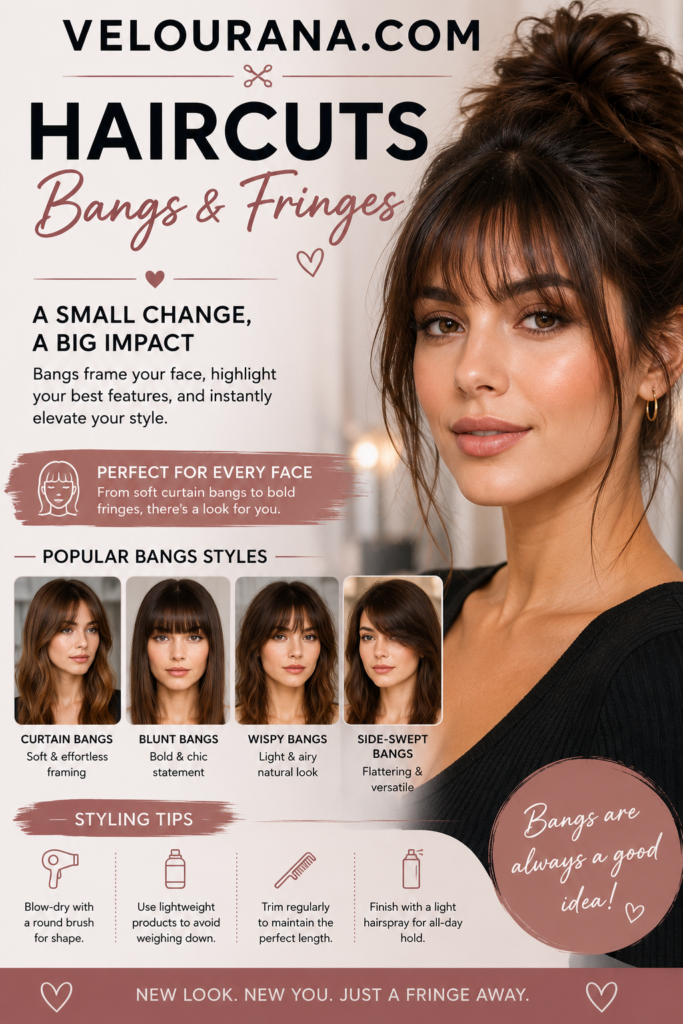
Curtain bangs have remained popular partly because they provide many of the visual benefits of a fringe without completely closing the forehead.
The basic shape is shorter toward the center and progressively longer toward the sides. When styled away from the face, the pieces separate around the forehead in a shape reminiscent of curtains opening.
The exact interpretation can vary enormously.
Some curtain bangs begin close to eyebrow length and create an obvious fringe. Others begin around the cheekbones and function more like dramatic face-framing layers. They can be airy and feathered or relatively dense and glamorous.
Their adaptability makes them particularly attractive to someone considering bangs for the first time.
Because the sides are longer, curtain bangs usually blend into the surrounding haircut more gradually than a blunt fringe. They can often be pushed away from the face on days when a more open appearance is preferred, and the growing-out stage tends to be less abrupt.
They are not completely maintenance-free, however.
The characteristic shape usually benefits from some styling, particularly if the natural growth direction of the hair pulls the fringe forward or creates separation in an unwanted place. A round brush, blow-dryer or other suitable styling method can encourage the hair to sweep outward.
The amount of work depends heavily on natural texture.
Someone whose hair naturally curves away from the face may find curtain bangs remarkably easy. Someone with strong cowlicks at the front may need more deliberate styling after every wash.
This difference is why examining the hairline before cutting is so important.
Full Bangs Create a Stronger Commitment
A full fringe makes a much clearer statement.
Instead of opening through the center, the hair falls across most or all of the forehead. The edge may be blunt, softly textured, curved or deliberately irregular, but the fringe remains a distinct feature of the haircut.
This can create beautiful emphasis around the eyes.
A full fringe can also give long hair a stronger shape because it introduces structure without changing the overall length. Combined with a bob, it can create anything from a classic geometric silhouette to a soft French-inspired haircut depending on texture and finishing.
The commitment is greater because there is less flexibility when the fringe is not behaving as intended.
A full fringe usually cannot simply disappear into the sides of the haircut. It needs to sit correctly, and because it is relatively short, changes in growth become noticeable quickly.
Regular trimming may therefore be necessary to maintain the intended length.
People with naturally oily skin or hair can also notice that full bangs become oily faster than the rest of the hairstyle. The fringe sits against the forehead and is frequently touched throughout the day, which can affect its appearance even when the rest of the hair still looks fresh.
This does not make full bangs impractical. It simply means they work best when the wearer understands the maintenance involved.
For someone who enjoys styling hair and likes the visual impact of a strong fringe, that maintenance may be entirely worthwhile.
Wispy Bangs Can Introduce Change Without Heavy Weight
Wispy bangs offer a lighter interpretation.
Instead of creating a continuous curtain of hair across the forehead, smaller sections fall with visible separation between them. The result can feel delicate, casual and less dominant.
This can be particularly useful when the objective is to change the haircut without allowing the fringe to become its defining feature.
The amount of hair selected for the fringe is crucial.
Fine hair does not necessarily prevent someone from having bangs, but taking too much hair forward can reduce density elsewhere. A stylist may therefore create a relatively shallow fringe section and use careful texturing to maintain softness.
Thick hair presents the opposite possibility. There may be plenty of density available, but an overly heavy section can create more bulk than intended. Removing weight strategically can help the fringe move rather than sitting as a solid block.
Wispy does not mean randomly thinned.
Excessive thinning can create short pieces that behave unpredictably or leave the ends looking weak. The softness should come from deliberate cutting and appropriate density rather than simply removing as much hair as possible.
When done well, wispy bangs can move naturally with the face and blend gradually into longer pieces at the sides.
Side-Swept Bangs Remain More Versatile Than Trends Suggest
Hair trends periodically announce that side bangs have returned or disappeared, but side-swept fringes never truly become unusable because asymmetry is such a fundamental styling tool.
A side fringe can be subtle, beginning around cheekbone length and merging almost immediately into layers. It can also be much more dramatic, crossing the forehead before sweeping toward one side.
The direction creates movement and can be especially useful when the hair naturally prefers to fall away from a central part.
Side-swept bangs can also accommodate some hairline growth patterns more easily than a perfectly centered fringe. Instead of fighting the natural direction of the hair, the cut can sometimes work with it.
The parting is important.
Moving the part slightly can completely change how the fringe sits and how much forehead remains visible. A deeper side part creates greater drama, while a softer off-center part can produce a more relaxed effect.
Because the longer edge blends into the rest of the haircut, side bangs can also provide an easier transition for someone growing out a shorter fringe.
Rather than waiting for every strand to reach one uniform length, the fringe can gradually become part of the face-framing layers.
Hair Texture Should Influence the Cut, Not Exclude You From It
One of the oldest misconceptions about bangs is that they belong primarily to straight hair.
Curly and wavy fringes can be extremely effective precisely because their texture creates movement and individuality around the face.
The difference is that textured hair needs to be cut with an understanding of how it behaves when dry.
A curl that appears long while stretched can spring considerably shorter once released. Different sections of the same head can also have different curl patterns, making a perfectly uniform wet cutting line unreliable as a prediction of the finished shape.
For curly bangs, the stylist needs to consider shrinkage, natural separation and the way individual curls group together.
The result does not need to imitate straight bangs.
Curly fringe can be rounded, separated, full, short or swept. The texture itself becomes part of the design.
Wavy hair provides similar opportunities. Natural bends can create an effortless curtain shape or soft movement across the forehead, although humidity and changing weather may alter the result from day to day.
Straight hair tends to reveal the cutting line more clearly. This can be ideal for blunt or geometric bangs but also means inaccuracies may be more visible.
Every texture therefore presents advantages and challenges.
The question is not whether your texture is “allowed” to have bangs. It is what type of fringe works with the movement your hair already has.
Cowlicks and Hairlines Matter More Than Many Inspiration Photographs Reveal
An inspiration photograph shows the finished hairstyle.
It rarely shows what happened before the photograph was taken.
The person may have had their fringe professionally blow-dried. Their natural hairline may cooperate perfectly with the chosen shape. Styling products may be holding everything in place. The photograph may have been taken immediately after a salon appointment.
Your own hairline needs to be considered independently.
Cowlicks can make one side lift while the other lies flat. A strong growth pattern may split a full fringe in the center. A widow's peak can influence where the hair naturally separates. Receding areas or uneven density around the temples can change how much hair should be brought forward.
None of these characteristics automatically rules out bangs.
They affect the design and styling method.
Sometimes the easiest solution is to choose a fringe that follows the natural movement. A strong central separation may work beautifully with curtain bangs. Hair that naturally sweeps to one side may suit a side fringe.
In other cases, styling can redirect the roots.
The important thing is knowing what will be required before the hair is cut short.
Styling Begins at the Roots
When bangs refuse to sit properly, people often concentrate styling products on the ends.
The problem frequently begins much higher.
The direction of the roots determines where the fringe wants to travel. Once short hair has dried in an unwanted direction, correcting it can become more difficult.
For many fringe styles, styling soon after washing is therefore helpful.
A blow-dryer can be used to control the root direction before shaping the lengths. Depending on the desired result, the fringe may be directed from side to side, forward, or away from the face.
Curtain bangs often benefit from lift and outward movement. Full bangs may require the roots to sit flatter before the ends are given a gentle curve. Side bangs need direction across the forehead without becoming stiff.
The goal is usually movement rather than excessive volume.
Over-rounding a fringe can produce an exaggerated shape that feels separate from the rest of the haircut. Modern bangs often look best when they retain enough natural movement to fall back into place rather than appearing fixed.
Heat protection is appropriate when using heated styling tools, and excessive heat should be avoided just as it would be elsewhere on the hair.
Bangs May Need Washing More Often Than the Rest of Your Hair
One of the practical realities of bangs is that they can look dirty before the rest of the hairstyle does.
They sit against the forehead, where they encounter skin oils, skincare products, sunscreen and perspiration. They are also touched constantly because people move them away from the eyes or adjust their position.
This can be particularly noticeable with fine or straight bangs, where a small amount of oil causes individual strands to group together.
The entire head does not necessarily need washing every time this happens.
Some people wash only the fringe between normal wash days. Because the section is small, this can take only a few minutes. The bangs can then be restyled while the rest of the hair remains dry.
Dry shampoo can also help absorb oil when appropriate, although too much can leave short hair feeling heavy or powdery.
Skincare deserves consideration too.
Rich facial products applied heavily across the forehead can transfer into bangs. Allowing skincare and sunscreen to settle before dropping the fringe into place may help reduce this.
These are small adjustments, but they can make living with bangs much easier.
The Growing-Out Stage Should Be Considered Before the First Cut
Bangs grow.
That obvious fact becomes surprisingly important several months after an impulsive haircut.
A short fringe cannot instantly return to the length of the rest of the hair when you decide you no longer want it. There will be an intermediate period during which the hair needs to be incorporated into the hairstyle differently.
Some fringe shapes make this transition easier than others.
Curtain bangs naturally evolve toward face-framing layers. As the center grows, the entire section can gradually be swept farther away from the face.
Side bangs can similarly merge into longer layers.
A very short or blunt full fringe requires more patience because the difference between the fringe and surrounding hair is greater.
That does not mean you should avoid a dramatic fringe if you genuinely want one. It simply helps to understand the complete life cycle of the haircut rather than thinking only about the first few weeks.
During the growing stage, changing the part, using clips or pins, introducing headbands, or having the fringe reshaped into longer layers can make the transition feel intentional.
Growing out bangs does not need to mean months of bad hair. It becomes another stage of the haircut.
Bringing the Inspiration Photograph to the Salon
Photographs are extremely useful when discussing bangs because words can be ambiguous.
“Curtain bangs” might mean eyebrow-length pieces opening through the center to one person and long cheekbone-length layers to another.
“Wispy” can describe anything from a very light fringe to a relatively full bang with textured ends.
Showing photographs gives the stylist much more precise information about the shape you find attractive.
It can be even more useful to bring several examples.
One might show the length you like.
Another might demonstrate the density.
A third might show how you want the sides to blend into the haircut.
The stylist can then identify the common characteristics and explain how they can be adapted to your hair.
This conversation should include practical information too.
How much time do you spend styling your hair?
Do you normally air-dry or blow-dry?
Do you wear glasses?
Do you exercise frequently?
Does your hair become oily quickly?
Do you want the ability to push the fringe away from your face?
Are you willing to have regular trims?
These answers can influence the best fringe just as much as face shape does.
A Fringe Should Feel Like Part of the Haircut
The most successful bangs rarely look as though they were attached to an unrelated hairstyle.
They connect with what happens around them.
A curtain fringe can flow into face-framing layers and then into long lengths.
A full fringe can echo the strong shape of a bob.
A textured fringe can complement a shag or layered haircut.
Soft side bangs can merge almost invisibly into longer layers.
This connection is what makes the haircut feel intentional from every angle rather than only from the front.
It also means bangs should be chosen in relation to the haircut you already have or intend to create.
Adding a fringe is not merely cutting a section at the forehead.
It changes the architecture of the entire front of the hairstyle.
Choosing Bangs You Can Actually Live With
The most beautiful fringe in a photograph is not necessarily the best fringe for everyday life.
A better question is whether you like both the appearance and the routine required to maintain it.
If you enjoy blow-drying your hair each morning, a style requiring deliberate shaping may be completely reasonable.
If you prefer washing your hair and leaving it alone, a fringe that works closely with your natural texture may be much more satisfying.
If you dislike frequent salon appointments, an extremely precise short fringe may become frustrating.
If you want flexibility, longer curtain or side-swept bangs may provide more styling options.
These practical considerations do not make the haircut less creative. They make it more personal.
Bangs occupy a small physical area of the hairstyle, but they have an unusually large influence on how the entire haircut feels. They can emphasize the eyes, change facial proportions, introduce movement, soften a strong haircut or give structure to long hair that has begun to feel familiar.
There is no single universally flattering fringe.
There is the fringe that works with your features, your hair and the way you actually live.
Once those elements are considered together, bangs stop being a risky haircut experiment and become what they should be: one of the most adaptable and expressive ways to change your hair without necessarily changing everything else.
The End
Velourana.
 Discover More From Our Family of Websites
 ZodiacBearing (Astrology, Tarot, Numerology, Angel Numbers & Spiritual Guidance)
 Velourana (Beauty, Makeup, Hair Care, Skincare & Beauty Tips)
 HavenBearing (Home, Living, Organization, Décor & Everyday Inspiration)
 PawBearing (Pet Care, Dog Breeds, Animal Health, Training & Pet Products)
 PsyCatherine (Notes From the Journal of a Psychologist on Real Life)