CATEGORY: After-Sun Skincare
After spending time in the sun, your skin begins a natural recovery process. Heat, ultraviolet (UV) radiation, wind, saltwater, and chlorinated pools can temporarily affect the skin’s moisture balance and protective barrier, leaving it feeling dry, tight, warm, or sensitive. While no skincare product can reverse sun damage, carefully selected after-sun ingredients can help hydrate the skin, improve comfort, and support the skin’s natural barrier as it recovers.
Walk through any skincare store and you will find countless after-sun products claiming to soothe, cool, nourish, or repair the skin. Understanding the ingredients inside these formulations is the key to choosing products that match your skin type and personal needs rather than relying solely on marketing claims.
This guide explores the most common ingredients found in after-sun skincare, explains what they do, how they work together, and how to choose products that support healthy-looking skin after sun exposure.
Why Ingredients Matter
Not every after-sun product is formulated the same way.
Some focus primarily on lightweight hydration, while others emphasize nourishing dry skin, supporting the skin barrier, or providing a refreshing cooling sensation.
The ingredients determine:
- Product texture.
- Moisturizing ability.
- Skin feel.
- Absorption speed.
- Suitability for different skin types.
Learning to recognize key ingredients makes it much easier to choose products with confidence.
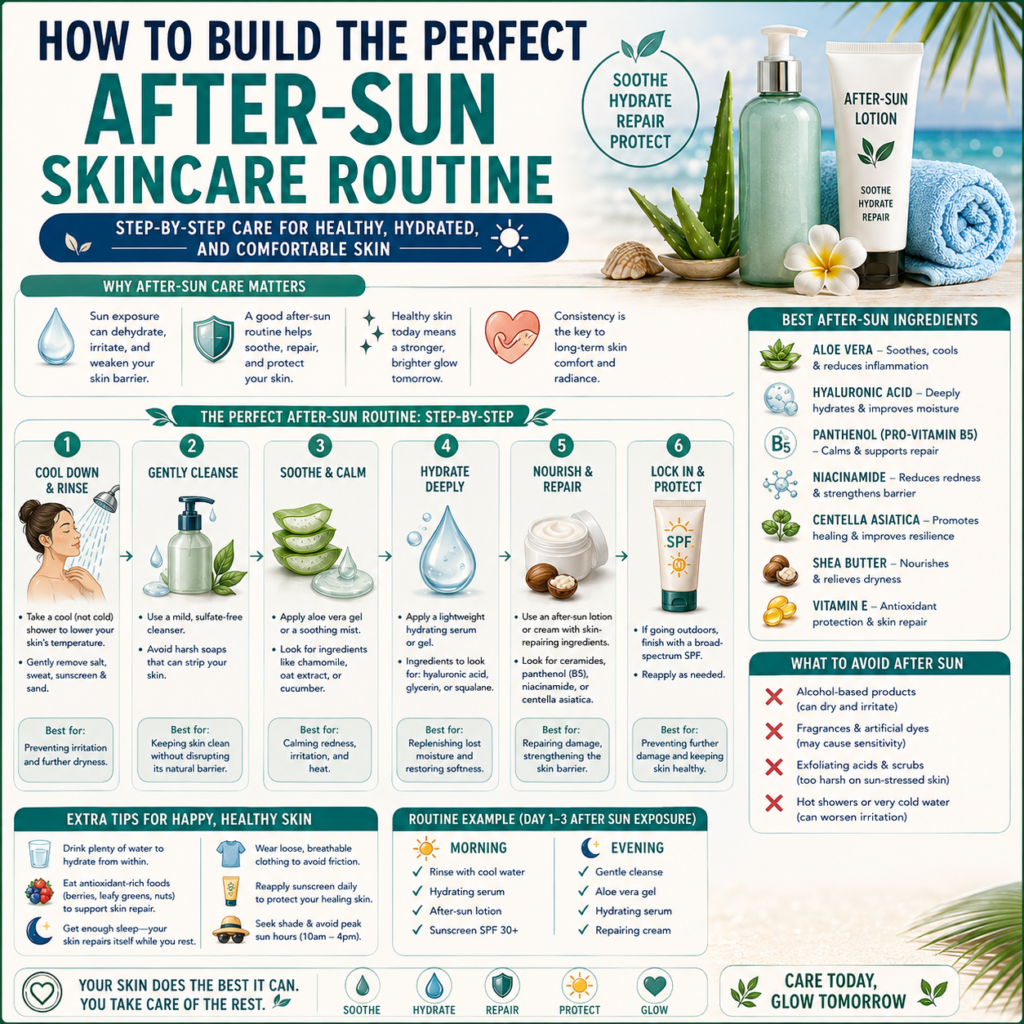
Aloe Vera
Aloe vera is perhaps the most widely recognized ingredient associated with after-sun skincare.
Extracted from the leaves of the aloe plant, aloe vera has been used in skincare for generations because of its lightweight, refreshing feel.
In cosmetic formulations, aloe vera is commonly used to:
- Provide hydration.
- Leave the skin feeling refreshed.
- Improve product spreadability.
- Support overall skin comfort.
Many after-sun gels use aloe vera as one of their primary ingredients because of its pleasant cooling sensation.
Hyaluronic Acid
Despite its name, hyaluronic acid is not an exfoliating acid.
It is a naturally occurring substance that helps attract and retain water within the skin.
In after-sun skincare, hyaluronic acid is valued because it:
- Supports hydration.
- Helps reduce feelings of dryness.
- Leaves the skin feeling smoother.
- Works well beneath moisturizers.
Different molecular sizes are sometimes used within formulations to provide hydration at various levels of the outer skin layers.
Glycerin
Glycerin is one of the most common and effective moisturizing ingredients used throughout the skincare industry.
As a humectant, it attracts moisture toward the skin and helps improve hydration.
Benefits include:
- Improved skin softness.
- Reduced feelings of tightness.
- Enhanced moisture retention.
- Compatibility with most skin types.
Because of its versatility, glycerin appears in many lotions, creams, gels, and serums.
Panthenol
Panthenol, also known as provitamin B5, is frequently included in products formulated for dry or stressed skin.
Within skincare products, panthenol is commonly used to:
- Support hydration.
- Improve skin comfort.
- Leave skin feeling softer.
- Complement other moisturizing ingredients.
Its gentle nature makes it suitable for many different skincare formulations.
Ceramides
Ceramides are naturally occurring lipids that form part of the skin’s protective barrier.
A healthy skin barrier helps reduce moisture loss while protecting the skin from external environmental influences.
Skincare products containing ceramides are designed to help support this barrier.
Potential benefits include:
- Improved moisture retention.
- Smoother skin texture.
- Reduced feelings of dryness.
- Enhanced barrier support.
Ceramides are particularly popular in products formulated for dry or sensitive skin.
Squalane
Squalane is a lightweight moisturizing ingredient often derived from plant sources.
Unlike heavier oils, squalane absorbs relatively quickly while helping reduce moisture loss.
Many people appreciate it because it:
- Leaves the skin feeling soft.
- Provides lightweight nourishment.
- Works well under other moisturizers.
- Is suitable for many skin types.
Its elegant texture makes it a common addition to premium skincare products.
Shea Butter
Shea butter is widely used in richer body creams and after-sun moisturizers.
It helps soften the skin while creating a protective layer that reduces moisture evaporation.
Benefits include:
- Rich moisturization.
- Improved skin softness.
- Long-lasting comfort.
- Support for dry skin.
People with very dry skin often prefer richer formulations containing ingredients such as shea butter.
Plant Oils
Many after-sun lotions include carefully selected plant oils.
Examples may include:
- Jojoba oil.
- Sunflower seed oil.
- Sweet almond oil.
- Coconut-derived ingredients in some formulations.
These ingredients help soften the skin while complementing other moisturizing agents.
Different oils vary in texture, making some more suitable for dry skin and others for lighter daily use.
Vitamin E
Vitamin E is a popular ingredient in many skincare formulations.
It is commonly included because it:
- Helps condition the skin.
- Supports moisturizing formulations.
- Complements other skincare ingredients.
- Contributes to product stability in many formulations.
Vitamin E often works alongside plant oils and moisturizers within after-sun products.
Niacinamide
Niacinamide, a form of vitamin B3, has become increasingly popular in modern skincare.
It is frequently included in products intended to support:
- Skin barrier function.
- Skin texture.
- Overall skin appearance.
- Moisture balance.
Many people use niacinamide throughout the year, including within their summer skincare routines.
Cooling Ingredients
Some after-sun products include ingredients selected primarily for the refreshing sensation they provide.
These formulations often create an immediate feeling of comfort after spending time outdoors.
The cooling effect usually comes from the formulation itself rather than indicating any reduction in skin temperature.
Many consumers simply enjoy the refreshing experience these products provide.
Fragrance Considerations
After-sun products are available in both scented and fragrance-free versions.
Some people enjoy fresh summer fragrances, while others prefer products without added fragrance, particularly if their skin is easily irritated.
Choosing between the two depends largely on individual preference and skin sensitivity.
Combining Ingredients Effectively
The best after-sun products rarely rely on a single ingredient.
Instead, they combine multiple ingredients that complement one another.
For example:
- Humectants attract moisture.
- Emollients soften the skin.
- Barrier-supporting ingredients reduce moisture loss.
- Lightweight oils improve comfort.
- Hydrating gels provide immediate freshness.
Balanced formulations often provide the most satisfying overall skincare experience.
Choosing Ingredients for Your Skin Type
Different skin types benefit from different formulations.
Dry Skin
Often benefits from richer creams containing ceramides, shea butter, and nourishing oils.
Oily Skin
May prefer lightweight gels containing aloe vera, glycerin, and hyaluronic acid.
Combination Skin
Usually responds well to balanced lotion formulations.
Sensitive Skin
Fragrance-free products with simple ingredient lists are often preferred.
Matching ingredients to your skin’s needs generally produces the best results.
Building an Ingredient-Focused Routine
A practical after-sun skincare routine may include:
- Gentle cleanser.
- Hydrating serum containing humectants.
- Moisturizer with barrier-supporting ingredients.
- Lip balm.
- Body lotion for exposed areas.
Choosing complementary products often provides better hydration than relying on a single product alone.
Final Thoughts
Understanding after-sun ingredients allows you to make informed skincare decisions based on your skin’s individual needs rather than marketing promises. Ingredients such as aloe vera, hyaluronic acid, glycerin, panthenol, ceramides, squalane, and nourishing plant oils each contribute in different ways to hydration, comfort, and support for the skin’s natural barrier after sun exposure.
The most effective after-sun skincare products combine these ingredients into balanced formulations that help replenish moisture and maintain healthy-looking skin throughout the summer. By learning what each ingredient offers, you can build a routine that keeps your skin feeling refreshed, comfortable, and well cared for after every sunny day.
—
The End
Velourana.com
 Discover More From Our Family of Websites
 ZodiacBearing (Astrology, Tarot, Numerology, Angel Numbers & Spiritual Guidance)
 Velourana (Beauty, Makeup, Hair Care, Skincare & Beauty Tips)
 HavenBearing (Home, Living, Organization, Décor & Everyday Inspiration)
 PawBearing (Pet Care, Dog Breeds, Animal Health, Training & Pet Products)
 PsyCatherine (Notes From the Journal of a Psychologist on Real Life)