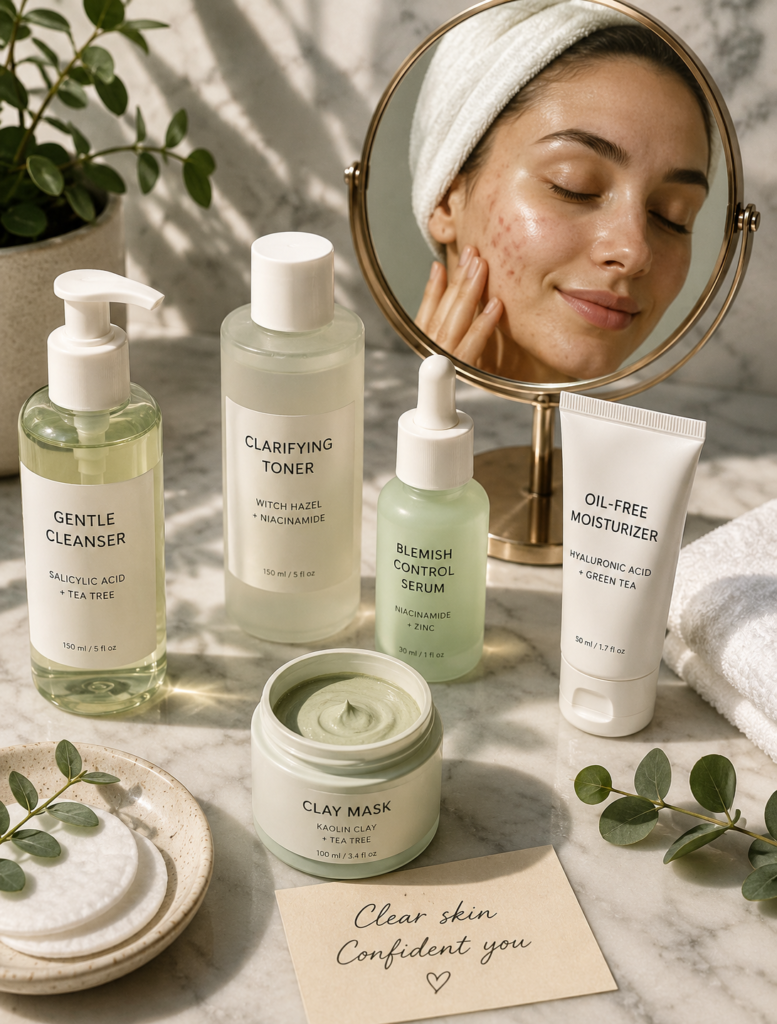
CATEGORY: Acne-Prone Skin
One of the most frustrating parts of acne is that a breakout can remain visible long after the actual blemish has healed. The swelling disappears, tenderness stops, and the pore is no longer actively inflamed, yet a red, pink, brown, purple, or grayish mark remains exactly where the pimple used to be.
For some people, these marks become almost as troublesome as the acne itself.
There is also another possibility: a breakout can alter the texture of the skin and leave a true scar. Depressions, indentations, raised areas, and uneven texture are fundamentally different from flat discoloration, even though people commonly describe all of them as “acne scars.”
Understanding the difference matters because the appropriate approach is not the same.
A flat post-acne mark may gradually fade and can often be supported with skincare and sun protection. A true structural scar involves a physical change in the skin and may require professional procedures for substantial improvement.
The first step, therefore, is not buying a scar serum.
It is identifying what acne has actually left behind.
Post-Acne Marks Are Not Always Scars
Imagine running a fingertip gently across an area where a blemish healed.
If the skin feels essentially level but the color is different, you may be dealing with post-inflammatory discoloration rather than a structural scar.
If the surface has developed a depression, pit, rolling unevenness, or raised area, true scarring may be present.
This distinction explains why someone can use a brightening product successfully on dark marks but see little change in deep indentations.
The product may not have failed.
It may simply have been asked to solve the wrong problem.
Skincare is particularly vulnerable to this confusion because products advertised for “acne scars” sometimes use the phrase broadly enough to include discoloration, texture, and actual scars.
The skin itself makes a more useful distinction.
Why Red or Pink Marks Remain
After inflammatory acne heals, some people are left with persistent red or pink areas.
These marks can result from changes associated with inflammation and blood vessels in the healing area. They are often described as post-inflammatory erythema.
They may be particularly noticeable in lighter complexions, although post-acne changes can occur across skin tones.
The frustrating part is that the blemish may have been active for only a week while the mark remains visible for considerably longer.
This can create the impression that acne is never improving.
Imagine ten blemishes developing over several months. If each leaves a mark that remains visible after the active lesion has disappeared, the face may still appear covered with “acne” even when only two current pimples are actually present.
Separating active acne from healing marks provides a more accurate picture of progress.
Why Brown or Dark Marks Develop
Other people develop brown, grayish, or darker patches after acne.
This is commonly associated with post-inflammatory hyperpigmentation.
Inflammation can stimulate excess pigment production in the affected area, leaving a flat mark after the original lesion heals.
These marks can be particularly persistent in medium and deeper skin tones.
Sun exposure can make pigmentation more noticeable or prolong its appearance, which is one reason daily sun protection becomes so important when treating post-acne marks.
A person can invest heavily in brightening products while simultaneously allowing repeated ultraviolet exposure to work against the goal.
Treatment and prevention need to work together.
What True Acne Scarring Looks Like
True acne scars involve changes in skin structure.
Some scars are depressed below the surrounding skin.
Others are raised.
Among depressed scars, dermatologists commonly distinguish patterns such as ice-pick, boxcar, and rolling scars.
Ice-pick scars tend to appear narrow and deep.
Boxcar scars are broader depressions with more defined edges.
Rolling scars create a wave-like or uneven surface because of changes beneath the skin.
Raised scars develop differently, involving excessive scar tissue.
These distinctions matter because different scar types may respond better to different professional treatments.
There is no single procedure that is automatically ideal for every acne scar.
Why Some Pimples Scar and Others Do Not
The likelihood of scarring is influenced partly by the depth and severity of inflammation.
Deep inflammatory acne, particularly nodules and cysts, has a greater potential to damage surrounding tissue.
Individual healing tendencies also matter.
Two people can experience apparently similar acne and develop very different degrees of scarring.
Delay in effective treatment can increase the opportunity for repeated deep inflammation to create damage.
Picking and squeezing can also contribute by adding mechanical trauma to already inflamed tissue.
This is why scar prevention begins while acne is still active.
The most effective acne-scar strategy is preventing as many scars as possible from forming in the first place.
The High Cost of Picking
Picking a pimple offers immediate satisfaction because it feels like the problem is being physically removed.
Unfortunately, acne does not always cooperate with this logic.
Pressure can increase inflammation and damage surrounding tissue. A small lesion that might have healed relatively quietly can become larger, redder, or injured.
The resulting mark may remain long after the original blemish would have disappeared.
Repeated picking can be particularly damaging when someone uses fingernails or tools to pursue material deep within the skin.
If nothing is easily coming out, increasing force is not a sign that the extraction needs greater determination.
It is often a sign that the lesion should be left alone.
Why Sunscreen Is One of the Most Important Products for Post-Acne Marks
Sunscreen does not bleach post-acne pigmentation.
Its role is protective.
Ultraviolet exposure can worsen pigmentation and make uneven tone more persistent. Consistent broad-spectrum sun protection therefore helps create better conditions for discoloration to improve.
This is especially important when the skincare routine contains ingredients that increase sensitivity to sunlight.
For acne-prone skin, choose a sunscreen that is comfortable and ideally non-comedogenic.
Texture matters because consistency matters.
A sunscreen that feels unpleasant enough to remain unused in a drawer offers no practical protection.
The best formula is one that provides appropriate protection and can realistically become part of every morning.
Azelaic Acid for Acne and Discoloration
Azelaic acid can be particularly useful when active acne and post-acne pigmentation exist simultaneously.
This overlap matters.
Someone may still be developing new pimples while trying to fade marks from old ones. If the routine focuses only on pigmentation while new acne continues appearing, progress can feel impossible.
Azelaic acid is useful because it can have a role in acne management while also helping address uneven pigmentation.
As always, formulation, concentration, frequency, and individual tolerance matter.
A useful ingredient still needs time.
Pigmentation does not usually disappear after several applications.
Retinoids and the Longer-Term Picture
Topical retinoids are established acne treatments and can also contribute to improvements in skin tone and texture over time.
Their most important role for someone prone to scarring may be preventive: controlling acne reduces the number of new inflammatory lesions capable of leaving additional marks or scars.
This creates an important shift in priorities.
Someone with twenty existing marks may naturally concentrate on fading those marks.
But if five new inflammatory pimples are developing every month, preventing the next twenty marks may be even more important.
Treat the source while improving the evidence it has already left behind.
Salicylic Acid and Surface Congestion
Salicylic acid can help unclog pores and manage acne, particularly blackheads and whiteheads.
Its value in a post-acne routine is often indirect.
By helping control active acne, it may reduce the number of future blemishes capable of producing discoloration.
It can also contribute to smoother-looking surface texture through exfoliation.
However, salicylic acid should not be expected to erase deep structural scars.
Again, matching the treatment to the problem prevents unrealistic expectations.
Vitamin C and Brightening Routines
Vitamin C is frequently included in routines designed to improve uneven skin tone and provide antioxidant support.
It may have a place in a routine addressing post-acne discoloration, particularly when combined with consistent sunscreen use.
However, acne-prone skin does not automatically need vitamin C.
If the routine already contains several active ingredients, adding another serum can create unnecessary complexity or irritation.
This is especially relevant for sensitive skin.
A brightening routine should not become so aggressive that it creates new inflammation, because inflammation itself can contribute to further discoloration.
Sometimes doing slightly less produces a better long-term cosmetic result.
Niacinamide as a Supporting Ingredient
Niacinamide can support the skin barrier and may help with uneven tone and inflammation.
For acne-prone skin that is already using stronger treatments, it can be a useful supportive ingredient.
But expectations should remain realistic.
A niacinamide serum is unlikely to dramatically reconstruct deep acne scars.
It may help the overall appearance and comfort of the complexion while more targeted acne and pigmentation treatments do their work.
Skincare becomes easier when every ingredient is given an appropriate job instead of expecting one serum to solve pores, oiliness, pigmentation, scars, wrinkles, redness, and active acne simultaneously.
Why Aggressive Exfoliation Can Backfire
Post-acne marks create impatience.
A person sees discoloration and thinks that removing more surface skin must make the mark disappear faster.
This can lead to repeated use of glycolic acid, salicylic acid, exfoliating pads, scrubs, peels, retinoids, and other active products.
The skin becomes irritated.
Inflammation increases.
Pigmentation can become more troublesome, particularly in skin prone to post-inflammatory hyperpigmentation.
Exfoliation can have a useful place in skincare, but there is a difference between controlled treatment and repeatedly injuring the skin in pursuit of faster results.
Healing cannot always be accelerated by increasing intensity.
Moisturizer Still Matters When Treating Marks
Pigmentation routines often become dominated by active ingredients.
Moisturizer can seem almost irrelevant by comparison.
But comfortable skin is more likely to tolerate consistent treatment.
If the routine produces constant peeling and irritation, the person may repeatedly stop and restart active ingredients.
A simple non-comedogenic moisturizer can help support the skin while treatments are being used.
This is particularly important when retinoids or exfoliating acids are involved.
Barrier support is not a distraction from the goal.
It helps make the goal achievable.
Can Home Skincare Remove Deep Acne Scars?
This is where expectations need to become particularly realistic.
Topical skincare can improve hydration, pigmentation, overall texture, and the appearance of the skin.
But significant depressed acne scars involve structural changes that creams and serums generally cannot completely reverse.
Professional treatments may produce much greater improvement.
Depending on scar type and individual circumstances, dermatologists may consider procedures such as microneedling, chemical peels, laser treatments, subcision, fillers, or other approaches.
These treatments are not interchangeable.
A procedure that is useful for one scar pattern may be less suitable for another.
Professional assessment matters because treatment should be matched to scar type, skin tone, medical history, and the presence of ongoing active acne.
Microneedling and Acne Scars
Microneedling involves creating controlled microscopic injuries in the skin to stimulate repair processes and collagen production.
It may be used professionally for certain types of acne scarring.
The word “controlled” is essential.
Home devices can create risks involving improper depth, inadequate hygiene, excessive treatment, infection, and pigmentation problems.
Professional procedures are performed under controlled conditions and can be adjusted according to the patient’s skin and treatment goals.
A skincare trend becoming popular online does not automatically make the professional procedure equivalent to something performed casually at home.
Chemical Peels
Chemical peels use controlled chemical exfoliation at varying depths.
Superficial peels may help with certain forms of pigmentation and surface irregularity, while stronger procedures have different indications and risks.
People sometimes assume that because low-strength acids exist in home skincare, professional peels are simply stronger versions of the same routine.
That oversimplifies the procedure.
Concentration, pH, application technique, skin preparation, exposure time, and patient selection all matter.
Attempting to imitate professional-strength chemical peeling at home can cause burns, scarring, or pigmentation changes.
Acne scars are not worth creating additional scars to treat.
Laser and Energy-Based Treatments
Various laser and energy-based procedures may be used for acne scars or persistent post-acne redness.
These treatments can work through different mechanisms and have different recovery periods and risk profiles.
Skin tone is an important consideration because some procedures carry greater pigmentation risks for certain complexions.
This is another reason generic advice such as “get laser for acne scars” is inadequate.
The useful question is not whether laser treatment exists.
It is which treatment, for which scar type, on which skin, performed by whom, with what expected benefit and risk.
Treat Active Acne Before Chasing Every Scar
If significant active acne is still developing, controlling it should usually become a major priority.
Imagine repairing a wall while someone continues damaging it every week.
Even excellent repair work will struggle to keep up.
The same principle applies to acne scarring.
Professional scar procedures may be far more satisfying once new inflammatory lesions are under better control.
This does not mean pigmentation must be ignored in the meantime.
It means the routine should prioritize preventing additional damage while gradually improving existing marks.
Why Progress Photographs Can Be Useful
Post-acne marks fade slowly enough that day-to-day changes can be difficult to notice.
Looking in the mirror every morning creates an unreliable comparison because lighting, mood, makeup, sleep, and even the angle of observation change.
Monthly photographs taken under similar lighting can provide a more objective record.
They may reveal that marks have faded considerably even though the person feels nothing has changed.
They can also show whether new acne is decreasing.
Progress becomes easier to recognize when it is measured over appropriate periods.
Do Not Judge Treatment After One Week
Acne creates urgency, and social media often reinforces unrealistic expectations with dramatic before-and-after images.
Biological healing takes time.
Pigmentation can persist for months.
Structural scars may require multiple professional treatment sessions.
A skincare routine should therefore be judged over a realistic period unless irritation or another adverse reaction requires earlier changes.
Switching brightening products every ten days can prevent any one strategy from being evaluated properly.
Consistency is not exciting.
It is often effective.
Preventing the Next Mark
The most powerful way to think about post-acne marks is prospectively.
Every new inflamed blemish is a potential future mark.
Every deep lesion carries some risk of scarring.
Therefore, treating active acne is also scar prevention.
Avoid picking.
Use appropriate acne treatment.
Protect the skin from the sun.
Keep irritation under control.
Seek dermatologic care when acne becomes deep, persistent, painful, or scarring.
This is more valuable than waiting until substantial damage has accumulated and then searching for a miracle scar treatment.
Accepting Improvement Rather Than Demanding Erasure
Scar marketing often uses language suggesting that completely flawless skin can be restored if the correct product or procedure is found.
Reality is more nuanced.
Post-acne discoloration may fade substantially.
Professional treatments can improve many forms of scarring.
Some scars may remain visible.
The goal should be meaningful improvement rather than an impossible promise that the skin must look as though acne never occurred.
Texture is part of real skin.
Even excellent results do not necessarily mean absolute perfection under magnification or harsh directional lighting.
A Smarter Post-Acne Strategy
The most effective approach begins by identifying the problem correctly.
If the mark is flat and red, pink, brown, or dark, focus on post-inflammatory discoloration and protection.
If the skin is indented or raised, consider the possibility of true scarring.
Continue treating active acne so new damage is less likely.
Use sunscreen consistently.
Choose evidence-based ingredients without overwhelming the skin.
Avoid picking.
Give treatments enough time to work.
And when structural scars are the primary concern, consider professional dermatologic assessment rather than expecting a cosmetic serum to rebuild deep tissue.
Acne may leave evidence behind, but that evidence does not all mean the same thing.
Once marks, pigmentation, and scars are separated into their correct categories, treatment becomes far more logical.
Instead of buying products based on the word “scar” printed on the label, you can begin choosing care according to what your skin actually needs.
That understanding is one of the most valuable tools for anyone dealing with the long aftermath of acne.
The End
Velourana
 Discover More From Our Family of Websites
 ZodiacBearing (Astrology, Tarot, Numerology, Angel Numbers & Spiritual Guidance)
 Velourana (Beauty, Makeup, Hair Care, Skincare & Beauty Tips)
 HavenBearing (Home, Living, Organization, Décor & Everyday Inspiration)
 PawBearing (Pet Care, Dog Breeds, Animal Health, Training & Pet Products)
 PsyCatherine (Notes From the Journal of a Psychologist on Real Life)