
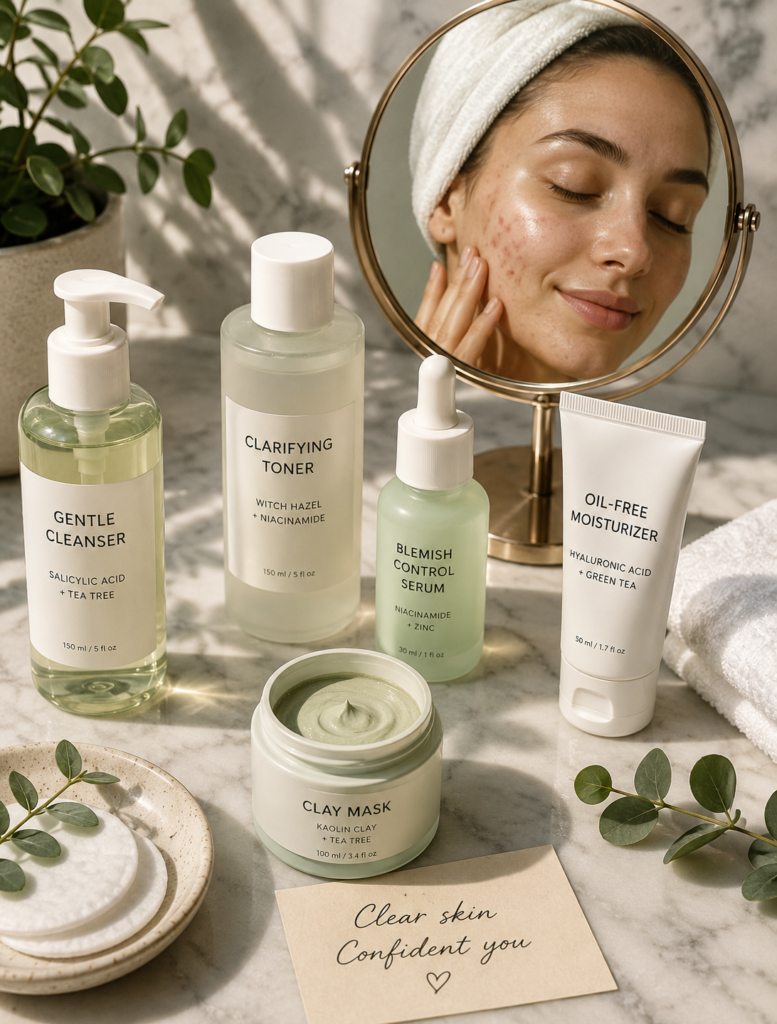
CATEGORY: Acne-Prone Skin
Acne-prone skin rarely behaves exactly the same way throughout the year. A routine that feels perfectly balanced in spring may become uncomfortably heavy during a hot, humid summer. The lightweight moisturizer that works beautifully in August may suddenly feel inadequate when cold weather, indoor heating, and dry air arrive. Sunscreen preferences change, sweating increases or decreases, and acne treatments that were easy to tolerate during one season may become irritating during another.
This does not mean the entire skincare routine needs to be replaced every few months.
In fact, constantly rebuilding a routine can make acne more difficult to understand because too many variables change simultaneously. A better strategy is to establish a stable foundation and then adjust selected parts according to climate, activity, and how the skin is actually behaving.
Seasonal skincare should be adaptation rather than reinvention.
For acne-prone skin, the fundamentals remain remarkably consistent: gentle cleansing, appropriate acne treatment, adequate moisturization, daily sun protection, minimal unnecessary irritation, and professional treatment when acne becomes severe or begins to scar.
What changes is how those fundamentals are delivered.
Why Weather Can Change the Way Acne-Prone Skin Feels
The skin exists in constant contact with its environment.
Temperature and humidity affect how comfortable products feel and how quickly moisture is lost from the skin. Heat can increase sweating. Cold weather and indoor heating can contribute to dryness. Sun exposure changes according to season and lifestyle. Clothing, hats, helmets, scarves, and other objects may create additional friction.
The skincare products themselves can also behave differently.
A rich cream that feels comfortable in cold weather may feel excessive during a humid summer. A very lightweight gel moisturizer that disappears instantly in July may not provide enough comfort in January.
This is why skin type should not be treated as an unchanging label.
Someone can fundamentally have oily, acne-prone skin while still experiencing significant winter dryness.
Another person may have combination skin that becomes much oilier during humid weather.
The routine needs enough flexibility to respond without becoming chaotic.
Summer Does Not Necessarily Cause Acne—but It Can Create Challenges
Summer can make acne-prone skin feel considerably more difficult to manage.
Heat increases perspiration. Sunscreen may be reapplied more frequently. The skin can feel oilier, and makeup may mix with sweat and sebum during the day.
People may also spend more time outdoors, exercise more frequently, swim, travel, or wear hats and protective equipment.
None of these things guarantees acne.
But together they can change the environment around acne-prone skin.
The response should not automatically be stronger cleansing.
Instead, think about managing accumulation and friction intelligently.
If you have been sweating heavily, cleansing the skin reasonably soon afterward can be useful. Avoid leaving sweaty, tight clothing against acne-prone areas for unnecessarily long periods.
At the same time, resist the temptation to wash the face every hour simply because it feels shiny.
Summer Cleansing Should Still Be Gentle
Hot weather creates a powerful psychological desire for intense cleansing.
A strongly foaming cleanser and cold splash of water can feel refreshing after a humid day.
But refreshing and appropriate are not always the same thing.
Acne-prone skin still does not need to be stripped.
If cleansing morning and evening plus after significant sweating is sufficient, repeatedly adding extra washes can create unnecessary irritation.
This becomes especially important when salicylic acid, benzoyl peroxide, retinoids, or other acne treatments are already part of the routine.
The cleanser should complement treatment rather than becoming another aggressive treatment step.
Choosing a Summer Moisturizer
People with oily acne-prone skin often reduce or completely eliminate moisturizer during summer.
Sometimes a lighter moisturizer is genuinely appropriate.
Completely abandoning hydration, however, is not automatically necessary.
A gel, fluid, or lightweight lotion may feel far more comfortable than a rich cream in humid conditions. Look for products designed for facial use and preferably described as non-comedogenic when acne is a concern.
If the skin remains comfortable without a separate moisturizer beneath sunscreen, the sunscreen formulation itself may provide enough emollience for some individuals.
The routine does not need to include products merely to satisfy a predetermined number of steps.
Evaluate the skin.
If it feels comfortable and treatment remains well tolerated, there may be no need to add heaviness.
Sunscreen Becomes Even More Visible in Summer
Sun protection matters throughout the year, but summer often makes the need more obvious because people spend longer periods outdoors and ultraviolet exposure can be more intense.
For acne-prone skin, sunscreen selection is partly a question of cosmetic elegance.
If the product feels extremely greasy, leaves an uncomfortable film, or makes the face look excessively shiny, daily use and reapplication become harder.
Lightweight fluids and gel-like sunscreens may feel more suitable for oily complexions, although individual preference varies.
Look for broad-spectrum protection and an appropriate SPF, and consider water resistance when swimming or sweating heavily.
Remember that sunscreen is not applied once in the morning as a magical shield that remains unchanged regardless of the day’s activities.
Outdoor exposure, sweating, swimming, and toweling can make reapplication important.
Swimming Pools, Seawater, and Acne-Prone Skin
Swimming is not inherently bad for acne.
However, pool chemicals, salt water, repeated sun exposure, and frequent showering can leave some people’s skin feeling dry or irritated.
After swimming, rinse the skin appropriately rather than allowing salt, chlorine, sunscreen, and sweat to remain indefinitely.
Then restore comfort with suitable moisturizer if needed.
The mistake is treating every swimming session as an opportunity for aggressive exfoliation.
If the skin already feels dry after hours of sun, water, and repeated sunscreen application, a strong acid treatment that evening may be less comfortable than usual.
A flexible routine responds to what the skin has experienced that day.
Sweat, Exercise, and Breakouts
Exercise has many health benefits and should not be avoided simply because the skin is acne-prone.
The practical issue is prolonged contact with sweat, friction, and equipment.
A tight helmet strap rubbing repeatedly against the same area can contribute to irritation and acne mechanica. The same can happen beneath sports clothing or equipment.
After significant sweating, change out of damp clothing and cleanse or shower when practical.
Avoid scrubbing the skin aggressively in an attempt to remove sweat “from the pores.”
Sweat itself is not something that needs to be excavated.
Gentle hygiene is enough.
Makeup During Hot Weather
Summer makeup often needs to solve several problems at once.
The skin may be oilier.
Sunscreen sits underneath.
Perspiration increases.
Foundation needs to remain presentable despite heat.
The natural response is to layer mattifying primer, long-wear foundation, powder, setting spray, and additional powder during the day.
This can work cosmetically, but acne-prone skin may find heavy accumulation uncomfortable.
Consider using thinner layers and targeted coverage.
A lightweight base with concealer only where needed may feel better than full coverage across the entire face.
Blotting excess oil before adding powder can also prevent thick layers from building throughout the day.
At night, remove long-wearing makeup and sunscreen thoroughly but gently.
Autumn Is a Good Time to Reassess
Autumn can function as a transitional season for the skin.
Humidity may fall.
Temperatures become cooler.
Summer oiliness may decrease.
At the same time, people may continue using the same strongly mattifying products that were comfortable in July.
This is a useful moment to reassess rather than waiting for obvious irritation.
Does the cleanser suddenly feel too strong?
Does the lightweight summer moisturizer disappear without providing enough comfort?
Is the skin beginning to feel tight after an acne treatment that was previously easy to tolerate?
Small adjustments now can prevent a larger winter problem.
Seasonal adaptation works best when it is responsive rather than reactive.
Winter and the Acne-Dryness Paradox
Winter creates one of the strangest experiences for acne-prone skin.
The face can still develop clogged pores and inflamed blemishes while simultaneously becoming dry, flaky, and sensitive.
People often respond incorrectly because acne remains visible.
They continue using exactly the same oil-control routine while dryness increases.
A foaming cleanser, exfoliating toner, benzoyl peroxide, retinoid, and lightweight gel moisturizer may have been manageable in humid weather.
In dry winter air, the same combination can become uncomfortable.
The acne has not necessarily become worse.
The environment surrounding the treatment has changed.
Indoor Heating Can Matter
Cold outdoor air receives most of the attention during winter, but indoor environments can also affect skin comfort.
Heating systems can reduce indoor humidity, and long periods spent in heated rooms may leave the skin feeling drier.
This is particularly relevant for people already using acne treatments that can cause peeling or irritation.
A moisturizer that seemed unnecessary in summer may become essential.
Some people may need to switch from a gel to a lotion or from a light lotion to a somewhat richer cream.
This does not mean abandoning acne-conscious product selection.
Look for non-comedogenic formulations that provide greater comfort without unnecessarily heavy textures.
Do Not Stop Sunscreen Because It Is Cold
Winter sunlight may feel weak compared with summer, but ultraviolet exposure does not disappear simply because the temperature falls.
Daily broad-spectrum sun protection remains important, particularly when acne treatments are being used and post-inflammatory pigmentation is a concern.
Winter may actually provide an opportunity to choose a slightly more moisturizing sunscreen if summer formulas have become too drying.
Again, the function remains the same.
The texture adapts.
Retinoids During Winter
Retinoids can become more difficult to tolerate when environmental dryness increases.
If a routine that was previously comfortable begins causing substantial peeling or irritation, the answer should not automatically be to endure it.
Moisturizer may need adjustment.
The frequency of other exfoliating products may need reconsideration.
The cleanser may need to become gentler.
If irritation remains significant, professional guidance can help determine how the treatment should be adjusted.
The important point is not to abandon an effective long-term acne strategy unnecessarily.
Sometimes the surrounding routine needs modification rather than the core treatment itself.
Exfoliation in Cold Weather
Dry winter skin can look rough and flaky, creating the temptation to exfoliate more frequently.
This is often exactly the wrong instinct.
If the flaking is caused by dryness or treatment-related irritation, repeatedly applying acids or scrubbing the surface may intensify the underlying problem.
Ask why the skin is flaky.
Is dead skin accumulating because exfoliation is genuinely inadequate?
Or is the skin peeling because the routine is already too aggressive?
The visible symptom can look similar while the correct responses are opposite.
Spring and the Return of Oiliness
As temperatures and humidity rise, some people notice that winter products begin feeling too rich.
Foundation may move more easily.
Sunscreen may appear shinier.
The forehead may become oily sooner.
This does not mean the entire winter routine was wrong.
It simply means the skin’s environment is changing again.
Gradually reduce unnecessary richness.
Perhaps a heavier nighttime moisturizer remains useful while the daytime cream becomes lighter.
Perhaps the cleanser does not need to change at all.
Perhaps only the sunscreen texture needs adjustment.
Change the minimum number of variables necessary.
Humid Climates Require Their Own Strategy
Season is only one part of the equation.
Climate matters more than the calendar.
A person living in a humid coastal environment may experience very different skin from someone spending the same month in a dry continental climate.
Humidity can make heavy products feel more occlusive and can increase the sensation of oiliness and sweating.
Lightweight layers often become more comfortable.
But humid weather does not mean moisturizer becomes biologically forbidden.
If acne treatments are drying the skin, hydration may still be needed.
Texture can change while function remains.
Dry Climates and Increased Water Loss
Dry climates can make acne treatment more challenging because the skin may lose water more readily into the environment.
Someone who normally considers themselves very oily may suddenly experience tightness and flaking after traveling somewhere much drier.
This is why travel-sized skincare routines should not be designed only according to the skin’s behavior at home.
A temporary moisturizer adjustment can be useful.
The same principle applies to air-conditioned environments and long flights, where the skin may feel different from its usual state.
Listen to current conditions rather than defending a permanent identity such as “I have oily skin, so I never use cream.”
Travel Can Disrupt Acne Even Without Climate Changes
Travel introduces multiple variables simultaneously.
Sleep changes.
Food changes.
Stress changes.
Water and climate may change.
Skincare schedules become irregular.
Pillowcases and towels are unfamiliar.
People may wear makeup for longer periods or spend entire days in sunscreen.
If acne worsens during a trip, identifying one precise cause can be impossible.
The best defense is often keeping the core routine stable.
Travel is not the ideal time to test five new skincare products.
Bring familiar basics whenever practical.
Seasonal Breakouts May Not Actually Be Seasonal
If acne appears at the same time every year, weather may seem like the obvious explanation.
But consider what else changes during that period.
Summer may mean more sports equipment, sweating, sunscreen, travel, or swimming.
Winter may mean scarves, hats, heavier hair products, indoor heating, or reduced cleansing after exercise.
Seasonal patterns can therefore be indirect.
Instead of simply saying, “My acne hates summer,” investigate what summer changes about daily life.
The answer may be surprisingly practical.
Adjust Texture Before Changing Active Ingredients
One of the safest ways to make seasonal changes is to adjust supportive products before changing the entire treatment strategy.
If summer feels too heavy, consider a lighter moisturizer or sunscreen.
If winter feels too dry, increase moisturization or use a gentler cleanser.
The active acne treatment may be able to remain stable.
This creates continuity.
If every seasonal change includes a new cleanser, acid, serum, retinoid, moisturizer, and sunscreen, it becomes difficult to know whether acne changes are caused by the weather or by the new products.
The Skin Barrier Does Not Know What Month It Is
Seasonal skincare advice can become overly rigid.
“Use gels in summer.”
“Use creams in winter.”
“Exfoliate more in spring.”
Real skin does not follow a calendar.
If December is unusually warm and humid, the skin may behave differently from the expected winter pattern.
If you spend August in heavily air-conditioned indoor environments, dryness may still occur.
The skin responds to conditions, not names of months.
Use seasonal advice as a framework, then look at the face in front of you.
When Seasonal Acne Needs Professional Attention
A predictable seasonal flare does not mean severe acne should simply be accepted every year.
If a particular season repeatedly produces deep, painful, widespread, or scarring acne, discuss the pattern with a dermatologist.
Treatment may be adjusted proactively.
Waiting until severe inflammation has already developed can make the cycle harder to manage.
Likewise, if acne suddenly changes dramatically without an obvious explanation, do not automatically blame the weather.
Other medical, hormonal, or medication-related factors may deserve consideration.
Build a Core Routine and a Flexible Outer Layer
One of the easiest ways to organize year-round acne care is to separate the routine into two parts.
The first is the core.
This includes gentle cleansing, the primary acne treatment, moisturization as required, and sun protection.
The second is flexible.
This includes moisturizer texture, sunscreen finish, frequency of optional exfoliation, makeup choices, and additional hydration according to current conditions.
The core creates consistency.
The flexible layer creates comfort.
Together, they prevent seasonal adaptation from turning into constant product experimentation.
Observe Trends Rather Than Individual Days
One unusually oily afternoon does not require a new summer routine.
One dry morning does not require replacing every product for winter.
Look for patterns lasting several days or weeks.
Is the skin consistently tighter after cleansing?
Is makeup repeatedly becoming oilier earlier in the day?
Has treatment-related peeling increased?
Does the moisturizer now feel too rich every morning?
Repeated observations justify adjustments.
Single days often reflect sleep, activity, weather, hormones, or countless other temporary variables.
Year-Round Acne Care Is About Stability
The most successful seasonal strategy is not having four completely different skincare routines.
It is having one intelligent routine capable of adapting.
Summer may call for lighter textures, careful sweat management, and sunscreen that remains comfortable in heat.
Winter may require greater barrier support and less unnecessary exfoliation.
Humidity may encourage lighter layers.
Dry environments may demand more moisturization.
Travel may require simplification.
But the principles remain remarkably stable.
Clean the skin without punishing it.
Treat acne with ingredients that have a clear purpose.
Moisturize according to what the skin currently needs.
Protect against ultraviolet exposure.
Avoid picking.
Do not respond to every breakout by adding more products.
And recognize when acne requires medical treatment rather than another cosmetic adjustment.
Acne-prone skin changes with its environment, but that does not mean you need to chase those changes constantly.
A stable foundation combined with small, intelligent seasonal adjustments gives the skin something far more valuable than an endlessly changing collection of products: consistency.
And in long-term acne care, consistency is one of the most useful advantages you can give your skin.
The End
Velourana
 Discover More From Our Family of Websites
 ZodiacBearing (Astrology, Tarot, Numerology, Angel Numbers & Spiritual Guidance)
 Velourana (Beauty, Makeup, Hair Care, Skincare & Beauty Tips)
 HavenBearing (Home, Living, Organization, Décor & Everyday Inspiration)
 PawBearing (Pet Care, Dog Breeds, Animal Health, Training & Pet Products)
 PsyCatherine (Notes From the Journal of a Psychologist on Real Life)

