
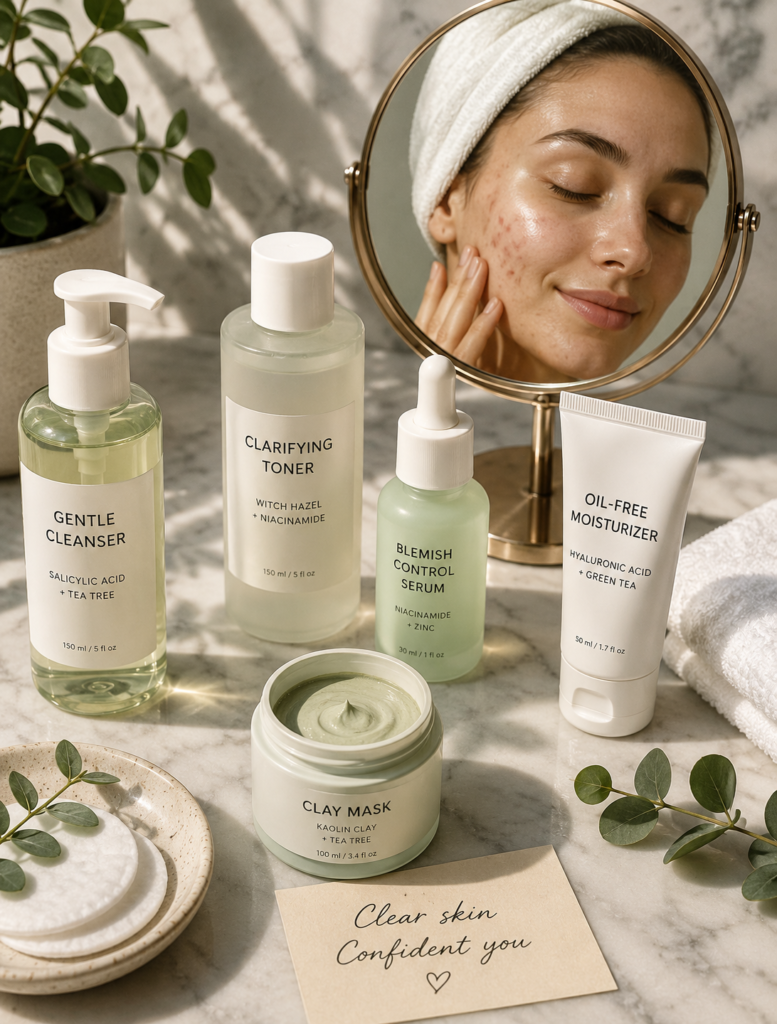
CATEGORY: Acne-Prone Skin
Acne-prone skin can be surprisingly difficult to care for because the instinctive response to breakouts is often to become more aggressive. A new blemish appears, so another treatment is added. Oiliness increases, so the skin is washed more frequently. Blackheads become visible, so scrubs and exfoliating products are used more vigorously. Within a short time, a routine intended to create clearer skin can leave the face dry, irritated, tight, and still breaking out.
The better approach is usually more measured.
Acne develops when hair follicles become blocked by a combination of sebum and dead skin cells, with bacteria and inflammation contributing to many types of lesions. It is therefore not simply evidence that the skin is “dirty,” and repeatedly washing or scrubbing the surface cannot remove the biological processes occurring inside follicles.
An effective skincare routine for acne-prone skin needs to accomplish several things simultaneously. It should cleanse without unnecessarily irritating the skin, use suitable acne-fighting ingredients when needed, maintain hydration, protect the skin from ultraviolet radiation, and remain simple enough to follow consistently.
That last requirement matters more than it may seem. Acne care is rarely about finding the harshest product. It is about creating a routine the skin can tolerate long enough for useful ingredients to work.
Understanding What Acne-Prone Skin Actually Means
“Acne-prone” is not a single skin type.
A person can have oily acne-prone skin, combination acne-prone skin, dry acne-prone skin, or sensitive skin that also develops acne. Two people experiencing similar-looking breakouts may therefore respond very differently to the same skincare routine.
Acne itself can also take several forms.
Blackheads and whiteheads develop from clogged follicles. Inflamed papules appear as red or tender bumps, while pustules contain visible fluid. Deeper nodules and cysts develop farther beneath the surface and carry a greater risk of permanent scarring.
This is why copying another person’s routine can be disappointing.
A product that works beautifully for someone dealing primarily with blackheads may not be sufficient for someone experiencing deep inflammatory acne. Likewise, a routine designed for very oily skin could be unnecessarily drying for someone whose acne-prone skin is already sensitive.
Good skincare begins with understanding the problem rather than simply attacking every blemish.
Why Over-Cleansing Can Make the Routine Worse
Oiliness creates the understandable feeling that the skin needs to be cleaned repeatedly.
But acne is not caused by inadequate hygiene.
Dermatologists generally recommend gently washing acne-prone skin up to twice daily and after significant sweating rather than repeatedly cleansing throughout the day. Scrubbing with rough washcloths, brushes, or abrasive tools can increase irritation rather than improving acne.
A cleanser therefore does not need to leave the face feeling dramatically “squeaky clean.”
That sensation can actually indicate that too much surface oil has been removed.
For everyday cleansing, the objective is straightforward: remove accumulated oil, sweat, makeup, sunscreen, and environmental debris while disturbing the skin as little as reasonably possible.
Use lukewarm water and the fingertips rather than treating cleansing as a form of exfoliation.
Afterward, the skin should feel clean but comfortable.
If it immediately feels painfully tight or becomes visibly irritated, the cleansing step may be too aggressive.
The Morning Routine: Keep It Functional
A morning routine for acne-prone skin does not need ten stages.
For many people, a sensible structure begins with gentle cleansing, followed by any appropriate treatment, moisturizer where needed, and sunscreen.
The treatment stage depends on the individual.
Salicylic acid is commonly used in acne products because it helps unclog pores and exfoliate within the follicular environment. It can be particularly useful for whiteheads and blackheads. Benzoyl peroxide works differently, helping reduce acne-associated bacteria and playing an important role in acne treatment. Azelaic acid can help unclog pores and reduce inflammation and may also help with the dark marks that remain after some acne lesions heal.
The mistake is assuming that because these ingredients can help acne, using several of them aggressively at the same time must work faster.
Skin does not necessarily respond that way.
Introducing treatments gradually makes it easier to determine what the skin tolerates and which product is actually helping.
Acne-Prone Skin Still Needs Moisture
One of the most persistent misconceptions in acne skincare is that moisturizer belongs only on dry skin.
People with oily complexions may fear that adding moisture will automatically produce more breakouts. Yet many acne treatments—including salicylic acid, benzoyl peroxide and topical retinoids—can cause dryness and irritation. A suitable moisturizer can help the skin tolerate treatment. Dermatologists recommend looking for products described as oil-free, non-comedogenic, or unlikely to clog pores.
This creates an important distinction between oil and hydration.
Skin can be oily and dehydrated at the same time.
A lightweight moisturizer may therefore be entirely appropriate for someone whose face becomes shiny during the day.
The ideal texture is personal. Some people prefer a light gel or lotion, while others need a more substantial cream in certain areas or during colder months.
The goal is not to make acne-prone skin as dry as possible.
The goal is to keep it comfortable enough that the rest of the routine can function without creating unnecessary irritation.
Sunscreen Is Part of Acne Care
Sunscreen can feel intimidating when you are prone to clogged pores, particularly if previous formulas have felt heavy or greasy.
Nevertheless, sun protection remains an important part of the routine.
The American Academy of Dermatology recommends broad-spectrum, water-resistant SPF 30 or higher and advises people with acne-prone skin to look for products labeled non-comedogenic or “won’t clog pores.” Some acne medications can also increase sensitivity to sunlight.
There is another cosmetic reason not to ignore sun protection.
After an inflamed blemish disappears, discoloration may remain. Preventing unnecessary ultraviolet exposure is part of caring for skin while these marks gradually improve.
The best sunscreen is not simply the one with the most sophisticated formulation on paper.
It is one that provides appropriate protection and feels comfortable enough that you will actually apply it consistently.
Building an Evening Routine
The evening routine has a slightly different purpose because the skin may be carrying sunscreen, makeup, oil, sweat, and other residue accumulated throughout the day.
Makeup should be removed before sleeping. Even products marketed as non-comedogenic should not simply remain on the skin overnight.
After cleansing, an acne treatment can be used according to its instructions or according to professional advice.
This is where restraint becomes particularly valuable.
People often create complicated nighttime routines containing exfoliating acids, retinoids, spot treatments, masks, serums, and other active products because nighttime feels like an opportunity to “repair” the skin.
The result can be cumulative irritation.
A simpler routine used consistently is often easier to evaluate.
If the skin becomes irritated after six new products were introduced simultaneously, identifying the cause becomes almost impossible.
Introduce changes thoughtfully enough that your skin can tell you what is working.
Why Spot Treatment Is Not Always the Whole Strategy
When a pimple appears, treating only the visible blemish seems logical.
But acne begins before every developing lesion becomes visible.
The American Academy of Dermatology notes that acne medication is often more effective for prevention when a thin layer is applied across the acne-prone area as directed rather than exclusively onto individual visible spots.
The exact approach depends on the medication, so product directions and professional advice matter.
The broader lesson is important: successful acne care is not merely an emergency response to today’s pimple.
It is an attempt to reduce the conditions that create tomorrow’s breakout.
The Problem With Constantly Changing Products
Acne creates impatience because the skin is highly visible.
When a product has been used for several days without obvious improvement, it can be tempting to abandon it and purchase something new.
Then another product arrives.
Then another.
Soon the routine changes every week.
This makes it difficult to know what is helping and increases the possibility of irritation. Dermatologists advise giving acne treatment time to work; noticeable improvement often requires several weeks rather than several days.
Skincare marketing encourages novelty.
Acne treatment often rewards consistency.
Photographing the skin periodically under similar lighting can sometimes provide a more objective impression than examining it closely in the mirror several times every day.
Do Not Try to Scrub Acne Away
Physical exfoliation can create an immediate sensation of smoothness, which makes aggressive scrubbing psychologically satisfying.
But acne cannot simply be polished off the face.
Scrubbing irritated acne-prone skin can increase inflammation and make the complexion look angrier. Dermatologists specifically recommend gentle cleansing rather than abrasive scrubbing.
This is especially relevant when active acne treatments are already increasing skin sensitivity.
More exfoliation is not automatically better exfoliation.
A sophisticated routine knows when to leave the skin alone.
Why Picking Pimples Is So Tempting—and So Unhelpful
Few skincare habits are harder to resist than squeezing a blemish that appears ready to disappear.
The problem is that manipulating acne can push material deeper into the skin, increase inflammation, prolong healing, and raise the risk of scarring or post-inflammatory discoloration.
The immediate visual reward can therefore create a longer-term problem.
One useful change is to reduce opportunities for unconscious touching.
Avoid spending excessive time examining the skin at extreme magnification. Keep hands occupied when working or watching television if face-touching has become habitual. Treat the blemish according to the routine and then allow the skin time to respond.
Not every imperfection needs immediate mechanical intervention.
Choosing Makeup for Acne-Prone Skin
Acne-prone skin does not mean makeup must be abandoned.
Product selection and removal matter more.
Look for makeup described as non-comedogenic or unlikely to clog pores, and remove it completely before sleeping. Brushes, sponges, and other applicators should also be kept personal rather than shared.
Heavy coverage can sometimes become part of a frustrating cycle.
A breakout creates the desire for more coverage. More products are layered onto already irritated skin. Removing those layers requires more cleansing. The skin becomes increasingly sensitive.
This does not mean full-coverage makeup is forbidden.
It means the entire routine—from application through removal—should remain as gentle as possible.
When Skincare Is Not Enough
There is an important limit to what a cosmetic skincare routine should be expected to accomplish.
Deep, painful nodules and cysts have a higher risk of permanent scarring and warrant professional dermatologic treatment. Persistent acne that does not respond after an appropriate period of consistent care can also require medical assessment.
Seeking professional treatment is not evidence that a skincare routine has “failed.”
Acne is a medical skin condition with multiple possible contributing factors, and some forms require prescription treatment.
This distinction protects people from spending months purchasing increasingly aggressive cosmetics for a problem that needs a different level of care.
The Best Routine Is Often the One You Can Maintain
A useful acne-prone skincare routine should not feel like a daily battle against your face.
It should be understandable.
Gentle cleansing removes what needs to be removed.
Appropriate active ingredients target the mechanisms contributing to acne.
Moisturizer supports comfort and treatment tolerance.
Sunscreen protects the skin.
Consistency gives the routine enough time to demonstrate whether it is working.
The most important change may therefore be moving away from the idea that acne-prone skin needs punishment.
It needs management.
Clearer-looking skin is rarely produced by scrubbing harder, washing more frequently, squeezing every blemish, or introducing a new miracle product every few days.
A calmer strategy respects the biology of the skin while using evidence-based ingredients intelligently.
For acne-prone skin, simplicity is not a lack of sophistication.
Sometimes it is exactly what allows a sophisticated routine to work.
 Discover More From Our Family of Websites
 ZodiacBearing (Astrology, Tarot, Numerology, Angel Numbers & Spiritual Guidance)
 Velourana (Beauty, Makeup, Hair Care, Skincare & Beauty Tips)
 HavenBearing (Home, Living, Organization, Décor & Everyday Inspiration)
 PawBearing (Pet Care, Dog Breeds, Animal Health, Training & Pet Products)
 PsyCatherine (Notes From the Journal of a Psychologist on Real Life)

