
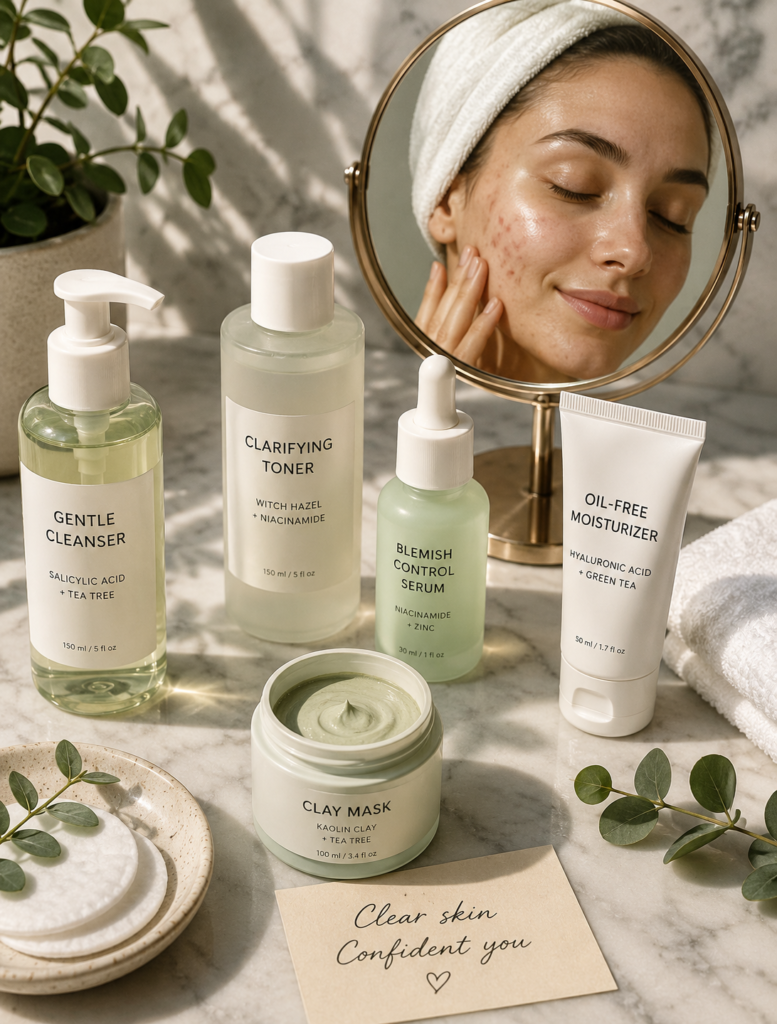
CATEGORY: Acne-Prone Skin
Having acne-prone skin does not mean giving up makeup. Foundation, concealer, powder, blush, and other complexion products can be worn successfully when the products and the surrounding skincare routine are chosen thoughtfully.
The difficulty is that acne changes what people often want from makeup.
Someone with relatively clear skin may use foundation mainly to even the complexion. Someone experiencing active acne may want to conceal redness, raised blemishes, dark post-acne marks, uneven texture, and oiliness simultaneously. That can encourage increasingly heavy layers of makeup, stronger primers, more powder, and aggressive cleansing at the end of the day.
Eventually, the attempt to hide acne can make the entire routine more complicated than the acne itself.
The better strategy is not necessarily to use less makeup. It is to understand what makeup can realistically accomplish, choose products suited to acne-prone skin, apply them without unnecessary friction, and remove them thoroughly but gently.
Makeup should coexist with acne care rather than compete with it.
Makeup Does Not Automatically Cause Acne
It is easy to blame makeup whenever breakouts occur because foundation sits directly on the areas where acne develops.
But makeup itself is not automatically incompatible with acne-prone skin.
Modern complexion products vary enormously in formulation. Many foundations, concealers, primers, and powders are specifically designed to be non-comedogenic, meaning they are formulated with the intention of minimizing pore clogging.
For acne-prone skin, labels such as “non-comedogenic,” “oil-free,” or “won’t clog pores” can provide a useful starting point.
They are not absolute guarantees.
Individual skin can react differently to the same formulation, and acne is influenced by far more than cosmetics alone.
Still, product selection matters.
If someone is experiencing persistent breakouts while using a very heavy or highly occlusive cosmetic routine, examining those products is reasonable.
The important point is to investigate rather than automatically assume.
Begin With Skincare, Not Foundation
The appearance of makeup depends heavily on the condition of the skin beneath it.
This becomes especially obvious when acne treatments are being used.
Benzoyl peroxide, salicylic acid, retinoids, and other active ingredients can produce dryness or peeling. Foundation applied over irritated skin may collect around flakes, cling to dry patches, and make texture more visible.
The instinct is often to add more foundation.
That usually makes the problem more obvious.
A better makeup day often begins with a better-prepared skin surface.
Cleanse gently.
Use the appropriate acne treatment according to the routine.
Apply moisturizer where needed.
Use sunscreen during the day.
Allow skincare products enough time to settle before beginning makeup.
The goal is not to create perfectly smooth skin. Active acne has texture, and makeup cannot completely remove three-dimensional texture.
The goal is to create a comfortable surface that allows makeup to sit as evenly as possible.
Moisturizer Can Improve Makeup on Oily Acne-Prone Skin
People with oily acne-prone skin sometimes skip moisturizer before makeup because they fear additional shine.
This can backfire.
If the skin is dehydrated or irritated, foundation may sit unevenly even when the face produces substantial oil later in the day.
A lightweight, non-comedogenic moisturizer can provide hydration without necessarily creating a heavy finish.
The amount matters.
Applying a thick layer immediately before foundation can cause products to move or pill. A modest amount, allowed to absorb properly, is often easier to work with.
This is another example of why oily skin and hydrated skin should not be treated as opposites.
A complexion can need hydration while still requiring oil management.
Choosing Foundation for Acne-Prone Skin
There is no single foundation texture that works for every acne-prone complexion.
Oily skin may prefer lightweight, long-wearing, or more matte formulations.
Dry acne-prone skin may look better with a flexible, hydrating finish.
Sensitive acne-prone skin may benefit from simpler formulations that avoid ingredients known to cause personal irritation.
Coverage is another decision.
Full-coverage foundation can reduce the need for extensive concealer, but it can also create a heavier overall appearance.
Light or medium coverage allows more natural skin variation to remain visible and can then be supplemented with concealer only where necessary.
Neither approach is inherently better.
The most useful foundation is the one that provides the desired cosmetic result without creating discomfort or interfering unnecessarily with the skincare routine.
Do Not Try to Flatten Texture With Product
Color can be concealed remarkably well.
Texture cannot.
A red mark can be covered because makeup changes the color visible to the eye. A raised inflammatory blemish remains physically raised regardless of how much foundation is placed over it.
This is where people often begin over-applying product.
A blemish remains visible from the side, so another layer of concealer is added.
Then powder.
Then another layer.
The color may disappear, but the accumulated product can make the texture more obvious.
Instead, concentrate on reducing color contrast.
If the redness is softened enough that the blemish no longer immediately attracts attention, the result may look more natural than attempting complete visual disappearance.
Concealing Individual Blemishes
Targeted concealing can be particularly effective for acne-prone skin.
After applying a relatively thin foundation layer, place a small amount of concealer directly over the remaining discoloration.
Use a clean fingertip, small brush, or other suitable applicator and avoid repeatedly rubbing the blemish.
Allowing the concealer to sit briefly before blending the edges can sometimes preserve more coverage exactly where it is needed.
The central area does not necessarily need heavy blending.
The edges do.
This creates the illusion that the concealer belongs to the surrounding complexion rather than forming an obvious patch over the blemish.
For raised spots, precision generally works better than volume.
Color Correction Can Reduce Heavy Layers
Very red acne can sometimes be neutralized with a small amount of color corrector before foundation or concealer.
Green-toned correctors are commonly used to counter visible redness because green sits opposite red in traditional color theory.
The key word is small.
Too much green corrector creates a new color problem that then requires additional foundation to hide.
A tiny amount placed only where redness is significant can reduce the amount of complexion makeup needed afterward.
Color correction is therefore not about painting the face green.
It is about strategically reducing contrast.
Powder Without Creating a Mask
Powder can be useful for oily acne-prone skin because it reduces shine and helps set complexion products.
But excessive powder can emphasize dryness, peeling, and raised texture.
Instead of applying a thick layer across the entire face, consider where oil actually becomes problematic.
For many people, that means the forehead, nose, and chin.
Other areas may require much less.
A small amount can also be pressed gently over concealed blemishes to improve longevity.
Again, the objective is not to transform skin into a completely matte surface.
Natural skin has dimension.
Strategic powdering usually looks more realistic than covering every area equally.
The Importance of Clean Brushes and Sponges
Makeup tools repeatedly contact skin, cosmetics, oils, and the surrounding environment.
They should therefore be cleaned regularly.
A foundation brush containing weeks of accumulated product is not an ideal tool for acne-prone skin.
Sponges require particular attention because damp environments and product residue can make hygiene more difficult.
Allow reusable tools to dry properly after cleaning and replace them when they are damaged or can no longer be cleaned effectively.
Also avoid sharing makeup brushes, sponges, or products that directly contact the skin.
Good tool hygiene is a simple part of an acne-conscious makeup routine.
Hands Matter Too
Many people apply foundation, concealer, or cream products with their fingers.
There is nothing inherently wrong with this technique.
Fingertips can provide excellent control and warmth can help certain products blend naturally.
But hands should be clean before touching the face.
The same principle applies throughout the day.
If makeup has separated around a blemish, repeatedly touching and smoothing it with unwashed fingers may not be the best solution.
Keep necessary touch-ups deliberate rather than turning face-touching into an unconscious habit.
Be Careful With Makeup Over Open or Damaged Blemishes
A blemish that has been picked, squeezed, or accidentally opened is different from intact acne.
The skin surface has been damaged.
Applying several layers of cosmetic product directly onto freshly injured skin may cause additional irritation.
Whenever possible, allow the area to settle rather than repeatedly manipulating it for cosmetic reasons.
This is another reason resisting the urge to squeeze pimples can improve makeup results.
An intact red blemish is often easier to conceal than a freshly picked lesion that is swollen, uneven, and difficult for makeup to adhere to.
Primer: Useful but Not Mandatory
Primer can improve makeup wear, reduce visible shine, or change how foundation sits on the skin.
But acne-prone skin does not automatically need primer.
If the moisturizer and sunscreen already create a suitable surface, another layer may add little benefit.
For someone with very oily skin, a mattifying primer applied selectively to high-shine areas may be useful.
Someone dealing with treatment-related dryness may prefer a hydrating primer.
The important question is whether the primer solves a specific problem.
Do not add products simply because a complete makeup routine supposedly requires them.
Sunscreen Must Come Before Makeup
Makeup containing SPF can be useful, but it should not generally be relied upon as the only sun protection because people rarely apply foundation in the quantity necessary to achieve the labeled sunscreen protection.
A dedicated broad-spectrum sunscreen should form the final skincare step before makeup.
For acne-prone skin, texture matters enormously.
A sunscreen that feels heavy beneath foundation may encourage someone to skip it.
Finding a lightweight, non-comedogenic formulation that works comfortably under makeup can make daily protection far easier.
Allow sunscreen to settle before applying foundation rather than immediately rubbing another product over it.
Touching Up Oily Skin During the Day
When oil begins appearing through makeup, the instinct may be to apply more powder immediately.
After several touch-ups, however, layers can become thick and uneven.
Blotting first can help.
Gently removing excess surface oil with blotting paper or an appropriate tissue reduces shine without immediately adding more material.
Powder can then be applied lightly where still necessary.
This often produces a cleaner result than continually layering powder over accumulating oil.
Removing Makeup Properly at Night
For acne-prone skin, makeup removal is one of the most important parts of the cosmetic routine.
Going to sleep with foundation, concealer, sunscreen, oil, and daily residue still on the face is not a good habit.
Long-wearing or water-resistant products may require an initial removal step before ordinary cleansing.
Micellar water, cleansing oils, balms, or other makeup removers can be used depending on personal preference and skin tolerance.
This can then be followed with a gentle facial cleanser when necessary.
The important word remains gentle.
Removing makeup thoroughly does not require scrubbing until the face feels raw.
Double Cleansing Without Double Stripping
Double cleansing can be useful when substantial makeup or resistant sunscreen has been worn.
The first cleanser dissolves or removes the cosmetic layer.
The second cleanses the skin.
But two cleansing stages should not mean two aggressive cleansers.
If the skin feels extremely tight after double cleansing every evening, the routine may need adjustment.
The objective is complete removal with minimal unnecessary disruption.
Someone wearing only light makeup may not always require the same removal routine as someone wearing full-coverage, waterproof products.
Adapt the process to what actually needs to be removed.
Makeup and Post-Acne Marks
Not every spot visible beneath foundation is active acne.
Post-inflammatory marks can remain long after the original blemish has healed.
These flat areas of discoloration are generally easier to conceal than active raised lesions.
This is useful psychologically because it allows makeup to do what makeup does particularly well: modify visible color.
A thin foundation layer followed by targeted concealer may provide substantial improvement without covering the entire face heavily.
Meanwhile, the skincare routine can address the discoloration gradually with appropriate ingredients and consistent sun protection.
Avoid Changing Foundation Every Time You Break Out
Acne develops over time.
If one new pimple appears the morning after wearing a foundation, that alone does not prove the foundation caused it.
Constantly changing complexion products can make identifying genuine triggers more difficult.
If you suspect a product, look for a pattern.
Did breakouts increase after it was introduced?
Are they occurring in areas where the product is consistently applied?
Does the problem improve after discontinuation?
Controlled observation is more reliable than blaming the newest product for every individual blemish.
Makeup Can Affect Confidence—But It Should Remain a Choice
Acne can make makeup feel less like decoration and more like armor.
Someone may reach a point where leaving the house without foundation feels impossible.
There is nothing wrong with using makeup to feel more comfortable.
At the same time, it can be helpful to remember that acne does not need to be completely invisible before you are allowed to be seen.
Makeup should ideally expand choices rather than restrict them.
Wear full coverage when you want it.
Wear concealer alone when that feels better.
Wear no makeup when you prefer.
The purpose of cosmetics is to serve the person using them, not to create another standard they feel obligated to satisfy.
When Acne Needs More Than Better Makeup
Makeup techniques can improve the visible appearance of acne, but they cannot treat severe acne beneath the surface.
If breakouts are deep, painful, persistent, widespread, or beginning to scar, professional dermatologic care becomes important.
This is especially true when increasingly heavy makeup is being used to conceal a condition that continues worsening.
Treating the underlying acne can eventually make the cosmetic routine easier as well.
Less inflammation means less redness to conceal.
Fewer new lesions mean fewer marks.
Better control can reduce the amount of makeup required for the same visual result.
Creating a Makeup Routine That Respects Acne-Prone Skin
The best makeup strategy for acne-prone skin is not built around fear of every cosmetic ingredient.
It is built around thoughtful choices.
Prepare the skin without overloading it.
Choose non-comedogenic products where possible.
Use foundation to even the complexion rather than trying to physically erase texture.
Conceal strategically.
Keep tools clean.
Avoid unnecessary touching.
Remove makeup properly every night.
Continue the acne treatment routine consistently beneath the cosmetic routine.
Most importantly, remember that makeup and skincare have different jobs.
Skincare works gradually on the condition and health of the skin.
Makeup changes how the skin appears today.
When those two purposes are kept separate, they can work together remarkably well.
Acne-prone skin does not have to choose between treatment and cosmetics. With sensible products, careful application, good hygiene, and gentle removal, makeup can remain an enjoyable part of beauty rather than another source of stress for already demanding skin.
The End
Velourana
 Discover More From Our Family of Websites
 ZodiacBearing (Astrology, Tarot, Numerology, Angel Numbers & Spiritual Guidance)
 Velourana (Beauty, Makeup, Hair Care, Skincare & Beauty Tips)
 HavenBearing (Home, Living, Organization, Décor & Everyday Inspiration)
 PawBearing (Pet Care, Dog Breeds, Animal Health, Training & Pet Products)
 PsyCatherine (Notes From the Journal of a Psychologist on Real Life)

