
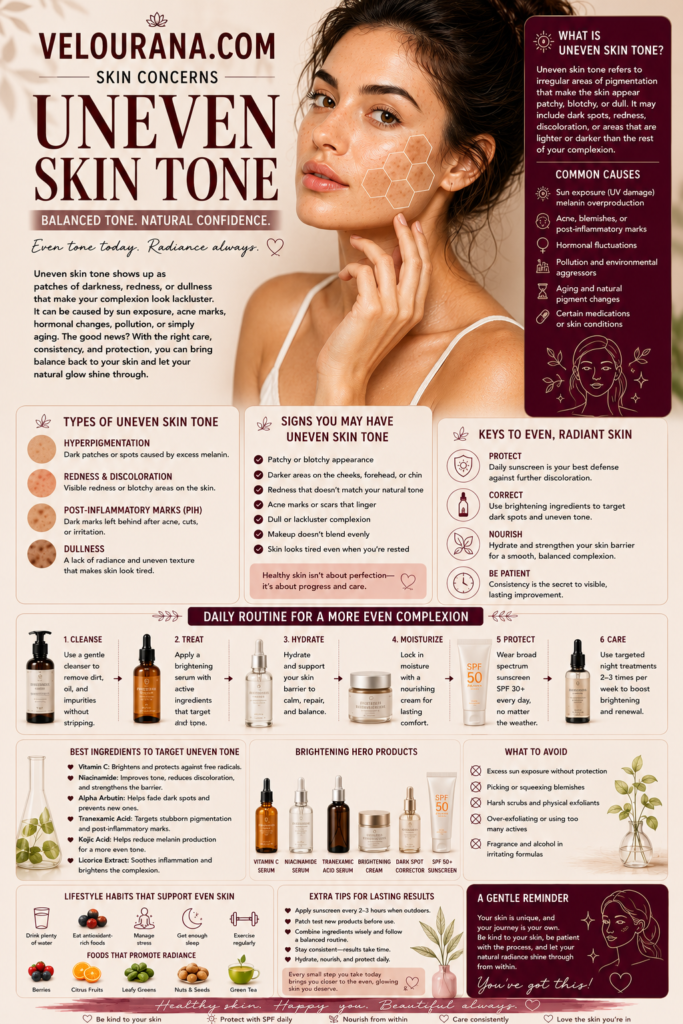
CATEGORY: Uneven Skin Tone
Uneven skin tone creates a particular kind of impatience because it is constantly visible and often slow to change. A blemish may disappear in days, yet the mark it leaves behind can remain for months. A patch of sun-related pigmentation can persist through several seasons. Redness may fade and return. Dullness can improve briefly with hydration, then reappear when the barrier becomes stressed.
Because the concern develops gradually but sits directly in view, it invites overreaction.
A stronger acid seems more promising than a gentle one. More frequent exfoliation appears more efficient than patience. Several brightening serums layered together can feel more convincing than one carefully selected treatment. The skincare market reinforces this instinct by presenting correction as something that should be accelerated.
Yet uneven tone is one of the concerns most likely to be worsened by excessive intervention.
Pigmentation is influenced by inflammation. Redness is influenced by irritation. Dullness is influenced by dehydration and barrier disruption. Texture becomes more visible when the skin is dry or inflamed. A routine that is too aggressive can therefore intensify several elements of unevenness at once.
This creates an important paradox.
The complexion often becomes more even not when treatment becomes stronger, but when the skin becomes more stable.
Stability is less dramatic than correction. It does not promise overnight transformation. It asks for repeated protection, controlled use of active ingredients, respect for the barrier and enough patience for biological processes to unfold.
But for many people, this quieter strategy produces the better long-term result.
Uneven Tone Is Often the End Result of Too Much Activity
When someone looks at uneven skin, the visual impression is simple: certain areas look different from others.
The causes are not simple.
One area may contain excess melanin. Another may be red because of inflammation. A third may appear darker because rough texture is creating shadow. A fourth may be dehydrated and reflecting light poorly.
When all of these variations are grouped together under one label, the instinct is to treat the whole face aggressively.
This is where problems begin.
If the dominant issue is pigmentation, repeated irritation can create more pigment in susceptible skin. If redness is important, strong exfoliation can intensify vascular visibility. If dryness is contributing to dullness, stripping the surface can make it look worse.
The skin does not care that the product is marketed for brightening.
It responds to the biological effect of the product.
This is why an ingredient can be useful in theory and counterproductive in practice.
The question is never simply whether an ingredient can improve uneven tone.
The question is whether it can improve this particular complexion at a frequency and strength the skin can tolerate.
Stability Is an Active Treatment Strategy
The word stability can sound passive.
In reality, it involves several active processes.
A stable skin barrier retains water more effectively. It provides better protection from external irritants. It reduces the tendency for ordinary products to sting. It creates a calmer environment in which targeted ingredients can be used more consistently.
A stable routine also allows cause and effect to become visible.
If the products remain relatively constant, it becomes easier to identify what triggers worsening. A sudden increase in pigmentation after intense sun exposure is easier to recognise. Redness after introducing a new exfoliant becomes obvious. Breakouts can be evaluated independently of constant product changes.
Stability therefore improves both biology and understanding.
This is particularly valuable for uneven tone because progress is usually gradual.
Constantly changing the routine destroys the baseline needed to judge whether improvement is actually occurring.
The Barrier Determines More Than Comfort
The skin barrier is often discussed in terms of sensitivity, but its relevance extends far beyond whether the face feels comfortable.
A compromised barrier changes appearance.
Water loss makes the surface rougher. Fine flaking creates irregular reflection. Redness becomes more visible. Makeup may settle unevenly. Active ingredients penetrate more unpredictably and can produce stronger reactions.
In pigmentation-prone skin, barrier disruption may also contribute indirectly to new discoloration through inflammation.
This means that moisturisation is not a secondary concern.
It is part of tone management.
A well-formulated moisturiser can support hydration, reduce surface roughness and improve the visual continuity of the complexion even before deeper pigmentation changes significantly.
This immediate optical improvement is sometimes underestimated because it is not equivalent to pigment removal.
But appearance is produced by both colour and surface quality.
Improving one can make the other look significantly better.
Why Over-Exfoliation Is So Seductive
Exfoliation offers immediate sensory rewards.
The skin often feels smoother after acids or scrubs. Light reflects more strongly. Makeup applies more evenly. The complexion may appear brighter within hours.
This immediate result can encourage overuse.
If twice a week looks good, daily use may seem even better.
But exfoliation has a threshold.
Beyond that threshold, removal of surface cells stops being beneficial and begins to interfere with barrier function.
The first signs can be subtle.
Tightness after cleansing.
A slight sting when applying moisturiser.
Increased shine accompanied by dehydration.
Flaking around the nose or mouth.
Products that once felt comfortable suddenly becoming irritating.
At this stage, continuing aggressive exfoliation can transform a tone-correcting routine into a source of unevenness.
The complexion may become simultaneously red, dull, rough and more pigmentation-prone.
This is not evidence that the skin is “purging” pigment.
It is evidence that the routine may have exceeded the skin's tolerance.
Skin Turnover Cannot Be Forced Without Consequences
The popularity of exfoliation is partly based on the understandable idea that removing older surface cells will reveal fresher skin underneath.
There is truth in this.
The epidermis continually renews itself. Superficial pigmented cells gradually move toward the surface and are eventually shed.
But natural turnover is an organised biological process.
It is not equivalent to stripping layers away as rapidly as possible.
Strong chemical exfoliation can influence surface renewal, but the objective should be controlled support rather than constant disruption.
This is particularly important when pigmentation sits deeper than the superficial epidermis.
No amount of scrubbing can simply remove pigment located in deeper skin layers.
Increasing exfoliation intensity in response to persistent deep pigmentation therefore creates risk without necessarily addressing the actual problem.
The Strongest Brightening Ingredient Is Not Always the Best Choice
Brightening ingredients differ in strength, mechanism and tolerability.
Vitamin C can support antioxidant protection and brightness.
Niacinamide can influence pigmentation while also supporting barrier function.
Azelaic acid can be particularly useful when uneven tone overlaps with acne or redness.
Retinoids influence cellular behaviour and can improve several signs of photoageing over time.
Alpha hydroxy acids can support surface renewal.
Tranexamic acid and alpha arbutin are also common in tone-focused formulations.
Each can have a legitimate place.
The mistake is assuming that the strongest formulation or highest concentration will always produce the best outcome.
An ingredient only works when it can be used consistently enough to matter.
If a strong formula repeatedly causes irritation, a gentler alternative may outperform it over time simply because the routine remains sustainable.
Multiple Good Ingredients Can Still Create a Bad Routine
One of the most common mistakes in tone correction is ingredient stacking.
A vitamin C serum is added in the morning.
An exfoliating toner follows cleansing.
A retinoid is used at night.
A separate brightening serum is layered on top.
A strong peel is used weekly.
Each individual product may be reasonable.
The combination may not be.
Skin tolerance is cumulative.
The barrier experiences the total routine, not each product in isolation.
This is why a routine built entirely from well-regarded products can still produce poor results.
The issue is not necessarily ingredient quality.
It is total treatment burden.
Irritation Creates Visual Noise
When the skin is inflamed, it becomes much harder to evaluate pigmentation accurately.
Redness changes contrast.
Dryness makes dark areas appear deeper.
Flaking exaggerates shadows.
Shine and dehydration coexist, creating irregular reflectivity.
The face becomes visually noisy.
This can lead to another layer of over-treatment because the person sees more unevenness and assumes the pigmentation itself is worsening.
In reality, much of the change may be inflammation.
Reducing irritation can therefore reveal the true baseline.
Sometimes the complexion looks significantly more even after several weeks of simplification even though no strong pigment-correcting treatment has been used.
The apparent improvement comes from removing inflammatory distortion.
Sun Protection Is the Most Important Form of Restraint
Restraint is not only about using fewer products.
It also means limiting the environmental stimulus most strongly associated with pigmentation.
Ultraviolet radiation encourages melanin production and contributes to cumulative photodamage.
This makes sunscreen one of the most important tools for anyone trying to improve uneven pigmentation.
The challenge is consistency.
Sunscreen is easy to treat as optional on cloudy days, during short errands or outside summer.
But pigmentation responds to accumulated exposure.
Protection therefore needs to become routine rather than seasonal.
Shade, hats and avoiding unnecessarily intense exposure can support sunscreen use.
The aim is not to eliminate daylight.
It is to reduce repeated stimulation of pigment production while the skin is being asked to correct existing unevenness.
Prevention Makes Treatment More Efficient
A routine that fades pigment while new pigment continues forming has limited visible impact.
This is why prevention changes the mathematics of uneven tone.
Imagine ten old marks gradually fading.
If ten new ones appear during the same period, the complexion may look unchanged.
If only two new marks appear, improvement becomes visible.
This principle applies to acne, sun exposure and irritation.
Reducing new inflammatory lesions reduces post-inflammatory marks.
Reducing ultraviolet exposure limits new pigment stimulation.
Reducing barrier damage limits inflammation.
Prevention does not merely protect the result after correction.
It makes correction easier in the first place.
Acne Control Often Matters More Than Another Brightening Serum
For acne-prone skin, the most rational pigmentation strategy may begin with breakout control.
Every inflammatory lesion creates another opportunity for a lingering mark.
A routine that successfully brightens old pigmentation while allowing frequent new breakouts cannot fully catch up.
Treating acne and uneven tone as separate concerns therefore misses their biological connection.
Ingredients such as salicylic acid, benzoyl peroxide, azelaic acid and retinoids can have roles depending on the type and severity of acne.
Persistent or severe acne may require professional treatment.
The central idea is simple.
Stop creating new marks before expecting the old ones to disappear completely.
Picking Extends the Pigmentation Cycle
Picking is one of the most preventable contributors to post-blemish discoloration.
Squeezing or scratching increases tissue injury and can prolong inflammation.
A blemish that might have healed relatively quietly becomes a larger inflammatory event.
The visible mark may remain long after the original breakout is forgotten.
This makes hands-off healing an important part of tone management.
It sounds trivial compared with sophisticated skincare ingredients.
But pigmentation often responds to behaviour as much as products.
Friction Can Be More Important Than Expected
Repeated rubbing can maintain unevenness in specific areas.
The chin, neck, upper lip and regions exposed to shaving or hair removal are particularly vulnerable.
Aggressive cleansing, rough towels and habitual touching can add low-level mechanical irritation.
One episode may do little.
Repeated daily, it becomes biologically relevant.
When pigmentation keeps returning to the same area, friction should be considered alongside products and hormones.
Hair Removal Requires Its Own Strategy
Waxing, threading, shaving and depilatory products can all affect the skin barrier.
If the method is well tolerated, the effect may be minimal.
If it repeatedly creates redness, burning or bumps, post-inflammatory discoloration can develop.
The upper lip and chin are especially common problem areas.
Changing technique may therefore improve tone more effectively than adding another brightening treatment.
This is another example of treating cause instead of appearance.
Dehydration Should Be Corrected Before Escalating Pigment Treatment
A dehydrated complexion can look substantially darker and duller.
The surface loses smoothness.
Fine lines become more visible.
Light reflects irregularly.
Shadows deepen around texture.
Because this can mimic pigmentation, it is sensible to improve hydration before assuming that stronger brightening is required.
Humectants, emollients and barrier-supportive ingredients can help restore surface quality.
Once the skin is hydrated, the remaining true pigmentation becomes easier to evaluate.
Redness Must Be Separated From Brown Pigment
Uneven skin often contains both vascular and pigmentary changes.
Brown marks may respond to melanin-targeting ingredients.
Red marks require a different approach.
Post-inflammatory erythema, facial sensitivity and vascular conditions cannot be treated simply by increasing pigment-focused actives.
If redness is prominent, calming the skin may produce a more even appearance faster than aggressive brightening.
Persistent or unexplained redness may require professional evaluation.
Brightness and Evenness Are Related but Not Identical
A bright complexion is not necessarily evenly pigmented.
An even complexion is not necessarily luminous.
Brightness refers partly to how the skin reflects light.
Evenness refers to the consistency of colour and appearance across the face.
Hydration, texture and surface smoothness strongly influence brightness.
Melanin distribution and vascular changes strongly influence tone.
This distinction helps explain why some products produce immediate radiance without significantly changing pigmentation.
Both outcomes can be valuable.
They should simply not be confused.
Time Allows You to Distinguish Improvement From Temporary Effects
Many skincare products create immediate cosmetic changes.
Hydration improves reflection.
Silicones smooth texture.
Exfoliation can create short-term brightness.
These effects are not meaningless, but they are different from long-term pigment correction.
True changes in uneven tone usually require sustained treatment.
This is why progress should be evaluated over weeks and months rather than hours.
Periodic photographs in similar lighting can help.
Daily mirror inspection often exaggerates small fluctuations.
Seasonal Changes Require Adaptation, Not Panic
The skin does not behave identically throughout the year.
Summer increases ultraviolet exposure and often oil production.
Winter may increase dryness and barrier vulnerability.
A pigmentation routine may therefore need minor seasonal adjustments.
This does not require rebuilding the entire routine every few months.
A stable core can remain while moisturiser richness, exfoliation frequency or sunscreen behaviour adapts to changing conditions.
Flexibility within stability is often more effective than constant reinvention.
Mature Skin Benefits From Multifunctional Thinking
As skin ages, uneven tone often overlaps with texture, dryness and photodamage.
Trying to address each concern with a separate aggressive product can create unnecessary complexity.
Multifunctional ingredients may be more useful.
A retinoid, when appropriate and tolerated, can influence texture, cellular behaviour and signs of photoageing.
Niacinamide can support both tone and barrier function.
Sunscreen protects against further pigmentation and photoageing simultaneously.
Moisturisation improves comfort and optical smoothness.
This integrated approach is often more sustainable than treating every visible issue independently.
More Products Can Make It Harder to Know What Works
Every additional active ingredient adds another variable.
If the skin improves, it becomes difficult to know what helped.
If irritation develops, it becomes difficult to know what caused it.
If pigmentation worsens, the source becomes even harder to identify.
A smaller routine creates clarity.
This makes it easier to adjust intelligently.
In skincare, diagnostic simplicity has practical value.
A Good Routine Should Become Boring
There is a point at which a successful skincare routine stops being exciting.
The products are familiar.
The order is predictable.
The skin rarely reacts dramatically.
New ingredients are introduced cautiously.
Results accumulate slowly.
This may feel less satisfying than constant experimentation.
But for uneven tone, boredom is often a sign of stability.
The complexion no longer spends its time recovering from the routine designed to improve it.
Professional Treatments Require the Same Principle of Restraint
Clinical procedures can be useful for persistent pigmentation.
Chemical peels, prescription topicals, lasers and other treatments may produce improvements beyond what ordinary skincare can achieve.
But greater treatment intensity does not remove the need for careful selection.
Some procedures can worsen pigmentation, particularly in skin prone to post-inflammatory hyperpigmentation.
The diagnosis, skin tone, pigment depth and treatment parameters all matter.
Professional treatment should therefore be precise rather than simply powerful.
When to Stop Experimenting and Seek Assessment
Skincare should not be used indefinitely on pigmentation that is unusual, changing or unexplained.
A new or changing mole, rapidly developing pigmentation, an area that bleeds, crusts or fails to heal, or a persistent mark that looks distinctly different from surrounding lesions should be assessed medically.
Likewise, extensive or recurrent pigmentation may benefit from dermatological evaluation.
The goal is not to make every cosmetic concern medical.
It is to recognise the limits of self-directed treatment.
The Best Routine Protects the Skin From the Routine Itself
There is an elegant principle at the centre of tone correction.
The routine should never become one of the major causes of the problem.
If treatment creates persistent inflammation, it is working against itself.
If the skin barrier is continually damaged, the environment for pigment correction is poor.
If sunscreen is abandoned because the routine has made the skin too sensitive to tolerate it, the strategy is failing.
Every product should therefore be judged not only by what it promises to improve, but by what it allows the rest of the routine to continue doing.
A More Even Complexion Is Built Through Repetition
The skin responds most strongly to what happens repeatedly.
Repeated protection reduces environmental stimulation.
Repeated moisturisation supports the barrier.
Repeated restraint reduces inflammation.
Repeated use of well-chosen active ingredients allows gradual correction.
Repeated avoidance of picking reduces new marks.
Repeated patience prevents unnecessary escalation.
This is less dramatic than chasing quick results.
But uneven tone is rarely created by one dramatic event.
It is usually created by accumulation.
It makes sense that improvement should also be built through accumulation.
Restraint Is Not Doing Nothing
Restraint in skincare does not mean ignoring pigmentation.
It means treating it without destabilising the skin.
It means selecting ingredients because they fit the problem rather than because they are powerful.
It means protecting the complexion while correction occurs.
It means recognising irritation early rather than treating pain as proof of effectiveness.
It means accepting that some improvements happen slowly.
It means stopping unnecessary habits that continually recreate the concern.
This approach may look conservative.
Biologically, it is often highly active.
The skin is being given fewer reasons to inflame, fewer reasons to produce irregular pigment and more opportunity to repair itself.
The Quiet Route to an Even Complexion
Uneven skin tone encourages urgency because the contrast is visible.
But visibility should not dictate treatment intensity.
Pigmentation, redness, dullness and texture are all influenced by the condition of the skin as a whole.
A calm barrier supports correction.
Controlled exfoliation can improve surface quality without creating unnecessary inflammation.
Targeted brightening ingredients can be used consistently because the skin remains comfortable.
Sun protection reduces the major environmental stimulus behind many pigment changes.
Breakout control limits new post-inflammatory marks.
Hydration improves optical evenness while deeper changes develop more slowly.
These processes work together.
The result is not achieved by attacking colour until it disappears.
It is achieved by changing the environment that allowed irregular colour to become dominant.
A more even complexion is therefore often the visible consequence of stability.
The skin becomes less reactive.
New marks appear less frequently.
Old marks gradually lose contrast.
Texture becomes smoother.
Redness becomes quieter.
The face begins to look more harmonious not because every natural variation has been erased, but because fewer biological disturbances are competing for attention.
That is the value of restraint.
It does not promise the fastest-looking intervention.
It creates the conditions under which genuine improvement has the best chance to last.
The End
Velourana.
 Discover More From Our Family of Websites
 ZodiacBearing (Astrology, Tarot, Numerology, Angel Numbers & Spiritual Guidance)
 Velourana (Beauty, Makeup, Hair Care, Skincare & Beauty Tips)
 HavenBearing (Home, Living, Organization, Décor & Everyday Inspiration)
 PawBearing (Pet Care, Dog Breeds, Animal Health, Training & Pet Products)
 PsyCatherine (Notes From the Journal of a Psychologist on Real Life)

