
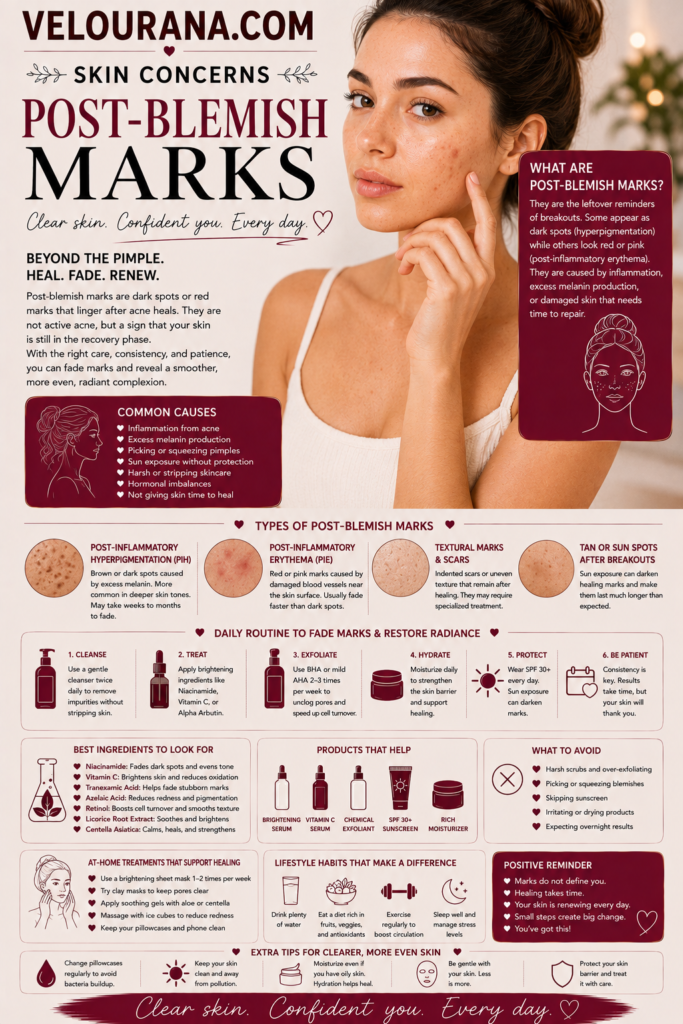
CATEGORY: Post-Blemish Marks
Post-blemish marks rarely disappear because of one dramatic intervention. They fade because a series of quieter processes begins working in the same direction.
New acne becomes less frequent. Inflammation settles more quickly. The skin barrier becomes more stable. Pigment production is no longer repeatedly stimulated by irritation. Sun protection prevents unnecessary darkening. Carefully chosen active ingredients influence cell turnover, pigmentation, or acne formation without overwhelming the skin. Time then does what no product can do instantly: it allows the complexion to recover.
This is not an especially glamorous description of skincare, but it is a realistic one.
The beauty industry often presents post-blemish discoloration as a problem requiring increasingly powerful correction. A dark mark appears and the instinctive response is to exfoliate it, brighten it, peel it, polish it, or add another active serum. If improvement seems slow, treatment is intensified.
That approach misunderstands the nature of the problem.
Most flat post-blemish marks are not foreign material sitting on the surface waiting to be removed. They are the visible consequence of biological changes triggered by inflammation. Pigment may have been produced in excess. Blood vessels may remain more noticeable. Epidermal cells containing extra melanin may still be progressing toward the surface. The area may also be recovering from the original blemish and from any squeezing, picking, or irritation that occurred while it was active.
The skin is therefore already engaged in repair.
The purpose of a good routine is not to overpower that repair process.
It is to stop interfering with it and then support it intelligently.
The First Decision Is Whether the Skin Needs More Treatment or Less
When someone has been struggling with post-blemish marks for months, the natural assumption is that something is missing.
Perhaps another acid is needed.
Perhaps a stronger retinoid.
Perhaps a high-percentage vitamin C serum.
Perhaps a weekly peel.
Perhaps the answer is the ingredient currently dominating skincare discussions.
Sometimes an additional treatment really is appropriate. But before adding anything, a more useful question is often overlooked:
Is the skin already doing too much?
A complexion using a foaming cleanser, exfoliating toner, salicylic acid, retinoid, brightening serum, spot treatment, vitamin C, and occasional peeling solution may not suffer from a shortage of active ingredients.
It may suffer from excessive stimulation.
Signs can be subtle at first.
The skin feels tight immediately after cleansing.
Moisturizer occasionally stings.
The corners of the nose peel.
The cheeks remain slightly red.
Makeup sits poorly over dry patches.
Small breakouts appear unpredictably.
The person responds by adding more acne treatment because the bumps suggest that the routine is not strong enough.
The cycle continues.
In this state, pigmentation can become unusually persistent because the skin is being exposed to repeated low-level inflammation.
The correct response may therefore be subtraction.
Simplifying treatment for a period can reveal whether chronic irritation has become part of the pigmentation problem.
This is one of the most difficult concepts in skincare because doing less can feel like abandoning progress.
In reality, reducing unnecessary inflammation may be the first meaningful progress the skin has experienced in months.
A Post-Blemish Routine Needs a Stable Foundation
Active ingredients receive most of the attention in pigmentation care, but they should sit on top of a much simpler structure.
A stable routine usually begins with cleansing, moisturizing, and photoprotection.
These three steps are not merely preparation for treatment.
They influence whether treatment remains tolerable over the long term.
Cleansing should remove excess oil, sunscreen, makeup, environmental debris, and other material from the surface without leaving the skin excessively stripped.
The popular idea that acne-prone skin must feel completely oil-free after cleansing is misleading. A squeaky, tight sensation does not prove that pores are cleaner. It may simply indicate that the cleansing system has removed more surface lipids than the skin comfortably tolerates.
At the opposite extreme, very rich cleansing balms or heavily emollient products may not suit everyone with acne-prone skin.
The ideal cleanser is therefore neither universally foaming nor universally creamy.
It is the cleanser that removes what needs to be removed while allowing the skin to feel normal afterward.
Moisturizer performs an equally practical role.
It reduces water loss, improves comfort, supports the barrier, and can make potentially irritating acne treatments easier to tolerate.
This is particularly important for people who avoid moisturizers because their skin is oily.
Oiliness does not guarantee adequate hydration.
Sebum production and barrier condition are different aspects of skin biology.
A lightweight gel cream may be enough for one complexion. Another may require a richer lotion. Seasonal changes can alter those preferences.
Then there is sunscreen.
For post-blemish pigmentation, sunscreen is not an optional anti-ageing accessory.
It helps reduce one of the environmental signals capable of sustaining uneven pigment production.
These three steps create the conditions in which treatment becomes sustainable.
Without them, the routine often becomes an endless negotiation between effectiveness and irritation.
The Most Useful Active Ingredient Is the One the Skin Can Continue Using
There is no universally superior ingredient for post-blemish marks because the underlying problem varies.
Some people have active acne and pigmentation.
Others have mostly residual brown marks.
Some have persistent redness.
Some have both vascular and pigmentary changes.
Some have structural scars in addition to discoloration.
Treatment should therefore be selected according to what is actually present.
Yet across all these situations, one principle remains remarkably useful:
An ingredient is only effective if the skin can tolerate it long enough for it to work.
This sounds obvious but is frequently ignored.
A high-strength treatment used for nine days before causing severe irritation is not necessarily more effective than a milder formulation used consistently for six months.
Post-blemish care is cumulative.
Progress depends on repeated exposure to beneficial treatment without repeated interruption from barrier damage.
This makes tolerability a core part of efficacy.
It is not a compromise.
It is part of the mechanism by which long-term improvement becomes possible.
Retinoids Are Powerful Because They Address More Than One Problem
Retinoids occupy an important place in acne and post-acne care because they influence several processes relevant to both.
They help normalise the way cells behave within the follicle, reducing the tendency toward clogged pores. They influence epidermal turnover. Over time, they can improve uneven tone and texture while also supporting acne prevention.
This combination makes them particularly valuable for people whose marks are continuously being replaced by new blemishes.
But retinoids also illustrate perfectly why restraint matters.
Introducing them too quickly can cause dryness, peeling, burning, and irritation.
The response should not be interpreted as proof that the product is "purging" or working more effectively.
Some adjustment can occur, but persistent irritation is not a desirable endpoint.
A gradual introduction allows the skin to adapt.
Some people begin with only a few applications each week and increase frequency depending on tolerance.
Moisturizer can be used strategically to reduce irritation.
Other strong exfoliants may need to be limited during the adaptation period.
The goal is not to reach nightly use as quickly as possible.
The goal is to establish a pattern that the skin can sustain.
For many people, that becomes the difference between a retinoid that transforms the complexion over time and one that is repeatedly started and abandoned.
Azelaic Acid Fits Naturally Into Post-Blemish Care
Azelaic acid is particularly useful in post-blemish routines because it sits at the intersection of several concerns.
It can support acne management.
It has anti-inflammatory properties.
It can also influence abnormal pigmentation.
That combination makes it attractive for skin that develops discoloration after inflammatory lesions.
Its usefulness does not mean every person needs it, and it can still cause tingling or irritation in some users, particularly at the beginning.
But conceptually it represents the kind of efficient treatment strategy that often works well for post-blemish skin: one ingredient addressing several relevant pathways without requiring an increasingly complicated routine.
This matters because complexity has a cost.
Every additional active ingredient introduces another opportunity for irritation, incompatibility, confusion, or inconsistent use.
A streamlined routine in which each product performs multiple useful functions can therefore be more elegant biologically as well as practically.
Exfoliation Should Be Purposeful, Not Automatic
Exfoliating acids are deeply embedded in modern skincare culture.
They are marketed for dullness, acne, pigmentation, texture, pores, fine lines, and almost every other visible concern.
Their usefulness is real.
Their overuse is equally real.
Alpha hydroxy acids can help remove cohesion between surface cells and may contribute to smoother texture and more even-looking pigmentation.
Beta hydroxy acids such as salicylic acid are particularly relevant to acne-prone skin because of their affinity for oily environments and their usefulness in managing congestion.
But a person using a retinoid, azelaic acid, acne medication, and other active treatments may not need frequent additional exfoliation.
The question should always be what exfoliation is contributing.
If it improves congestion or pigmentation without causing irritation, it may deserve a place in the routine.
If it is present only because skincare routines are assumed to require an acid, it may be redundant.
The skin does not need to be constantly reminded to shed.
Desquamation is already part of normal epidermal biology.
Chemical exfoliation modifies that process.
It should therefore be used with intention.
Vitamin C Can Support Tone, but Formulation Matters
Vitamin C is widely associated with brightening and antioxidant care.
In appropriate formulations, it can contribute to a routine targeting uneven pigmentation while also helping counter oxidative stress.
But vitamin C is not a single uniform product category.
Different derivatives behave differently.
Concentration varies.
Acidity varies.
Stability varies.
Some formulations are elegant and well tolerated.
Others can sting considerably, particularly on skin already using retinoids or exfoliating acids.
This is where the broader post-blemish strategy becomes useful.
An ingredient does not deserve a place simply because it has a strong reputation.
It deserves a place if it provides a meaningful benefit without destabilising the routine.
Someone already achieving good acne control and gradual pigmentation improvement may not gain much by adding an acidic vitamin C formula that introduces daily irritation.
Another person with resilient skin may find it fits beautifully into the morning routine.
Skincare cannot be separated from individual tolerance.
Niacinamide Is Often Useful Because It Does Not Need to Dominate the Routine
Niacinamide has become one of the most common ingredients in contemporary skincare partly because it can be incorporated into many formulations.
It can support barrier function and may contribute to improvements in uneven pigmentation and overall skin appearance.
Its value is often greatest when it behaves quietly.
A moderate amount incorporated into a moisturizer or serum may provide support without turning the routine into another aggressive treatment step.
The tendency toward extremely high concentrations deserves caution.
More is not always better.
An ingredient can be beneficial at moderate levels without becoming proportionally more useful when pushed to increasingly high percentages.
Post-blemish care benefits from abandoning the assumption that concentration is a competition.
The best formula is the one that fits the system.
Spot Treatment Has Limits
Post-blemish marks encourage targeted treatment because they appear as individual spots.
Applying a brightening product only to the mark seems efficient.
Sometimes it is.
But pigmentation rarely exists in complete isolation from the surrounding skin.
A complexion with multiple post-acne marks often benefits more from a controlled whole-area approach than from repeatedly applying concentrated treatment to dozens of individual locations.
Spot treatment also creates a risk of uneven irritation.
A strong acid applied repeatedly to the same small area can produce dryness or inflammation around the mark, making it appear more prominent.
There is another conceptual limitation.
If the skin continues developing acne across an entire region—the forehead, cheeks, jawline, or chin—preventive acne treatment generally needs to address that whole acne-prone area rather than only visible lesions.
Treating what can already be seen does not necessarily prevent what is forming beneath the surface.
This is why dermatological acne strategies often emphasise consistent treatment across affected zones rather than emergency treatment of individual pimples.
Post-blemish care should follow the same logic.
It should manage patterns, not merely isolated spots.
Sunscreen Is the Daily Non-Negotiable for Pigmentation-Prone Skin
Pigmentation care without adequate photoprotection is inherently incomplete.
Ultraviolet exposure can stimulate melanogenesis and increase the persistence of post-inflammatory discoloration.
The degree of risk varies with skin tone, geographic location, season, outdoor exposure, and other factors, but the principle remains important.
Daily sunscreen helps create an environment in which pigmentation can fade without receiving repeated ultraviolet stimulation.
For people especially concerned with visible pigmentation, tinted sunscreens may provide additional benefit because iron oxides can help protect against portions of visible light that contribute to pigmentation in some skin tones.
Cosmetic suitability is critical.
The sunscreen must work with the complexion.
A formula that leaves a strong white cast on deep skin may be abandoned.
A heavy cream that contributes to congestion may not suit acne-prone skin.
A product that pills beneath makeup may become frustrating enough that it is used inconsistently.
This is why sunscreen selection is not a trivial cosmetic detail.
Adherence determines real-world protection.
Reapplication Should Be Realistic Rather Than Theatrical
Sunscreen advice sometimes becomes so rigid that people either follow it obsessively or give up.
Someone working outdoors for several hours has different reapplication needs from someone spending most of the day inside an office away from windows.
Sweating, swimming, wiping the face, and prolonged sun exposure all increase the importance of reapplication.
Daily life should guide the behaviour.
The objective is meaningful protection, not anxiety.
A routine is sustainable when it fits reality.
This principle applies to almost every aspect of post-blemish care.
Barrier Damage Can Mimic Treatment Failure
When the barrier becomes compromised, the complexion can look considerably worse.
Redness increases.
Texture becomes rough.
Fine flakes catch light.
The skin may appear dull.
Marks can look darker because the surrounding tissue is inflamed or dehydrated.
Small bumps may appear.
Someone may interpret all of these changes as worsening acne or pigmentation.
They respond by increasing treatment.
The skin deteriorates further.
Recognising barrier damage early can interrupt this pattern.
If several normally comfortable products suddenly sting, that is information.
If the skin feels tight after washing despite being oily later, that is information.
If persistent peeling develops around the mouth or nose, that is information.
A short period of reduced active treatment may sometimes be more productive than forcing the routine forward.
Once the barrier stabilises, treatment can be reintroduced carefully.
Repair is not lost time.
It protects future progress.
A Routine Should Be Strong Enough to Work and Gentle Enough to Survive
This balance sounds simple, but it is the central skill of long-term skincare.
Too little treatment may fail to control acne or pigmentation.
Too much treatment creates inflammation.
The effective zone sits somewhere between those extremes.
Finding it requires observation rather than ideology.
Some people tolerate active ingredients extremely well.
Others have naturally reactive skin.
Climate matters.
Humidity matters.
Age matters.
Prescription medications matter.
Seasonal changes matter.
There is no universal number of active nights per week or ideal percentage that applies to everyone.
The routine should respond to the skin rather than forcing the skin to obey the routine.
Pigmentation Often Fades Unevenly
One of the reasons post-blemish recovery can be visually confusing is that marks do not disappear in the order they appeared.
A newer mark may fade faster than an older one.
A small dark spot may remain while a larger but more superficial area lightens quickly.
Marks on one side of the face may respond differently from those on another.
Inflammation depth, pigment depth, sun exposure, picking history, and local skin behaviour can all influence the timeline.
This uneven fading can make progress look chaotic.
The complexion may not become uniformly clearer week by week.
Instead, individual marks soften at different rates until the overall pattern gradually changes.
Long-term photographs are helpful precisely because they reveal this collective improvement.
The goal is not synchronized disappearance.
It is a general reduction in contrast and frequency.
The Skin Around the Mark Should Become Healthier Too
A successful pigmentation routine should improve more than the spots themselves.
The surrounding skin should become calmer.
Texture should feel more consistent.
Hydration should improve.
The complexion should tolerate treatment better.
New breakouts should become less frequent.
Redness should become less persistent.
This broader definition of progress matters because focusing only on whether a dark mark has vanished can obscure meaningful improvement.
A complexion can look substantially better even while several residual marks remain.
Skin quality is not measured by perfect uniformity.
It is measured by the overall behaviour and appearance of the tissue.
Makeup Can Reduce the Pressure to Overtreat
There is a tendency to separate skincare and makeup philosophically, as though using concealer represents failure to solve the underlying problem.
That division is unnecessary.
Post-blemish marks can take time to fade.
Makeup provides an immediate cosmetic solution while treatment addresses the biological process.
A well-matched concealer can reduce the visibility of individual marks without requiring more aggressive skincare.
For some people, this reduces the emotional urgency surrounding discoloration.
The skin can be allowed to recover at a reasonable pace because appearance can be managed temporarily.
This is particularly valuable when pigmentation affects confidence.
There is no requirement to expose every mark while waiting for treatment to work.
Cosmetic camouflage and biological recovery can coexist perfectly well.
Colour Correction Can Make Coverage More Natural
Some post-blemish marks are difficult to conceal because their underlying colour shows through foundation.
Colour correction can reduce that effect.
Redness may be softened with a carefully applied green-toned corrector.
Blue-grey or very deep brown pigmentation may respond cosmetically to peach, orange, or related warm tones depending on skin depth.
The corrector should generally be used sparingly.
Too much creates a new colour problem that foundation must then hide.
When applied strategically, colour correction allows thinner layers of concealer to achieve better coverage.
This matters because heavy makeup over textured or acne-prone skin can sometimes make irregularities more noticeable.
The objective is optical balance, not complete masking at all costs.
When Topical Care Reaches Its Limit
There is a point at which another serum is unlikely to transform the problem.
Persistent pigmentation, pronounced vascular redness, or structural scars may require professional assessment.
Dermatologists can determine whether a mark is primarily pigmentary, vascular, structural, or mixed.
That diagnosis can open treatment options unavailable at home.
Chemical peels may be useful for selected pigmentation concerns.
Microneedling may be considered for certain types of acne scarring.
Vascular lasers can target persistent redness.
Pigment-targeting lasers or other devices may be appropriate in selected cases.
Prescription depigmenting agents can provide stronger intervention when necessary.
But procedures introduce additional variables.
Skin tone matters.
History of PIH matters.
Scar type matters.
Device settings matter.
Provider experience matters.
The strongest available treatment is not always the safest or most appropriate.
Professional care is valuable precisely because intensity can be adjusted to the biology of the individual skin.
True Acne Scars Require a Different Strategy
Flat discoloration can improve substantially with topical care and time.
Depressed acne scars cannot be treated as though they were merely dark marks.
If the skin surface is indented, the issue involves structural collagen change.
Different scar types respond to different procedures.
Rolling scars may require one approach.
Narrow deeper scars may require another.
Broader depressions may need yet another.
Raised scars introduce an entirely different treatment problem.
This complexity is why buying a "scar cream" based solely on marketing language can be misleading.
A topical product may improve hydration, tone, or surface appearance.
It cannot necessarily reconstruct substantial tissue loss.
Understanding what skincare can and cannot do protects expectations.
It also helps people seek professional treatment earlier when structural scarring is developing.
Persistent Acne Should Be Treated Before Scarring Becomes the Main Problem
If acne is creating new scars or substantial pigmentation continuously, the priority should shift from cosmetic correction to disease control.
Deep nodules and cysts are particularly important because inflammation extends further into the skin.
Repeated severe lesions can produce permanent structural changes.
At that stage, continuing to experiment indefinitely with over-the-counter skincare may carry an opportunity cost.
Every month of uncontrolled inflammatory acne can create additional marks and scars that will later require treatment.
Dermatological intervention may include prescription topical therapy, oral medication, hormonal approaches, or other options depending on the individual.
Preventing scarring is generally easier than correcting established scarring.
This is one of the few situations in post-blemish care where waiting too long can genuinely matter.
Progress Should Be Evaluated Over Months
The rhythm of post-blemish care is measured more naturally in months than in days.
A blemish can change quickly.
Pigmentation usually does not.
This mismatch creates unrealistic expectations.
Someone may spend twenty minutes examining the face after using a brightening serum for two weeks and feel disappointed.
But many of the biological processes being influenced are gradual.
Melanin already present must move through the skin.
New inflammatory lesions must be prevented.
Barrier stability must improve.
Treatment effects accumulate.
A better evaluation interval is often several weeks to a few months depending on the treatment.
Photographs can help.
They should ideally be taken in similar lighting, from similar angles, and without filters.
Comparing images taken months apart can reveal progress invisible in daily mirror checks.
The purpose is not obsessive tracking.
It is protecting the routine from premature abandonment.
Improvement Is Often Visible Before Complete Fading
A mark does not need to disappear to demonstrate that treatment is working.
Its colour may become less intense.
The border may become less defined.
The contrast with surrounding skin may decrease.
It may require less concealer.
It may look obvious under direct bathroom lighting but barely noticeable in ordinary daylight.
These changes matter.
Complete clearance is an appealing goal, but defining success only as total disappearance creates unnecessary frustration.
Biological improvement exists on a continuum.
Recognising partial improvement makes it easier to maintain a routine long enough for further change to occur.
The Most Successful Routine Is Often the One That Becomes Boring
At the beginning of a skincare journey, novelty feels productive.
A new product creates hope.
A new ingredient creates something to research.
A new routine feels like action.
But long-term improvement often begins when the routine stops changing.
The cleanser remains the same.
The moisturizer remains the same.
The sunscreen remains the same.
One or two active ingredients continue doing their work.
The skin becomes predictable.
Irritation decreases.
New acne becomes less frequent.
Old marks slowly fade.
There is little excitement left.
That stability is not stagnation.
It is the environment in which cumulative treatment finally becomes visible.
Consistency Beats Intensity Because Skin Is a Living System
A wall can be sanded aggressively because it is an inert surface.
Skin cannot.
It reacts.
It becomes inflamed.
It repairs itself.
It changes pigment production.
It alters barrier behaviour.
Every intervention creates a biological response.
This is why treating skin as though it were a surface that can simply be scrubbed clean leads to problems.
Post-blemish marks are particularly unforgiving of that mentality because inflammation is already central to their formation.
The treatment therefore needs to respect the living nature of the tissue.
Small repeated signals can produce substantial changes over time.
A retinoid used consistently.
Sunscreen applied daily.
Acne prevented month after month.
Picking reduced.
Barrier irritation minimised.
These actions may seem less dramatic than a powerful peel.
Their cumulative effect can be far more meaningful.
There Is No Need to Chase Perfect Skin
Post-blemish marks can create a distorted standard of what normal skin should look like.
Social media filters, studio lighting, foundation, image retouching, and highly controlled photography have made completely uniform skin appear ordinary.
It is not.
Real complexions contain colour variation.
Pores are visible.
Small vessels may show.
Old blemishes may leave temporary traces.
Pigmentation is not distributed with mathematical precision.
The objective of treatment should therefore be healthier, calmer, more even skin rather than an impossible absence of every visible irregularity.
This does not diminish legitimate concern about post-acne marks.
It simply places the goal in a biologically realistic context.
A complexion can improve dramatically without becoming digitally perfect.
The Best Long-Term Strategy Is Built Around Prevention and Recovery
When post-blemish care is viewed over six months rather than six days, the priorities become clearer.
The first objective is to reduce new inflammatory acne.
The second is to avoid increasing inflammation through picking or excessively aggressive skincare.
The third is to protect the skin from environmental factors that can sustain pigmentation.
The fourth is to use targeted treatment consistently enough for it to influence the biology of the mark.
The fifth is to recognise when the problem exceeds what topical skincare can reasonably accomplish.
This hierarchy prevents the routine from becoming distracted by novelty.
It keeps attention on the factors most likely to change the complexion over time.
What Fading Really Looks Like
The disappearance of a post-blemish mark is rarely dramatic.
There is usually no morning when the mirror suddenly reveals that it has vanished.
Instead, the mark slowly loses authority over the complexion.
At first, it is the first thing the eye notices.
Later, several other features become equally noticeable.
Then the mark seems softer.
Its edges are no longer sharply defined.
The colour becomes less saturated.
A layer of concealer hides it completely.
Eventually, someone looking at an old photograph realises how dark it once was.
That is what fading often looks like.
Not disappearance as an event.
Disappearance as a gradual loss of visual importance.
Healthy Skin Is Not Skin That Has Never Been Inflamed
Acne leaves evidence because skin responds to injury.
Inflammation triggers repair.
Pigment responds.
Blood vessels respond.
Cells reorganise.
Sometimes collagen changes.
The presence of a temporary mark therefore does not mean the skin has failed.
It means the skin reacted.
The objective is to help that reaction settle without continuously provoking another one.
This perspective changes the emotional relationship with post-blemish marks.
They become less like permanent defects and more like temporary records of recent inflammation.
Some records fade quickly.
Others remain for a long time.
Structural scars may require professional correction.
But flat discoloration often has substantial capacity to improve.
The Long Game Produces the Clearest Skin
Post-blemish marks reward patience, but not passive patience.
They reward structured patience.
The kind that controls acne rather than merely waiting for it to stop.
The kind that wears sunscreen consistently.
The kind that introduces treatment gradually.
The kind that avoids picking even when a blemish feels irresistible.
The kind that gives a product enough time to reveal whether it is useful.
The kind that reduces treatment when the barrier becomes irritated instead of assuming stronger action is always required.
The kind that recognises when professional care would be more appropriate than another cosmetic experiment.
This is what makes post-blemish care a long-term strategy rather than a collection of spot treatments.
The skin is continually changing.
Marks are fading while new cells are forming.
Inflammation is resolving.
Pigment is being redistributed.
New acne may or may not be appearing.
The routine influences all of these processes indirectly.
Its success comes from making the overall direction favourable.
When the Routine Stops Fighting the Skin
There is a point in good skincare when the relationship between treatment and skin changes.
At first, the routine feels like constant correction.
Something is always being treated.
A pimple.
A dark mark.
A rough patch.
An area of redness.
Then, gradually, the skin becomes more stable.
Fewer blemishes require emergency attention.
The barrier is rarely irritated.
Post-acne marks are still present, but fewer new ones appear.
Older marks fade quietly in the background.
The routine begins to feel less like repair and more like maintenance.
That transition is one of the clearest signs of progress.
It means treatment is no longer chasing the consequences of continuous inflammation.
The complexion has entered a more favourable cycle.
Post-Blemish Marks Are Best Treated by Changing the Direction of the Skin
The deepest lesson of post-blemish care is that individual marks matter less than the direction in which the complexion is moving.
A face can still contain visible discoloration while improving substantially.
If new acne is decreasing, the direction is favourable.
If inflammation is less intense, the direction is favourable.
If marks are becoming lighter, the direction is favourable.
If the skin barrier is stronger, the direction is favourable.
If the routine is becoming simpler and easier to tolerate, the direction is favourable.
The objective is to maintain that direction long enough for accumulated improvement to become visible.
This is why the best strategy rarely feels urgent.
It is deliberate.
It treats active acne while respecting recovery.
It uses effective ingredients without turning the skin into a testing ground for every trend.
It recognises the difference between pigmentation, redness, and scarring.
It protects against ultraviolet and visible-light influences where relevant.
It values barrier stability.
It measures change over meaningful periods.
And when skincare reaches its limits, it allows dermatology to take over.
Post-blemish marks can be stubborn.
Some will fade faster than others.
Some require targeted treatment.
Some need professional intervention.
But the skin does not need to be attacked into becoming clear.
It needs fewer inflammatory events, better protection, appropriate treatment, and enough uninterrupted time to recover.
Once those conditions remain consistent, the marks gradually stop defining the complexion.
They become part of its past rather than its future.
The End Velourana
 Discover More From Our Family of Websites
 ZodiacBearing (Astrology, Tarot, Numerology, Angel Numbers & Spiritual Guidance)
 Velourana (Beauty, Makeup, Hair Care, Skincare & Beauty Tips)
 HavenBearing (Home, Living, Organization, Décor & Everyday Inspiration)
 PawBearing (Pet Care, Dog Breeds, Animal Health, Training & Pet Products)
 PsyCatherine (Notes From the Journal of a Psychologist on Real Life)

