
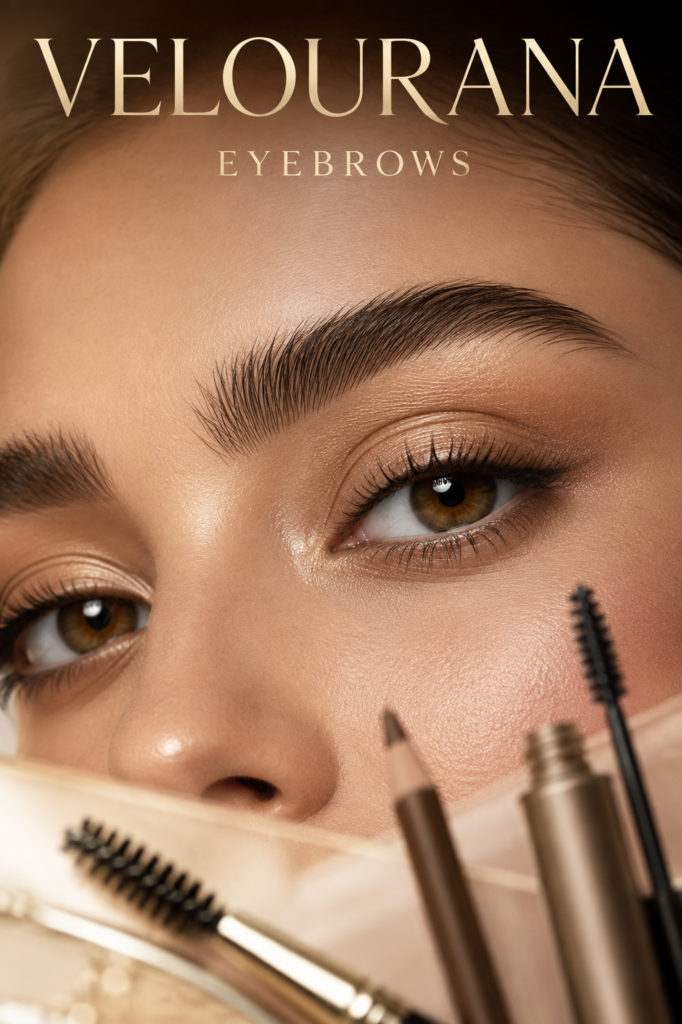
CATEGORY: Natural Brows
A convincing natural brow is built through a series of decisions about what not to change as much as what to enhance. The objective is not simply to use less makeup. A lightly applied product can still look artificial when placed incorrectly, while a carefully constructed brow involving several products can appear remarkably authentic. Naturalism depends on respecting the visual behavior of eyebrow hair: its changing direction, uneven density, soft boundaries, subtle color variation, and relationship with the underlying skin.
This makes natural brow technique fundamentally observational. Before a pencil touches the skin or a spoolie moves through the hairs, the existing eyebrow provides information. It reveals where the strongest density sits, how the front grows, where the arch naturally develops, whether the tail is complete, and which differences between the two brows are structural rather than accidental.
Once these characteristics are understood, enhancement becomes more selective. Instead of automatically filling the entire eyebrow, attention can be directed toward the areas that genuinely need support. Instead of defining every edge, only weak sections need clarification. Instead of forcing hairs into a uniform position, grooming can reinforce their natural movement.
The most convincing result is often one in which it is difficult to identify exactly where the makeup begins.
Reading the Brow Before Changing It
Natural brow work begins with the eyebrow in a relatively neutral state. When hairs are heavily coated with skincare, foundation, old brow gel, or other products, their actual density and direction can be difficult to assess. Once the brow is visible clearly, brushing through it reveals much of its structure.
The inner portion often grows differently from the rest. Some brows begin with vertical hairs, while others immediately angle outward. The middle generally contains the greatest density, although this varies considerably. The arch may be defined by bone structure, hair growth, or a combination of both. The tail can be long and tapered, short and sparse, or dense until its endpoint.
It is useful to notice the spaces between hairs as carefully as the hairs themselves. A gap may be a true area of sparse growth, or it may simply appear when hairs are brushed in a particular direction. Some apparent gaps disappear once surrounding hairs are repositioned.
The upper and lower boundaries also deserve attention. Natural brows rarely possess identical sharpness along their entire perimeter. One section may have a clean line while another diffuses gradually into finer hairs. Preserving some of this variation helps maintain authenticity.
The two brows should then be considered together. One may begin slightly farther inward. One arch may peak earlier. One tail may be thinner. These differences establish a baseline for deciding what actually requires balancing.
Without this initial assessment, it is easy to apply a standardized eyebrow shape that ignores the information already present on the face.
Building From Hair Rather Than From an Outline
Many traditional brow techniques begin by establishing a perimeter and filling the interior. Natural brow technique often works more effectively in the opposite direction. It begins with the hairs and allows their collective placement to create the shape.
Brushing the brow first can immediately produce greater fullness. When hairs are lying flat or crossing one another, the brow may appear narrower and less dense than it actually is. Separating and directing them exposes their full length.
Once the hairs are arranged, cosmetic pigment can be placed only where necessary. A fine stroke can replace a missing hair. Several strokes can strengthen an incomplete arch. A soft shadow can create the impression of density where the skin is particularly visible.
This method avoids creating an obvious frame around the eyebrow.
The lower edge may still receive some definition, particularly through the middle and tail, because this can visually anchor the shape. But rather than drawing a continuous line, pigment can be broken into small marks and softened into the hair. The upper edge usually benefits from even greater restraint, especially near the front.
The tail can tolerate somewhat more precision because natural brow hairs often converge into a narrower endpoint. Even here, however, an excessively long, dark, or sharply pointed tail may look disconnected from the rest of a soft brow.
The architecture emerges through accumulation. Each small mark contributes to the overall impression while remaining subordinate to the natural hair.
Understanding Hair Direction
One of the most revealing signs of drawn-on brows is incorrect hair direction. Real eyebrow hairs do not grow as a collection of identical diagonal lines.
Near the inner corner, hairs may grow vertically or slightly outward. Moving toward the center, they gradually rotate. Around the arch, they often become increasingly horizontal. At the tail, they generally follow the narrowing direction of the brow.
These patterns vary among individuals, which is why studying the actual eyebrow matters more than following a universal diagram.
When filling with a pencil or pen, cosmetic strokes become more believable when they mimic the surrounding growth. Their length should also vary. Natural hairs are not identical, and repetitive marks can create a visibly illustrated effect.
Pressure can vary as well. Some strokes can be extremely faint while a few are slightly deeper. This variation reproduces the way genuine hairs catch light differently and overlap.
Drawing strokes into completely bare skin requires particular care because there are fewer real hairs to disguise them. The marks should appear to emerge from plausible follicles and connect visually with the existing brow.
A spoolie can soften strokes afterward, but excessive brushing may blur them into a uniform shadow. The intention is not to erase the marks but to integrate them.
Hair direction is therefore not a minor finishing detail. It is one of the foundations of realistic eyebrow enhancement.
Soft Density Instead of Solid Pigment
Density is perceived through contrast. A brow appears fuller when more dark or colored information occupies the area, but that information does not have to form a solid layer.
Natural eyebrows contain negative space. Tiny sections of skin remain visible even within relatively full brows. Maintaining this negative space is particularly important when filling sparse eyebrows.
Powder can create a gentle density beneath existing hair. Applied with a controlled brush, it produces a diffused shadow that resembles the visual effect of numerous fine hairs at a distance. Because powder does not necessarily imitate individual strands, it works particularly well when enough real hair remains to provide surface texture.
Pencils create more localized density. They can address gaps without affecting surrounding areas. A fine pencil also allows the tail or arch to be extended with greater precision.
Pens can create exceptionally delicate strokes, although their pigmentation and stain-like quality can make mistakes more noticeable. They are often most effective when applied to relatively dry skin and used sparingly.
Pomades offer richness and durability but can quickly become opaque. Removing excess product from the brush before touching the brow allows them to function more like controlled drawing media than heavy fillers.
Regardless of formula, the visual principle remains similar: density should accumulate where the brow naturally requires strength rather than being distributed equally from beginning to end.
A little transparency is not unfinished work. In natural brows, it is part of the finish.
The Natural Gradient From Front to Tail
A softly graded eyebrow usually appears more realistic than one carrying identical intensity across its entire length.
The inner brow is particularly important because it occupies the central facial area. Heavy pigment here can make both eyebrows appear more severe. Keeping the front relatively light allows it to merge gradually with the skin.
This does not mean every natural brow must have a dramatically faded front. Some people genuinely have dense inner brows. In those cases, artificially lightening the area may be unnecessary. The principle is to respect the natural distribution rather than impose a cosmetic gradient where one does not belong.
For many brows, however, intensity naturally increases through the body. The middle section contains overlapping hairs and therefore appears darker. The arch often requires enough definition to maintain shape, and the tail narrows into a controlled endpoint.
Makeup can follow this progression.
If powder is used, the brush can carry the smallest amount of remaining product into the front rather than beginning there with a freshly loaded brush. If pencil is used, the lightest pressure can be reserved for the inner area. Gel can be applied through the body first and then brushed through the front with less product.
These small choices prevent concentration of pigment in the most visually sensitive area.
The resulting gradient should not resemble an obvious ombré effect. It should simply reproduce the subtle change in density characteristic of real brows.
Working With Sparse, Uneven, or Over-Tweezed Brows
Natural-looking brows are sometimes assumed to require naturally full hair growth, but sparse eyebrows can also be enhanced convincingly. The technique simply has to provide more of the structure that dense brows already possess.
The first challenge is identifying the remaining natural pattern. Even sparse brows usually contain clues about their original direction and proportions. Existing hairs indicate the likely front, body, arch, and tail.
Rather than filling the entire empty region with one product, combining visual textures can create greater realism. A faint background of powder may reduce the contrast between bare skin and hair. Fine strokes can then be placed over that background to imitate strands.
The spacing of these strokes matters. Packing them tightly together can recreate the same solid effect the technique is trying to avoid. Leaving small irregular gaps makes the reconstruction more believable.
Where the tail is missing, extending it gradually from existing hair is usually more convincing than drawing a sharply defined triangular endpoint. The new strokes should become finer as they approach the end.
Over-tweezed brows may also contain an unusually narrow section. Instead of drawing a heavy border outside the remaining hair, delicate strokes can gradually rebuild width. This allows the original hair to remain integrated into the result.
Patience is particularly important with sparse brows because each mark contributes more visibly to the finished shape. Precision does not mean making every stroke perfect. It means placing enough variation that the collective result resembles natural growth.
Working With Full and Unruly Brows
Dense eyebrows present the opposite challenge. They already possess abundant texture, so excessive cosmetic enhancement can obscure one of their greatest advantages.
The first priority is often grooming rather than filling. Brushing through dense brows reveals whether the apparent bulk comes from actual width or simply from long hairs lying in multiple directions.
A brow gel can organize this texture while preserving fullness. The hairs may be directed upward at the front, diagonally through the body, and outward along the tail. The exact arrangement should respond to their natural growth rather than forcing all hairs vertically.
Selective trimming can help when a few unusually long hairs repeatedly extend beyond the desired shape. Cutting every hair to an identical length, however, can make dense brows look less dimensional.
Tweezing can refine the perimeter, particularly when stray hairs create a shape that feels heavier than desired. Yet dense brows often derive their character from slightly diffused edges. Removing every fine surrounding hair can convert a naturally full eyebrow into a sharply sculpted one.
Pigment may only be needed in isolated gaps or where one brow is less dense than the other. A fine pencil or small amount of powder can provide enough correction.
For naturally full brows, one of the most sophisticated techniques is knowing when the eyebrow already contains everything it needs.
Brow Gel and the Illusion of Greater Fullness
Brow gel plays an important role in natural styling because it works directly with actual hair. Instead of creating an entirely new shape on the skin, it changes the position, visibility, and sometimes color of existing strands.
Clear gel emphasizes structure without adding pigment. It is useful when brow color is already sufficient but hairs need organization. By separating strands and holding them in a more flattering direction, clear gel can make the eyebrow appear fuller even though no additional color has been introduced.
Tinted gel adds another dimension. Coating individual hairs can increase contrast and make fine or pale strands more visible. This may create substantial apparent density with less skin-level pigment than pencil or powder would require.
Fiber-containing formulas can add still more texture by adhering tiny fibers to existing hairs. The effect can be convincing when applied carefully, although excessive product may create clumps.
Application direction affects the final style. Brushing straight upward throughout the entire brow creates a distinctive lifted aesthetic, but it is not the only interpretation of natural brows. Following the changing direction of the hair can produce a softer, more traditional result.
Once the gel begins setting, repeated manipulation can sometimes create flakes or disturb the finish. Allowing the hairs to settle preserves their separation.
Gel demonstrates an important principle of natural brow styling: making existing hair more visible can often be more effective than drawing additional hair.
The Role of the Arch in a Natural Brow
The arch influences expression and facial balance, but it does not need to be dramatic to be effective. Some eyebrows naturally form a high, defined peak, while others curve gently or remain almost straight.
Natural brow technique respects these differences.
Attempting to create a strong arch where little natural elevation exists may require removing significant hair beneath the brow and adding pigment above it. Although this can transform the shape, it may also distance the result from the eyebrow's natural architecture.
A subtler approach can emphasize the existing highest point. Brushing hairs upward and outward near the arch creates lift. Filling a sparse upper edge can strengthen the curve. Slight definition beneath the arch can make its elevation more visible.
Conversely, naturally high arches can be softened if desired by avoiding excessive definition at the peak and maintaining fullness through the lower portion.
The tail also influences how the arch is perceived. A tail that descends sharply can exaggerate the peak, while a more horizontal tail can make the brow appear straighter. Extensions should therefore consider the relationship between arch and endpoint rather than treating them separately.
Natural brows do not require a particular arch. They require an arch—or absence of one—that appears connected to the person's existing features.
Balancing Brows Without Making Them Identical
The idea that eyebrows should be related rather than identical is especially relevant to natural styling. Differences between the two sides of the face are normal, and brows often respond to differences in bone structure, muscle movement, hair growth, and habitual expression.
One eyebrow may naturally rise higher. One may contain a denser front. The arch may occur at slightly different positions. Attempting to erase every difference can require substantial makeup.
Instead, balance can be approached according to visual importance.
A noticeably shorter tail may benefit from extension because length strongly affects overall proportion. A small difference in front density may be corrected with a few strokes. A slight variation in arch height may not require intervention at all if the brows look harmonious when the face is viewed normally.
It is useful to move attention repeatedly between the brows during application. Completing one eyebrow entirely before beginning the other can make matching more difficult because intensity gradually increases without comparison.
Natural balance is also affected by expression. Raising one eyebrow, squinting, or concentrating can temporarily change its apparent height. Evaluating the brows with the face relaxed provides a more reliable reference.
The goal is coherence. Both brows should appear to belong to the same face and aesthetic without looking mechanically duplicated.
Preserving Naturalism in Polished Makeup
Natural brows are not limited to bare-faced or minimal beauty. They can provide an effective counterpoint to sophisticated complexion makeup, strong lips, sculpted cheeks, or dramatic eyes.
In polished makeup, the challenge is maintaining enough brow presence to balance the other features without abandoning natural texture.
More definition may be appropriate through the arch and tail when eye makeup is strong. The brow can become slightly deeper while still preserving a softer front and visible hair separation. This prevents it from disappearing visually without turning it into a rigid frame.
With luminous complexion makeup, brows that retain texture can reinforce the impression of real skin and hair. With matte full-coverage makeup, brushing foundation residue from the brows becomes particularly important because coated hairs can appear flat or gray.
Concealer around the eyebrow should be used according to the desired finish. A tiny amount can clean an accidental mark or subtly clarify an edge. A bright, continuous line beneath the entire brow creates a deliberately sculpted appearance that may compete with a natural aesthetic.
The same principle applies to highlighting. Light naturally catches the brow bone, so a restrained highlight can complement natural brows. Strong contrast creates a more visibly cosmetic result.
Natural brow styling therefore does not dictate the intensity of the entire face. It determines how the eyebrow retains its own authenticity within that intensity.
Common Reasons a Brow Stops Looking Natural
A brow can become artificial-looking through accumulation rather than one dramatic mistake. Several small additions may each seem reasonable when viewed close to the mirror, but together they can overwhelm the natural structure.
Too much pigment at the front is particularly influential. Because the inner brows sit near the center of the face, excessive darkness or sharply squared edges attract attention immediately.
Uniform density can also flatten the brow. When front, body, arch, and tail all carry exactly the same opacity, the variations associated with real hair disappear.
Continuous outlines produce a similar effect. Even a relatively light border can become obvious when it runs uninterrupted around the entire eyebrow.
Incorrect product color may make subtle application conspicuous. A shade that is dramatically too warm, cool, dark, or saturated can separate visually from the genuine hairs.
Over-grooming removes texture before makeup even begins. Excessive tweezing can create unusually clean borders, while aggressive trimming can shorten hairs until they no longer overlap naturally.
Finally, repeated attempts at symmetry can enlarge both brows beyond their intended shape. Correcting one side and then compensating on the other can continue until the original structure is almost hidden.
Recognizing these tendencies is valuable because natural brows often improve through subtraction. Brushing away excess pigment, softening an edge, or leaving one small asymmetry untouched may contribute more than another layer of product.
The Beauty of an Eyebrow That Still Looks Like Hair
The enduring appeal of natural brows lies in their ability to frame the face without dominating it. They can provide structure, expression, and balance while preserving the evidence of individual hairs.
This requires a different understanding of polish. Precision is not measured by perfectly straight borders or identical arches. Instead, precision appears in the placement of small corrections: pigment exactly where density disappears, grooming exactly where growth becomes distracting, and enough hold to establish direction without eliminating texture.
The result can vary enormously from person to person. One natural brow may be thick and almost untouched. Another may be sparse and carefully reconstructed. One may have a high arch, another a gentle curve, another a nearly horizontal line. Their common characteristic is not shape but credibility.
Natural brows also allow facial identity to remain central. Instead of imposing a fashionable template, the technique responds to the eyebrow that already exists. This makes it inherently adaptable to different ages, hair colors, face shapes, densities, and personal styles.
Trends will continue to change. Brows may become fuller, thinner, straighter, softer, more laminated, or more defined as beauty cycles evolve. Yet the principles behind natural-looking enhancement remain remarkably stable because they are based on the visual characteristics of real hair.
Observe before altering. Preserve texture. Build density selectively. Follow genuine growth direction. Keep the front responsive to natural structure. Balance rather than duplicate. Allow small irregularities to remain when they contribute authenticity.
When these principles work together, brow makeup becomes difficult to separate from the eyebrow itself. The shape appears clearer, the density more harmonious, and the face more framed, but the viewer still perceives hair rather than cosmetic construction.
That is ultimately what defines the natural brow. It is not an eyebrow without intervention. It is an eyebrow in which intervention respects the character of what was already there.
THE END VELOURANA
 Discover More From Our Family of Websites
 ZodiacBearing (Astrology, Tarot, Numerology, Angel Numbers & Spiritual Guidance)
 Velourana (Beauty, Makeup, Hair Care, Skincare & Beauty Tips)
 HavenBearing (Home, Living, Organization, Décor & Everyday Inspiration)
 PawBearing (Pet Care, Dog Breeds, Animal Health, Training & Pet Products)
 PsyCatherine (Notes From the Journal of a Psychologist on Real Life)

