
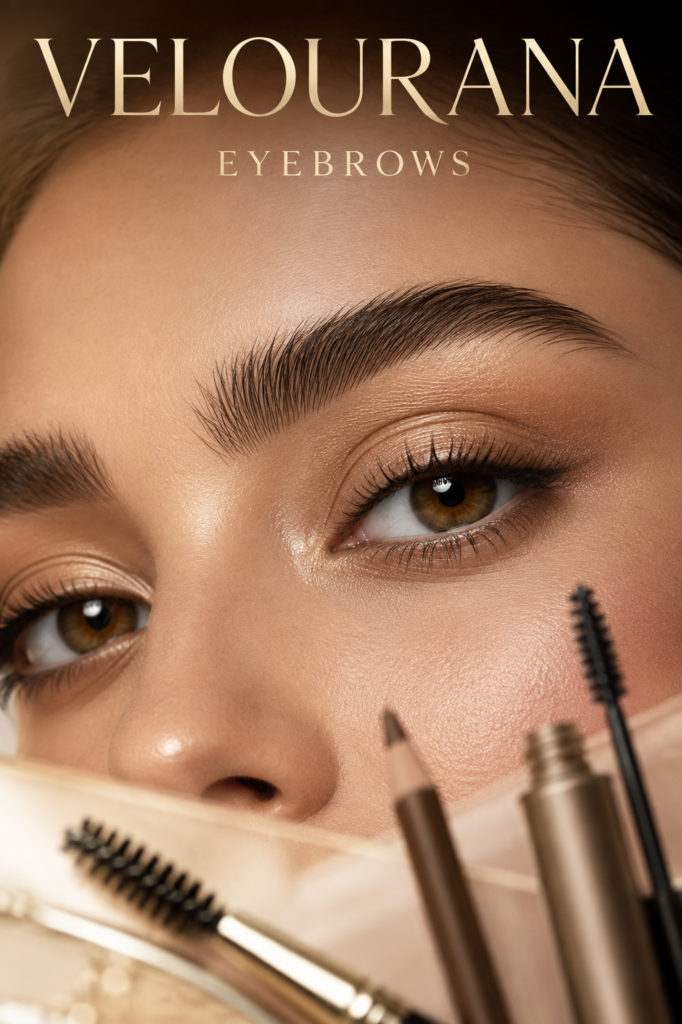
CATEGORY: Straight Brows
Straight brows are defined less by the absence of an arch than by the way the eyebrow travels across the face. Instead of rising noticeably toward a pronounced peak before descending, the brow maintains a relatively level direction from its inner portion through much of its length. There may still be a gentle lift, taper, or change of angle near the tail, but the overall impression is horizontal, controlled, and understated.
This seemingly simple shape can have a surprisingly strong influence on facial appearance. Eyebrows occupy a prominent position within the upper third of the face, framing the eyes while establishing visual relationships with the forehead, temples, nose, and cheekbones. Changing their direction by only a few degrees can alter how the proportions of the face are perceived. A strongly arched brow introduces vertical movement, whereas a straighter brow emphasizes width and continuity. For this reason, straight brows can make the eye area appear broader, create a calmer expression, and sometimes visually shorten a long or vertically dominant face.
The appeal of straight brows also reflects a broader shift in beauty culture. Highly sculpted arches once dominated eyebrow trends, particularly when sharply defined outlines, strong concealer borders, and dramatic brow tails were fashionable. Contemporary approaches frequently favor softer architecture. Individual hairs remain visible, transitions are less severe, and the natural direction of growth is allowed to contribute to the finished result. Straight brows fit naturally into this aesthetic because their impact comes primarily from proportion rather than obvious sculpting.
Yet a successful straight brow is rarely created by simply removing an existing arch. The most convincing versions respect natural growth, bone structure, hair density, and facial proportions. Straightness is a visual relationship, not a rigid geometric requirement. Understanding that distinction is essential to making the shape look intentional rather than artificially flattened.
What Makes an Eyebrow Look Straight
Almost every natural eyebrow contains some degree of curvature. Even brows commonly described as straight usually rise slightly from the inner brow toward the outer third. What distinguishes them is that the rise remains subtle enough that the eye reads the overall line as predominantly horizontal.
The position of the highest point matters greatly. In a classic arched eyebrow, the peak is visibly higher than the inner brow and is followed by a noticeable downward tail. In a straight brow, the difference in height between these areas is reduced. The brow may remain nearly level until relatively far toward the temple, where the tail narrows gently rather than dropping abruptly.
Thickness also affects perception. A moderately full straight brow tends to emphasize the horizontal line because there is enough visual weight for the eye to follow continuously across the face. An extremely thin eyebrow can technically be straight but may appear more like a fine drawn line than a structural facial feature. Conversely, an exceptionally thick brow with uneven upper and lower boundaries can obscure its direction altogether.
The lower edge often plays an important role in establishing the shape. When the underside rises sharply toward the arch, the eyebrow immediately appears more angular. A smoother lower boundary creates greater continuity. This does not mean that every hair beneath the natural arch should be preserved. Instead, grooming can focus on minimizing abrupt changes while maintaining enough natural variation to prevent the brow from appearing stamped onto the face.
The tail completes the architecture. A tail that descends significantly below the level of the brow head can make even a relatively flat central section appear arched. Straight-brow styling therefore tends to favor a tail that extends outward rather than dramatically downward. The result can feel elongated and expansive, particularly when viewed together with eye makeup that also emphasizes horizontal direction.
Straight Brows and Facial Proportion
Eyebrow shapes do not exist independently from the face around them. Their visual effect depends on the proportions they intersect, which is why the same brow can appear elegant on one person and overly severe on another.
A straight brow creates a strong horizontal reference line. On a long or oblong face, this horizontal emphasis can counterbalance vertical length. Rather than directing attention upward toward a high arch, the eye moves laterally across the brow. The face may consequently appear somewhat broader and more balanced.
On rounder faces, the effect is different. Because round faces already contain substantial horizontal width and softer contours, an extremely flat brow may reinforce that width. Some people prefer this harmonious softness, while others may want a slight lift toward the outer third to introduce additional vertical structure. The distinction demonstrates why brow categories should be treated as adaptable design principles rather than fixed formulas.
Square and angular faces can also interact interestingly with straight brows. Strong jawlines and defined facial planes already provide geometric structure. A very sharply outlined straight eyebrow may intensify that geometry, while a fuller brow with soft hair texture can create a more balanced contrast. The underlying shape remains straight, but the finish determines whether the result appears strong, relaxed, polished, or natural.
Heart-shaped and triangular faces introduce another set of relationships because the forehead and lower face may differ noticeably in width. The length and density of the brow become especially relevant. A straight brow extending too far toward the temple can exaggerate upper-face width, whereas a slightly shorter or softly tapered version may preserve equilibrium.
These relationships are not rules determining who is permitted to wear a particular shape. They are simply explanations of why adjustments in thickness, tail direction, and subtle curvature can make a straight brow feel integrated with an individual face.
Natural Straight Brows and Their Growth Patterns
For some people, straight brows require almost no intervention. Their follicles naturally produce a relatively level growth pattern, with limited elevation toward the outer third. These brows often respond best to conservative grooming because excessive removal can introduce an arch that was not originally present.
Natural straight brows may vary considerably in density. Some are broad and full, with hairs growing upward at the front before settling sideways through the body. Others are finer and more delicate, with a uniform direction from beginning to end. The common characteristic is not a particular thickness but the absence of a dominant peak.
Hair direction contributes significantly to how the brow is perceived. Front hairs often grow upward or diagonally, while hairs through the middle may become progressively more horizontal. Toward the tail, follicles can point downward. Brushing techniques can temporarily modify these directions and reveal how much of the apparent arch comes from hair orientation rather than the actual placement of follicles.
This is one reason brow gel, wax, or soap can alter the appearance of a straight brow without any hair removal. When the middle and outer hairs are brushed outward instead of upward, the brow appears longer and flatter. When the same hairs are brushed vertically, the upper edge becomes irregular and elevated, creating more apparent curvature.
Natural asymmetry should also be expected. Human faces are not perfectly symmetrical, and eyebrows rarely grow as mirror images. One brow may rise slightly higher, contain a stronger arch, or have a denser tail. Attempting to force perfect equality through repeated tweezing can gradually make both brows thinner without actually solving the underlying difference.
A more sophisticated approach treats the brows as related rather than identical structures. Their overall weight, length, and direction can be balanced while small differences remain visible. This preserves authenticity and usually requires less maintenance.
Creating a Straighter Appearance Without Over-Grooming
Transforming a naturally arched brow into a straighter silhouette requires restraint. The temptation is often to remove hairs from the upper portion of the arch until the brow becomes level. This can be problematic because substantial removal from the top edge changes the natural framework and may leave the brow unusually thin.
A less destructive approach often begins by studying the lower line and the spaces that can be filled rather than immediately removing hair. If the brow rises because the underside becomes sparse beneath the arch, carefully placed pencil, powder, or pen strokes can visually reduce the elevation. By adding subtle density underneath the highest area, the apparent difference between the brow head and arch decreases.
The upper edge can then be refined only where genuinely necessary. Isolated hairs that sit well above the primary brow mass may be removed if they disrupt the desired shape, but the fundamental growth pattern should generally remain intact. This preserves flexibility. If preferences change later, the brow can return more easily to its natural architecture.
The tail deserves similar caution. A naturally descending tail can sometimes be made to appear straighter by emphasizing its upper boundary and avoiding heavy definition along the lowest hairs. In some cases, a small number of hairs at the extreme underside of the tail may be groomed, but extensive thinning can create a disconnected or shortened appearance.
Cosmetics provide a reversible way to experiment before committing to structural changes. A brow pencil can extend the lower body slightly, while a fine-tip pen can mimic hairs in sparse areas. Powder can soften transitions so that newly filled sections do not appear like blocks of pigment. Gel can direct existing hairs outward and hold them in a flatter arrangement.
Experimenting cosmetically also reveals whether a completely straight shape is actually desirable. Many faces benefit from a softened arch rather than its total elimination. The difference may be only a few millimeters, yet that slight rise can maintain openness around the eye while preserving the horizontal character associated with straight brows.
Thickness, Density, and the Character of the Brow
Straight brows can communicate very different aesthetics depending on their thickness. A broad, dense straight brow tends to feel youthful and substantial because the eyebrow remains a prominent facial feature. When individual hairs are visible and the perimeter is softly defined, the effect can appear relaxed and contemporary.
A medium-width straight brow is particularly adaptable. It retains enough weight to establish the horizontal direction but can be refined for polished makeup or softened for minimal looks. Because the architecture is clear without becoming dominant, this width often integrates easily with a variety of eye shapes and facial proportions.
Thin straight brows create a different visual language. They may reference minimalist, editorial, or historically inspired aesthetics. Because there is less hair mass, precision becomes more noticeable. Small changes in placement or angle can have a greater impact, and harsh pigment can quickly make the brow appear drawn rather than dimensional.
Density is not identical to thickness. A brow can occupy a broad area while containing relatively sparse hairs, or it can be narrow yet extremely dense. Sparse straight brows often benefit from techniques that reproduce natural variation instead of simply filling the entire area with uniform pigment. Hairlike strokes can preserve texture, while a small amount of powder can provide background shading where necessary.
Very dense brows may need little color at all. Their shape can often be controlled through brushing, trimming, or transparent styling products. In such cases, adding heavy pigment may obscure the natural dimension that makes the brow attractive.
The goal is therefore not to achieve a predetermined level of fullness. It is to create enough continuity for the straight direction to read clearly while maintaining a believable relationship between hair, skin, and cosmetic definition.
Straight Brows and Eye Expression
Eyebrows participate directly in the way expressions are interpreted. A high arch can suggest alertness, drama, or intensity because it creates visible elevation above the eye. A straighter brow tends to produce a calmer horizontal frame.
This does not mean straight brows inevitably make a person look expressionless. The effect depends heavily on their position, thickness, and tail. Brows sitting relatively low over the eyes can create intensity, particularly when thick and dark. Brows with greater space between the eyelid and lower brow edge may feel more open even when their shape remains straight.
The relationship with eye shape is equally important. Horizontally elongated eyes can be reinforced by straight brows that extend outward in a similar direction. Rounded eyes may appear more elongated when paired with a brow that guides attention laterally. Hooded or deep-set eyes can respond differently depending on brow height because the available visible space between brow and eyelid influences how open the eye area appears.
Eye makeup can either support or counteract the direction of the brows. Extended eyeliner, outward-blended eyeshadow, and elongated lashes echo the horizontal architecture, creating a cohesive effect. More lifted eyeshadow placement or strongly curled outer lashes introduce upward movement and can prevent the overall look from becoming excessively flat.
This interplay demonstrates why eyebrow design should not be considered separately from makeup. The brow establishes one of the dominant directional lines of the face, and other elements can either repeat that line or deliberately contrast with it.
The Importance of the Brow Head
The inner brow is particularly influential because it determines where the eyebrow visually begins and how strongly the two brows frame the nose.
Straight brows often look most natural when the brow head remains relatively soft. A heavily squared inner edge combined with a flat upper and lower boundary can create a rigid rectangular appearance. Allowing individual hairs to remain visible prevents the horizontal architecture from becoming overly graphic.
Front hairs commonly grow upward, even when the rest of the eyebrow grows sideways. Preserving this natural change in direction adds dimension. The brow can therefore be structurally straight while still displaying vertical texture near the center of the face.
Color intensity should generally transition gradually. Natural brows rarely contain identical density from beginning to end. The front often appears lighter because hairs are more separated and skin remains visible between them. The body becomes denser before tapering toward the tail.
Reproducing this variation cosmetically is particularly useful with straight brows because their simple geometry can otherwise reveal artificial definition quickly. A softer beginning, substantial middle, and controlled taper give the eyebrow visual rhythm without requiring a pronounced arch.
Placement also matters. Extending the inner brow too far toward the nose can make the brows appear close together and visually narrow the central face. Beginning too far outward may widen the perceived space between the eyes. Natural anatomy provides a useful reference, but subtle adjustments can be made according to individual proportions rather than relying on an inflexible mapping formula.
Tails, Length, and Horizontal Movement
The tail determines whether the straight brow retains its horizontal character through the outer face. A dramatically descending tail introduces curvature even if the first two-thirds of the brow are flat. For this reason, straight-brow styling frequently emphasizes outward extension.
Length should still remain proportionate. An excessively long tail can pull visual attention toward the temples and make the brow dominate the eye area. A very short tail may interrupt the horizontal movement and make the eyebrow appear incomplete.
Tapering creates refinement. Instead of maintaining identical thickness all the way to the end, the brow usually becomes progressively narrower. This transition can occur gradually so that the tail feels like a natural continuation rather than a separate drawn line.
People with sparse outer brows may need cosmetic support to establish this taper. Fine strokes placed in the direction of growth generally integrate better than a single solid extension. The objective is not merely to make the brow longer but to continue its texture and density convincingly.
A slight downward movement at the extreme end is entirely compatible with a straight-brow classification. Perfectly horizontal tails can sometimes look unnatural because facial anatomy curves around the orbital area. The key is moderation. The tail can follow the face while avoiding a steep descent that creates an obvious arch.
Maintaining Straight Brows Over Time
Maintenance depends on how closely the chosen shape matches natural growth. Someone whose brows are naturally straight may need only occasional removal of stray hairs and minor trimming. Someone modifying a pronounced natural arch will usually require more frequent attention.
This difference matters because repeated grooming can gradually alter the apparent shape. Removing one or two hairs may seem insignificant, but over months the brow can become progressively narrower. Photographs taken several weeks apart can be useful for recognizing changes that are difficult to notice during daily grooming.
Trimming also requires moderation. Long brow hairs contribute volume and can cover small gaps. Cutting them too short may expose sparse areas and make the brow appear less continuous. Brushing the hairs into their normal styling position before trimming helps reveal which lengths genuinely extend beyond the intended boundary.
Cosmetic maintenance can evolve with changes in hair density, color, and personal preference. A brow that once required pencil may later need only tinted gel, while naturally thinning areas may benefit from more detailed filling. The fundamental straight architecture can remain while the technique changes.
Seasonal lighting, hair color, and makeup intensity can also influence how strongly the brows need to be defined. Dark, sharply outlined brows may balance dramatic evening makeup but appear dominant beside very minimal complexion products. Adjusting pigment intensity rather than constantly altering the physical shape protects the brow while keeping it adaptable.
Straight Brows as an Individual Design Choice
The enduring appeal of straight brows lies in their ability to look both structured and understated. Their geometry is clear, yet it does not depend on a dramatic peak. They can appear youthful when full and softly brushed, sophisticated when carefully tapered, or editorial when rendered with greater precision.
Their simplicity also exposes the importance of proportion. Because there is no strong arch to command attention, subtler details become more significant: the softness of the inner brow, the continuity of the body, the direction of the tail, the relationship between thickness and facial scale, and the amount of visible skin between individual hairs.
The most successful straight brows therefore rarely come from forcing every eyebrow into an identical template. They emerge from interpreting natural anatomy through a horizontal design principle. Some will be almost perfectly level. Others will retain a small lift or soft bend. Both can read unmistakably as straight when the dominant visual movement remains lateral rather than vertical.
Beauty trends will continue to change, but understanding the architecture behind a shape makes it possible to adapt rather than simply imitate. Straight brows demonstrate this particularly well. Their character comes not from eliminating every curve but from controlling how those curves interact.
A well-designed straight brow preserves enough natural irregularity to remain human while introducing enough structure to influence the proportions of the face. That balance between geometry and individuality is ultimately what gives the shape its versatility.
THE END VELOURANA
 Discover More From Our Family of Websites
 ZodiacBearing (Astrology, Tarot, Numerology, Angel Numbers & Spiritual Guidance)
 Velourana (Beauty, Makeup, Hair Care, Skincare & Beauty Tips)
 HavenBearing (Home, Living, Organization, Décor & Everyday Inspiration)
 PawBearing (Pet Care, Dog Breeds, Animal Health, Training & Pet Products)
 PsyCatherine (Notes From the Journal of a Psychologist on Real Life)

