
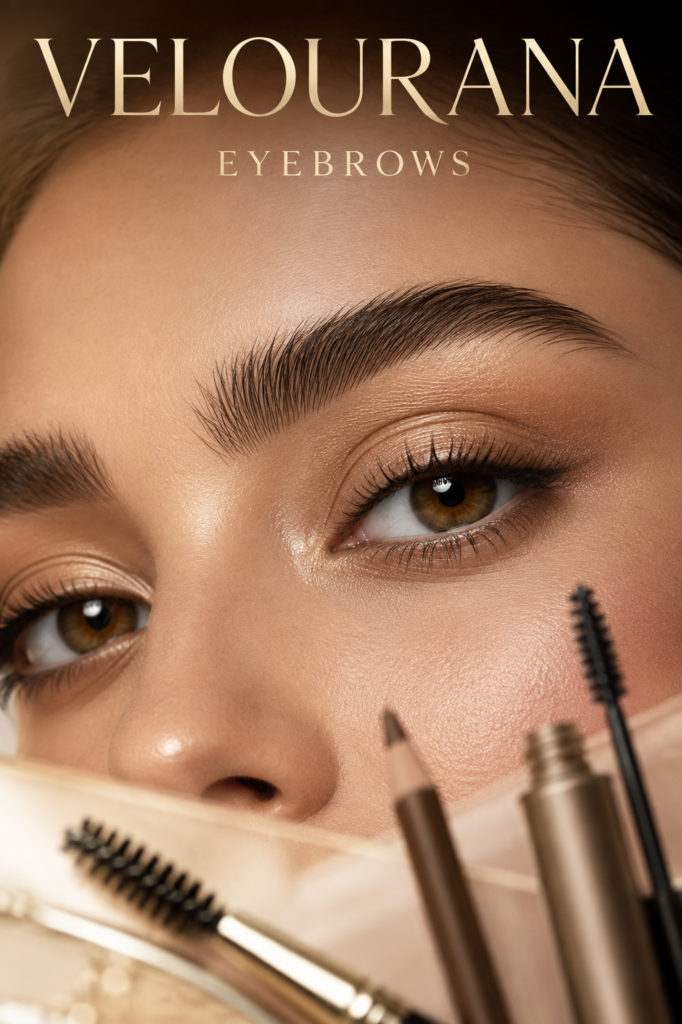
CATEGORY: Soft-Angled Brows
A soft-angled eyebrow can look deceptively effortless. Its arch is visible but restrained, its tail is defined but not excessively sharp, and its inner portion often retains enough natural texture to prevent the brow from appearing drawn onto the face. Yet producing that apparent simplicity requires an understanding of proportion, hair growth, cosmetic placement, and restraint.
The challenge is not merely to create an angle. It is to ensure that the angle belongs naturally within the eyebrow.
When too much emphasis is placed on the highest point, the brow becomes sharply arched. When the transition is smoothed excessively, it can become rounded. When elevation disappears, the result approaches a straight brow. Soft-angled styling depends on maintaining a carefully controlled middle ground.
This is why successful shaping usually begins long before tweezers or makeup are involved. It begins by studying how the natural brow moves across the face and identifying where definition can be introduced without fighting its underlying structure.
Reading the Brow Before Reshaping It
Natural eyebrows are rarely uniform.
The hairs near the inner brow may grow vertically, diagonally, or even in several directions at once. Through the central body, they often overlap more densely and begin moving outward. Around the arch, their orientation may change again before the tail becomes progressively finer.
These variations create the eyebrow's natural architecture.
Before deciding where a soft angle should sit, it is useful to consider the brow in its untouched state. Heavy filling can conceal sparse areas and make artificial boundaries seem natural. Strong gel can redirect hairs so completely that their original growth pattern becomes difficult to see.
When the brow is clean and brushed gently, its existing strengths become clearer.
There may already be a subtle elevation that simply needs definition. The underside may contain a few low-growing hairs that obscure an otherwise attractive angle. One section may be sparse enough to require filling rather than removal elsewhere.
This distinction is important because shaping should not automatically mean taking hair away.
In many cases, the most effective soft angle is created by preserving the majority of the natural eyebrow and making relatively minor adjustments around its boundaries. Cosmetic products can then compensate for areas where growth is inconsistent.
This approach also protects against one of the most common shaping problems: repeatedly removing hairs to correct asymmetry until both brows become substantially thinner than intended.
Understanding the Beginning of the Brow
Although attention naturally gravitates toward the arch, the inner brow strongly influences the final appearance.
A soft angle needs a beginning that visually supports the rest of the shape. If the front is excessively dark, square, or sharply vertical, it can create a block-like starting point that conflicts with the gradual movement of the brow. If it is too faint, the arch and tail may appear detached.
Natural texture is especially valuable here.
Individual hairs often create a slightly irregular boundary, and preserving some of that irregularity can make even a carefully filled brow appear more believable. Cosmetic pigment can be concentrated between hairs rather than placed as a solid layer over them.
The lower front boundary can be somewhat more defined when additional structure is desired, but the intensity usually benefits from increasing gradually toward the body.
This tonal progression has an important visual effect. The eye is guided naturally from the softer beginning toward the more structured outer brow.
The front also influences perceived brow spacing. Bringing pigment too far toward the bridge of the nose can make the brows appear close together and may create heaviness around the center of the face. Removing too much from the inner brow can create excessive separation.
Traditional mapping methods provide approximate reference points, but individual anatomy remains decisive. Nose width, eye spacing, brow growth, and personal preference all affect what looks proportionate.
The objective is not adherence to a universal coordinate. It is a beginning that feels integrated with the face and provides a natural foundation for the angle that follows.
Building the Brow Body
The body of the eyebrow connects the softer front with the eventual arch, and it is essential to the soft-angled effect.
If this region is kept completely horizontal and the arch suddenly rises near the outer edge, the shape can appear abrupt. If the body begins climbing too early, the eyebrow may look continuously diagonal.
A convincing soft angle usually develops gradually.
The lower and upper boundaries do not need to rise at identical rates. Small differences between them influence thickness and perceived elevation. A brow may maintain a relatively calm upper line while the lower boundary gradually rises, creating subtle lift without an obvious peak.
Alternatively, a fuller brow may carry enough density that neither boundary needs to be strongly emphasized. Hair direction itself can establish the movement.
This is one reason brushing the brows before filling is so important. Styling changes the apparent shape. Hairs brushed diagonally outward can reveal an angle that seemed absent when they were lying downward.
The central brow is also where excessive cosmetic density can flatten dimension. When every gap is completely filled with opaque pigment, the natural overlap of hairs disappears. The brow becomes a graphic silhouette.
For a softer appearance, different levels of opacity can coexist. Natural hair provides the darkest individual elements, cosmetic strokes reinforce missing areas, and subtle shadow can create fullness between them.
This layered appearance allows the brow to remain substantial without becoming visually heavy.
Developing the High Point Without Creating a Peak
The high point is the defining region of the soft-angled brow, but it should not behave like a sharp summit.
A pronounced triangular peak immediately communicates drama. That can be attractive when intentionally creating a high arch, but it changes the character of a soft angle.
Instead, the highest region can extend across a small area rather than existing as one exact point. The rising line gradually approaches it, changes direction, and then transitions into the tail.
This creates a softer visual articulation.
When using makeup, it is often more effective to reinforce the hairs surrounding the natural high point than to draw a new point substantially above them. Small strokes can strengthen the upper boundary where density is lacking, while subtle definition underneath can reveal elevation.
The lower arch requires particular caution during grooming. Removing hair from this region produces immediate visual change, which can encourage over-tweezing. Once the underside becomes deeply excavated, the brow may appear dramatically arched even if that was not the intention.
A soft angle usually retains more substance beneath the high point.
That fullness helps connect the body and tail, preventing the eyebrow from looking like two separate segments.
The arch should also be judged with the eyes open and the face relaxed. Facial expressions can temporarily raise the brows, changing their apparent position. Evaluating the shape only while lifting the forehead or stretching the skin can lead to unexpected results when the face returns to its normal resting state.
Designing a Tail That Completes the Angle
The tail is not merely the final few millimeters of the brow. It determines how the angular movement resolves.
After the high point, the brow should taper progressively toward the temple. The direction of this descent influences whether the overall expression feels lifted, neutral, or visually lowered.
An excessively steep tail can create a hooked shape. A very long downward tail may draw attention toward the outer corners of the eyes and can alter the perceived balance of the upper face. A tail that is too short may make the eyebrow appear incomplete.
Soft-angled brows generally benefit from a controlled diagonal descent.
Thickness should decrease gradually as well. A tail that remains almost as thick as the brow body can look heavy, while an abrupt transition from full arch to hairline-thin tail can appear artificial.
Natural hair density often already provides much of this taper. Makeup should therefore respond to what is missing rather than automatically redrawing the entire area.
When the tail is sparse, fine pencil or pen strokes can create convincing extension. Their direction should correspond with the existing hairs. Powder can then provide subtle shadow if greater density is required.
A solid opaque line may create precision, but it can also make the tail appear disconnected from the textured body of the eyebrow.
Continuity is more important than absolute sharpness.
Grooming Methods and Their Effect on the Shape
Different grooming methods can produce the same general soft-angled architecture, but their degree of precision varies.
Tweezing allows individual hairs to be removed selectively. This can be useful when refining a subtle angle because changes can be made incrementally. It also encourages careful evaluation between removals rather than eliminating a large region at once.
Threading can create very clean boundaries and remove fine surrounding hairs efficiently. The precision can be valuable, although an excessively crisp outline may need to be balanced with natural texture if softness is the goal.
Waxing can define broader boundaries quickly. As with any method that removes several hairs simultaneously, accurate shape planning is important because an overly aggressive pass beneath the arch can alter the geometry considerably.
Trimming affects density rather than the follicular boundary. Long hairs can make the upper or lower edges appear irregular, but they also overlap neighboring hairs and contribute to fullness. Cutting them excessively short can expose skin and produce unexpected gaps.
Whatever method is chosen, the principle remains similar: preserve enough natural density to support the soft transition.
The eyebrow does not need to be surrounded by perfectly hairless skin to appear groomed. A few fine hairs outside the principal shape may be virtually invisible at normal viewing distance, whereas excessive removal from the structural brow can have a significant impact.
Working With Naturally Straight Brows
Naturally straight brows can be adapted toward a soft angle, but the transformation should generally remain proportional to their original architecture.
If there is little natural elevation, attempting to create a high arch may require removing substantial hair underneath while drawing a new upper boundary. This can create maintenance challenges and may look artificial without makeup.
A more subtle change can be highly effective.
Allowing the central body to remain relatively straight while creating modest elevation through the outer region can introduce an angle without abandoning the natural character of the brow.
Directional styling is particularly useful. Brushing hairs slightly upward around the prospective arch can increase apparent height. Filling along the upper boundary can reinforce that elevation, while a gently descending tail establishes the change in direction.
The result may be a low soft angle rather than a classic high arch, but it still belongs within the category because the essential directional transition is present.
This illustrates why eyebrow categories should not be treated as rigid templates. A soft angle can be shallow or moderately elevated. What matters is the relationship between its sections.
Working With Naturally Arched Brows
Naturally high arches require a different approach.
Rather than creating additional elevation, the objective may be to soften what already exists.
Allowing slightly more fullness beneath the highest region can reduce the apparent sharpness. Filling sparse areas surrounding the peak can create a broader transition instead of a narrow point. The upper boundary may require little intervention if the natural hairs already establish the desired direction.
Makeup intensity can also change perception. A dark, sharply outlined arch looks more dramatic than the same shape rendered with softer edges and visible texture.
The tail can help moderate the effect as well. A very thin, sharply descending tail emphasizes the peak. A somewhat fuller, progressively tapered tail distributes visual weight more evenly.
People with naturally arched brows therefore do not necessarily need to lower or remove their arch to achieve a softer appearance. Often the solution is to broaden the transitions surrounding it.
Working With Sparse or Uneven Growth
Sparse brows present a design challenge because the natural architecture may be difficult to identify.
Past over-tweezing can leave gaps beneath the arch, through the tail, or even across the central body. Other brows may simply grow with naturally lower density.
In these situations, cosmetic reconstruction should begin with overall proportion rather than individual strokes.
It is useful to imagine the intended silhouette first: where the brow begins, how thick the body should appear, where elevation develops, and how the tail descends. Once that framework is established, fine strokes can recreate missing texture.
Trying to fill every visible gap independently can produce an irregular result because each correction is made without reference to the whole shape.
Sparse areas also require careful pigment selection. A shade that appears appropriate when applied lightly can become much darker when several strokes overlap. Building gradually preserves control.
Where natural hair is minimal, combining techniques can create greater realism. A soft underlying shadow can suggest density while individual strokes provide texture. This prevents the entire reconstructed region from depending on heavy lines.
The soft angle is particularly useful for sparse brows because it does not require a razor-sharp peak. A broader transition can be reconstructed more naturally.
Product Texture and the Finished Effect
Different brow products interpret the same architecture in distinct ways.
Powder produces diffuse density. It is well suited to brows that already contain substantial hair but need greater fullness or a more coherent silhouette. Because the edges remain relatively soft, powder naturally supports understated angles.
Pencil offers greater precision. A fine pencil can create small strokes, strengthen the underside, extend the tail, or correct asymmetry without covering the entire brow.
Pomade can provide substantial pigment and strong control. It is effective for dramatic or polished interpretations, but using it across the whole brow at equal intensity can make a soft angle appear much more severe.
Brow pens are particularly useful for hair-like detailing. Their thin marks can recreate texture in sparse regions, although stroke direction and pigment intensity need careful control.
Clear and tinted gels affect both color and orientation. They can reveal an existing soft angle simply by organizing the hairs. Stronger hold can maintain lifted texture, while flexible formulas preserve movement.
Waxes and brow soaps can create even greater directional control, especially when fuller hairs need to be repositioned.
None of these products determines the shape by itself. The same soft angle can look natural, editorial, glamorous, minimalist, or highly polished depending on product selection and application intensity.
Color as Part of Brow Architecture
Color changes how strongly the shape registers.
A very dark eyebrow naturally emphasizes every directional change. Even a relatively shallow angle can look pronounced when there is high contrast between the brow and surrounding skin or hair.
A softer or lower-contrast shade diffuses the geometry.
This does not necessarily mean selecting a dramatically lighter brow product. Undertone and saturation also matter. A shade that harmonizes with the natural brow hairs can add density without creating an obvious layer of cosmetic color.
Using one intensity from beginning to end can make the eyebrow look static. Allowing the front to remain somewhat lighter and gradually increasing definition through the body and tail creates dimension.
This tonal gradient also supports the soft angle because the eye encounters increasing structure progressively rather than immediately.
Individual hair strokes can be slightly more visible around sparse portions of the arch and tail, while shadow underneath dense natural hairs may be almost imperceptible.
The best color strategy is therefore connected to both anatomy and density.
Styling Fuller Soft-Angled Brows
Full brows offer considerable freedom because their natural density already provides structure.
Rather than outlining them heavily, styling can concentrate on direction. The inner hairs may be encouraged upward, the central hairs guided diagonally, and the outer hairs aligned toward the tail.
This changing orientation naturally reinforces the angle.
Strategic grooming can then remove only the hairs that significantly interrupt the intended lower or upper boundary.
Full brows also allow the arch to remain broad. Because there is more hair surrounding the high region, the transition can be clearly defined without becoming pointed.
Makeup may be limited to small gaps or areas where the density differs between the two brows.
The risk with naturally full eyebrows is often excessive refinement. Removing too much hair to obtain perfectly smooth edges can eliminate the texture that makes the brow attractive in the first place.
Soft-angled fullness works because structure and natural variation coexist.
Styling Fine Soft-Angled Brows
Fine brows require a different balance.
Their narrower silhouette makes changes in direction more obvious, so a small arch can appear stronger than it would on a full brow.
Maintaining a moderate rise is therefore important. The highest point can remain visible without becoming exaggerated.
Cosmetic filling should also respect the original scale of the eyebrow. Extending pigment far beyond the natural boundaries may produce a brow that feels disproportionately large, while an excessively thin drawn line can look dated or severe.
Fine strokes can add apparent density without substantially increasing the overall width.
The tail deserves particular attention because fine brows often become extremely delicate in the outer region. A small amount of carefully placed pigment can restore continuity while maintaining taper.
The objective is not necessarily to make fine brows look thick. It is to give their existing architecture enough support that the soft angle remains coherent.
Maintaining the Shape Over Time
Eyebrows are dynamic. Hair grows in cycles, cosmetic trends change, and personal preferences evolve.
A soft-angled shape should therefore be viewed as a framework rather than a permanent fixed outline.
As hairs regrow, some will clearly fall outside the established structure while others may contribute useful density. Automatically removing every new hair can prevent the brow from recovering from earlier over-grooming.
Periodic reassessment is valuable.
A brow that once required extensive filling may gradually develop enough growth to support a softer cosmetic approach. Conversely, changes in density may make a previously effortless shape require more definition.
Maintenance also becomes easier when the fundamental architecture is clear. Instead of recreating the brow from the beginning each time, grooming can focus on preserving the relationship between body, high point, and tail.
This is another advantage of choosing a shape compatible with natural growth. The less aggressively the brow has been forced away from its inherent pattern, the easier it generally is to maintain.
Soft-Angled Brows in Minimal Makeup
Without elaborate eye or complexion makeup, eyebrow details become especially visible.
A minimalist look often benefits from retaining individual hairs and avoiding heavily saturated edges. A small amount of pencil through sparse regions, followed by gel to organize the hairs, may be sufficient to establish the angle.
The natural skin showing through the brow becomes part of the appearance.
This transparency prevents the brows from feeling disproportionately polished compared with the rest of the face.
A soft angle is particularly effective in this context because it offers definition without requiring graphic precision. The eyes remain framed, but the eyebrow does not appear detached from an otherwise natural complexion.
Soft-Angled Brows in Polished Makeup
More elaborate makeup can support greater brow definition.
Foundation and concealer create an even visual field around the brows, allowing sharper edges to appear intentional. Structured eyeshadow or eyeliner may also require additional brow intensity to maintain balance.
The soft angle can be preserved even when the finish becomes more precise.
The key is to avoid turning the arch into a narrow point. The boundaries may be cleaner, pigment may be richer, and the tail may be more exact, but the transition through the highest region should remain gradual.
A polished brow does not need to be a severe brow.
This distinction allows soft angles to move comfortably between everyday and formal beauty looks.
Why Restraint Often Produces the Best Result
Eyebrow shaping offers immediate visual feedback. Removing one hair can reveal a cleaner line. Adding one stroke can fill a distracting gap. Because each small correction appears beneficial, it is easy to continue correcting beyond the point where the brow actually improved.
Soft-angled brows are particularly dependent on knowing when to stop.
Their character comes from moderation. The arch is present but not extreme. The tail is defined but not needle-like. The beginning is structured but not block-shaped. The edges are controlled but need not be mechanically perfect.
Every part of the brow contributes to this equilibrium.
When grooming, styling, and makeup all become simultaneously aggressive, the softness disappears. When none of them provides enough structure, the angle disappears.
The successful result lies between those extremes.
A Shape Defined by Transition
The essential beauty of a soft-angled brow is not located at one point. It exists in the transitions connecting the entire eyebrow.
The inner hairs establish texture and direction. The body provides substance. The gradual rise introduces lift. The high region changes direction without becoming a sharp summit. The tail resolves that movement through controlled taper.
When these elements are considered together, the brow appears coherent.
This is why copying another person's exact brow shape is rarely the most effective strategy. The same dimensions cannot produce identical visual results on different faces because the underlying anatomy, hair growth, density, and proportions differ.
Soft-angled brows are most successful when interpreted rather than copied.
Their versatility comes from that flexibility. They can be low or moderately high, full or fine, natural or polished. They can accompany changing makeup styles while retaining the same fundamental architecture.
Above all, they demonstrate that eyebrow definition does not require severity.
A carefully judged soft angle can frame the eyes, introduce subtle lift, organize facial proportions, and maintain natural expression without appearing rigid. When the shape follows the existing brow and cosmetic enhancement remains responsive to natural texture, the result has an effortless quality even when considerable thought has gone into creating it.
That balance is the signature of the soft-angled brow: structure that remains graceful, precision that does not erase individuality, and an arch that defines the face without overpowering it.
THE END VELOURANA
 Discover More From Our Family of Websites
 ZodiacBearing (Astrology, Tarot, Numerology, Angel Numbers & Spiritual Guidance)
 Velourana (Beauty, Makeup, Hair Care, Skincare & Beauty Tips)
 HavenBearing (Home, Living, Organization, Décor & Everyday Inspiration)
 PawBearing (Pet Care, Dog Breeds, Animal Health, Training & Pet Products)
 PsyCatherine (Notes From the Journal of a Psychologist on Real Life)

