
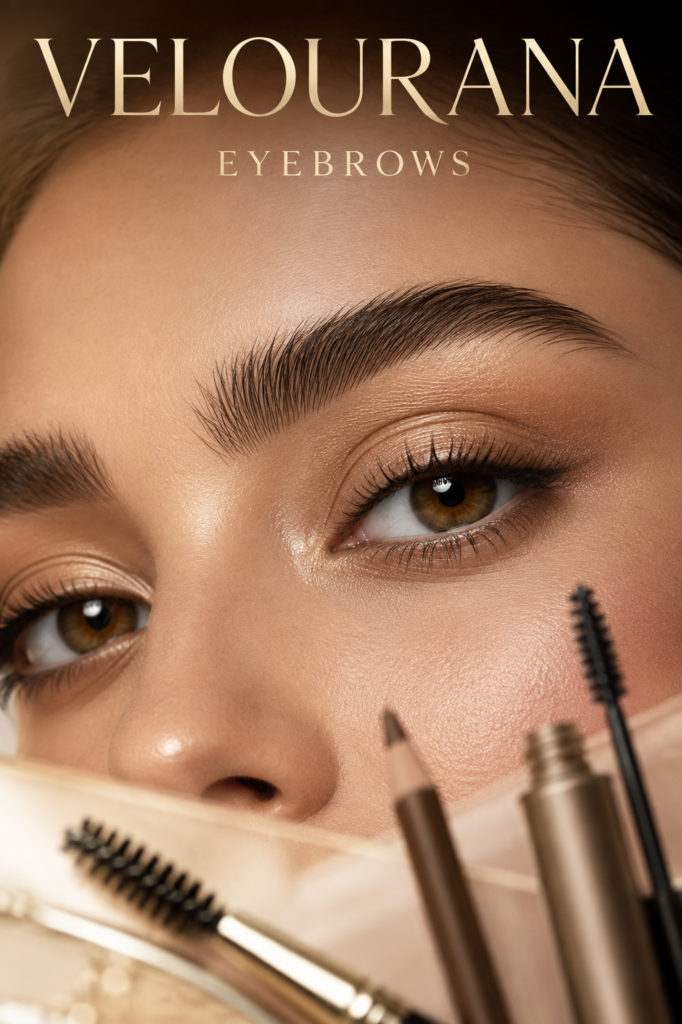
CATEGORY: Soft-Angled Brows
Soft-angled brows occupy a distinctive place in eyebrow design because they combine two qualities that are often treated as opposites: structure and softness. They have enough definition to frame the face clearly, yet their highest point transitions gradually rather than forming a dramatic peak. The result can appear polished without looking severe, expressive without becoming theatrical, and carefully shaped without seeming excessively engineered.
The appeal of the soft angle is not simply that it is a less dramatic version of an arched brow. Its geometry is different. Instead of creating a conspicuous change of direction at the arch, the brow rises progressively from the inner portion, reaches a controlled high point, and then descends into the tail with a smooth transition. That subtle change in direction creates definition while preserving visual continuity.
This makes soft-angled brows remarkably adaptable. They can be full or fine, fluffy or sleek, dark or barely enhanced. They can accompany understated everyday makeup as naturally as they complement a more sculpted beauty look. What defines them is not thickness, color, or even a precise numerical arch position. It is the relationship between the rising body of the brow, the gently articulated high point, and the descending tail.
Understanding that relationship is the key to appreciating why the soft-angled brow has become such an enduring shape.
The Geometry Behind a Soft Angle
Every eyebrow contains a sequence of visual movements. The brow begins near the bridge of the nose, travels across the brow bone, reaches some form of elevation, and eventually tapers toward the temple. Different brow shapes emphasize these movements differently.
A straight brow minimizes vertical movement. A strongly arched brow deliberately emphasizes it. A rounded brow replaces the angular transition with a continuous curve. A soft-angled brow exists between these approaches.
From the front of the brow, the upper and lower boundaries generally rise gradually rather than immediately climbing toward a peak. The body maintains enough substance to prevent the eyebrow from appearing thin or sharply drawn. As the brow approaches its highest region, the direction changes perceptibly but not abruptly. The tail then slopes downward in a controlled line.
This geometry matters because the eye notices changes in direction even when they are subtle. A sharply pointed arch can become one of the strongest features of the upper face. A soft angle provides some of the same lifting and framing effect while distributing attention more evenly across the entire brow.
The lower boundary is particularly influential. Removing too much hair underneath the arch can turn a soft angle into a much sharper one even when the upper boundary remains unchanged. Conversely, allowing the underside to become excessively rounded can erase the angular character altogether.
For this reason, achieving a convincing soft angle is often less about constructing an obvious peak and more about controlling the transitions surrounding it.
A naturally occurring change of direction should generally be respected. The most harmonious soft-angled brows often look as though the brow simply grows that way, even when careful grooming and makeup have contributed significantly to the finished appearance.
Why Soft-Angled Brows Can Look So Balanced
Eyebrows influence how the proportions of the upper face are perceived. Their position, density, direction, length, and curvature interact with the eyes, forehead, temples, nose, and cheek structure. Because a soft-angled brow contains both horizontal and diagonal movement, it can create a particularly balanced frame.
The relatively calm inner portion gives stability to the face. The gradual rise introduces lift. The high point provides definition, while the descending tail completes the frame without creating the dramatic punctuation associated with a very sharp arch.
This combination can make soft-angled brows feel visually versatile. They do not depend on a single extreme characteristic. Instead, several moderate characteristics work together.
That moderation also helps explain why the shape adapts to changing makeup trends. During periods when fuller brows dominate beauty aesthetics, the soft angle can be expressed through natural density and brushed-up texture. When cleaner, more refined brows become fashionable, the same fundamental geometry can be maintained with greater edge definition and a smoother finish.
The underlying shape survives because it is not tied to one particular thickness or styling method.
Soft angles can also accommodate natural asymmetry more gracefully than highly geometric brows. Human faces are not perfectly symmetrical, and eyebrow growth rarely mirrors itself exactly from side to side. When the desired shape depends on an extremely precise peak, minor differences may become conspicuous. A softer transition allows small variations to remain part of the face rather than appearing automatically incorrect.
This does not mean symmetry is irrelevant. Rather, the objective becomes visual balance instead of duplication.
Soft-Angled Brows and Facial Proportion
Discussions of eyebrow shapes frequently attempt to assign one ideal brow to each face shape. While face shape can provide useful context, the relationship is more nuanced than a simple chart can suggest. Two people described as having oval faces, for example, may have very different forehead heights, eye spacing, brow bones, cheek structures, natural eyebrow densities, and facial expressions.
A soft angle is adaptable partly because its intensity can be adjusted.
On a rounder face, a modest rise and clearly defined tail can introduce vertical and diagonal movement without the starkness of an extremely high arch. The brow can visually interrupt some of the face's dominant curves while remaining natural.
On a square or angular face, the softness around the high point can prevent the brows from adding another strongly geometric element. Definition remains, but the transition does not compete aggressively with the jawline or other pronounced contours.
Longer faces may benefit from keeping the rise restrained and preserving some horizontal extension through the body and tail. If the arch is raised excessively, the face can appear even more elongated. A low or moderate soft angle can offer structure without unnecessary vertical emphasis.
Oval faces often accommodate numerous brow styles because their proportions are comparatively adaptable, and a soft angle can reinforce that balance without introducing a dominant new geometry.
Heart-shaped and diamond-shaped faces can also work beautifully with soft angles because the brow can be tailored through arch placement and tail direction. The aim is not to follow a universal formula but to consider how the eyebrow interacts with the width and movement already present in the face.
The important point is that "soft-angled" describes a family of related shapes rather than one fixed stencil. The height of the angle, the thickness of the body, the length of the tail, and the degree of taper can all change while the essential character remains recognizable.
Finding the Natural Architecture of the Brow
Creating a flattering soft angle usually begins with observation rather than removal.
Natural eyebrow growth contains valuable information. Hair direction often changes around the region where an arch can be developed. Density may naturally decrease toward the tail. The brow bone itself provides another anatomical guide, indicating where elevation and descent can appear harmonious.
Before reshaping, it is useful to see the brow without heavy makeup and with the hairs brushed into their natural direction. This reveals the actual distribution of density rather than the silhouette produced by cosmetic products.
The front of the brow often contains hairs that grow upward or diagonally. Moving outward, the hairs typically become more horizontal before gradually turning toward the temple. These changes contribute to the natural flow of the eyebrow.
A soft angle should generally cooperate with that flow.
Trying to force a very low natural brow into an unusually high arch may require substantial hair removal underneath and extensive reconstruction above. The result can be difficult to maintain and may look disconnected from the underlying brow bone. Similarly, forcing naturally arched brows into an almost straight shape can require removing valuable hair from the upper region.
The most convincing transformations usually refine what is already present.
This is especially important when brows have previously been over-tweezed. Sparse areas can distort the apparent natural shape, making it tempting to continue removing hair until both sides match. Often the better approach is to preserve remaining growth, allow uncertain areas time to recover where possible, and use cosmetic definition to test a desired shape before committing to further removal.
Makeup can function as a temporary design sketch. It allows the position of the arch, lower boundary, and tail to be evaluated in relation to the whole face.
The Importance of Arch Placement
The location of the high point changes the personality of a soft-angled brow.
When the highest point sits too close to the center, the brow may acquire a surprised or peaked appearance. The shape can begin to resemble two separate lines meeting at a summit rather than one continuous eyebrow.
When the high point sits too far toward the temple, the brow may remain flat for too long before dropping suddenly. Depending on the natural growth pattern, this can make the tail feel disconnected.
A balanced soft angle generally develops its elevation progressively through the outer portion of the brow body. The exact location varies with anatomy, so rigid mapping formulas should be treated as references rather than universal laws.
Traditional brow mapping often uses imaginary lines extending from the nose toward the eye to estimate the beginning, arch, and endpoint. Such methods can be useful for establishing approximate proportions, particularly when rebuilding sparse brows. Yet they cannot account perfectly for every variation in nose width, eye placement, brow bone structure, or personal aesthetic.
The face itself remains the more important reference.
The transition surrounding the high point is just as significant as its location. A soft angle should not appear like a sharp triangle inserted into an otherwise smooth brow. The rising line should gradually prepare the eye for the change in direction, while the descending line should flow naturally toward the tail.
When those transitions are successful, the arch can remain clearly visible without appearing pointed.
Thickness Changes the Character of the Shape
Soft-angled brows can exist at many thicknesses, but thickness changes how their geometry is perceived.
Fuller brows naturally diffuse angles because there is more visual mass surrounding the high point. The shape can therefore carry considerable lift without appearing severe. Individual hairs and slight variations along the edges may remain visible, giving the brow an organic finish.
Medium-thickness brows can display the architecture particularly clearly. There is enough density to create a substantial body, yet the lower boundary and tail can reveal the change in direction distinctly.
Fine brows require greater restraint. When the entire brow is narrow, even a small angular transition can look sharp because there is less surrounding density to soften it. A heavily defined lower line or pointed peak may therefore transform a supposedly soft angle into a much more dramatic shape.
Thickness should also be considered from front to tail rather than as one measurement. Natural-looking brows rarely maintain identical width throughout their length. The inner and central portions usually carry more visual weight, while the outer portion gradually narrows.
A sudden reduction in width immediately after the arch can create a hooked appearance. Gradual tapering tends to preserve the fluid quality associated with a soft angle.
The beginning of the brow deserves similar restraint. A dense rectangular front combined with a delicate tapered tail can make the brow appear divided into incompatible sections. Allowing texture and subtle tonal variation at the front helps the entire shape read as one continuous feature.
Grooming Without Losing the Softness
One of the easiest ways to accidentally destroy a soft-angled shape is excessive grooming.
The temptation often arises underneath the arch. Removing a few hairs can reveal definition, so removing additional hairs may seem as though it will improve that definition further. Eventually, however, the lower line can become steep and hollowed, producing a much sharper arch than intended.
The upper boundary can create a similar problem. While stray hairs above the brow may be groomed when appropriate, aggressively carving the upper edge can eliminate natural texture and make the angle look manufactured.
A more conservative philosophy tends to suit this brow style. The objective is to reveal structure rather than excavate it.
Trimming also influences the silhouette. Long brow hairs can extend beyond the intended boundary when brushed upward, but cutting them too short may create gaps and reduce the ability of the hairs to overlap naturally. That overlap contributes significantly to fullness.
The tail is another vulnerable area. Because it is usually finer than the body of the brow, a small amount of over-removal can substantially alter its length or direction. Preserving enough density to create a continuous taper is especially important.
Professional shaping can be useful when the natural architecture is difficult to interpret, but even professional work should ideally respond to the existing brow rather than impose an unrelated template.
A well-groomed soft angle should retain enough individuality that the brow still belongs to the face.
Creating Soft-Angled Brows With Makeup
Cosmetics can clarify the shape without making it rigid.
The most effective approach generally varies the intensity across the eyebrow. The front often benefits from lighter definition, the body can carry more density, and the outer portion can receive greater precision where necessary.
Pencils can recreate individual hairs or strengthen boundaries selectively. Very fine tips are useful where small gaps interrupt the shape, particularly around the arch and tail. Instead of drawing one continuous outline, short marks that follow the natural direction of growth can preserve texture.
Powders create softer shadow and can be especially effective when the brow already has a good underlying shape but needs additional fullness. Their diffused finish naturally complements a soft angle.
Pomades can provide stronger definition, particularly for sparse brows or more polished makeup, but their opacity requires control. A heavily carved lower boundary combined with a saturated front can overwhelm the subtle geometry of the shape.
Brow pens can simulate fine hairs in sparse areas and are useful when maintaining visible skin between strokes is desirable. The success of this technique depends heavily on matching the direction of natural growth.
Gels influence the final silhouette by controlling hair direction. Brushing the inner hairs upward can create openness and texture, while guiding the central and outer hairs diagonally toward the temple reinforces the brow's natural movement. Strong lamination-inspired styling can produce a more vertical appearance, whereas a softer brushing pattern preserves the classic angled structure.
The choice of product matters less than the distribution of intensity.
Soft-angled brows tend to look most sophisticated when makeup supports their architecture rather than announcing every boundary.
Texture and the Modern Soft-Angled Brow
Contemporary eyebrow aesthetics increasingly recognize texture as part of shape.
Earlier approaches to brow makeup often concentrated on creating a perfectly continuous silhouette. Every gap was filled, every boundary sharpened, and individual hairs became secondary to the overall block of color. Modern interpretations frequently allow more of the natural brow to remain visible.
This is particularly compatible with soft angles.
Visible hair direction creates subtle movement through the brow. At the front, upward-growing hairs prevent the beginning from appearing static. Across the body, overlapping hairs create density without requiring complete cosmetic opacity. Near the arch, directional changes reinforce the underlying geometry. Through the tail, increasingly aligned hairs produce natural taper.
Texture also allows a soft angle to remain recognizable even when its borders are not perfectly crisp.
This can be valuable for mature brows, sparse brows, coarse brows, or brows with mixed growth patterns. Rather than trying to erase every irregularity, styling can organize the hairs enough to establish a coherent direction while leaving some natural variation intact.
The result often feels more dimensional because skin, hair, shadow, and cosmetic pigment contribute separately to the finished brow.
Soft Angles Across Different Brow Densities
Natural density strongly influences how the shape should be approached.
Dense brows already contain considerable visual weight. Their soft angle may be created primarily through strategic grooming and directional styling rather than extensive filling. Removing too much density can sacrifice one of their strongest characteristics.
Sparse brows present the opposite challenge. The intended geometry may need to be reconstructed through makeup. In this situation, it is particularly important to establish the broad architecture before concentrating on tiny details. Adding individual strokes without a clear understanding of the desired lower boundary, arch position, and tail direction can produce density without shape.
Uneven brows require a combination of both strategies. One region may need grooming while another needs cosmetic filling.
Density also changes with age, hormonal influences, grooming history, genetics, and other individual factors. A brow style that worked naturally at one stage of life may require a different balance of grooming and cosmetic support later.
The concept of the soft angle remains useful because it can be adapted rather than abandoned. A thinner mature brow can retain a restrained angular transition. A fuller youthful brow can express the same structure through abundant texture.
The defining quality is the flow, not a prescribed amount of hair.
Symmetry Without Artificial Duplication
Eyebrows are often described as sisters rather than twins, but the familiar phrase points toward an important design principle: successful brow symmetry is perceptual.
One eyebrow may naturally sit slightly higher. One arch may occur marginally earlier. Hair density can differ, and muscle movement can alter the resting position.
Trying to make both brows mathematically identical can sometimes exaggerate these differences because increasingly large cosmetic corrections become necessary.
For soft-angled brows, the more useful objective is to harmonize their major visual landmarks. Their general thickness, degree of elevation, tail length, and overall intensity should feel related. Minor variations can remain.
It is also important to assess both brows together rather than completing one perfectly before beginning the other. The face provides the relevant context. A beautifully shaped eyebrow considered in isolation may look inappropriate when compared with its counterpart.
Softness makes this process more forgiving. Because the angle does not depend on an exact pointed vertex, small differences in the highest region are less conspicuous.
This flexibility is one of the shape's greatest practical advantages.
How Makeup Around the Eyes Influences the Brow
Brows never exist independently of the rest of the makeup.
A strong winged eyeliner creates pronounced outward movement. A soft-angled brow can echo that direction subtly through its tail without needing to become equally sharp. Smoky eyes may benefit from slightly greater brow definition so the upper face retains structure. Minimal eye makeup can work beautifully with lightly groomed brows whose individual hairs remain visible.
Eyeshadow placement can also change how brow height is perceived. Highlighting the brow bone directly beneath the arch makes the elevation more noticeable, while diffused shadow extending upward can visually reduce the distance between the eye and eyebrow.
Complexion makeup matters as well. Highly polished skin combined with completely untouched brows can sometimes create an intentional contrast, while precisely defined brows can reinforce a similarly refined complexion. Neither approach is inherently superior; the desired relationship matters.
Hair color influences perceived intensity too. Very dark brows against much lighter hair become visually prominent even without strong shaping. Conversely, low-contrast brow color may allow a relatively defined shape to appear gentle.
Soft-angled brows adapt well because their structure can remain consistent while pigment, texture, and edge definition change with the broader beauty look.
Avoiding the Overdrawn Arch
When people attempt to create more lift, they sometimes add product increasingly high above the natural arch. This can create an eyebrow that looks convincing from a distance but artificial at conversational range, particularly when the drawn region contains no supporting hair texture.
A softer strategy is to distribute small corrections across a wider area.
Instead of raising only the peak, subtle filling along the upper portion leading toward the arch can create a gradual rise. Similarly, strengthening the underside before the high point can improve structure without requiring an exaggerated upper boundary.
The tail should then continue the direction established by the arch. If it drops too steeply, the eyebrow may appear hooked. If it remains completely horizontal, the high point may seem isolated.
The aim is continuity.
This principle applies regardless of whether the brow is created with pencil, powder, pomade, tint, or a combination of products. The eye should perceive a natural progression from beginning to end rather than a collection of separately corrected areas.
The Enduring Appeal of Soft-Angled Brows
Beauty trends continually reinterpret eyebrows. They have moved through periods of extreme thinness, exaggerated arches, dense block-like definition, brushed-up fullness, laminated verticality, and deliberately understated grooming.
Soft-angled brows persist because they can absorb elements of these trends without surrendering their fundamental balance.
They can become thinner without becoming entirely curved. They can become fuller without losing direction. They can be brushed upward while retaining a recognizable arch. They can be precisely filled while keeping the transition around the high point controlled.
Most importantly, they do not require the eyebrow to dominate the face.
A successful soft angle frames the eyes and organizes the upper facial proportions while allowing other features to remain equally important. Its definition is noticeable, but it does not need to become the first thing observers see.
That quiet structural role is what gives the shape its longevity.
The best soft-angled brows are therefore not necessarily the most perfectly mapped, sharply groomed, or densely filled. They are the ones in which natural growth, facial architecture, grooming, and cosmetic enhancement appear to cooperate.
Their beauty lies in controlled transition: a brow that rises without becoming dramatic, angles without becoming severe, and tapers without losing continuity.
In that balance between precision and softness, the soft-angled brow achieves its defining character.
THE END VELOURANA
 Discover More From Our Family of Websites
 ZodiacBearing (Astrology, Tarot, Numerology, Angel Numbers & Spiritual Guidance)
 Velourana (Beauty, Makeup, Hair Care, Skincare & Beauty Tips)
 HavenBearing (Home, Living, Organization, Décor & Everyday Inspiration)
 PawBearing (Pet Care, Dog Breeds, Animal Health, Training & Pet Products)
 PsyCatherine (Notes From the Journal of a Psychologist on Real Life)

