
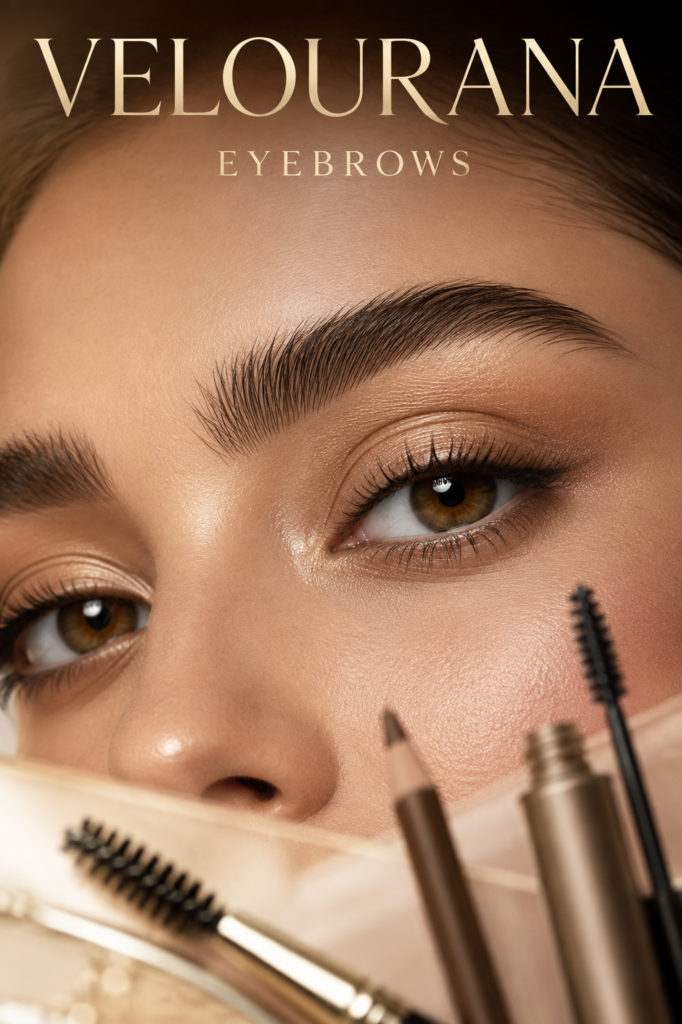
CATEGORY: Rounded Brows
Creating rounded brows successfully requires more than removing hairs until a curved outline appears. The shape depends on proportion, natural growth, facial anatomy, and the controlled transition from the inner brow through the highest point and into the tail. Because rounded brows are intended to look soft, even small mistakes can change their character. Too much removal underneath the arch creates an angle. Excessive curvature produces an exaggerated semicircle. A tail that drops too sharply makes the eye area appear heavier. The most convincing rounded brows are therefore shaped gradually.
A rounded brow can be naturally occurring or cosmetically created. Some people have brow hairs that already follow a gentle arc and need little more than maintenance. Others have straighter, more angular, sparse, or asymmetrical brows and use grooming and makeup to introduce a softer curve. In both cases, the objective is not mathematical perfection. Natural brows contain irregularities, and preserving some of that variation is essential to a believable result.
Modern brow styling has also moved away from the idea that every stray hair must be removed. Fullness and visible texture often contribute to the softness associated with rounded brows. Rather than drawing a continuous artificial arc, contemporary techniques focus on guiding existing hairs, filling genuine gaps, and refining only the areas that disturb overall balance.
The process begins with understanding the brow that already exists. Its width, density, bone position, growth direction, and relationship to the eye establish realistic limits. Once those variables are recognized, the curve can be refined without sacrificing natural structure.
Reading the Brow Before Changing It
The most important stage in brow shaping happens before tweezers, wax, thread, pencil, or pomade are used. The existing brow should be studied in its natural position.
Hair direction provides valuable information. Inner hairs often point upward, while hairs through the body increasingly travel outward. Toward the tail, they may become more horizontal or descend slightly. These directional changes already create visual movement. Shaping should support that pattern whenever possible.
Density also matters. A brow may appear angular because dense hairs concentrate around a natural peak, while finer hairs beneath it are less visible. Another brow may appear straight because the tail is sparse. What seems like a structural problem may therefore be partly an issue of hair visibility rather than actual growth distribution.
The upper and lower boundaries should be evaluated separately. In many rounded brows, the lower line creates most of the visible curvature while the upper line remains comparatively gentle. Removing hair equally from both edges can make the brow unnecessarily thin.
The relationship between brow and orbital bone is equally important. The bone beneath the eyebrow often suggests where elevation occurs naturally. Following this anatomy usually creates a more harmonious shape than attempting to copy a brow seen on another person.
Before reshaping, it is useful to observe the brows from normal conversational distance rather than only in a magnifying mirror. Close inspection exaggerates minor irregularities and can encourage excessive tweezing. The overall facial impression is more important than isolated hairs.
Establishing a Rounded Shape Without Drawing a Semicircle
The most common misconception about rounded brows is that the entire eyebrow should follow one continuous mathematical arc. Natural facial anatomy rarely works this way.
A sophisticated rounded brow usually contains several subtle directional phases. The inner section begins relatively vertically or horizontally depending on natural growth. Through the center, the brow starts to rise gradually. The highest portion is broad rather than pointed. The tail then descends smoothly.
If these transitions are erased and replaced with one perfect semicircle, the eyebrow can look theatrical. The face may appear surprised because the middle of the brow becomes excessively elevated.
The curve should instead develop progressively. The front should feel stable, giving the brow visual weight. The middle introduces lift. The outer third completes the curve without collapsing downward.
A useful way to understand the shape is to think of it as softened architecture. There is still an apex, but the apex extends across a small zone rather than occurring at one sharp coordinate. There is still a descending tail, but it begins gradually.
This approach preserves expression. When the brow rises too abruptly near the center, it can mimic the muscular movement associated with surprise. When the curve remains moderate and its highest point shifts slightly outward, the expression generally appears calmer.
Determining Where the Brow Should Begin
The inner brow establishes the width of the upper face and strongly affects how close or far apart the eyes appear.
Traditional brow mapping often uses the side of the nose as a reference point, but facial proportions vary too much for one universal measurement to be treated as law. Natural hair growth, bridge width, eye spacing, and aesthetic preference all matter.
For rounded brows, the inner section should usually avoid excessive curvature. If shaping begins by immediately removing hairs underneath the front, the brow may start rising too early. This produces a parenthesis-like effect rather than a refined curve.
Preserving fullness near the front helps anchor the shape. Individual hairs can be brushed upward or slightly outward to maintain softness. Dense inner brows may benefit from controlled grooming, but creating a hard vertical edge can make the brow appear blocky.
Sparse beginnings can be filled with fine strokes that mimic hair. The strongest pigment should rarely sit directly at the inner boundary. Allowing the front to remain lighter than the body creates natural depth.
The two brows should also be considered together. Making the inner edges too close can visually narrow the bridge of the nose and intensify the central face. Placing them too far apart may make the nose appear broader and the eyes more separated. Rounded shaping works best when the starting positions support existing facial balance.
Locating a Soft High Point
Although rounded brows lack a sharp peak, they still need a highest area. Without it, they become straight or downward sloping.
The high point commonly occurs somewhere within the outer half of the brow, often around or slightly beyond the outer edge of the iris when looking forward. This is a reference rather than a strict formula.
Placement affects expression. A high point too close to the nose causes the brow to rise rapidly and can create excessive roundness. Moving it outward lengthens the ascending section and makes the curve appear more relaxed.
For people with naturally angular brows, softening the peak may involve allowing hairs beneath or around it to grow rather than removing more hair. Additional fullness blurs the corner where the brow changes direction.
Makeup can accomplish the same effect. Instead of defining the exact apex with a precise pencil line, pigment can be distributed across a broader section. The viewer then perceives a curve rather than a corner.
High-point height should also correspond to facial proportions. Someone with a tall forehead may prefer moderate elevation, while another person may enjoy a higher curve for additional eye-area lift. The defining feature remains smoothness rather than a particular measurement.
Creating a Tail That Completes the Curve
A rounded brow can be beautifully shaped through the first two-thirds and still appear unbalanced if the tail is poorly positioned.
The tail should usually taper, becoming progressively narrower rather than ending abruptly. This taper creates visual direction and prevents the outer brow from appearing heavy.
Its descent should be carefully controlled. A tail that drops sharply can make the outer eye appear lower. A tail that remains excessively horizontal may interrupt the rounded silhouette. The ideal compromise is a gradual downward movement that completes the curve while preserving lift.
Natural tails are frequently sparse, especially after years of grooming. Cosmetic products can restore length, but the extension should follow believable hair direction. Drawing the tail significantly below the natural brow line often produces a drooping effect.
Length also needs to be proportionate. A very short tail makes the brow appear unfinished and emphasizes the central curve. A very long tail can visually widen the upper face or dominate the temple area.
When both brows have different natural tail lengths, cosmetic correction is usually preferable to removing hair from the longer brow solely for symmetry. Preserving healthy growth gives greater future flexibility.
Tweezing and the Importance of Restraint
Tweezing is particularly suitable for rounded brows because it allows individual hairs to be evaluated before removal.
The greatest risk is creating an accidental angle underneath the arch. Removing several hairs from one concentrated area can form a notch. Once this happens, the eye immediately interprets the shape as more angular.
A better approach is gradual refinement across a broader area. Hairs clearly outside the intended shape can be removed first. After that, the brow should be reassessed before additional removal.
Tweezing from the lower boundary usually has a stronger shaping effect than tweezing from the upper boundary. However, the old rule that upper brow hairs should never be touched is unnecessarily rigid. Stray hairs far outside the natural top edge can be removed when needed, but major restructuring from above can flatten the brow or alter its natural position.
Lighting matters because fine hairs can be nearly invisible in dim conditions. At the same time, magnification should be used cautiously. Excessively close viewing encourages pursuit of tiny imperfections that are irrelevant at normal distance.
Rounded brows often look better with a few soft hairs around the boundaries than with an exceptionally sharp outline. This slight diffusion contributes to their natural character.
Waxing, Threading, and Professional Shaping
Waxing and threading can create clean rounded brows efficiently, but both methods remove multiple hairs at once, which makes accurate planning important.
Waxing can establish a smooth lower contour quickly. However, if the waxing line is drawn too deeply beneath the natural arch, the resulting shape may become dramatically angled. The technician must preserve enough hair around the high point to maintain curvature.
Threading offers excellent control over lines and can be particularly useful for refining the underside while leaving the main body intact. Because threading can create extremely crisp edges, some people choose to combine it with softer makeup or brushing so the finished result does not look overly graphic.
Professional shaping is especially helpful when the brows have been over-tweezed, are highly asymmetrical, or need substantial restructuring. An experienced brow artist can identify which hairs should remain during regrowth and which areas can be refined safely.
Communication is essential. Terms such as rounded, soft arch, curved, natural, and low arch may be interpreted differently. Visual references can clarify the desired result, but they should be treated as inspiration rather than exact templates because the reference person's facial anatomy may differ.
A skilled professional should adapt the concept to the client rather than attempting to reproduce the same outline on every face.
Trimming Without Flattening the Brow
Trimming affects brow texture and can subtly influence perceived shape.
Long hairs sometimes extend above or below the intended outline even when their follicles are positioned correctly. Removing the entire hair through tweezing would reduce density, whereas trimming preserves the follicle while shortening the visible strand.
The brows should generally be brushed into a realistic styling position before trimming. If every hair is brushed straight upward and cut along one horizontal line, the hairs may become too short when returned to their normal direction.
Rounded brows benefit from natural overlap between hairs because this overlap helps create a continuous curve. Aggressive trimming can expose gaps and make the outline look thinner or more angular.
Only clearly excessive length usually needs attention. Thick brow hairs may require slightly more control, while fine brows often need minimal trimming.
The inner brow should be handled especially carefully because short, bluntly trimmed hairs can stand upright and appear coarse. Preserving variation in hair length often produces a softer result.
Filling Sparse Rounded Brows With Pencil or Pen
Pencils and brow pens can create convincing rounded brows when used to imitate hair rather than merely outlining the desired shape.
Sparse areas should first be identified. Some brows need density through the body, while others primarily lack a tail. Filling every area equally can create unnecessary heaviness.
Hair-like strokes work best when they follow local growth direction. Near the inner brow, strokes may be more vertical. Through the center they angle outward, and near the tail they become increasingly horizontal or slightly downward.
The lower edge can receive slightly more definition because it establishes structure, but the line should not become so sharp that it forms an artificial angle beneath the high point.
The apex should remain broad. Drawing several fine strokes across the transition zone creates a rounded appearance more effectively than placing one dark line at the peak.
Pressure control is important. Heavy pencil application produces uniform density, while natural brows contain variation. Lighter strokes near the front and slightly stronger definition toward the tail generally create better dimensionality.
Pen products can reproduce individual hairs extremely well, but their precision makes mistakes visible. Small strokes integrated with existing hair are usually more convincing than long uninterrupted lines.
Using Powder for Softer Curvature
Brow powder is particularly well suited to rounded brows because its diffused finish naturally complements the shape's softness.
Rather than creating individual hairs, powder builds a shadow beneath existing growth. This can make sparse brows appear fuller while keeping edges relatively gentle.
Application through the front should usually remain light. More product can be concentrated through the body where density is naturally strongest. The tail may receive additional definition but should still taper.
Powder is also useful for softening angular brows. If a natural peak looks sharp, lightly filling the area around it can blur the transition and create the perception of a broader curve.
A narrow angled brush provides control, but the final effect should not resemble a sharply stenciled outline. Blending with a spoolie helps distribute pigment and reveal natural hairs.
For people who prefer highly natural brows, powder can sometimes be enough on its own. Others may combine it with pencil strokes in sparse sections. The products serve different functions: powder supplies density while pencil supplies structural hair detail.
Pomades and Stronger Brow Definition
Pomades create more saturated and durable definition, which makes them useful for sparse brows, dramatic makeup, or situations requiring longer wear.
Because pomades can easily create sharp lines, they require restraint when designing rounded brows. A heavily carved lower edge can introduce angularity even if the overall outline is curved.
Using a small amount of product allows better control. The brush should distribute pigment through the hairs rather than coating the skin in a continuous opaque shape.
The front can remain softer by using residual product rather than beginning application there. More definition can be placed through the middle and tail.
At the high point, the upper and lower outlines should transition gradually. Creating a pointed upper edge immediately changes the perceived geometry.
Pomades can be especially helpful when reconstructing missing tails because their pigmentation provides strong coverage. The extension should still taper and follow the intended rounded descent.
Brow Gels and Hair Direction
Brow gel can alter the apparent shape even when no hairs are removed.
Clear gel primarily organizes existing hairs, while tinted versions also increase visual density. Both can reinforce rounded geometry by controlling direction.
Through the front, hairs may be brushed upward and slightly outward. In the middle, outward brushing follows the developing curve. Near the tail, hairs can be guided toward the temple.
If every hair is brushed completely vertical, the brow may appear taller and straighter through the upper edge. This can be attractive in laminated styles but may reduce the traditional rounded silhouette.
A softer diagonal brushing pattern generally preserves curvature while adding fullness.
Gel is also valuable for asymmetry. If one brow naturally curves more strongly, directional brushing can subtly alter the other without removing hair.
The finish can range from flexible to strongly laminated. Rounded brows usually benefit from enough hold to maintain order while still allowing individual hair texture to remain visible.
Managing Asymmetry
Nearly all natural brows differ. One may sit higher, contain more hair, begin closer to the nose, or develop a stronger arch.
Rounded brows can actually make asymmetry easier to manage because their soft transitions tolerate small differences. A sharply angular shape draws attention to peak placement, while a broad curved high point allows greater variation.
The goal should be visual balance rather than mathematical identity. Removing healthy hair from the fuller brow simply to match a sparse brow can reduce both long-term flexibility and overall density.
Makeup offers a safer method of adjustment. A slightly lower brow can be filled subtly along the upper boundary to create the appearance of lift. A brow with a sharper peak can be softened by adding density around the angle. A short tail can be extended.
Facial muscles also contribute to asymmetry. One brow may naturally lift more when a person speaks or smiles. No amount of hair removal can permanently equalize dynamic facial movement.
Accepting some difference preserves natural expression and often creates a more believable result.
Regrowing Over-Shaped Rounded Brows
Brows that have been repeatedly tweezed into thin or highly angular shapes may require time before a fuller rounded structure can be restored.
During regrowth, isolated hairs often appear before the overall shape becomes clear. Removing these hairs prematurely can restart the cycle of over-shaping.
Temporary cosmetic filling can make the transition easier. Pencil, powder, tinted gel, or pen can visually connect new growth with existing hair while the brow becomes denser.
The most important zones are often beneath the arch and along the tail. Hair returning beneath a previously sharp peak can soften the angle significantly.
Growth patterns vary, and not every follicle necessarily returns after repeated removal. Expectations should therefore remain realistic. If permanent sparsity exists, cosmetic products or professional techniques may be used to approximate the desired curve.
The regrowth period is also an opportunity to reconsider the natural brow rather than recreating an old ideal. Often the emerging pattern reveals a softer, fuller architecture that requires less intervention.
Adapting Rounded Brows to Different Makeup Styles
Rounded brows are versatile enough to work with minimal, classic, glamorous, editorial, and dramatic makeup.
With minimal makeup, visible hair texture becomes especially important. Light grooming and selective filling generally maintain a believable frame around the eyes.
Classic makeup can support slightly more definition. A clean lower edge, softly filled body, and tapered tail create polish without sacrificing curvature.
Glamorous makeup may use deeper pigment and stronger boundaries. Even then, preserving a broad apex prevents the brow from appearing unexpectedly angular.
Editorial looks can exaggerate the rounded shape deliberately, perhaps by increasing thickness, extending the tail, bleaching the hairs, or creating graphic symmetry. Such styling treats the brow as a fashion element rather than purely natural framing.
The same fundamental brow can therefore shift dramatically depending on product intensity. Shape and styling should be considered separately: the underlying architecture may remain rounded even when the finish becomes bold.
Long-Term Maintenance and Shape Stability
Once a flattering rounded brow has been established, maintenance becomes simpler because there is no need to redesign it repeatedly.
Regrowth should be assessed against the established shape rather than removed automatically. Some new hairs may actually improve density or soften a previously thin area.
Spacing between grooming sessions allows enough growth to distinguish genuine strays from hairs that belong to the brow. Constant daily tweezing can gradually change the architecture without the person noticing.
Cosmetic products should also be adjusted as hair density changes. A brow that once required substantial pencil filling may need less after regrowth or tinting.
Changes in hair color can influence perceived brow intensity as well. Darker hair may make the shape appear more pronounced, while lighter brows may need additional definition to remain visible.
Age can alter density, texture, and hair direction. Rounded brows can adapt gracefully because the shape does not depend on one sharp structural point. As density changes, the curve can be maintained through subtle grooming and selective cosmetic enhancement.
Building a Rounded Brow That Still Looks Like Your Own
The most successful brow shaping does not erase individuality. Rounded brows should appear related to the person's natural features rather than attached as a standardized template.
This is why exact mapping measurements, celebrity references, and trend diagrams have limitations. They can provide useful starting points, but they cannot account fully for bone structure, eye spacing, hair direction, expression, and asymmetry.
A rounded brow should begin where the face naturally supports it, rise gradually rather than abruptly, maintain a broad soft high point, and taper through a controlled tail. Density should remain sufficient to preserve texture, while cosmetic products should enhance rather than conceal the underlying hair.
Small imperfections are often part of what makes the result convincing. A slightly irregular front, a few softer hairs at the boundary, or minor differences between the two brows can prevent the shape from appearing manufactured.
Rounded brows are ultimately less about drawing a curve and more about managing transitions. The movement from front to body, body to high point, and high point to tail should feel continuous. When those transitions are handled carefully, the brow frames the eyes without demanding attention for itself.
That subtle balance is what gives rounded brows their enduring appeal. They can provide definition without severity, lift without sharpness, and polish without sacrificing natural character. Whether created through grooming, makeup, professional shaping, or simply careful maintenance of existing growth, the rounded brow remains one of the most adaptable ways to introduce softness and harmony to the upper face.
THE END VELOURANA
 Discover More From Our Family of Websites
 ZodiacBearing (Astrology, Tarot, Numerology, Angel Numbers & Spiritual Guidance)
 Velourana (Beauty, Makeup, Hair Care, Skincare & Beauty Tips)
 HavenBearing (Home, Living, Organization, Décor & Everyday Inspiration)
 PawBearing (Pet Care, Dog Breeds, Animal Health, Training & Pet Products)
 PsyCatherine (Notes From the Journal of a Psychologist on Real Life)

