
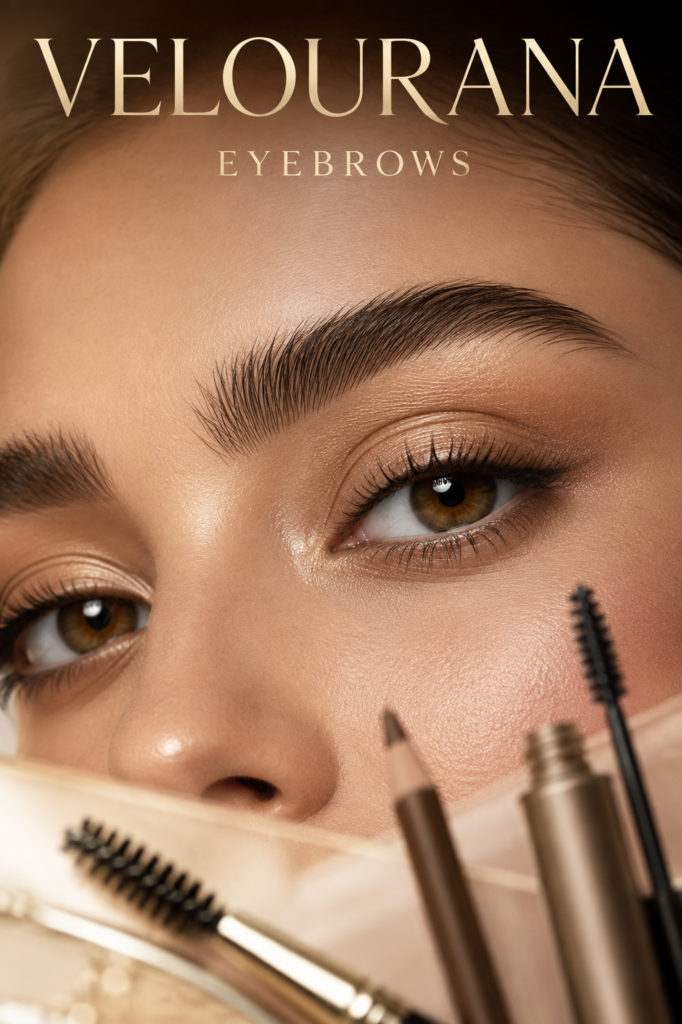
CATEGORY: Arched Brows
Arched brows are among the most recognizable eyebrow shapes because they introduce visible structure to the upper face without necessarily appearing severe or heavily styled. The defining feature is a noticeable rise from the inner brow toward a higher point before the brow descends into its tail. Yet an attractive arch is rarely created simply by removing hair beneath the highest point. The most convincing arched brows are built around facial proportions, natural hair growth, brow density, bone structure, and the relationship between the eyes, forehead, temples, and cheekbones.
The idea of the “perfect arch” can therefore be misleading. There is no single angle, height, thickness, or position that suits every face. Some brows naturally rise sharply and form a pronounced peak, while others create a softer curve that becomes apparent only toward the outer third. Both can be considered arched brows. What matters is whether the transition from the beginning of the brow to its highest point and then into the tail looks intentional and harmonious.
Arched brows also illustrate how relatively small changes in eyebrow geometry can influence the way the entire face is perceived. Raising the apparent peak slightly can make the eye area seem more open. Extending the tail can create greater horizontal balance. Filling the lower edge may make a naturally irregular arch look cleaner, while softening the upper boundary can prevent the brow from becoming excessively graphic. Understanding these relationships is more useful than following a rigid brow template.
What Defines an Arched Brow
An eyebrow can be thought of as having three broad visual areas: the head near the bridge of the nose, the body through the central section, and the tail extending toward the temple. In an arched brow, the body gradually rises until reaching a distinct high point. From there, the upper and lower boundaries descend toward the tail.
The position of this peak is important. When the highest point appears too close to the center of the face, the brow can look rounded or surprised rather than elegantly arched. When it occurs extremely far toward the temple, the brow may appear unusually straight for most of its length before dropping abruptly. A naturally balanced arch commonly develops somewhere in the outer portion of the brow rather than directly above the center of the eye.
The character of an arch is also determined by the difference in height between the brow head and the peak. A small difference produces a soft arch. A larger rise creates a more dramatic one. Neither is inherently superior. The appropriate degree of elevation depends largely on the natural brow and surrounding facial structure.
Thickness changes the impression further. A full, gently arched brow can look relaxed and contemporary because the natural density softens its geometry. A thinner brow with an identical peak may appear much sharper because every change in direction becomes more visible. For this reason, arch height should never be considered independently from brow width and density.
The tail completes the architecture. A beautifully developed peak can still look unbalanced when followed by a tail that is extremely short, overly thin, or drawn downward too steeply. Ideally, the tail appears to continue naturally from the arch rather than looking like a separate line attached to it.
Natural Architecture Matters More Than a Template
Eyebrow trends have repeatedly shifted between thin, highly sculpted arches and fuller, more natural shapes. These changes can make it tempting to reshape brows dramatically whenever a new aesthetic becomes fashionable. The problem is that eyebrow growth patterns do not change as quickly as trends.
Every brow has an underlying architecture created by follicle placement. Some people naturally have a pronounced arch. Others have predominantly straight brows with only a modest rise. Some have dense hair through the body but sparse tails. Others have irregular growth underneath the arch or hairs that point downward along the outer section.
Working with this architecture generally produces a more convincing result than attempting to impose a completely different brow shape.
A naturally straight brow can certainly be styled to appear somewhat more arched. Strategic filling along the upper outer boundary and careful definition beneath the peak can increase the visual rise. However, removing large amounts of hair to manufacture a dramatic arch may create an artificial shape that requires continuous maintenance.
Similarly, naturally high arches rarely need additional exaggeration. Removing too much hair from underneath them can leave the brow looking permanently startled. In these cases, preserving thickness and controlling the peak with grooming and makeup may create greater balance.
Natural asymmetry must also be considered. Human faces are not perfectly symmetrical, and eyebrows frequently differ in height, density, growth direction, and curvature. Trying to force them into exact mirror images can require unnecessary removal of healthy brow hair. A more sophisticated approach is to make the brows visually related while allowing minor structural differences to remain.
How Arched Brows Influence Facial Expression
Eyebrows are closely associated with expression because their position changes when facial muscles move. Permanent eyebrow shape therefore interacts with visual cues that people instinctively associate with emotion.
A very high arch can create an impression of alertness or intensity. A softer arch tends to appear more relaxed. A tail that descends dramatically can sometimes make the outer eye area seem heavier, while a tail that extends outward with a moderate downward angle can create a more lifted impression.
These effects are subtle, but they explain why changing eyebrow shape can seem to alter much more than the brows themselves.
The relationship with the eyes is particularly important. A carefully positioned arch can emphasize the space above the outer iris and create greater visual openness around the eyelid. This can be especially noticeable when eye makeup is also designed to draw attention outward and upward.
The arch also interacts with the forehead. Brows that are excessively thin and highly elevated may leave a large uninterrupted area between the eye and hairline, making the forehead appear more prominent. Fuller brows provide greater visual weight and can create a stronger frame for the eyes.
At the temples, the length and direction of the tail influence how the brow connects visually with the rest of the face. An extremely short tail may make the brow seem incomplete. An excessively long tail can pull the visual direction outward or downward. The objective is not mathematical perfection but proportional continuity.
Soft Arches and High Arches Create Different Effects
Not every arched brow should have a dramatic peak. In fact, the distinction between soft and high arches is one of the most important considerations when choosing how strongly to define the shape.
A soft arch rises gradually and transitions smoothly into the tail. There may be no obvious corner at the highest point. Instead, the brow follows a gentle curve that becomes slightly more elevated toward the outer portion. This shape can retain much of the natural softness of a straight or rounded brow while adding subtle definition.
Soft arches are particularly adaptable because they do not dominate the face. They can work with fuller brows, lightly groomed styles, understated makeup, and more polished looks. When the natural brow already contains a slight rise, relatively little intervention may be necessary.
A high arch creates greater vertical movement. The peak is more obvious, and the descending tail forms a stronger contrast with the rising body. This can produce a sculpted appearance and emphasize the upper facial structure.
The challenge with a high arch is restraint. Increasing the height does not indefinitely increase the lifting effect. Beyond a certain point, the shape begins to look disconnected from natural anatomy. Excessive removal underneath the peak can also reduce brow thickness exactly where structural strength is needed.
A high arch often looks most convincing when supported by sufficient density. Hair provides texture that prevents the geometric outline from becoming too severe. When the brow is naturally sparse, extremely sharp definition can make the drawn portions more noticeable.
The decision between a soft and pronounced arch should therefore emerge from existing proportions rather than from a universal beauty rule.
Finding the Visual Peak
Traditional brow mapping often uses imaginary lines extending from the nose through different areas of the eye to estimate the beginning, arch, and end of the eyebrow. Such methods can provide useful reference points, but they should be treated as guides rather than immutable laws.
Faces differ in nose width, eye spacing, brow bone structure, and natural eyebrow length. Applying identical mapping rules to every person can produce awkward results.
The natural brow usually provides more useful information. Looking closely at the upper boundary often reveals where the hairs naturally reach their greatest height. The lower boundary may also begin changing direction in roughly the same region. This existing transition is a logical starting point for determining the arch.
Rather than creating a new peak, grooming can clarify the one already present.
Makeup offers another way to test potential changes before removing hair. A brow pencil or powder can slightly increase the upper boundary around the proposed arch while concealer can temporarily disguise a few hairs underneath. Seeing the complete effect before tweezing or waxing reduces the risk of irreversible over-shaping.
The peak should also be viewed from normal conversational distance rather than exclusively through a magnifying mirror. Close inspection is useful for individual hairs, but eyebrow shape is perceived as part of the entire face. A curve that looks imperfect from a few centimeters away may appear completely balanced at normal distance.
Thickness Is Part of the Arch
One of the most common misconceptions about arched brows is that definition requires thinness. In reality, a strong arch can exist within a very full eyebrow.
Thickness determines how much visual weight the brow carries. Fuller brows can support a pronounced arch while retaining softness because individual hairs remain visible and the outline is less dominant. Thin brows emphasize the contour itself, which makes every angle more conspicuous.
When shaping an arch, preserving thickness through the body is particularly important. Removing hair repeatedly from the underside in an attempt to raise the peak can gradually create a narrow central section. The brow may then become thicker at the head, unexpectedly thin around the arch, and almost threadlike at the tail.
A more balanced structure maintains a reasonably consistent progression. The head is usually the fullest area, the body gradually narrows, and the tail tapers naturally.
Makeup can help correct uneven thickness without requiring further removal. Fine pencil strokes can replace the appearance of missing hairs, while powder can create subtle density through larger sparse areas. Pomade can provide stronger definition when a more sculpted finish is desired.
The key is maintaining the visual integrity of the arch without turning it into an isolated angular feature.
Grooming Without Over-Shaping
The most significant long-term risk when maintaining arched brows is repeated over-removal. A single grooming session may remove only a few unnecessary hairs, but small changes accumulated over months or years can gradually alter the natural brow.
Before removing anything, brushing the hairs into their normal direction reveals the actual structure. Some apparent irregularities disappear once longer hairs are positioned correctly. Brow gel can also show how the shape looks when the hairs are lifted or controlled.
Stray hairs well outside the main brow structure are usually easier to identify than hairs sitting directly along the boundary. Those close to the shape deserve more caution because removing one can alter the apparent thickness or angle.
The area underneath the arch is especially sensitive. A few hairs may obscure an otherwise clean curve, but aggressive removal can quickly create an exaggerated peak. It is generally safer to refine gradually and reassess the brow repeatedly.
Trimming also requires restraint. Long brow hairs contribute to fullness and may cover small gaps. Cutting them too short can expose sparse areas that were previously invisible. When trimming is needed, the hairs should be brushed into position so that only clearly excessive length is addressed.
Waxing, threading, and professional shaping can produce clean outlines, but the same principle applies: the goal should be refinement of the natural structure rather than automatic pursuit of maximum sharpness.
Makeup Can Strengthen an Arch Without Permanently Changing It
One advantage of eyebrow makeup is that it allows experimentation. The apparent height, thickness, tail length, and sharpness of an arch can all be adjusted temporarily.
A pencil is particularly useful when the arch needs localized correction. Fine strokes can extend the upper boundary slightly near the peak or restore density underneath an uneven section. Matching the direction of natural hair growth helps the additions blend with the brow.
Powder creates a softer effect. Rather than constructing individual hairs, it introduces a veil of color beneath the existing brow. This can make an arch look fuller without making its outline excessively crisp.
Pomades and highly pigmented brow products are capable of producing dramatic definition. They can be effective for evening makeup, photography, or deliberately sculpted styles, but they require careful blending. A solid block of color can obscure the natural hair texture that gives brows dimension.
Brow pens can create fine marks in sparse areas, particularly around the tail. Because the outer section often contains fewer hairs, realistic strokes can be useful for maintaining a taper while extending the shape.
Gel changes the architecture differently. Rather than adding substantial color, it controls hair direction. Brushing the body slightly upward can increase apparent fullness, while directing the hairs around the arch outward can clarify the transition into the tail.
Different products can therefore alter the same arched brow in very different ways without changing its underlying structure.
The Brow Head Should Not Compete With the Arch
When people concentrate on creating a defined arch, they sometimes overlook the beginning of the eyebrow. Yet the brow head strongly influences whether the finished shape looks natural.
A heavily squared inner edge combined with a sharp arch can make the entire brow appear graphic. This may be intentional in certain makeup styles, but it is not necessary for definition.
Natural brow heads usually contain hairs that are more vertical and somewhat less densely packed than those through the body. Preserving this texture creates a gradual beginning rather than an abrupt block.
When filling sparse brows, applying less pigment at the head and gradually increasing definition toward the body can help maintain dimension. Brushing through the area after applying product also disperses excess color.
The position of the brow head matters as well. Bringing both brows too close together can visually narrow the bridge of the nose and create heaviness at the center of the face. Removing too much from the inner edges can make the eyes appear farther apart and shorten the brows.
The arch should be the structural focus of an arched brow, but it works best when the head provides a quiet beginning from which the shape can develop.
Why the Tail Matters So Much
The tail is the conclusion of the eyebrow, and its direction can reinforce or undermine the arch.
After the peak, the brow should narrow progressively. If the tail remains equally thick until its end, the eyebrow may look blunt. If it becomes extremely thin immediately after the peak, the arch may appear disconnected.
Length is equally important. Sparse natural tails can be extended subtly with makeup, but extending them too far can distort facial proportions. Direction should also be considered carefully. Drawing the tail sharply downward may visually lower the outer brow and counteract the openness created by the arch.
A more outward trajectory generally preserves a lifted appearance, although the ideal angle depends on the natural brow bone.
Texture makes artificial extensions more believable. Rather than drawing one continuous line, fine strokes can imitate individual hairs. A small amount of powder or gel can then integrate those marks with the natural eyebrow.
Because the tail occupies relatively little space, even minor adjustments can significantly alter the final silhouette.
Arched Brows and Different Facial Proportions
Face-shape categories can offer broad inspiration, but they should not dictate eyebrow design. Real faces contain combinations of characteristics that do not always fit neatly into categories such as round, oval, square, heart, or long.
Nevertheless, understanding proportion can help explain why different arches produce different effects.
A face with strong horizontal width may appear more vertically balanced when the brows have some visible elevation. Conversely, extremely high arches on an already elongated face may increase the perception of vertical length.
Strong jawlines can coexist beautifully with structured brows, but excessively angular eyebrows may intensify an already geometric appearance. A slightly softer peak can introduce contrast while maintaining definition.
Faces with delicate features may be overwhelmed by extremely dark, thick, sharply arched brows if the brow becomes the dominant element. This does not mean full brows are unsuitable; rather, color intensity and edge definition may need adjustment.
Eye shape, eye spacing, forehead height, and cheekbone prominence often matter as much as the general face outline. Brow design works best when these elements are considered together.
The objective is visual balance rather than correction. Facial features do not need to be “fixed” by eyebrow geometry. Instead, the brow can emphasize characteristics the wearer wishes to highlight.
Symmetry Without Artificial Perfection
Perfectly symmetrical brows are rare because the underlying face is itself asymmetrical. One brow bone may sit slightly higher. One eyebrow may contain a stronger natural arch. Hair density may differ between sides.
Attempting to eliminate every difference can lead to a cycle of removing hair from one brow and then trying to match the other. Eventually both may become thinner than intended.
Visual balance is a more useful goal.
Makeup can compensate for small differences without permanently altering the brows. A slightly lower arch can be enhanced with a few strokes along its upper boundary. A sparse tail can be extended. A small gap can be filled without changing the opposite brow.
Photographs can sometimes reveal overall differences more clearly than a close mirror because they reduce the temptation to focus on individual hairs. However, even photographs can exaggerate asymmetry depending on lighting, camera angle, and facial expression.
Brows should ultimately be assessed while the face is relaxed and from a normal viewing distance.
Allowing Arched Brows to Evolve
Eyebrows change over time. Hair density can shift, individual hairs may become coarser or finer, and personal preferences evolve. Makeup trends also change continually.
An arched brow that looks contemporary does not need to be locked into a permanent formula.
Preserving natural hair wherever possible gives greater flexibility. Fuller brows can be styled softly one day and sharply another. They can be brushed upward, filled more dramatically, or left almost untouched. Once substantial amounts of hair have been removed, those options become narrower.
This is why thoughtful maintenance is more valuable than chasing exact measurements. The strongest brow shape is often one that remains adaptable.
Arched brows can be polished without appearing artificial, strong without becoming severe, and expressive without dominating the face. Their appeal lies not simply in the existence of a high point but in the gradual movement that surrounds it: a natural beginning, a balanced rise, a controlled peak, and a tapering tail.
When those elements work together, the arch becomes part of the face rather than a shape imposed upon it.
THE END VELOURANA
 Discover More From Our Family of Websites
 ZodiacBearing (Astrology, Tarot, Numerology, Angel Numbers & Spiritual Guidance)
 Velourana (Beauty, Makeup, Hair Care, Skincare & Beauty Tips)
 HavenBearing (Home, Living, Organization, Décor & Everyday Inspiration)
 PawBearing (Pet Care, Dog Breeds, Animal Health, Training & Pet Products)
 PsyCatherine (Notes From the Journal of a Psychologist on Real Life)

