
CATEGORY: Hooded Eye Makeup
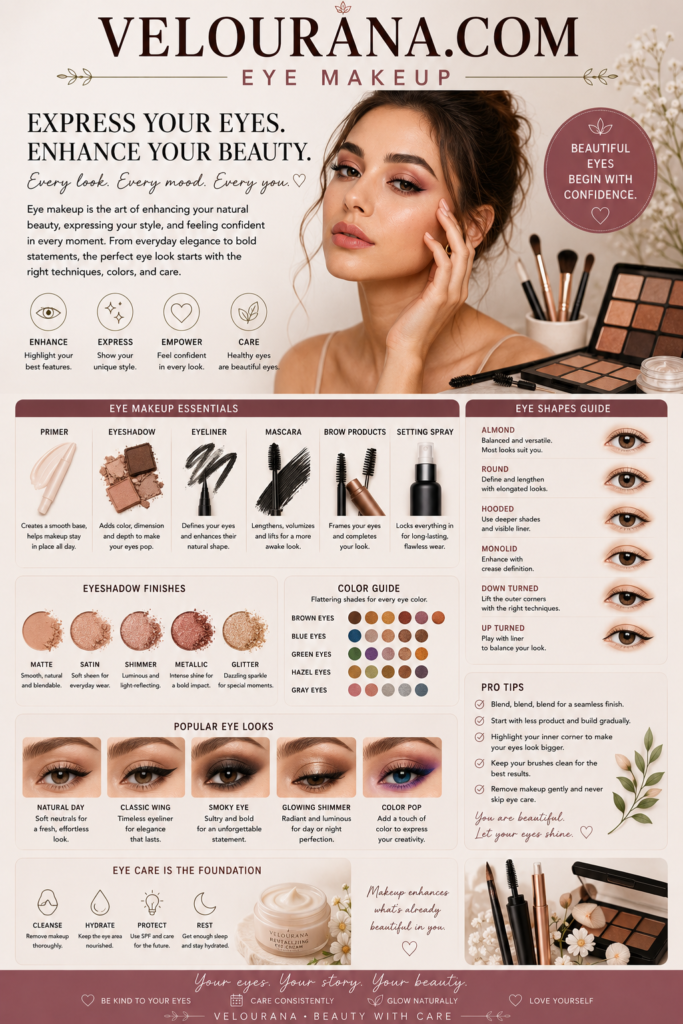
Hooded eyes have a distinctive structure that changes the way eyeshadow is seen when the eyes are open. A fold of skin extends from the brow area toward the lash line, partially or substantially covering the natural crease. The degree of hooding varies enormously: for some people, only the outer portion of the crease disappears; for others, most of the mobile lid becomes concealed when looking straight ahead. Neither version represents a problem that makeup needs to correct. Hooded eye makeup is simply an exercise in understanding where color remains visible and how placement can influence the apparent shape of the eye.
Many conventional eyeshadow instructions assume that the natural crease is permanently visible. They recommend placing a transition shade directly inside that crease, deepening the outer corner, and concentrating shimmer across the mobile lid. On hooded eyes, following those instructions literally can produce a very different result. Carefully blended crease color may disappear beneath the fold, shimmer may transfer upward, and a beautifully constructed gradient can become almost invisible once the eyes return to a relaxed position.
Successful hooded eye makeup therefore depends less on following standard anatomical landmarks and more on observing the eye while it is open. The visible space becomes the true working area. Once that principle is understood, hooded eyes offer remarkable possibilities for sophisticated, dimensional makeup that can appear soft and natural, intensely smoky, polished and sculpted, or luminous and dramatic.
Understanding the Architecture of a Hooded Eye
The defining feature of a hooded eye is the relationship between the mobile eyelid and the skin above it. When the eye is closed, there may appear to be generous lid space and a clearly identifiable crease. When the eye opens, however, the upper fold can descend over that crease and conceal part of the work placed beneath it. This movement is why hooded-eye makeup needs to be evaluated repeatedly with the eyes open rather than designed entirely on a closed lid.
There is also considerable variation within the broad description of hooded eyes. Some eyes are hooded primarily at the center, while others have more coverage toward the outer corner. The brow bone may be prominent or relatively flat. The eyes themselves may be round, almond-shaped, deep-set, close-set, wide-set, upturned, or downturned. Hooding is only one structural characteristic, and treating every hooded eye as though it has identical proportions can result in unnecessarily rigid makeup.
The amount of visible space can also change with facial expression. Raising the brows temporarily exposes more lid, while relaxing the forehead restores the natural fold. For this reason, makeup created while deliberately lifting the eyebrows can be misleading. A placement that looks perfect in that position may disappear as soon as the face relaxes. Working with a neutral expression provides a much more accurate view of how the finished makeup will actually appear.
The goal is not necessarily to make a hooded eye look less hooded. Makeup can instead work with the existing architecture, emphasizing the lash line, extending visible color above the fold, controlling the direction of darker shades, and deciding deliberately where light should appear. This approach respects the natural eye while giving the wearer far greater control over the final visual effect.
Building a Crease That Remains Visible
One of the most transformative ideas in hooded eye makeup is that the visible crease created with eyeshadow does not always need to follow the anatomical crease. Instead, shadow can be placed slightly above it so that the color remains visible when the eye is open. This creates the impression of depth without allowing the entire gradient to disappear beneath the hood.
The most reliable way to determine this placement is to look straight ahead with the face relaxed. A softly diffused midtone can then be positioned just above the point where the fold naturally closes. When the eye is subsequently lowered or closed for blending, that visible placement becomes the guide. The result is sometimes described as creating a new or artificial crease, although the effect does not need to resemble a formal cut crease. In everyday makeup, it can be extremely subtle.
Blending direction matters as much as placement. If dark shadow is concentrated too heavily inside the deepest part of the natural crease, it can visually compress the eye. By allowing the transition color to rise slightly higher and remain softly diffused at its upper edge, the eye gains visible dimension even from a frontal view. The deepest shade can then occupy a narrower area beneath or along the lower portion of that transition.
The height of the placement should remain proportional to the available space between the fold and eyebrow. Raising shadow does not mean carrying dark pigment indiscriminately toward the brow. The objective is controlled visibility. A soft transition should appear above the hood when the eye is open, while enough clean space remains beneath the eyebrow to preserve structure and prevent the entire upper eye area from becoming visually heavy.
Color intensity can also be built gradually. Hooded eyes often respond beautifully to translucent layers because gradual depth makes it easier to control the shape. A small amount of pigment can establish the direction, another layer can reinforce the outer area, and deeper color can be added only where necessary. This creates dimension without producing a thick block of shadow.
Using the Outer Eye to Control Direction
The outer portion of the eye plays an especially important role because it determines whether the finished shape appears lifted, elongated, rounded, or downward-facing. On hooded eyes, heavy shadow placed too low at the outer corner can visually pull the eye downward. Extending the blend slightly outward and upward can instead create a more open, elongated impression.
This does not require a sharply angled or exaggerated shape. Even soft everyday eyeshadow can be directed with intention. Rather than blending in circular motions without considering the final silhouette, the outer edge can be diffused toward the end of the eyebrow or slightly above the natural outer corner. The precise direction depends on the individual eye, but the principle is to prevent the deepest color from collecting beneath the level where a lifted shape is desired.
The outer hood itself may conceal some pigment, so checking the makeup with the eyes open remains essential. A dark outer corner that looks dramatic when the eye is closed may appear surprisingly small when it opens. Conversely, color extended too far upward can become much stronger than expected. Alternating between open-eye observation and closed-eye blending allows the placement to remain controlled.
A smaller brush can be useful for establishing depth before a larger blending brush softens the edges. This prevents the deepest shade from spreading too widely across the hood. The technique creates a layered effect: concentrated depth close to the outer lash area, a medium tone surrounding it, and a softer transition dissolving into the upper edge. The result can appear dimensional without overwhelming limited visible lid space.
For eyes that are both hooded and naturally downturned, the placement may benefit from stopping the darkest shadow before it reaches the lowest point of the outer corner. The blend can then continue visually upward rather than tracing the downward anatomical line. For hooded eyes that are already strongly upturned, a more horizontal extension may create balance. Individual structure should always determine the final direction.
Light, Shimmer, and the Visible Lid
Shimmer is sometimes treated cautiously in advice about hooded eyes, but there is no universal reason to avoid it. The more useful question is where the reflective finish will be visible and how it interacts with the fold. Strategic shimmer can bring remarkable brightness and dimension to hooded eyes, particularly when it is concentrated where the lid catches light naturally.
The center and inner portion of the visible lid often provide excellent locations for luminosity. Applying shimmer while looking downward can make the mobile lid easier to access, but the final placement should still be checked with the eye open. If almost all of the reflective shade disappears, a small amount can be extended slightly above the fold at the center so that a glimmer remains visible from the front.
Texture matters. Finely milled satin and metallic finishes tend to create a smoother reflective surface, while very chunky glitter can emphasize texture and may transfer more readily where the lid folds against itself. That does not make glitter unsuitable, but adhesion and placement become more important. A suitable eyeshadow base or glitter adhesive can help reflective particles remain where they were intended.
A bright inner corner can also create the impression of greater openness. The highlight does not need to be stark or icy. A soft satin shade slightly lighter than the surrounding makeup can catch enough light to define the inner eye without dominating the look. The effect can be especially elegant when the rest of the eyeshadow remains matte or softly luminous.
Highlighting directly beneath the brow should be approached according to the structure of the brow bone. A strong reflective highlight over a prominent hood can bring that area visually forward. A softer satin or matte brightening shade often creates a more seamless transition. On flatter brow structures, however, a subtle sheen may work beautifully. Again, the anatomy rather than a universal rule should guide the choice.
Eyeliner and the Importance of Open-Eye Space
Eyeliner on hooded eyes can dramatically influence how much eyelid remains visible. A very thick line across the upper lashes may consume most of the exposed mobile lid, particularly at the center. For someone who wants the eyeshadow to remain visible, keeping the liner relatively close to the lash roots can preserve valuable space while still adding definition.
This does not mean hooded eyes cannot wear bold eyeliner. Graphic wings, smoky liner, and dramatic shapes can all work beautifully, but they often benefit from being designed while the eye is open. A conventional wing drawn entirely with the eyelid closed may fold or appear interrupted when the eye opens because the hood changes the surface geometry.
Open-eye mapping solves much of this problem. The direction and visible outline can first be established while looking straight ahead. The eye can then be partially closed to connect and refine the shape. In some cases, the resulting line looks unusual when the eye is fully closed because it crosses the fold in a nontraditional way, yet appears smooth and intentional when the eye is open. The visible result matters more than whether the line follows a conventional shape on a closed eyelid.
Smudged liner can be particularly harmonious with hooded eyes because it does not depend on an absolutely crisp geometric edge. Deep shadow or pencil concentrated close to the lashes can create density, then soften gradually into the surrounding eyeshadow. This gives definition without sacrificing as much visible lid area.
Tightlining the upper lash line can intensify the appearance of the lashes while using almost no external lid space. Because the technique involves the sensitive waterline area, products intended for that placement should be used, and irritation should never be ignored. When comfortable and appropriate, the effect can provide subtle definition beneath a comparatively light eyeshadow look.
Balancing the Lower Lash Line
Hooded-eye makeup is often discussed almost entirely in terms of the upper lid, yet the lower lash line contributes significantly to the overall proportions. A small amount of shadow beneath the eye can connect the upper and lower makeup, add softness, and create a more complete frame.
The intensity should correspond with the desired effect. A soft neutral shade concentrated near the outer lower lashes can support an elongated upper shape without making the lower eye appear heavy. A smoky look may carry deeper pigment farther inward, while a fresh daytime look may use almost no lower shadow at all.
Connecting the lower outer shadow with the upper outer blend can create continuity, but the connection should not automatically follow the lowest edge of the eye if that pulls the shape downward. Instead, the lower shadow can fade before meeting the upper blend, allowing the outer eyeshadow to maintain its chosen direction.
The waterline offers another opportunity to alter the visual impression. Deep tones can create intensity and make the eye feel more enclosed, while lighter neutral tones may produce a more open appearance. Neither is inherently more flattering; they simply create different effects. The choice should support the overall mood rather than follow a fixed rule about what hooded eyes supposedly must wear.
Longevity Where the Eyelid Folds
Because portions of a hooded eyelid frequently touch each other, product transfer can be more noticeable. Oils, warmth, and repeated movement may cause eyeshadow or eyeliner to migrate into the fold, particularly over a long day. Preparation therefore has practical importance beyond simply intensifying color.
An eyeshadow primer can create a more stable surface and help reduce creasing. The amount should be thin enough to avoid adding unnecessary texture. Heavy layers of skincare, concealer, and primer beneath eyeshadow can sometimes make the surface more mobile rather than more secure, so restraint can be useful.
Cream products can work extremely well on hooded eyes when their formulas set reliably. Long-wearing cream shadows can create smooth color with minimal effort, while very emollient formulas may remain mobile and transfer. Powder shadow applied over a compatible base can further reinforce longevity when needed.
Eyeliner should likewise be given time to set before the eye is allowed to fold completely. This is especially relevant with liquid or gel formulas. Looking downward briefly after application can reduce immediate transfer while the product dries. Once set, a suitable long-wearing formula can remain surprisingly stable even where the lid naturally overlaps.
The purpose of these measures is not to make the makeup rigid. Eyes move constantly, skin produces natural oils, and some fading over many hours is normal. Longevity techniques simply allow the original design to remain recognizable for longer.
Designing Makeup Around the Individual Eye
The most sophisticated hooded-eye makeup begins when generalized rules become secondary to observation. Two people can both have hooded eyes and require completely different placement. One may have considerable space between the fold and eyebrow, while another has very little. One may have a visible inner lid and concealed outer lid; another may experience the reverse. Brow position, eye depth, lash direction, and facial proportions all influence the result.
Experimentation is therefore more useful than attempting to force the eye into a predetermined template. Photographing makeup with the eyes naturally open can reveal proportions that are difficult to assess in a close mirror. The image may show that the transition shade needs to sit slightly higher, that the outer corner could extend farther, or that a liner shape is occupying more visible space than intended.
The same eye can also support radically different aesthetics. Soft matte neutrals can create understated definition, while metallic color can turn the visible center of the lid into a deliberate focal point. A smoky eye can use the hood itself as part of the gradient, allowing deep color to emerge around the lashes and dissolve upward. Graphic makeup can work across the fold rather than pretending the fold is not there.
Age and natural changes in skin elasticity can alter hooding over time. Makeup placement that worked several years earlier may begin to behave differently, not because the technique has somehow become incorrect but because the architecture has changed. Reassessing visible space and adjusting the height, direction, or texture of eyeshadow allows the makeup to evolve naturally with the face.
Hooded eye makeup becomes far easier when the eye is treated as a three-dimensional moving structure rather than a flat surface. The fold is not an obstacle to beautiful eyeshadow; it is simply part of the architecture. By positioning depth where it remains visible, controlling the outer direction, preserving or deliberately using lid space, and checking the design with the eyes naturally open, makeup can become both more predictable and more expressive.
The strongest result is rarely the one that follows the largest number of rules. It is the one that understands where the eye naturally hides color, where it reveals light, and how those qualities can be incorporated into the design. Hooded eyes can carry delicate washes, sophisticated sculpting, dramatic smoke, brilliant metallics, or architectural liner with equal confidence. Technique becomes effective when it responds to the eye rather than asking the eye to conform to the technique.
THE END VELOURANA
 Discover More From Our Family of Websites
 ZodiacBearing (Astrology, Tarot, Numerology, Angel Numbers & Spiritual Guidance)
 Velourana (Beauty, Makeup, Hair Care, Skincare & Beauty Tips)
 HavenBearing (Home, Living, Organization, Décor & Everyday Inspiration)
 PawBearing (Pet Care, Dog Breeds, Animal Health, Training & Pet Products)
 PsyCatherine (Notes From the Journal of a Psychologist on Real Life)

