
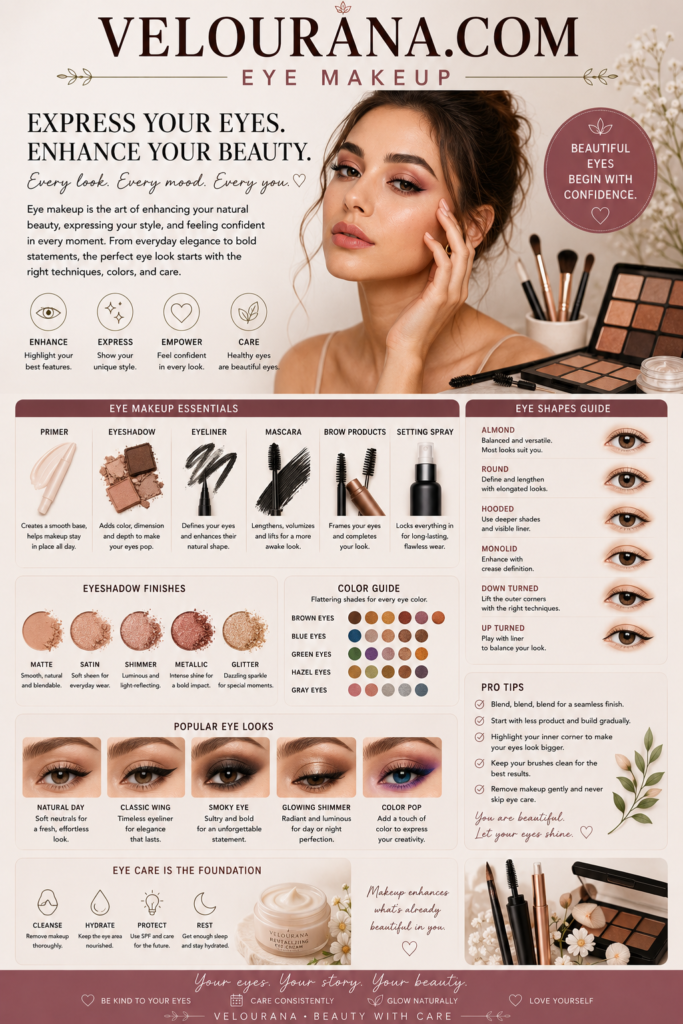
CATEGORY: Powder Eyeshadow
Powder eyeshadow is often introduced as one of the easiest forms of eye makeup, but truly polished powder application depends on a subtle understanding of pigment, pressure, texture, placement, and restraint. The difference between a beautifully diffused eye and an uneven application rarely comes from one dramatic mistake. It usually comes from a series of small decisions: how much product was collected, where the brush first touched the skin, whether the base was too tacky, whether the deepest shade remained concentrated, and whether blending stopped before the structure disappeared.
This is what makes powder eyeshadow so interesting. It rewards refinement.
The product itself is highly adaptable. A small amount can create almost invisible definition. More concentrated application can generate opaque color. Several shades can create depth and tonal movement, while contrasting finishes can alter the relationship between light and shadow.
Unlike some fast-setting formulas, powder usually provides time to adjust.
That working time is valuable. It allows the wearer to build intensity slowly, evaluate the eye while it is open, and change direction without immediately committing to the full effect.
Yet the same flexibility can encourage overworking. Powder can be blended until colors lose clarity, layered until texture becomes heavy, or extended beyond the intended shape.
The most sophisticated powder makeup therefore depends not on doing more, but on knowing which actions actually improve the result.
Starting With the Shape Rather Than the Product
Before opening a palette, it is useful to consider what the eye makeup is intended to do.
Does the design need to lengthen the eye? Create greater depth? Emphasize visible lid space? Produce a smoky enclosure? Remain almost undetectable?
These questions influence placement more than the popularity of any particular color.
Powder eyeshadow is often taught through standardized diagrams: light shade here, medium shade through the crease, dark shade at the outer corner. These patterns can be useful introductions, but they are not universal solutions.
Every eye has different proportions.
The crease may be high, low, visible, hidden, deep, shallow, symmetrical, or asymmetrical. Lid space varies. Brow position varies. The outer corner may naturally rise or descend.
Designing the makeup according to the actual eye creates a more convincing result than reproducing a diagram mechanically.
Looking at the eyes while they are naturally open is particularly valuable. Pigment placed beautifully on a closed lid may disappear when the eye opens. A shape that looks symmetrical during application may appear different once natural folds return.
Powder is ideal for adapting to these realities because it can be adjusted incrementally.
A small amount of color can be added where visibility is needed rather than redesigning the entire eye after the fact.
The First Brush Placement Controls More Than Expected
When a loaded brush touches the eyelid, the highest concentration of powder usually transfers at the first point of contact.
This simple fact has major consequences.
If the darkest shade is intended for the outer corner, placing the brush there first helps keep maximum depth in the correct location.
If the brush first touches the center of the crease, a concentrated patch may develop there even if the intention was soft diffusion.
The same principle applies to vivid colors.
Initial placement establishes the strongest zone. Blending redistributes some of that pigment, but it does not erase the significance of where the application began.
This is why controlling the amount of product on the brush matters.
A heavily loaded brush deposits more than a nearly empty one. With intensely pigmented formulas, touching excess powder away before approaching the eye can make the difference between gradual control and immediate saturation.
The goal is not always to minimize pigment. It is to place maximum pigment deliberately.
Building Depth in Thin Layers
One of powder eyeshadow's greatest strengths is its ability to build.
A thin first layer creates a map. Subsequent layers can strengthen areas that need more contrast while leaving softer areas relatively untouched.
This process produces dimensionality because opacity varies across the eye.
The darkest zone does not have to be created in one application. In fact, gradually increasing depth usually offers more control.
If the first layer is too dark, correction becomes difficult. If it is slightly lighter than the desired final result, additional pigment can be placed precisely where needed.
This is particularly valuable with black, deep brown, navy, burgundy, charcoal, and other intense shades.
Dark colors reveal mistakes quickly because even a small amount changes the eye dramatically.
Gradual layering also helps preserve texture. A thick accumulation of powder can look heavy or dry. Thin layers tend to integrate more naturally with the surface.
The same principle applies to bright colors. Several controlled layers can create vivid saturation without requiring the brush to deliver an excessive amount at once.
Blending Without Erasing Dimension
Blending is essential to most powder eyeshadow looks, but the purpose of blending is often misunderstood.
The objective is not to make every shade indistinguishable.
A dimensional eye requires areas of different depth. The darkest pigment must remain visibly darker than the surrounding transition. The brightest lid color must remain distinct enough to create contrast.
Blending should refine the relationships between these areas.
A useful way to think about this is to separate placement from transition.
First, establish where a color belongs.
Then soften only its boundary.
If the entire colored area is repeatedly swept with a large brush, the pigment spreads. The original structure becomes wider and less controlled.
This is how smoky eyes can become uniformly gray or brown instead of retaining purposeful depth.
Using light pressure around the edge preserves the center of intensity.
The brush should move less product as it travels outward.
This creates the illusion that the color gradually disappears rather than simply becoming smeared across a larger area.
Blending is therefore an exercise in restraint as much as movement.
How Powder Creates a Natural-Looking Crease
The crease is one of the most common areas for powder eyeshadow because matte powder can imitate natural recession exceptionally well.
A shade slightly deeper than the surrounding complexion creates the impression of greater socket depth.
The effect becomes stronger as the shade becomes darker.
But placement should respond to the eye.
Someone with a visible crease may follow its natural shape closely. Someone with hooded eyes may need to bring some color above the physical fold so the shading remains visible when the eyes are open.
Deep-set eyes already contain significant natural shadow. Adding too much darkness through the entire socket may produce a heavier result than intended.
The transition should also be considered in relation to the brow.
A soft crease does not necessarily require pigment to reach high toward the brow bone. Sometimes keeping the color compact preserves more open space and produces a cleaner appearance.
Powder's ability to fade gradually makes these adjustments easy.
The crease can remain barely visible or become a major sculptural feature depending on the intensity of the application.
The Mobile Lid as a Separate Visual Surface
The mobile lid provides a different opportunity because it changes dramatically when the eye opens and closes.
Powder applied here can create color, brightness, texture, or contrast.
Matte lid shades produce a smooth field of pigment. Shimmer and metallic powders respond to the curvature of the eyelid and can create additional dimension through reflection.
The boundary between the lid and crease is especially important.
A sharp line may be deliberate in graphic makeup, but softer looks require the lid color to transition into surrounding depth.
This does not mean blending reflective shades endlessly into the crease.
Doing so can spread shine into areas that were intended to remain matte.
Instead, the transition can be created through controlled overlap. A small amount of the surrounding matte can meet the edge of the reflective shade, allowing the finishes to remain distinct while still appearing connected.
This preserves contrast.
The lid remains visibly luminous, while the crease retains depth.
Soft Smoky Powder Without Harsh Borders
Powder eyeshadow is particularly suited to smoky makeup because it can be diffused gradually.
A smoky eye depends on the transition from concentrated pigment to progressively softer edges.
The strongest color can remain close to the lashes, outer corner, or another chosen focal area. Medium tones then provide a bridge into surrounding skin.
Trying to blend very dark powder directly into bare skin can produce unevenness.
Intermediate tones reduce this problem.
They create a more gradual visual progression and allow the deepest pigment to remain rich rather than being spread until it becomes gray.
The lower lash line can either reinforce or soften the effect.
Connecting upper and lower depth creates stronger enclosure. Leaving more open space beneath the eye produces a lighter result.
Powder gives the wearer the ability to adjust this relationship slowly.
A small amount below the lashes may be enough. More can be added if the design requires greater drama.
The Difference Between Softness and Lack of Definition
A soft eye is not the same as an undefined eye.
Beautifully diffused powder makeup still benefits from contrast.
The lash line may remain deeper than the crease. The outer corner may remain stronger than the inner eye. A reflective lid may remain brighter than its surroundings.
These differences give the eye structure.
If every area reaches the same medium intensity, the makeup may look blurred rather than polished.
This is particularly important when using neutral powders. Browns and taupes can merge naturally with the complexion, making it easy to lose visible dimension.
Maintaining a clear deepest point prevents the entire design from flattening.
Even minimalist makeup benefits from this principle.
A single brown shadow can look sophisticated when most of the color remains near the lashes and outer eye while the remainder fades outward.
The shade is the same. The opacity is different.
That difference creates shape.
Choosing Powder Color Through Depth and Undertone
Color selection is often discussed primarily in terms of hue, but depth and undertone can be equally important.
A brown shadow may lean red, orange, yellow, gray, olive, or purple. These differences become significant when the color is placed next to skin or another shadow.
A cool taupe can create natural-looking recession. A warm caramel introduces visible warmth. A reddish brown can create a richer, more expressive contour.
Depth determines how strongly the shade defines the eye.
A medium shade may be ideal for transition but insufficient for deep smoky definition. A very dark shade can anchor the lash line but may overwhelm a subtle look if used broadly.
The most useful powder collections contain variation in value as well as color.
This allows the wearer to create a genuine gradient rather than relying on several shades that appear different in the pan but nearly identical once applied.
Colorful Powder and Controlled Saturation
Bright powder eyeshadow introduces another level of complexity because saturation becomes highly visible.
Vivid blue, green, yellow, orange, pink, and purple often demand careful placement to maintain clarity.
A highly pigmented bright powder can create remarkable intensity, but its edges may require more control than those of a muted neutral.
The base beneath the shadow can also affect vibrancy.
A more uniform base may prevent natural discoloration of the eyelid from altering the color. A tackier surface can increase pigment adhesion and make some vivid shades appear stronger.
However, stronger adhesion reduces working time.
Once again, the ideal preparation depends on the desired effect.
A softly diffused colorful haze requires freedom to blend. An opaque graphic block benefits from stronger grip.
Powder can achieve both, but the application must change accordingly.
Preventing the Look From Becoming Heavy
Powder eyeshadow can accumulate invisibly until texture suddenly becomes obvious.
This often happens when repeated attempts to perfect a blend introduce more product each time.
A brush used for blending may still contain pigment. Every pass therefore adds color even when the wearer believes they are merely softening the existing application.
Using a cleaner brush toward the end can help refine edges without increasing density significantly.
It is also useful to evaluate the makeup from a normal viewing distance.
Up close, tiny irregularities may appear dramatic. From conversational distance, they may be completely invisible.
Continuing to manipulate the eye in pursuit of microscopic perfection can sometimes make the finished makeup worse.
Powder rewards knowing when enough has been done.
Longevity and the Reality of Eyelid Movement
Eyeshadow is applied to one of the most mobile areas of the face.
The eyelids blink, fold, produce natural oils, and experience friction.
No powder exists independently of these conditions.
Longevity therefore depends on the interaction between formula, skin, preparation, environment, and time.
Oily eyelids may break down some powders more quickly. Humidity can affect wear. Hooded areas may experience greater transfer where skin touches repeatedly.
Primer can improve performance, but no preparation can make the eyelid stop behaving like skin.
This realistic perspective is useful when evaluating products.
A shadow that looks perfect after ten minutes but creases quickly may not suit the wearer. Another may appear less dramatic at first yet maintain its structure beautifully throughout the day.
Wear matters as much as immediate appearance.
Correcting Powder Without Starting Again
Powder eyeshadow is relatively forgiving because many mistakes can be adjusted.
If an edge extends too far, a clean brush can sometimes soften or redirect the pigment.
A small amount of complexion product around the perimeter can refine the shape, although excessive correction can create visible texture.
If a dark area becomes muddy, adding more darkness everywhere is rarely the best solution.
Restoring contrast is often more effective.
A clean lid shade can bring brightness back. A deeper tone can be reapplied only to the intended focal area. A transition shade can reconnect the surrounding edge.
The goal is to recover hierarchy.
Powder remains adaptable as long as the surface has not become overloaded.
The Power of One Powder Shadow
Complex palettes are attractive, but one of the clearest demonstrations of powder eyeshadow's versatility is the single-shadow eye.
A single shade can create several apparent tones simply through changes in opacity.
Near the lash line, the pigment can be dense.
Through the crease, it can become translucent.
At the outer edge, almost nothing may remain.
The result contains depth without requiring multiple colors.
Reflective powder becomes even more dynamic because the curved eyelid changes how light reaches the same shade.
A bronze can appear deep in shadow and bright at the center of the lid.
This simplicity can produce some of the most elegant eye makeup because every element belongs to one unified color story.
Why Technique Matters More Than Quantity
Powder eyeshadow collections can become enormous, but owning more shades does not automatically create better makeup.
The quality of the result depends far more on understanding placement, intensity, transition, and finish.
A small number of powders can create extraordinary variety when these principles are understood.
One matte can sculpt.
One deep shade can define.
One reflective powder can illuminate.
Together they can create countless interpretations because the wearer controls where each effect begins and ends.
The real sophistication of powder eyeshadow lies here.
It is not primarily a product category built around endless color acquisition.
It is a medium built around control.
Powder Eyeshadow as a Lasting Beauty Language
Fashion changes the preferred colors, textures, and shapes of eye makeup, but powder continues to adapt.
One era favors softly diffused neutrals. Another embraces vivid color. Graphic shapes return. Smoky eyes reappear. Minimal monochromatic looks become popular.
Powder accommodates all of them because the format itself is not tied to one aesthetic.
It can imitate natural shadow or create deliberate artifice.
It can disappear into the face or dominate it.
It can create quiet refinement, romantic softness, dramatic darkness, or experimental color.
That versatility explains why powder eyeshadow remains central even as cosmetic technology expands into newer formats.
The pan may be traditional, but the possibilities are not.
Every change in brush pressure, density, placement, finish, and color transforms the way the powder behaves.
At its best, powder eyeshadow gives the wearer complete control over the visual architecture of the eye.
Depth can be created where none naturally exists. Brightness can be concentrated. The eye can appear longer, softer, rounder, more lifted, more dramatic, or almost untouched.
Few makeup formats offer such a broad spectrum between invisibility and transformation.
That is the enduring strength of powder eyeshadow: not merely the color contained inside the pan, but the extraordinary range of effects that can emerge once that powder meets the eye.
THE END VELOURANA
 Discover More From Our Family of Websites
 ZodiacBearing (Astrology, Tarot, Numerology, Angel Numbers & Spiritual Guidance)
 Velourana (Beauty, Makeup, Hair Care, Skincare & Beauty Tips)
 HavenBearing (Home, Living, Organization, Décor & Everyday Inspiration)
 PawBearing (Pet Care, Dog Breeds, Animal Health, Training & Pet Products)
 PsyCatherine (Notes From the Journal of a Psychologist on Real Life)

