
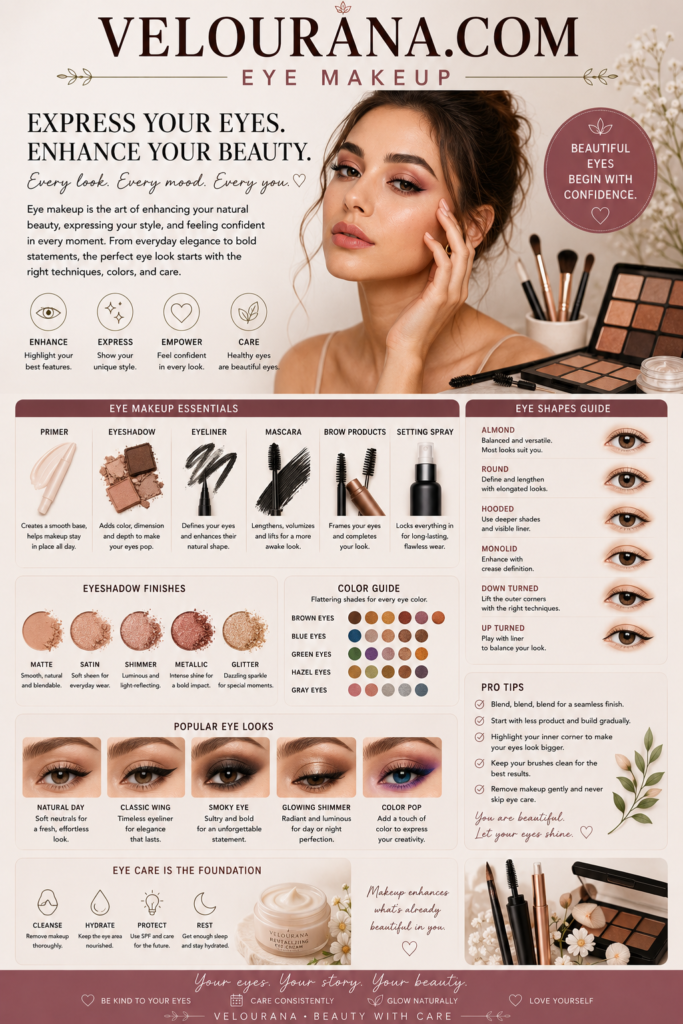
CATEGORY: Metallic Eyeshadow
Metallic eyeshadow is often imagined through the familiar language of precious metals: gold, silver, bronze, and copper. These shades remain classics because their relationship with actual metallic surfaces is immediately recognizable. Yet modern metallic eye makeup extends much further. Emerald can look molten. Violet can become electrically reflective. Blue can resemble polished cobalt, while rose, burgundy, olive, teal, graphite, and even black can develop metallic dimensions that completely change their character.
What makes these colors compelling is the tension between pigment and light. The wearer sees the shade itself, but simultaneously sees illumination moving across its surface. The result can appear different from moment to moment.
This dynamic quality distinguishes metallic eyeshadow from finishes that rely primarily on static color. It also creates opportunities for remarkably sophisticated makeup because reflection can be used strategically rather than simply maximized.
The modern metallic eye does not have to resemble a sheet of foil. It can involve subtle luminosity, concentrated flashes, softly diffused metal, multidimensional color, or deliberately graphic reflection.
Once metallic eyeshadow is approached as a design material rather than simply a shiny finish, its possibilities become considerably broader.
Understanding the Difference Between Metallic, Shimmer and Glitter
Beauty terminology is not always perfectly standardized, and different brands may use finish descriptions somewhat differently. Nevertheless, metallic, shimmer, and glitter generally create distinguishable visual impressions.
Shimmer tends to provide visible luminosity distributed throughout the color. The reflection may be fine and relatively delicate. Glitter produces more distinct sparkling points, often with individual reflective particles that can be visually identified.
Metallic eyeshadow typically aims for something more continuous.
When applied densely, reflective particles create a surface that resembles polished or molten metal. Instead of seeing isolated sparkle against a base color, the observer perceives a broader plane of reflection.
The boundaries can overlap. A metallic formula may contain sparkling particles, while an intense shimmer may appear metallic when applied densely. Marketing terminology cannot always predict exactly how a product will look on the eyelid.
For this reason, visual behavior is more useful than the label alone.
Does the shadow create a smooth reflective field? Does it scatter individual flashes? Is the base color opaque or translucent? Does reflection dominate the color, or does it merely illuminate it?
These characteristics determine how the product will function within a makeup look.
A translucent reflective shadow can layer beautifully over other colors because the base beneath it remains visible. An opaque metallic can become the dominant lid color. A highly textured formula may create dramatic sparkle but require different handling from a smooth pressed metallic.
Understanding these distinctions helps prevent disappointment. Someone seeking a seamless liquid-metal effect may not be satisfied with a loosely sparkling topper even if both products are described using similarly glamorous language.
The Extraordinary Range of Metallic Color
Traditional metallic neutrals remain popular because they combine reflection with familiar, wearable color. Gold brings warmth and richness. Bronze offers depth with luminosity. Copper can appear vibrant yet earthy. Silver creates cool brightness, while pewter and gunmetal provide deeper alternatives.
But metallic color becomes especially interesting beyond these classics.
Green illustrates this beautifully. Olive metallics can feel subdued and sophisticated, particularly when paired with brown or khaki mattes. Emerald creates greater saturation and jewel-like intensity. A blue-green metallic can shift the mood toward teal or peacock tones depending on its base.
Purple offers another broad spectrum. Muted metallic plum can function almost like a neutral smoky shade, whereas bright violet creates unmistakable color. Burgundy metallics combine red, brown, and purple influences and can appear dramatically different under warm and cool lighting.
Blue metallic shadow can range from deep navy, which provides reflective darkness, to brilliant cobalt or icy blue. The deeper versions are particularly useful when someone wants a smoky eye that remains dimensional without depending entirely on black.
Even black itself changes dramatically when given a metallic finish. Matte black absorbs light and creates strong recession. Metallic black retains darkness while simultaneously reflecting illumination. The result is less like a conventional shadow and more like polished graphite.
This illustrates an important principle: finish can alter the emotional character of a color almost as much as hue.
The same basic shade can feel natural in matte, delicate in satin, sparkling in glitter, and dramatic in metallic form.
Using Metallic Placement to Control Attention
The brightest point of an eye look naturally attracts attention, making metallic placement an effective way to direct the viewer's gaze.
A reflective center lid can become the focal point of the eye. The surrounding areas may remain relatively subdued, causing the brightness to appear concentrated and dimensional. This placement is particularly effective when the metallic shade transitions gradually into deeper colors at either side.
Moving the reflection toward the inner lid changes the emphasis. The eye can appear brighter near the inner corner, while the outer portion remains defined by deeper tones.
Extending metallic pigment across almost the entire mobile lid creates a larger reflective plane. This can be striking even with neutral colors because the effect comes from surface luminosity rather than dramatic hue.
Graphic placement takes the idea further.
Metallic shadow can be shaped into deliberate blocks, wings, floating forms, or sharply defined areas. Because the finish reacts strongly to light, a graphic metallic shape can appear almost architectural.
The surrounding negative space becomes important in these looks. Leaving areas of bare or matte skin around a metallic shape increases contrast and allows the reflective section to remain visually distinct.
Placement should also be evaluated through movement. An eye look designed entirely while the lid is closed may change significantly when the eye opens. Folded skin can conceal part of a metallic area or break its reflective continuity.
Checking the makeup repeatedly with the eyes open helps ensure that the intended focal point remains visible.
Creating a Seamless Metallic Surface
An intense metallic eye looks most impressive when the reflection appears continuous. Achieving that effect depends on controlling both the base and the way pigment is deposited.
Sweeping a metallic powder repeatedly back and forth can disperse the particles, producing shimmer but reducing the dense surface associated with foil. Pressing or patting often concentrates the formula more effectively.
This is why flat brushes and fingertips are commonly useful for metallic textures. They allow product to be transferred rather than endlessly moved around.
The edges require different treatment.
A metallic lid with a harsh accidental boundary can look unfinished, while over-blending can spread reflection into areas where depth was intended. The solution is often to treat the central metallic area and its perimeter as separate problems.
The main surface can be pressed into place for density. The boundary can then be refined with smaller amounts of product or connected to surrounding shadows.
This preserves intensity without sacrificing integration.
Layering can also increase continuity, but thick application is not always beneficial. Some formulas become textured when overloaded. Building controlled thin layers allows the wearer to observe how the product behaves before adding more.
Liquid metallics demand particular attention because many set after a limited working period. Blending should occur while the product remains movable. Once it begins to dry, repeatedly disturbing the surface can create unevenness.
Cream formulas may provide more flexibility but can crease if the layer remains too emollient for the wearer's eyelids. Formula behavior should therefore dictate technique rather than forcing every metallic product to behave like pressed powder.
Combining Metallic Shades Without Creating Visual Confusion
Multiple metallic colors can produce spectacular dimension, but reflective finishes compete for attention more readily than mattes. When several equally bright metallics occupy the same small area, their distinctions can disappear.
Successful combinations usually preserve some form of hierarchy.
One shade may provide the principal reflection while another creates depth. A pale gold can transition into bronze. Rose metal can deepen into burgundy. Silver can move toward graphite. Emerald can merge with deeper green.
These combinations work because the shades differ not only in hue but often in brightness.
The eye perceives a progression rather than several unrelated flashes.
Contrasting metallic colors can also work when the separation is intentional. Gold beside blue, copper beside teal, or silver beside violet can create striking visual tension. In these cases, attempting to blend every boundary into complete softness may actually weaken the design.
Sometimes the contrast should remain visible.
This is an important distinction between blending for smoothness and blending for uniformity. Makeup can have beautifully controlled transitions without every color becoming indistinguishable.
Metallic finishes reward deliberate placement because their reflective nature already provides substantial visual complexity. The composition often becomes stronger when fewer colors are allowed more room to express themselves.
Metallic Shadow and the Mature or Textured Eyelid
One of the most persistent beauty myths is that metallic or reflective eyeshadow belongs only on perfectly smooth, youthful eyelids. Real skin makes such rules unnecessarily restrictive.
Reflective finishes can emphasize surface texture because light catches raised and recessed areas differently. That is a characteristic of reflection, not a prohibition against using it.
The practical question is how much reflection is desired and where it should be placed.
A very thick, highly textured metallic may emphasize skin texture more than a finely milled, smoother formula. A concentrated metallic accent may behave differently from covering the entire eyelid. Softer metallic finishes can provide luminosity without producing the same intensity as highly foiled products.
Preparation also influences the result. Comfortable, well-prepared skin and thin, controlled product layers generally create a more refined surface than heavy application.
Most importantly, texture is not inherently something makeup must hide.
Eyelids naturally fold and move. Metallic pigment moving with that structure can still be beautiful. The wearer may prefer a smoother finish, a stronger foil, or visible multidimensional texture according to personal taste.
Beauty advice becomes more useful when it explains visual consequences rather than imposing arbitrary age restrictions.
From Daytime Metal to Evening Drama
Metallic eyeshadow can change character dramatically according to intensity.
During the day, a softly reflective neutral can function almost like a luminous extension of natural eyelid color. Champagne, soft bronze, muted rose, taupe-metallic, or gentle copper can provide enough reflection to make the eyes appear dimensional without becoming the dominant feature of the face.
The effect becomes stronger as contrast increases.
Deepening the outer eye, strengthening the lash line, increasing metallic opacity, or choosing a more contrasting color can transform the same basic structure into evening makeup.
This transition demonstrates that day and evening makeup are not necessarily separate categories requiring completely different products. Often they exist on a continuum of saturation, depth, contrast, and reflection.
A lightly applied bronze at midday can become molten bronze at night simply by increasing density and surrounding it with richer matte definition.
A soft silver accent can evolve into a full graphite smoky eye.
Metallic formulas are particularly suited to this flexibility because their intensity can often be altered significantly through application technique alone.
Why Metallic Eyeshadow Looks Different on Everyone
Metallic makeup interacts with individual anatomy in ways that make exact replication difficult.
The curvature of the eyelid changes how light strikes the product. Eye depth affects natural shadow. Lid space determines how much reflective surface remains visible. Skin tone influences the apparent base color, particularly with translucent formulas.
Lighting then changes everything again.
This means a metallic shade seen in a photograph, swatch, or video cannot be expected to reproduce identically on every person. Even the same wearer may see different effects in daylight, indoor lighting, direct sunlight, or photography.
Rather than treating this variability as a flaw, it can be understood as part of the appeal.
Metallic eyeshadow is responsive. It belongs to the face wearing it and the environment surrounding it.
The most successful application therefore comes from observing the product directly on the eye. The wearer can see where reflection naturally appears strongest and decide whether to emphasize, move, or soften that brightness.
This approach is more reliable than copying placement without considering individual structure.
Reflection as a Form of Expression
Metallic eyeshadow ultimately offers something that ordinary pigment cannot: movement created through light.
It can be elegant without being subtle and dramatic without requiring complicated color combinations. A single metallic shade can create multiple apparent tones simply because the curved eyelid receives illumination unevenly.
That natural variation is part of what makes metallic makeup so visually rich.
The finish also adapts easily to different identities. Gold can feel classical or futuristic. Silver can appear delicate or industrial. Copper can be romantic, earthy, or intensely glamorous. Jewel-toned metallics can move between sophisticated and experimental depending on placement.
There is no single correct metallic eye.
A small reflective accent and a fully foiled lid belong to the same category but communicate entirely different ideas. Softly diffused bronze and graphic cobalt metal use the same fundamental interaction with light while producing completely different aesthetics.
The artistry lies in deciding how much reflection the eye needs and where that reflection should live.
Once metallic eyeshadow is understood in those terms, it stops being merely the sparkling option beside the mattes in a palette. It becomes a way of sculpting with illumination.
Color provides the identity. Placement provides the structure. Reflection provides the movement.
Together, they give metallic eyeshadow its unmistakable ability to transform the eye every time the light changes.
THE END VELOURANA
 Discover More From Our Family of Websites
 ZodiacBearing (Astrology, Tarot, Numerology, Angel Numbers & Spiritual Guidance)
 Velourana (Beauty, Makeup, Hair Care, Skincare & Beauty Tips)
 HavenBearing (Home, Living, Organization, Décor & Everyday Inspiration)
 PawBearing (Pet Care, Dog Breeds, Animal Health, Training & Pet Products)
 PsyCatherine (Notes From the Journal of a Psychologist on Real Life)

