
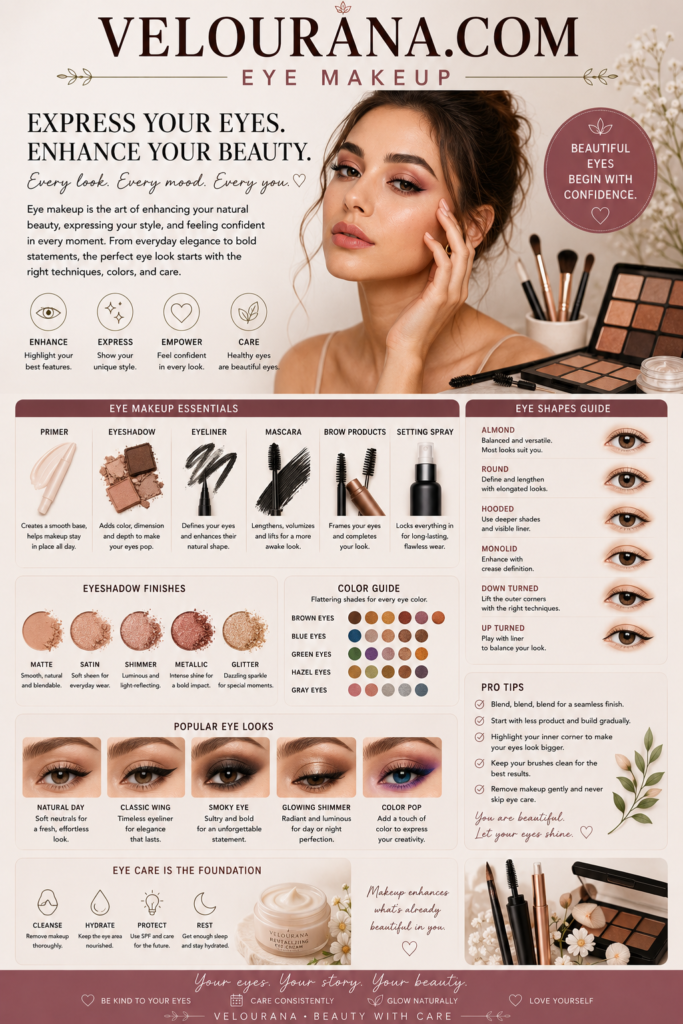
CATEGORY: Winged Eyeliner
Winged eyeliner has an unusual position in makeup. It can be delicate enough to disappear into the lash line or dramatic enough to determine the entire character of the face. A few millimeters of pigment extending beyond the outer corner can change the apparent direction of the eye, strengthen the lashes, introduce sharpness into otherwise soft makeup and create a visual sense of lift. Few eyeliner techniques offer such influence with so little physical product.
The wing is often described as though it were simply a line with an upward flick at the end. In reality, successful winged eyeliner depends on proportion. The angle of the extension, the thickness across the lid, the position at which the line begins to widen and the relationship between the wing and the natural outer corner all contribute to the finished shape. A wing that appears beautifully balanced on one eye can look completely different on another because eyelid structure changes the way the line is seen when the eyes are open.
This is why winged eyeliner becomes much easier to understand when it is treated as visual architecture rather than a predetermined shape. The objective is not to reproduce one universal wing. It is to construct an extension that works with the visible eye and produces the desired direction.
From the restrained elegance of a tiny tapered flick to the commanding geometry of an elongated black wing, the technique offers remarkable creative range. Its enduring appeal comes from this ability to remain recognizable while continually adapting to different faces, eras and styles.
The Geometry Behind the Wing
Every wing begins with direction. Before thickness or intensity matters, the extension establishes where the eye appears to travel.
A wing that rises noticeably toward the end of the brow creates an upward visual movement. One that extends more horizontally emphasizes length. A shorter extension can subtly sharpen the outer corner without noticeably changing the overall proportions of the eye, while a long wing can become an architectural feature in its own right.
The lower lash line provides a useful visual relationship because its natural trajectory already suggests one possible direction beyond the outer corner. Extending that general movement can create a wing that feels connected to the existing eye rather than attached afterward. This does not mean the lower lash line must dictate every wing. Different angles can intentionally create different effects, but understanding the natural geometry provides a reliable reference.
The upper line then determines how the wing integrates with the eyelid. A very thin line that remains close to the lashes before tapering outward preserves maximum visible lid space. A thicker line introduces greater graphic weight and can make the wing appear more substantial even if the extension itself is not particularly long.
The transition between these two areas is crucial. If the eyeliner suddenly becomes thick immediately before the outer corner, the wing may look heavy. When the increase in width is gradual, the shape generally feels more fluid. Graphic styles can deliberately reject this softness, but classic winged eyeliner usually benefits from a controlled transition.
The tip carries disproportionate importance. A clean taper gives the impression that the line continues naturally into space. A blunt end changes the entire character, making the shape feel more graphic and less traditionally elegant. Even a dramatic wing often relies on an extremely fine final point to preserve movement.
Symmetry introduces another layer of geometry. Human eyes and brows are rarely perfectly identical, so mechanically reproducing exactly the same measurements on both sides may not create the most balanced visual result. One eyelid may fold differently, one brow may sit slightly higher, or one outer corner may have a different natural angle.
The goal is therefore visual harmony rather than mathematical duplication. The wings should appear related when the face is viewed normally. Tiny structural differences between them may actually be what allows that impression of symmetry to emerge.
From Barely There to Dramatically Extended
Winged eyeliner is not one aesthetic. Its character changes considerably according to scale.
The smallest version is essentially an extension of lash-line definition. The eyeliner remains exceptionally thin across the lid and travels only slightly beyond the outer lashes. From a distance, the viewer may notice a more defined and lifted eye without immediately identifying a conventional wing.
This restrained approach works particularly well when the rest of the makeup is minimal. It can provide structure beside luminous skin, understated eyeshadow and softly defined brows without becoming the dominant feature. Brown, charcoal or muted black can make the effect even quieter.
A classic wing introduces a more visible extension while retaining balance between the line and the eye itself. The lid is clearly defined, the outer corner becomes stronger and the tapered point is visible, yet the eyeliner remains part of the complete makeup rather than functioning as an independent graphic element.
Increasing length changes the emphasis. An elongated wing stretches the eye horizontally and can create a sophisticated, feline impression. The angle becomes increasingly important because a long line exaggerates whatever direction it follows. A slightly upward trajectory can appear elegant and lifted; a nearly horizontal one can produce an intentionally stretched, editorial shape.
Thickness creates another form of drama. A broad wing can occupy substantial eyelid space and create a bold black silhouette. This style often feels more retro or graphic depending on the accompanying makeup. Because the pigment becomes visually dominant, the relationship with brows, lashes and eyeshadow needs greater consideration.
There are also wings that intentionally separate themselves from conventional smoothness. Extended geometric shapes, sharply cut negative spaces and exaggerated points can transform the familiar wing into editorial eyeliner. The essential concept remains—the line extends beyond the natural eye—but its purpose changes from enhancement to design.
These variations demonstrate why the wing should be chosen according to the desired visual result rather than habit. A person who automatically draws the same wing every day may be using only one possibility from a much broader language.
Eye Shape Changes How the Line Is Seen
The eyelid is not a flat canvas. It folds, curves and moves, and winged eyeliner must exist across that changing surface.
On eyes with a broad visible lid, there may be considerable space for both liner and eyeshadow. A wing can gradually widen across the outer lid without consuming the entire visible area. This provides freedom to explore thicker classic styles or more elaborate graphic variations.
Hooded eyes create a different structural challenge because part of the mobile lid may disappear beneath the fold when the eyes are open. A wing drawn beautifully while the eye is closed can become interrupted or distorted once the lid returns to its natural position.
For this reason, assessing the wing with the eye open is particularly valuable. The visible shape matters more than how perfect the line appears on a closed eyelid. In some cases, the eyeliner may need to navigate around a fold rather than follow a conventionally smooth path across it. When the eye closes, the shape may appear unusual; when it opens, the wing can become visually continuous.
Deep-set eyes also benefit from attention to visible space. A very thick upper line can reduce the amount of lid that remains apparent, particularly when natural socket depth already creates strong shadow. A finer line with emphasis concentrated at the outer corner can preserve openness while still providing the directional quality of a wing.
Round eyes can be visually elongated by keeping the inner portion relatively thin and extending the outer line outward. The objective is not to disguise roundness but to alter the balance between vertical and horizontal emphasis. A longer outer extension naturally draws attention sideways.
Naturally almond-shaped eyes can support an enormous range of wings because their existing outer taper already provides directional momentum. A small flick can reinforce the natural shape, while a longer wing exaggerates it into a more feline silhouette.
Downturned outer corners present another opportunity for strategic construction. Rather than automatically following the outermost lashes downward, the wing can begin slightly before the corner and establish a new upward trajectory. The precise solution varies according to anatomy, but the principle is to design according to the visible result rather than blindly trace every natural contour.
The most important lesson is that winged eyeliner should respond to movement. A line is successful when it looks intentional with the eyes open, blinking and viewed from ordinary conversational distance.
The Relationship Between Thickness, Length and Lift
Winged eyeliner is governed by three closely connected variables: thickness, length and angle. Changing one affects how the others are perceived.
A very long wing paired with an extremely thin lash line creates delicacy despite the dramatic extension. The eye appears stretched rather than heavily lined. The same length attached to a broad black line produces much greater visual weight.
A short but thick wing can create strong definition without substantially elongating the eye. This can feel distinctly retro, particularly when the upper lid carries a smooth, rounded sweep of liner before ending in a compact point.
Angle determines where that visual weight travels. A steeply rising wing creates pronounced lift but can become disconnected from the eye if the angle is extreme. A horizontal extension produces length but relatively little upward movement. Between these positions lies a broad range of possibilities that can be adapted to the natural outer corner.
The surrounding eyeshadow also influences these proportions. A wing extending beyond softly blended shadow may appear shorter because the eye makeup already occupies that space. Against a completely bare lid, the same physical line becomes much more noticeable.
Brows provide another visual reference. The tail of the brow creates an upper boundary for the eye area, and a wing often feels balanced when its direction communicates with that brow structure. This does not require pointing directly toward the brow tail. It simply means considering the two lines together rather than designing the eyeliner in isolation.
Lashes affect perceived thickness as well. Dense false lashes can visually absorb a substantial portion of eyeliner, making a relatively bold wing seem balanced. Against lightly coated natural lashes, the same wing may dominate. A fine flick that appears understated before mascara can become almost invisible after particularly dense lashes are added.
This interaction explains why winged eyeliner sometimes needs adjustment after the rest of the eye is assembled. The wing may technically be complete, but its visual weight can change once mascara, shadow or lashes alter the surrounding contrast.
The strongest designs maintain hierarchy. The wing should either support the eye makeup or deliberately become its focal point. Problems often arise when it sits awkwardly between those roles—too heavy to disappear into the composition but not intentional enough to function as a statement.
Liquid, Gel, Pencil and the Character of the Edge
Different eyeliner formulas produce different kinds of wings because texture determines how sharply a line can be controlled.
Liquid eyeliner is closely associated with the classic crisp wing. Its fluid pigment can create a highly saturated line with a fine, precise edge. Felt-tip and brush-tip formats offer different experiences, but both are capable of producing a tapered point when handled carefully.
The visual finish of liquid liner is particularly suited to graphic definition. Against matte or neutral eyeshadow, a dense black liquid wing creates a clean contrast that can feel polished and deliberate. The disadvantage is that irregularities may be more visible because the edge itself is so sharp.
Gel eyeliner offers substantial control with a slightly different character. Applied with an appropriate brush, it can produce anything from a fine classic wing to a broader dramatic shape. The texture can be particularly useful when gradually building the line because the product does not necessarily require the entire shape to be created in one movement.
Pencil produces a softer interpretation. Although some long-wearing pencils can create remarkably precise lines, pencil naturally lends itself to diffused edges and smoky wings. Instead of a razor-sharp point surrounded by completely clean skin, the outer extension can dissolve gradually into shadow.
This softness can make winged eyeliner feel less formal. Brown pencil smudged outward at the outer corner creates direction without the obvious graphic quality of liquid black liner. The result can be sophisticated precisely because the technique is less conspicuous.
Eyeshadow can also form a wing when applied with controlled placement. A deep shadow extended beyond the outer corner produces the softest version, particularly when the edge is blended. This belongs conceptually to winged eyeliner because the makeup still establishes an extended directional line, even though the boundary is diffused rather than sharply drawn.
Formula therefore influences more than application difficulty. It changes the emotional quality of the wing. Liquid can feel graphic, gel sculpted, pencil sensual and shadow atmospheric. These categories can overlap, but the texture provides a starting language.
Choosing the formula according to the desired edge often produces better results than choosing it simply according to familiarity.
Building a Wing Without Losing Its Flow
A convincing wing should appear continuous even when it was constructed through several controlled movements.
Trying to create the entire shape in one uninterrupted stroke can be unnecessarily difficult. The hand must simultaneously manage direction, pressure, curvature and thickness. Breaking the design into visual relationships allows greater control without making the finished eyeliner look segmented.
The outer extension establishes direction. Once that direction is satisfactory, the line can be connected back toward the upper lashes. The resulting shape is then refined according to the desired thickness.
What matters is not the number of physical movements used but whether the final edges communicate as one form.
The lash line itself should remain connected. Small pale gaps between eyeliner and lashes can weaken the illusion of density, particularly with black liner. Keeping pigment close to the lash roots allows the wing to feel anchored rather than floating above the eye.
The inner portion requires restraint when the objective is elongation. A thick line near the inner corner can create considerable weight and may compete with the outer extension. Allowing the liner to begin finely and gradually increase toward the outer eye often creates a more graceful transition.
The upper edge of the wing deserves as much attention as the lower edge. A clean lower boundary alone does not guarantee an elegant shape. The upper line determines how smoothly the wing narrows toward its tip and how naturally it joins the lid.
Overcorrection can become a problem. One small irregularity is widened to make it smooth, which requires widening the opposite side for symmetry, which then changes the original proportions. Winged eyeliner can become progressively heavier through this cycle.
Recognizing when the shape is visually balanced from normal viewing distance is therefore an important skill. Makeup does not need microscopic perfection to appear polished. The human face is constantly moving, and eyeliner is perceived as part of that living expression.
A wing retains elegance when refinement preserves its original direction rather than gradually burying it beneath additional pigment.
Soft Wings and the Beauty of Diffusion
The cultural image of winged eyeliner is often a perfectly sharp black flick, yet some of the most wearable interpretations abandon the hard edge almost entirely.
A smoky wing creates direction through shadow. Instead of ending in a precise point, pigment becomes progressively lighter as it moves outward. The eye still appears elongated, but the boundary between eyeliner and surrounding skin becomes less obvious.
Brown is particularly effective for this approach. Deep chocolate or espresso tones can strengthen the outer lashes without creating the severity of black. When gently diffused into neutral eyeshadow, the wing can look almost like a natural extension of the lash shadow.
Charcoal provides a cooler alternative, while plum, burgundy and deep navy introduce subtle color without sacrificing sophistication. Because these shades are usually less visually absolute than black, their edges can disappear beautifully into surrounding makeup.
Soft wings also integrate well with mature or textured eyelids because they do not depend entirely on an uninterrupted razor-sharp boundary. Natural skin texture becomes part of the finish rather than something the eyeliner must visually overcome.
This does not mean soft liner requires less control. Diffusion must still preserve direction. If pigment is blended equally in every direction, the wing loses its extension and becomes general outer-corner shadow. Successful softness retains a clear outward movement even though the edges are blurred.
The technique can be extremely effective for daytime makeup. A small amount of deep pencil or shadow concentrated at the outer lashes can subtly alter the eye without creating an obvious eyeliner statement.
It can also become dramatic. A long smoked-out wing combined with deep shadow around the outer eye produces an atmospheric alternative to graphic liner. The effect is less architectural but no less intentional.
Winged eyeliner therefore exists on a spectrum between precision and diffusion. Sharpness is one expression of the technique, not its defining requirement.
When the Wing Becomes the Entire Makeup Statement
At its most dramatic, winged eyeliner moves beyond enhancement and becomes graphic design.
An exaggerated black wing can extend substantially beyond the eye, occupy a large area of the lid or develop into an angular shape that deliberately ignores conventional proportions. In such makeup, the eyeliner is not attempting to look natural. Its artificiality is part of its beauty.
Negative space introduces another possibility. Rather than filling the entire wing, outlines can define empty areas of skin. The familiar silhouette remains recognizable while the interior becomes part of the design.
Double wings create parallel movement, often separating the upper and lower extensions. Floating lines can echo the angle of a conventional wing without remaining attached to the lash line. Colored wings can replace black entirely, turning the outer extension into a saturated accent.
White and pastel liner can create especially striking graphic effects because they reverse the expectation of dark definition. Metallic finishes introduce reflected light, while deep jewel tones offer a compromise between conventional darkness and obvious color.
The rest of the face determines how these designs are interpreted. Complex eye geometry paired with restrained skin and lips allows the liner to dominate. Equally dramatic lips or sculpted complexion makeup create a more maximalist composition.
Scale also changes emotional impact. A small colored flick can feel playful. A huge cobalt wing becomes editorial. A compact black wing can appear classic, while an enormous version of essentially the same silhouette becomes theatrical.
The wing is therefore one of the rare makeup forms that can be enlarged far beyond its traditional proportions without losing its identity. As long as the extension maintains a relationship with the eye, the viewer continues to understand the fundamental gesture.
Why Winged Eyeliner Continues to Endure
Winged eyeliner survives changing beauty trends because it is not dependent on one formula, one era or one interpretation.
It can evoke vintage glamour without becoming a costume. It can accompany contemporary minimalism, smoky evening makeup, colorful experimentation or highly conceptual editorial beauty. It can be almost invisible or deliberately enormous.
More importantly, the wing interacts directly with the geometry of the face. It extends an existing feature rather than simply placing decoration on top of it. This creates a sense of movement that static blocks of color do not always achieve.
A beautifully constructed wing draws the gaze outward. It strengthens the rhythm of the lashes and establishes a direction that can communicate with the brow, cheekbone and surrounding makeup. Even when the extension is tiny, that directional quality remains.
Mastery therefore does not mean learning one perfect template and reproducing it indefinitely. It means understanding why different wings behave differently. Angle controls direction. Length controls extension. Thickness controls visual weight. Formula controls the character of the edge. Eye structure determines how all of these elements appear in motion.
Once those relationships become clear, winged eyeliner stops being a difficult shape that must somehow be copied correctly. It becomes a flexible design language.
The finest wing is not necessarily the longest, darkest or sharpest. It is the one whose proportions make sense within the complete eye and whose final taper appears to belong exactly where it has been placed.
THE END VELOURANA
 Discover More From Our Family of Websites
 ZodiacBearing (Astrology, Tarot, Numerology, Angel Numbers & Spiritual Guidance)
 Velourana (Beauty, Makeup, Hair Care, Skincare & Beauty Tips)
 HavenBearing (Home, Living, Organization, Décor & Everyday Inspiration)
 PawBearing (Pet Care, Dog Breeds, Animal Health, Training & Pet Products)
 PsyCatherine (Notes From the Journal of a Psychologist on Real Life)

