
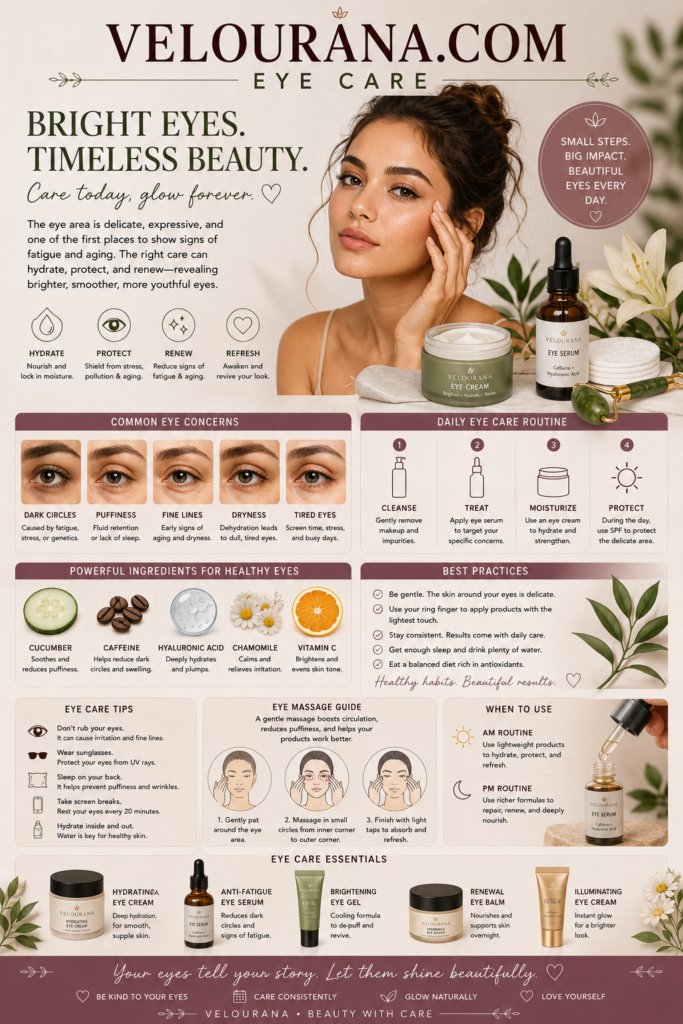
CATEGORY: Eye Product Application
Eye care can appear deceptively isolated from the rest of skincare. The jar is smaller, the quantity applied is smaller, and the area being treated occupies only a narrow portion of the face. Yet eye product application is deeply connected to everything that happens before and after it. Cleansing determines the condition of the surface. Facial serums may overlap with the eye contour. Moisturizer can alter the richness of the final layers. Sunscreen must coexist with morning eye products, while concealer introduces an entirely different set of texture and wear considerations.
For this reason, successful eye care is less about memorizing a single application gesture and more about integration. The product needs to fit into the rhythm of the routine, cooperate with neighboring formulas, remain comfortable throughout the day or night, and respect the sensitivity of the eye area.
A beautifully formulated eye cream can perform poorly when applied over too many incompatible layers. A modest hydrating gel can perform exceptionally well when used in the right quantity on properly prepared skin. Technique becomes the bridge between formulation and experience.
Understanding that relationship makes eye product application considerably more intuitive.
The Eye Contour as Part of the Face, Not an Isolated Zone
Beauty routines often divide the face into categories: eye care, lip care, facial skincare, neck care. These divisions are useful for product development and application, but the skin itself does not observe neat cosmetic boundaries.
A facial serum applied across the cheeks can easily reach the under-eye area. Moisturizer can migrate upward. Sunscreen is deliberately distributed broadly. Makeup later overlaps almost everything. The eye contour therefore receives the cumulative effects of several products, even when only one item in the routine carries the words "eye cream" on its packaging.
This explains why an eye product cannot always be evaluated independently. If the under-eye area feels excessively greasy, the eye cream may not be solely responsible. A rich moisturizer underneath it could be contributing. If pilling develops, the interaction between serum, eye cream, sunscreen, primer, and concealer may matter more than any single formula.
Thinking in layers rather than isolated products produces a more intelligent routine. Every additional layer changes the surface slightly. Hydrating products increase water content and slip. Emollients soften the skin and create lubrication. Occlusive ingredients slow moisture loss. Film-forming products create a surface layer. Cosmetics then need to sit successfully over this entire structure.
The smaller and more mobile eye contour makes these interactions especially noticeable.
Cleansing Sets the Stage for Application
Eye care begins with cleansing because residue influences everything that follows. Long-wearing eye makeup, waterproof mascara, sunscreen, concealer, and setting products can require careful removal, particularly at the end of the day.
The objective is effective cleansing without turning removal into repeated friction. Tugging at the eye area in an attempt to remove stubborn makeup can leave the skin feeling uncomfortable before skincare has even begun. A cleanser or makeup remover suited to the products being worn can reduce the need for mechanical force.
Once cleansing is complete, residue from the cleansing product itself should also be considered. Some removers leave an oily film that may be pleasant but can alter the spread and absorption of subsequent skincare. Whether that residue needs further cleansing depends on the product and routine, but applying eye cream onto a heavily coated surface can make it difficult to judge the cream's actual texture.
The skin does not need to feel squeaky or stripped. In fact, over-cleansing can leave the delicate eye contour feeling tight and dry. The ideal starting point is simply clean, comfortable skin prepared to receive the next layer.
This foundation is easy to underestimate. Many apparent problems with eye products originate before the eye product is ever opened.
Understanding Texture Before Choosing Technique
Texture communicates a great deal about how a product wants to be applied. A fluid serum spreads rapidly and can travel farther than expected. A gel may offer immediate slip but become tacky as it sets. A cream gives more control but varies enormously in richness. A balm may remain mobile for longer because of its higher concentration of emollient ingredients.
Application should respond to these differences.
Fluid products benefit from restraint because a tiny amount can cover a surprisingly large area. Depositing too much at once may allow the formula to run toward the eye before it can be distributed. Controlled placement is therefore more useful than quickly spreading a large drop.
Gels often suit light pressing or minimal smoothing. Because many gels form a noticeable surface film as they dry, prolonged rubbing can disrupt that film and create rolling or pilling. Once an even layer has been achieved, leaving the product alone is often preferable.
Creams allow greater control. A small quantity can be placed at several points and gently distributed. Rich creams may soften with the warmth of the skin, so their initial thickness should not encourage excessive application.
Balms and very emollient treatments generally need even greater moderation. Their persistent slip can make them comfortable for dry skin, but that same mobility can encourage migration when they are placed too close to the eye.
Technique therefore begins with observation. Before developing habits around a product, noticing how it moves, sets, and interacts with the skin provides valuable guidance.
Application Pressure and the Myth of Working Product Into the Skin
The phrase "work it into the skin" can create the impression that skincare requires physical effort. Around the eyes, this is rarely helpful.
Topical cosmetic products are formulated to spread across the skin and interact with its surface without being manually pushed into it. Rubbing harder does not create a deeper route for an eye cream. Instead, it increases friction and movement of the skin.
A more sophisticated application uses enough contact to distribute the formula and no more. Small pressing movements can transfer product from fingertip to skin. Gentle smoothing can connect areas of application where the formula has sufficient slip. Once coverage is even, continued manipulation has little purpose.
This is particularly important when the skin is dry. Dry skin creates greater resistance against the fingertip, which means the same movement may generate more friction than it would over a well-lubricated surface. If a product begins dragging, adding pressure is not the answer. The application technique or formula may need reconsideration.
The same principle applies to massage. Eye massage can be a separate beauty technique when performed appropriately, but ordinary eye cream application does not need to become a massage session every time. Product distribution and massage are related but distinct activities.
Separating them prevents an everyday skincare step from becoming unnecessarily aggressive.
Creating a Comfortable Under-Eye Layer
The under-eye area is where most eye products are concentrated, partly because dryness, shadows, fine lines, and temporary puffiness are particularly visible there. It is also the region most likely to receive concealer, making texture management essential.
An even layer begins with controlled placement. Rather than depositing the entire quantity in one spot and dragging it across the skin, distributing smaller amounts allows the formula to spread with less movement. The exact application area should follow the product's instructions, with appropriate distance from the eye itself.
Attention should extend toward the outer eye contour where appropriate, since this region experiences considerable movement from facial expression. However, pulling the skin outward to create a flat application surface is unnecessary. The product can be applied while the face remains relaxed.
The inner eye area deserves caution because products can migrate toward the tear duct. Concentrating a large amount there may increase the likelihood of watering or discomfort. A lighter hand is generally preferable.
Once applied, the under-eye surface should feel conditioned rather than overloaded. If the product remains visibly thick, gathers when the face moves, or transfers easily when touched several minutes later, the quantity may be greater than necessary.
A successful application becomes almost unnoticeable. The skin feels comfortable, and the product ceases to demand attention.
Upper-Eye Care Requires Product-Specific Judgment
The upper eye contour introduces an important distinction. Not every product marketed for the eye area is intended for application on the mobile eyelid.
Packaging directions are especially valuable here. Some formulas explicitly indicate suitability for the eyelids or broader eye contour. Others direct application only around the orbital area. Assuming that every eye product can be used everywhere around the eye ignores meaningful differences in formulation and testing.
The eyelid is mobile, folded, and close to the eye itself. Products placed there can migrate as the eyes blink and as natural oils accumulate throughout the day. Rich textures may also interfere with eye makeup or create unwanted heaviness.
When a product is appropriate for upper-eye use, a very controlled quantity is generally sufficient. The same principles of gentle contact and minimal friction apply. The objective is not to saturate the skin but to create an even, comfortable layer.
This is an area where restraint becomes especially valuable. More coverage is not automatically more effective, and expanding the application zone beyond the manufacturer's recommendation offers no inherent advantage.
Coordinating Eye Serum and Eye Cream
The expansion of specialized eye care means some routines now include both serums and creams. These products can complement one another, but layering should have a purpose.
A lightweight eye serum typically provides a thinner first layer, while a cream may contribute additional moisturization and comfort. When both are used, the serum is generally allowed to distribute and settle before the richer product is applied, assuming the product directions support this order.
The quantities should remain conservative because two eye products create cumulative coverage. Applying the normal generous amount of each can quickly overwhelm the small treatment area.
The final texture is more important than the number of products. If the combination leaves the skin comfortable and stable, the layering may suit the routine. If it produces persistent stickiness, pilling, migration, or irritation, simplifying the routine can be more productive than trying to perfect an increasingly complicated technique.
Eye skincare does not earn additional value merely through multiplication. A single suitable product used consistently may provide a more elegant routine than several formulas layered without a clear reason.
Sunscreen Changes the Morning Equation
Daytime eye care must eventually coexist with sun protection. This makes morning application fundamentally different from nighttime skincare.
An eye cream may moisturize the area, but it should not automatically be treated as sufficient sun protection unless it is specifically formulated, labeled, and used as such. Appropriate sunscreen remains an essential component of daytime skincare.
The challenge is layering without creating an unstable surface. If the eye cream is extremely rich or applied too generously, sunscreen may move across it rather than forming an even layer. Allowing skincare to settle and keeping the eye product thin can improve compatibility.
Sunscreen itself must also be used according to its directions, including guidance concerning the eye area. Individual tolerance varies considerably. Some sunscreen formulas feel comfortable around the eyes, while others may cause stinging if they migrate.
This makes product compatibility highly personal. A morning eye routine should not be judged solely by how luxurious it feels immediately after application. It should also be judged by whether sunscreen can be applied successfully afterward and remain comfortable throughout normal wear.
Preparing the Eye Area for Concealer
Concealer exposes application mistakes quickly. Too much emollient eye cream can make pigment slide. Too little hydration may leave dry skin looking textured. A tacky layer can cause uneven blending, while incompatible formulas may pill.
The objective is balance rather than maximum moisture.
After eye care and sunscreen have settled, the surface should feel comfortable but not heavily coated. Concealer can then be applied in the quantity required rather than being used to compensate for unstable skincare underneath.
When makeup repeatedly performs poorly, changing the eye cream is not always necessary. Reducing the morning amount may solve the problem. Allowing additional settling time may help. Avoiding excessive overlap between moisturizer and eye cream can also improve the surface.
Powder introduces another variable. A heavily moisturized under-eye area covered with large quantities of powder may still appear textured because the two extremes are competing. Successful makeup preparation comes from creating a balanced surface rather than attempting to erase natural skin texture with increasingly thick layers.
Eye product application therefore becomes part of makeup artistry. The skincare is invisible, but its influence on the finished result can be substantial.
Evening Eye Care as a Moment of Recovery
Nighttime application removes many of the constraints associated with cosmetics and daytime wear. Richer textures can be considered, and there is more freedom to focus on comfort.
This does not eliminate the importance of placement. A generous layer of cream applied immediately before lying down may transfer to bedding or migrate toward the eyes. Applying skincare with enough time for it to settle can create a more comfortable experience.
The evening routine is also an opportunity to evaluate the day's condition of the skin. Weather, air conditioning, makeup wear, cleansing, and environmental exposure can all change how the eye contour feels. A routine does not have to remain identical every night. A lighter product may be enough when the skin feels balanced, while a more emollient formula may feel preferable during periods of dryness.
Consistency should not be confused with rigidity. Consistent care means maintaining thoughtful habits, not ignoring changes in the skin.
When Less Product Produces a Better Routine
Eye skincare is an area where excess frequently disguises itself as diligence. A larger quantity feels more intensive. More layers feel more comprehensive. Longer application feels more thorough.
Yet good technique often moves in the opposite direction.
Using less can reduce migration. Fewer overlapping layers can reduce pilling. Less rubbing can reduce friction. A shorter, more deliberate application can improve consistency because the routine becomes easier to maintain.
This does not mean eye products should be used sparingly to the point of inadequate coverage. It means the amount should correspond to the product's instructions and the area being treated. There is a meaningful difference between complete coverage and excessive coating.
Observing how much product remains on the surface after application is useful. If the skin accommodates the layer comfortably, the quantity is probably closer to appropriate. If substantial residue remains and must repeatedly be moved around, the routine may benefit from adjustment.
Building Technique Through Observation
The most reliable eye product application method is ultimately developed through attentive repetition. Different formulas behave differently, and individual skin changes with season, environment, age, makeup habits, and the rest of the skincare routine.
Observation reveals whether a cream migrates. It shows whether a gel pills beneath sunscreen. It reveals whether a rich nighttime formula is comfortable or excessive. It can also demonstrate that a supposedly sophisticated layering routine is less effective than a simpler one.
This is why rigid beauty rules have limited value. Principles such as gentle pressure, clean application, controlled quantity, appropriate placement, and respect for product instructions remain dependable. The exact movements and quantities surrounding those principles can then adapt to the formula and the person using it.
There is elegance in this flexibility. Eye care stops being a performance and becomes a practical conversation between formulation, technique, and skin.
A More Refined Relationship With Eye Care
Eye product application is one of the smallest physical actions in a skincare routine, yet it illustrates a broader truth about beauty: precision often matters more than intensity.
A thoughtfully chosen product does not need to be rubbed aggressively into the skin. A luxurious cream does not need to be applied in a thick layer to justify its presence. An elaborate collection of eye products does not automatically outperform one well-suited formula.
The strongest routine respects the characteristics of the eye contour. It recognizes its delicacy without treating it as impossibly fragile. It uses enough product to create comfortable coverage while avoiding excess. It integrates eye care with facial skincare, sunscreen, and makeup instead of treating each layer as though the others did not exist.
Over time, these habits make application almost effortless. The hand learns to use less pressure. The eye becomes better at judging quantity. The routine becomes cleaner, quicker, and more consistent.
That is the real sophistication of eye product application: not complexity, but control.
THE END VELOURANA
 Discover More From Our Family of Websites
 ZodiacBearing (Astrology, Tarot, Numerology, Angel Numbers & Spiritual Guidance)
 Velourana (Beauty, Makeup, Hair Care, Skincare & Beauty Tips)
 HavenBearing (Home, Living, Organization, Décor & Everyday Inspiration)
 PawBearing (Pet Care, Dog Breeds, Animal Health, Training & Pet Products)
 PsyCatherine (Notes From the Journal of a Psychologist on Real Life)

