CATEGORY: Eye Massage
The eye area has a way of revealing what the rest of the face can sometimes conceal. A short night, a long day in front of a screen, seasonal allergies, emotional strain, dehydration, or simply the natural architecture of the face can all influence how the skin around the eyes appears. Puffiness may become more noticeable in the morning, the brow can feel tense after hours of concentration, and the entire upper face may seem less relaxed than usual. Against this background, eye massage has become one of the simplest rituals in contemporary beauty: no dramatic transformation, no complicated equipment, and no need to treat delicate skin aggressively.
Yet simplicity does not mean that technique is irrelevant. The skin surrounding the eyes is comparatively thin and mobile, while the area itself contains an intricate arrangement of muscles, blood vessels, connective tissue, and lymphatic pathways. The purpose of a cosmetic eye massage is therefore not to press, knead, or manipulate the eye itself. It is to work gently around the orbital area, using controlled contact that respects the anatomy beneath the skin.
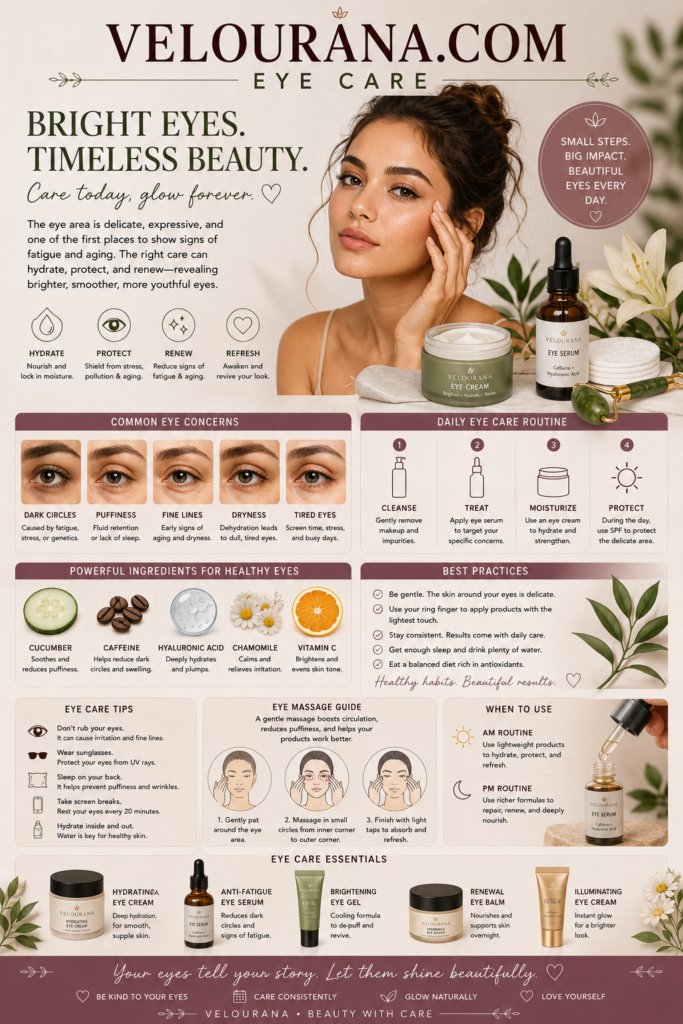
Performed thoughtfully, eye massage can become part of a broader routine designed to make the eye area feel comfortable and look refreshed. It may help temporarily redistribute superficial fluid associated with morning puffiness, encourage a sense of relaxation around the brows and temples, and improve the experience of applying an eye cream or lightweight facial product. Just as importantly, it creates a few deliberate minutes in which skincare becomes less mechanical and more attentive.
The value of the ritual lies largely in restraint. Around the eyes, more pressure is rarely better.
Understanding the Delicate Landscape Around the Eyes
The phrase “eye area” describes much more than the small crescent of skin immediately beneath the lower lashes. From a skincare perspective, it extends across the orbital contour, including the under-eye region, the outer corners, the brow bone, and the surrounding temple area. These structures move constantly throughout the day as we blink, squint, smile, read, concentrate, and react emotionally.
The skin here differs from many other areas of the face. It has relatively little cushioning compared with fuller areas such as the cheeks, which helps explain why swelling, shadows, fine surface lines, and changes in texture can appear particularly visible. The appearance of dark circles can also be influenced by several entirely different factors, including pigmentation, visible vascular structures, facial anatomy, hollowness, and shadows. Massage cannot reasonably be expected to correct all of these causes.
Puffiness presents another example of why expectations matter. Temporary morning swelling may be influenced by fluid distribution, sleeping position, salt intake, allergies, irritation, or normal overnight changes. Very light massage around the orbital contour may make transient puffiness look somewhat less prominent for some people, particularly when paired with cooling skincare. Persistent or unexplained swelling, however, belongs in a different category and should not simply be treated as a cosmetic massage problem.
The muscles surrounding the eyes and brows also contribute to how the area feels. Concentration can encourage repeated squinting or brow contraction, particularly during prolonged computer or phone use. Massage cannot permanently alter these muscular patterns, but gentle contact around the brow and temples may create a temporary sensation of release. This is one reason an eye massage can feel beneficial even when its visible cosmetic effects are subtle.
Understanding these limitations actually makes the technique more useful. Eye massage works best when approached as supportive care rather than as a treatment capable of restructuring the face.
Pressure Is the Technique That Matters Most
Many facial massage demonstrations emphasize elaborate movements, but around the eyes the defining skill is pressure control. The appropriate touch is remarkably light. Skin should not be dragged noticeably across the underlying tissue, and the eyeball itself should never be pressed.
The ring finger is frequently used for eye-product application because many people find it easier to maintain a delicate touch with it. The exact finger is less important than the amount of force applied. Someone with excellent pressure awareness can work safely with several fingers, while using a supposedly “gentle” finger does not automatically prevent excessive pressure.
A useful visual principle is that the skin should remain largely in place beneath the fingertips. When massage creates obvious stretching, pulling, or repeated folding of the under-eye skin, the movement has become unnecessarily aggressive. The goal is controlled gliding or light stationary contact rather than friction.
The orbital bone provides a useful geographical guide. Instead of working immediately against the lash line, much of the massage can follow the bony contour surrounding the eye. Beneath the eye, this means staying around the upper cheek and orbital rim rather than pressing upward into the eyeball. Above the eye, the brow bone offers another stable area where gentle contact can be used without treating the mobile eyelid like ordinary facial skin.
This distinction becomes particularly important with mature, dry, reactive, or sensitized skin. A technique that looks elegant in a short beauty video may involve more stretching than is desirable when repeated every day. Effective eye massage is often visually uneventful. The movements are small, slow, and controlled.
That lack of drama is a strength rather than a weakness.
Creating Slip Without Overloading the Eye Area
Massage performed on completely dry skin can generate unnecessary friction. A small amount of suitable skincare can provide enough slip for the fingertips to move comfortably without requiring heavy pressure.
The ideal texture depends on the individual. A lightweight eye cream, gel-cream, serum-compatible moisturizer, or facial moisturizer that is already well tolerated may work effectively. The purpose is not to saturate the area but to create a thin, even layer that prevents dragging.
Too much product creates its own problems. Rich creams can migrate, particularly as facial warmth and massage movement spread them beyond the original application area. Products placed too close to the lashes may reach the eyes and cause watering or irritation. The massage medium should therefore be compatible with the eye area and used conservatively.
Active skincare ingredients require additional judgment. Massage increases the amount of physical manipulation occurring during application, so it is not always the ideal moment to vigorously work in a strong exfoliating formula or another product that already has irritation potential. If the skin is adapting to retinoids, exfoliating acids, or other potent treatments, a simple moisturizer may provide a more comfortable massage medium.
Clean hands are equally important. The ritual places fingertips close to the eyes, making hand hygiene more than a cosmetic nicety. Any reusable tool used in the area also needs regular cleaning according to its material and manufacturer instructions.
Contact lenses can make the experience less comfortable for some people, particularly if product migrates toward the eye. Removing them before a longer massage may be preferable when practical.
The objective is to create an environment in which the fingertips move effortlessly while the skin remains calm.
A Flow That Follows the Face Rather Than Fighting It
A refined eye massage does not need dozens of movements. It benefits more from continuity.
The ritual can begin by allowing the hands to settle lightly at the temples or along the upper cheek. This initial contact establishes pressure before the more delicate under-eye region is approached. From there, fingertips can make small, feather-light movements along the orbital contour beneath the eyes. Rather than repeatedly sweeping the same patch of skin at speed, the hands can move gradually across the area with minimal displacement of the surface.
Near the outer eye, contact can transition naturally toward the temples. This region often feels particularly satisfying after prolonged visual concentration because it sits beside the muscles involved in facial expression and jaw activity. Slow circular movements can be used here, provided they remain superficial and comfortable.
The brow deserves equal attention. Fingertips can rest beneath or directly along the brow line, following the shape of the orbital bone. Gentle stationary pressure may feel more appropriate than vigorous rubbing. Moving gradually from the inner brow toward the outer brow creates a sense of continuity with the under-eye portion of the massage.
The upper eyelid itself requires greater restraint. Unless a technique has specifically been recommended by a qualified professional for an individual need, there is little reason to massage the mobile lid aggressively. Most of the satisfying cosmetic ritual can be accomplished around the orbital framework instead.
A final movement toward the temples and sides of the face can complete the sequence. Some massage traditions describe this as lymphatic drainage, although true manual lymphatic drainage is a specialized therapeutic technique and should not be confused with every light facial massage seen in beauty content. For an everyday cosmetic routine, it is more accurate to describe these movements as gentle superficial massage intended to support relaxation and the temporary appearance of puffiness.
The distinction protects the technique from exaggerated claims while preserving what makes it appealing.
Morning Puffiness and the Role of Cooling
Eye massage is particularly associated with mornings because temporary puffiness tends to be most noticeable after waking. During sleep, horizontal positioning can affect how fluid distributes through facial tissues. Once a person is upright and active again, some of this appearance may naturally diminish.
Massage can be integrated into that transition, and cooling may enhance the refreshing sensation. A cool eye product, chilled facial tool designed for safe cosmetic use, or comfortably cool compress can make the area feel especially soothing. Cold temperatures can temporarily influence superficial blood vessels and may make swelling appear less prominent for a short period.
The important word is cool rather than painfully cold.
Extreme temperatures should not be applied directly to delicate skin. Ice placed directly against the eye area can be uncomfortable and potentially damaging, particularly when held in one place. A beauty ritual does not become more effective simply because the sensation is intense.
Cooling and massage also do different things. Cooling provides a temperature-based effect, while massage provides gentle mechanical contact. Combining them may create a pleasant morning ritual, but neither should be presented as permanently eliminating under-eye bags caused by anatomy, fat-pad prominence, skin laxity, or hereditary facial structure.
This is particularly relevant because “eye bags” is used casually to describe several different appearances. Temporary fluid-related swelling is not the same phenomenon as structural fullness beneath the eyes. A person may have both simultaneously, but a massage that helps the temporary component will not remove the underlying anatomy.
Beauty advice becomes more useful when these distinctions are respected.
Eye Massage in a Screen-Heavy World
Modern eye fatigue has helped move eye massage beyond traditional skincare. Many people spend substantial portions of the day alternating between computers, phones, tablets, and other close-range visual tasks. The resulting sensation of tired eyes can involve dryness, reduced blinking, focusing strain, headaches, neck tension, or muscular tension around the forehead and brows.
Massage may feel relaxing around the temples and brows, but it does not replace the measures that address the actual causes of digital eye strain. Regular visual breaks, appropriate screen positioning, adequate lighting, conscious blinking, and professional eye care when symptoms persist remain more relevant to ocular health.
This boundary matters because cosmetic massage takes place around the eyes, not inside them. It cannot correct refractive errors, treat dry-eye disease, resolve persistent headaches, or compensate for an unsuitable vision prescription.
What it can do is create a transition ritual after concentrated work. Light contact at the temples, brow bone, and upper cheek can encourage someone to stop squinting, release the forehead, close the eyes briefly, and disengage from the screen. The benefit may therefore be partly behavioral: massage provides a reason to interrupt a pattern of continuous visual concentration.
Even a brief ritual can feel surprisingly restorative when it is performed slowly. The sensation does not need to be medically transformative to have value.
Why Tools Are Optional Rather Than Essential
The popularity of facial tools has given eye massage a substantial accessories market. Rollers, sculpting stones, metal applicators, cooling wands, and specially shaped massage devices are all promoted for use around the orbital area. Some are beautifully designed and genuinely pleasant to use, particularly because certain materials retain a cool temperature.
None of them, however, changes the fundamental requirement for gentle technique.
A roller can reduce the amount of direct finger contact and may provide an easy, consistent gliding sensation. A smooth stone can offer broader contact with the skin. A metal applicator attached to an eye product may combine dispensing, cooling, and massage in one format. These qualities can improve the sensory experience and make a person more likely to maintain a routine.
The danger comes when the presence of a tool encourages excessive force. Hard materials do not become safe merely because they are marketed for facial massage. Pressing a rigid edge deeply into the orbital area, rapidly scraping the skin, or attempting to “sculpt” delicate under-eye tissue can turn a gentle ritual into unnecessary mechanical stress.
Tool hygiene also deserves attention. A device repeatedly passed across skincare products and skin can accumulate residue. It should be cleaned appropriately and stored in a way that keeps its surface hygienic. Damaged tools with chipped or rough edges should not be used around the eyes.
Hands remain perfectly capable instruments. They provide immediate feedback about pressure, temperature, texture, and tenderness. For someone learning eye massage, fingertips may actually make it easier to understand how little pressure is necessary.
Tools should enhance the ritual, not dictate it.
What Eye Massage Can and Cannot Change
Beauty techniques often become surrounded by claims that extend far beyond their realistic effects. Eye massage is particularly vulnerable because concerns around the eyes—dark circles, wrinkles, bags, puffiness, hollowness, and tiredness—are highly visible and emotionally persuasive.
Temporary puffiness is one of the more reasonable cosmetic targets. Gentle massage may help some people redistribute superficial fluid and create a less swollen appearance for a period of time. Cooling can complement this effect.
Relaxation is another credible benefit. Slow touch around the brows and temples can feel soothing and may help reduce the subjective sensation of facial tension.
Product application can also become more deliberate. Massage encourages a small amount of eye cream or moisturizer to be distributed carefully rather than rubbed quickly across the skin.
The boundaries are equally important. Massage does not erase genetically determined dark circles. It does not permanently remove wrinkles. It does not rebuild lost facial volume, remove protruding orbital fat, lift significantly lax skin, or permanently change bone structure. It cannot cure eye disease or replace medical treatment.
Dark circles demonstrate the complexity particularly well. Brown-toned darkness may involve pigmentation. Blue, purple, or reddish tones may relate partly to visible vascular structures through thin skin. Hollowness can cast shadows regardless of skin color. Allergies and habitual rubbing can contribute to discoloration or irritation. Massage may temporarily refresh the area, but expecting one physical technique to correct every form of darkness ignores the underlying differences.
Fine lines are similarly multifactorial. Hydration can temporarily make superficial dehydration lines look softer, and a moisturizer used during massage may therefore improve the immediate appearance. Expression lines created by repeated muscle movement and structural changes associated with aging are different phenomena.
Realistic expectations make the ritual more satisfying because success is no longer measured against impossible promises.
When the Eye Area Should Be Left Alone
There are moments when massage is inappropriate, even if it is normally part of a daily routine. Active irritation, broken skin, significant inflammation, infection, unexplained pain, or a recent injury are clear reasons to avoid manipulating the area and seek appropriate professional guidance when necessary.
A stye, for example, is not an invitation for vigorous cosmetic massage. Nor should red, painful, swollen, or discharging eyes be treated as ordinary beauty concerns. Sudden changes in vision, significant eye pain, severe swelling, or other alarming ocular symptoms require medical assessment rather than experimentation with facial techniques.
Recent cosmetic procedures and surgery create another category in which individualized instructions matter. After injectables, lasers, peels, eyelid procedures, or other treatments around the face, the appropriate timing for massage depends on the procedure and the clinician's advice. Generic internet instructions should not override post-treatment guidance.
Sensitive skin also benefits from caution. If massage consistently produces burning, prolonged redness, itching, or worsening irritation, the problem may be the pressure, the product, the tool, or the massage itself. There is no requirement to continue simply because the technique is fashionable.
Comfort should be immediate and uncomplicated. Eye massage is supposed to be gentle enough that the skin does not need to recover from it.
Turning Technique Into a Sustainable Beauty Ritual
The most effective eye massage routine is rarely the longest one. Consistency becomes easier when the ritual fits naturally into skincare rather than functioning as a separate obligation.
Morning massage can accompany moisturizer or eye cream when puffiness is the primary concern. Evening massage can emphasize relaxation around the brows and temples after makeup removal and cleansing. Neither requires prolonged manipulation. A short period of controlled contact can provide the sensory benefits without repeatedly stretching the area.
Breathing and posture subtly change the experience as well. Someone hunched over a bathroom counter while rapidly rubbing the face is technically performing massage, but the ritual bears little resemblance to the relaxed practice people generally hope to create. Allowing the shoulders to drop and the jaw to relax can make the upper-face massage feel more coherent.
This is also where eye massage intersects with the broader philosophy of skincare. Beauty routines are often evaluated entirely through ingredients and visible results, yet touch influences how products are experienced. The temperature of a cream, the smoothness of an applicator, the rhythm of the hands, and the quiet of a short routine can all contribute to whether skincare feels restorative or merely functional.
There is no need to convert that sensory experience into pseudoscience. Something can be pleasant, calming, and cosmetically useful without being described as a cure.
Eye massage is at its best when it occupies precisely that space.
A Softer Philosophy for Caring for the Eye Area
The skin around the eyes is frequently approached as a problem zone. Advertising encourages close inspection of every line, shadow, fold, and trace of fatigue, turning ordinary facial anatomy into a collection of defects requiring correction. Massage offers an opportunity to approach the same area differently.
Instead of aggressively trying to erase evidence of expression or age, the ritual can focus on comfort, hydration, temporary de-puffing, and relaxation. This shift changes the technique itself. Hands become lighter because they are no longer trying to force the face into another shape.
A rested-looking eye area is influenced by far more than massage. Sleep, allergies, hydration, sun protection, skincare tolerance, genetics, facial structure, vision habits, and age all play roles. Some can be modified; others are simply part of the face.
Within that larger picture, eye massage remains modest but worthwhile. It can make a cool morning eye product feel more refreshing. It can encourage a tense brow to relax after hours of concentration. It can turn moisturizer application into a slower ritual and provide a moment of physical stillness in a screen-dominated day.
Its effectiveness depends less on mastering an elaborate sequence than on understanding one central principle: delicate tissue deserves delicate treatment.
When the touch is light, the products are comfortable, expectations remain realistic, and the anatomy of the eye is respected, massage becomes what good beauty care should often be—simple, pleasurable, considered, and kind to the skin.
THE END VELOURANA
 Discover More From Our Family of Websites
 ZodiacBearing (Astrology, Tarot, Numerology, Angel Numbers & Spiritual Guidance)
 Velourana (Beauty, Makeup, Hair Care, Skincare & Beauty Tips)
 HavenBearing (Home, Living, Organization, Décor & Everyday Inspiration)
 PawBearing (Pet Care, Dog Breeds, Animal Health, Training & Pet Products)
 PsyCatherine (Notes From the Journal of a Psychologist on Real Life)