
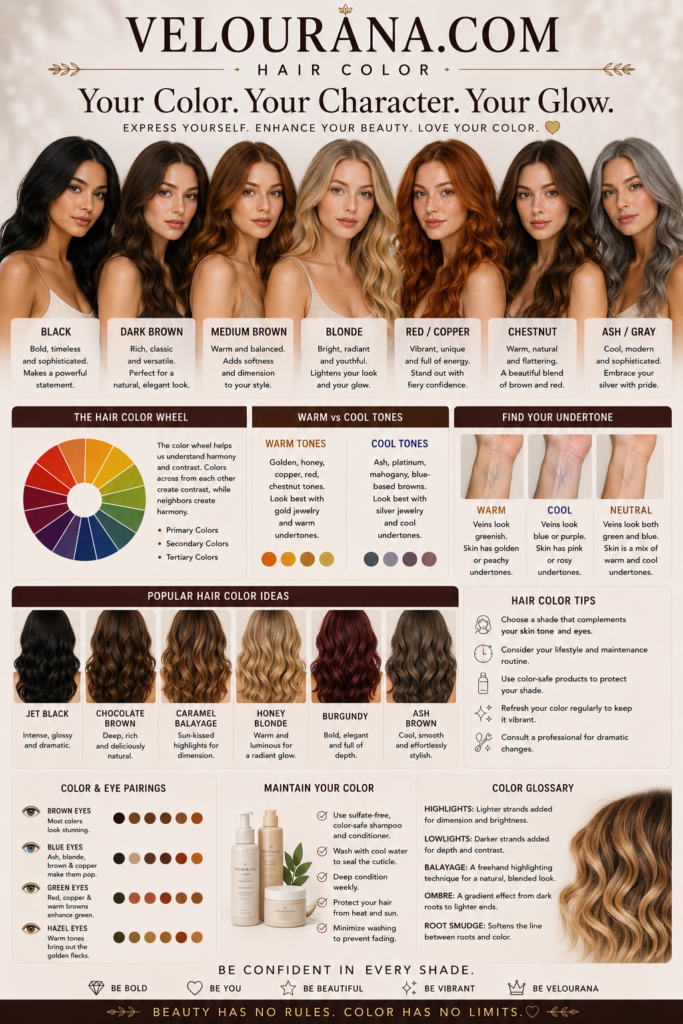
CATEGORY: Gray & Silver Hair
Gray and silver hair occupy a distinctive place in the world of hair color because they are simultaneously natural biological developments, powerful aesthetic statements, and increasingly influential beauty references. Unlike a conventional shade chosen from a salon color chart, naturally graying hair develops gradually and individually. It may begin as a few bright strands around the temples, appear first along the hairline, emerge in concentrated streaks, or spread almost evenly through the entire head. The result is rarely a single uniform gray. Instead, natural gray hair can contain white, silver, charcoal, pewter, salt-and-pepper, and remnants of the original pigment, creating a complex pattern that manufactured color often attempts to imitate.
For decades, beauty culture largely treated visible gray hair as something to conceal. The conventional response to the first silver strands was permanent color, frequent root maintenance, and an ongoing effort to preserve the appearance of the original shade. That expectation has changed considerably. Gray hair is increasingly worn intentionally rather than automatically covered, while silver itself has become a desirable salon color among people whose hair has not naturally grayed. What was once regarded almost exclusively as evidence of aging now exists within a much broader beauty vocabulary that includes sophisticated silver, dramatic steel, luminous white, smoky charcoal, and dimensional salt-and-pepper hair.
Yet embracing gray hair successfully involves more than simply discontinuing hair dye. The disappearance of pigment changes the way hair interacts with light, while the hair fiber itself may also behave differently over time. Texture, porosity, moisture retention, shine, environmental staining, previous chemical treatments, and the contrast between pigmented and unpigmented strands can all influence how gray hair looks and feels. Understanding these characteristics makes it possible to treat gray and silver hair as a color category with its own visual strengths rather than as a diminished version of another hair color.
What Actually Creates Gray and Silver Hair
Hair color begins inside the follicle. Pigment-producing cells called melanocytes contribute melanin to the developing hair fiber, and the amount and type of melanin help determine whether hair appears black, brown, blonde, red, or somewhere between those broad categories. As pigment production declines, newly growing hairs contain less melanin. When pigment becomes greatly reduced or absent, individual strands appear gray, silver, or white depending on their remaining pigmentation, surrounding hairs, surface characteristics, and the way light reflects from them.
This explains one of the most important facts about naturally gray hair: a head of “gray hair” is frequently not composed of uniformly gray strands. What the eye perceives as gray may actually be a mixture of strongly pigmented hairs and hairs containing little or no visible pigment. Dark hair interspersed with white strands can produce a cool salt-and-pepper effect from a distance. As the proportion of unpigmented strands increases, the overall appearance may become silver and eventually predominantly white.
The transition is therefore inherently dimensional. Someone whose original hair is deep brunette may initially develop striking silver threads against a dark background. A person with blonde hair may experience a much less obvious transition because pale unpigmented strands blend more easily with the original color. Red hair can move through especially interesting combinations as remaining warm pigment contrasts with increasingly cool or white strands.
Genetics strongly influence when graying begins and how quickly it progresses. There is no universal age at which hair is supposed to turn gray, nor does every person follow the same sequence. The process can begin relatively early for some people and much later for others. Even within one head of hair, follicles do not necessarily reduce pigment production simultaneously. This irregularity produces the streaks, clusters, ribbons, and scattered highlights that give natural gray hair much of its visual individuality.
The words gray, silver, and white are often used interchangeably in everyday beauty language, but visually they can suggest different effects. Gray generally describes a mixture or intermediate appearance. Silver suggests a brighter, cooler, more reflective result, while white describes hair with very little visible pigment. These distinctions are aesthetic rather than rigid biological categories. Lighting can also transform perception dramatically: hair that looks soft gray indoors may appear brilliant silver in daylight.
Why Gray Hair Can Feel Different as Well as Look Different
The loss of pigment is only one part of the experience of graying hair. Many people notice that their silver strands do not behave exactly like the pigmented hair they remember. Some gray hairs feel coarser or more wiry, while others become finer, softer, drier, or more fragile. The overall hair may also change in density, curl pattern, or responsiveness to humidity. These changes are not identical for everyone, and it is important not to assume that gray hair has one universal texture.
Hair characteristics can evolve with age because the scalp, follicles, sebaceous activity, and diameter of individual fibers can change. A person who once had naturally oily hair may eventually find that the lengths require considerably more conditioning. Someone with previously straight hair may notice bends or waves developing in some silver strands. Others discover that their gray hair is smoother than expected.
This variation is why gray-hair care is most successful when based on the actual condition of the fiber rather than on stereotypes about mature hair. A coarse silver strand that feels dry may benefit from richer conditioning, while fine white hair can become limp when repeatedly coated with heavy products. Curly gray hair may require a completely different balance of moisture and definition from straight silver hair.
Porosity is particularly significant because it affects the way hair absorbs and loses water, conditioning ingredients, styling products, and unwanted environmental color. Previously dyed sections may be more porous than newly grown natural gray roots. This difference becomes especially obvious during a transition from permanent color. The natural silver growth may look bright and healthy while older colored lengths appear warmer, duller, or drier.
Gray hair also makes surface condition visually important. Dark pigment can create a sense of depth that disguises some irregularities, whereas pale silver and white strands rely heavily on reflected light for their brilliance. When the cuticle is relatively smooth, silver hair can look luminous and almost metallic. When the surface becomes rough, dehydrated, or coated with residue, the same hair may appear matte or cloudy.
The goal should not be to force every gray strand into an artificial glass-like finish. Texture is part of hair's character. Instead, good care supports flexibility, manageable moisture levels, and enough surface smoothness for the natural variation of silver tones to remain visible.
The Extraordinary Color Range Inside Natural Gray
One reason gray hair has become so influential aesthetically is its complexity. Natural silver rarely resembles a flat block of neutral gray. It contains contrasts that would require sophisticated placement if created artificially.
Salt-and-pepper hair is perhaps the clearest example. Dark pigmented strands remain alongside pale ones, creating an intricate pattern that changes according to movement, hairstyle, and lighting. When the distribution is relatively even, the result can resemble extremely fine highlighting. When white strands concentrate around the temples or front hairline, they create natural face-framing brightness. A concentrated silver section can become a dramatic feature rather than something requiring camouflage.
As graying advances, the visual balance may shift toward pewter or silver. Pewter tones tend to retain more depth, producing a smoky, metallic appearance. Bright silver reflects more light and can appear almost icy. Predominantly white hair creates still another effect: clean, luminous, and highly responsive to surrounding colors.
Skin tone and clothing can change the perceived temperature of gray hair. Against cool navy, charcoal, cobalt, or crisp white, silver may look especially icy. Surrounded by warm beige, camel, rust, or golden light, the same hair can appear softer. Makeup also influences the relationship between hair and complexion because removing strong pigment from the hair alters the overall contrast around the face.
This does not mean that someone with silver hair must adopt a prescribed wardrobe or makeup palette. The more useful observation is that gray changes the visual framework. A deep brunette who becomes predominantly silver has altered one of the largest areas of color surrounding the face. Colors that once seemed understated may suddenly become prominent, while shades previously considered too strong may become beautifully balanced by the neutrality of silver hair.
Natural gray also changes continuously. A salt-and-pepper pattern at one stage may become dramatically lighter several years later. This evolving quality makes gray hair unlike a static salon shade. Its color story develops along with the person wearing it.
Growing Out Artificial Color Without Losing the Beauty of the Transition
For someone who has colored the hair consistently for years, deciding to reveal natural gray can create an awkward practical question: how does the artificial color disappear while the natural silver grows in?
Simply stopping permanent color is the most straightforward approach, but it can produce a visible demarcation line between new growth and previously colored lengths. The contrast can be particularly pronounced when dark permanent dye has been used over predominantly silver roots. As the natural hair grows, the head may temporarily contain two very different color stories.
That stage does not mean the transition is failing. It is simply the physical reality of growing out color that cannot disappear from the already treated fiber. Hair grows from the scalp; the previously colored lengths remain colored until they are cut away, fade sufficiently, or are professionally altered.
Some people deliberately accept the line of demarcation and allow the process to unfold naturally. This approach avoids additional chemical processing and preserves the condition of the new growth, although patience is required. Regular haircuts gradually remove the old color, and shorter styles naturally complete the transition faster than very long hair.
Others prefer to soften the contrast through professional color work. The appropriate method depends heavily on the starting shade, percentage of gray, condition of the hair, history of permanent dye, and desired final result. Strategic highlights or lowlights can sometimes break up a harsh boundary and integrate natural silver with previously colored sections. In other situations, carefully removing or lightening old artificial pigment may be considered.
The challenge is that creating a convincing silver effect on previously dark-colored hair can be chemically demanding. Artificial dark pigment may need substantial lifting before a cool pale result becomes possible, and repeatedly processed lengths may not tolerate aggressive lightening safely. A photograph of an icy silver transformation cannot reveal the complete chemical history behind the result.
For this reason, preserving hair integrity should take precedence over achieving instant uniformity. Natural silver roots do not require the older lengths to become platinum immediately. A transitional mixture of gray, beige, softened brunette, and silver can be beautiful in its own right when the tones are intentionally blended.
There is also a psychological adjustment during the grow-out period. Someone accustomed to seeing one consistent dark or warm shade may initially interpret variation as untidiness simply because it is unfamiliar. After sufficient natural gray emerges, however, the pattern begins to look intentional and coherent. The silver develops enough visual presence to become the dominant identity rather than appearing as isolated regrowth.
Keeping Silver Bright Without Making It Artificial
One of the most common concerns with gray and white hair is yellowing. Because very pale hair contains little pigment to visually overpower subtle deposits, changes in tone can become noticeable quickly. Product residue, environmental exposure, minerals in water, heat, smoke, pollution, and the condition of the hair surface can all influence the appearance of pale strands.
The first response is often purple shampoo because violet sits opposite yellow within traditional color theory and can visually neutralize excessive yellow warmth. Used appropriately, a violet-toned cleanser or treatment can make silver hair appear clearer and cooler. But purple products are not automatically necessary at every wash, nor does stronger pigmentation always produce a better result.
Overuse can make very pale or porous hair acquire a temporary lavender, blue-violet, or dull cast. A heavily pigmented product may also exaggerate uneven porosity, depositing strongly on some sections while barely affecting others. Silver hair should therefore be observed rather than treated according to a rigid schedule. If the color already looks clean and neutral, there may be nothing to correct.
Clarifying can be equally important when dullness comes from buildup rather than unwanted underlying warmth. Styling products, conditioning films, minerals, and other deposits can reduce brightness by coating the fiber. Removing appropriate buildup may restore luminosity without relying entirely on violet pigment. However, frequent strong cleansing can also leave dry hair feeling rough, so cleansing intensity should reflect the hair's actual needs.
Heat deserves attention as well. Excessively high temperatures can contribute to dryness and may affect the appearance of delicate pale hair. Heat protection and sensible temperature control support both fiber condition and color clarity. The goal is not to avoid styling completely but to recognize that brilliant silver hair displays surface condition very visibly.
Sun exposure can influence hair quality and tone, particularly when hair is already dry or chemically processed. Protective styling, hats when appropriate, and conditioning care can help maintain the appearance of the lengths. Again, the objective is not to create anxiety around natural silver but to preserve the qualities that allow it to reflect light beautifully.
Perhaps the most important principle is moderation. Silver hair does not need to be aggressively toned into an icy blue-white shade to be attractive. Natural gray often contains warmer, cooler, darker, and brighter strands simultaneously. Excessive correction can erase some of the dimensional complexity that makes it distinctive.
Moisture, Shine, and the Architecture of Healthy Silver Hair
Beautiful gray hair is less about making every strand perfectly smooth than about creating an appropriate relationship between cleansing, conditioning, styling, and the natural structure of the hair.
Dryness can make silver hair look less reflective because a roughened surface scatters light. Conditioning helps improve manageability and can reduce the friction that contributes to tangling and breakage. Yet the amount of conditioning needed depends strongly on texture and density. Thick, coarse silver hair may welcome richer formulas, whereas fine hair may need lighter conditioning concentrated primarily through the lengths.
Shine products can enhance the metallic quality of silver, but shine should not be confused with oiliness. Heavy application of oils or silicone-rich finishing products can collapse fine hair or create separation that makes the scalp more visible. Small amounts applied strategically often produce a more elegant result than saturating the fiber.
Haircuts also influence how gray color is perceived. A precise shape can emphasize the graphic contrast of salt-and-pepper hair, while long layers allow silver strands to move through darker sections and reveal dimensional variation. Curly and coily textures can create remarkable interplay between shadow and light because each bend exposes the silver differently. Long white hair can look ethereal and fluid when the ends remain healthy enough to retain a defined shape.
There is no haircut that someone is required to adopt after going gray. The old assumption that mature women should automatically cut silver hair short belongs to a narrow beauty convention rather than a structural rule. Short silver crops can be striking, but so can shoulder-length waves, long straight silver hair, textured bobs, curls, coils, braids, and layered styles.
What matters is whether the cut supports the density, texture, condition, and desired visual effect of the individual hair. Because gray can increase visible contrast with the scalp in some cases, shape and volume placement may become particularly important for people experiencing changes in density. A thoughtful haircut can create movement and structure without pretending that every head of hair has the same needs.
Healthy-looking silver therefore emerges from an integrated approach. Color clarity matters, but so do softness, movement, controlled texture, and a cut that gives the hair intentional form.
Gray Hair as a Modern Color Choice Rather Than a Compromise
The cultural meaning of gray hair has changed substantially because more people have begun presenting it as an intentional aesthetic rather than evidence that they have abandoned beauty maintenance. This distinction matters.
For years, hair-color advertising often positioned gray coverage as an unquestioned necessity. Visible roots represented a problem to solve. The language surrounding graying was frequently based on concealment, correction, and reversal. That narrative placed people—particularly women—into an expensive and repetitive maintenance cycle in which a completely normal biological change had to remain invisible.
Choosing not to cover gray challenges that expectation, but embracing silver does not require rejecting cosmetics, hairstyling, fashion, or salon care. Someone can wear natural gray while maintaining an elaborate haircut and polished makeup. Another person may prefer minimal styling. Neither approach is inherently more authentic.
The growing visibility of silver hair has also expanded ideas about what glamorous hair can look like. Glossy brunette, luminous blonde, vivid copper, and deep black no longer occupy the entire aspirational color spectrum. Silver can be equally dramatic. In fact, its neutrality gives it unusual flexibility. It can appear futuristic with a geometric cut, romantic in long waves, sophisticated in a smooth bob, rebellious in a textured crop, or completely effortless when worn in its natural pattern.
This shift also benefits people who still choose to color their gray. Greater acceptance turns coverage into a genuine aesthetic choice rather than a social obligation. Someone may love being brunette and continue coloring indefinitely. Someone else may enjoy changing between silver and fashion shades. The important development is the expansion of options.
Gray hair does not have to carry a philosophical message. It can simply be a hair color.
The Difference Between Natural Silver and Salon-Created Silver
The popularity of silver has created an interesting reversal: while some people color natural gray hair to restore pigment, others remove pigment from naturally dark or blonde hair specifically to create silver.
Salon-created silver can be exceptionally beautiful, but it is technically very different from naturally unpigmented hair. To produce a clean silver on darker hair, the underlying pigment generally has to be lifted to a sufficiently pale level before cool toners can create the desired effect. If too much yellow or orange remains, applying a silver toner alone will not necessarily produce a clear metallic result.
This is why dramatic dark-to-silver transformations can involve significant processing. The final photograph may suggest effortless gray, while the chemical route required to achieve it can be complex. Hair condition, previous permanent dye, metallic salts, henna, repeated bleaching, and other aspects of color history can affect what is realistically achievable.
Artificial silver is also prone to tonal fading because the cool pigments used to create it may gradually wash away, revealing warmer underlying lightened hair. Maintaining the shade can therefore require toning products and periodic salon refreshes.
Natural silver behaves differently. The pale strand is produced by the follicle itself rather than created by bleaching away existing pigment. It can still become stained or visually yellowed, but there is no artificially lightened yellow base waiting beneath a temporary silver toner in the same way.
Understanding this distinction helps prevent unrealistic comparisons. Someone growing naturally silver hair should not assume it must resemble a perfectly uniform salon platinum. Conversely, someone requesting silver color at a salon should not assume that naturally white-looking results can always be recreated instantly on dark, previously colored hair.
Both are legitimate forms of silver hair, but their maintenance and chemistry are fundamentally different.
Letting Gray Hair Become Its Own Identity
Perhaps the most interesting stage of going gray occurs when the hair stops being perceived as the former color with silver interruptions and begins to be seen simply as gray hair.
At first, every white strand may attract attention because it contrasts with the established visual identity. As the pattern expands, the relationship reverses. The remaining dark or colored strands become part of the dimension inside a predominantly silver composition.
This transition can alter how facial features are perceived. Hair is a major framing element, and changing from deep pigment to silver reduces, increases, or redistributes contrast depending on skin tone and features. Eyebrows may suddenly appear more prominent. Eye color can become unexpectedly noticeable. Lip colors that once seemed strong may feel balanced. Jewelry may interact differently with the cooler neutrality surrounding the face.
None of these effects creates universal rules. They are invitations to reassess rather than prescriptions to correct. Gray hair can encourage experimentation precisely because it provides a new neutral framework.
The most compelling silver hair often appears when its wearer stops trying to make it imitate the characteristics of the previous color. Natural gray does not need to look like blonde. White hair does not need artificial darkness merely to create conventional youthfulness. Salt-and-pepper hair does not need perfect uniformity.
Its irregularity is part of its architecture.
Every silver pattern records the independent behavior of thousands of follicles, producing something that cannot be duplicated exactly with foils, balayage, or a bottle of dye. Two people with the same original brunette shade can develop entirely different gray patterns. One may acquire a brilliant white front section while retaining darkness at the back; another may become evenly peppered; another may develop cool silver throughout.
That individuality is arguably gray hair's greatest aesthetic strength. It is a color transformation that creates its own placement.
Once treated with the same attention given to blonde, brunette, copper, or fashion colors, gray hair reveals itself not as the absence of color but as an entire spectrum of its own—smoke, steel, pearl, frost, pewter, charcoal, silver, and white, constantly changing with texture and light.
The modern beauty of gray hair lies precisely there. It does not need to disguise where it came from, and it does not need to predict where it is going. It can be maintained, styled, toned, polished, cut, grown long, blended, highlighted, or simply left to develop naturally.
Silver is not the disappearance of a hair-color identity. For many people, it becomes the most distinctive color identity they have ever had.
THE END VELOURANA
 Discover More From Our Family of Websites
 ZodiacBearing (Astrology, Tarot, Numerology, Angel Numbers & Spiritual Guidance)
 Velourana (Beauty, Makeup, Hair Care, Skincare & Beauty Tips)
 HavenBearing (Home, Living, Organization, Décor & Everyday Inspiration)
 PawBearing (Pet Care, Dog Breeds, Animal Health, Training & Pet Products)
 PsyCatherine (Notes From the Journal of a Psychologist on Real Life)

