CATEGORY: Black Hair
There is a particular visual authority to black hair. It frames the face decisively, gives silhouettes clarity, makes reflected light appear brighter, and can transform even a simple hairstyle into something striking. Yet the most compelling black hair rarely owes its beauty to darkness alone. Its impact comes from the balance between pigment and light, intensity and softness, uniformity and dimension.
This distinction matters because black is frequently approached as an uncomplicated hair-color choice. Someone wants darker hair, selects black, and assumes the destination is self-explanatory. But black can be natural or deliberately artificial, warm or cool, reflective or muted, soft or saturated. It can resemble deep espresso, polished obsidian, charcoal, dark chocolate, or blue-black ink. On different textures, each variation acquires another identity.
Choosing black successfully is therefore an exercise in refinement. The objective is not simply to make hair as dark as possible. It is to understand how depth interacts with complexion, natural coloring, hair history, texture, haircut, maintenance, and future plans.
For naturally black hair, the conversation is different but equally rich. The goal may be preserving depth, increasing visible shine, understanding why the ends appear warmer, or enhancing the hair without obscuring its natural variation. Black hair is not a blank, featureless background. It is a color environment of its own.
When Darkness Becomes a Design Element
Hair color affects the visual proportions of the face because it occupies a substantial area around it. The darker that area becomes, the more clearly its edges can be perceived.
Black hair can therefore make a haircut feel more intentional. A blunt perimeter becomes graphic. Bangs can create a strong architectural line across the forehead. A long center-parted style may produce symmetry and drama. A pixie cut can emphasize the shape of the head and the contrast between hair and skin.
On textured hair, darkness operates differently. The outer silhouette may remain strong, but internal dimension emerges through curls, coils, twists, waves, and areas of reflected light. Instead of relying on multiple hair colors to reveal shape, the style uses geometry and surface reflection.
This is why black should not automatically be described as flat. Flatness is a visual condition, not an inevitable characteristic of dark pigment. Hair can be uniformly black yet extraordinarily dimensional when its texture, movement, and shine remain visible.
Conversely, artificial color can create flatness when pigment becomes excessively dense. Repeatedly covering already-black lengths with permanent black dye can reduce subtle tonal differences. The hair may become almost opaque in appearance, particularly under low light.
A sophisticated black result often preserves enough variation for the eye to read the hair as a collection of moving fibers rather than a single dark shape. This can be achieved naturally through texture and reflection or, when appropriate, through carefully controlled color work.
The concept is similar to black fabric in fashion. Velvet, silk, leather, cotton, and satin may all be described as black, yet each appears different because its surface interacts differently with light. Hair behaves in much the same way.
Natural Black and Dyed Black Tell Different Color Stories
Naturally black hair develops through biological pigmentation. Eumelanin is present in high concentration, creating the deep appearance associated with dark brown and black hair. The precise amount and distribution of pigment vary between individuals, which is why natural black is not identical from person to person.
Under strong light, naturally black hair may reveal warmth. Brown, reddish, or even slightly golden reflections can become visible, particularly through weathered lengths. Other naturally black hair remains noticeably cool, producing charcoal or blue-toned reflections.
These subtleties are difficult to reproduce perfectly with a single artificial shade because natural hair contains variation. Different fibers may reflect light differently, and individual sections have different histories of sun exposure, washing, heat, friction, and growth.
Dyed black hair begins with a different process. Artificial color molecules are introduced to create or reinforce darkness. Depending on the color type, formulation, starting hair, and application history, the resulting pigment may be exceptionally uniform.
That uniformity can be desirable. Someone seeking an intense blue-black fashion statement may want an almost ink-like result. Another person may want a natural-looking black that retains softness and does not immediately appear cosmetically colored.
The distinction becomes especially important when covering gray or white hair. Hair lacking its previous natural pigment creates a different starting canvas from already-dark strands. A formula must account for coverage, tonal balance, percentage of gray, and the desired final depth. A professional colorist can adjust these variables rather than assuming one black formula will behave identically across every strand.
Color history also matters. Virgin hair, previously highlighted hair, bleached hair, henna-treated hair, and repeatedly dyed hair cannot be assumed to respond in the same way. What is visually black today may conceal a complicated chemical history underneath.
Choosing Between Soft Black, Natural Black, and Blue-Black
The language surrounding black hair color can be confusing because shade names are not universally standardized. One brand's natural black may resemble another brand's soft black, and a shade described as "black brown" may look virtually black except under bright illumination.
The underlying concepts, however, are useful.
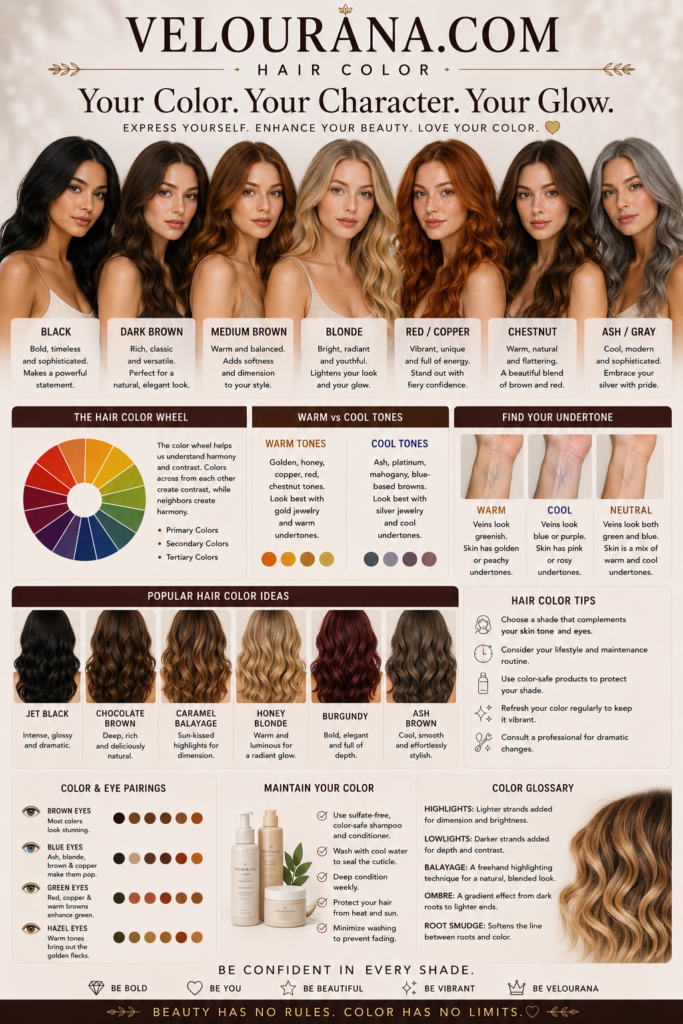
Soft black generally creates darkness without the maximum intensity associated with the deepest black formulas. It can be particularly attractive when the goal is to move from brunette into black territory while maintaining some gentleness around the face. Under bright light, a subtle brown character may remain visible.
Natural or neutral black tends to sit closer to the center of the tonal spectrum. It avoids intentionally conspicuous blue reflection while still providing unmistakable depth. For many people seeking the appearance of naturally black hair, this category provides a useful reference point.
Blue-black is intentionally cooler and more dramatic. The hair may appear pure black in ordinary indoor conditions, then reveal blue, navy, or indigo reflections when light strikes it. On a smooth surface, the effect can be particularly intense because reflected bands of cool color travel across the hair.
Brown-black and espresso shades occupy the transition between black and the deepest brunettes. They can appear black from a distance while revealing warm or neutral brown dimension up close. For someone concerned that pure black might overpower their natural coloring, this area of the spectrum can offer a sophisticated alternative.
The decision should be made by considering the whole person rather than an isolated hair swatch. Natural brow color, eye depth, complexion, undertone, usual makeup, clothing palette, and desired level of contrast all affect the outcome.
A dramatic contrast can be beautiful when intentional. So can seamless harmony. The purpose of shade selection is not to follow a universal matching rule but to understand which visual relationship is being created.
Moving From Light Hair to Black Requires More Than Dark Dye
Few transformations appear as immediate as taking blonde or light-brown hair to black. The change can be accomplished far more quickly than the reverse journey, but speed should not be confused with simplicity.
Naturally dark hair contains underlying pigments that contribute to its richness. Hair that has been heavily lightened has had much of its natural pigment removed. Depending on how light and porous it has become, applying a very dark shade directly may not always create the expected result.
Professional color correction frequently considers the pigments missing from the hair before substantial darkening. Warmth may need to be restored so that the final dark shade has an appropriate foundation. Without sufficient underlying pigment, some transformations can appear excessively cool, hollow, muddy, or unstable.
Porosity complicates the process further. Lightened hair may absorb artificial color unevenly. Highly porous sections can grab pigment more strongly than healthier areas, creating unexpected differences in depth. Ends may become darker than the roots, or damaged sections may lose certain tones faster during subsequent washing.
A thoughtful darkening service therefore begins with the current condition of the hair rather than the desired shade alone.
This becomes especially important when the transformation is emotional or impulsive. Black can feel wonderfully decisive after months or years of blonde hair, but returning to blonde is unlikely to be equally immediate. Artificial black pigment can be stubborn, and removing it generally exposes warmth before significant lightness is achieved.
Someone who enjoys changing hair color frequently may therefore prefer a less permanent approach or a very deep brunette rather than immediately committing to repeated permanent black applications. The appropriate option depends on the starting hair and desired longevity, but the future should be considered before the first application.
Black is one of those colors for which tomorrow's possibilities are influenced strongly by today's decision.
Why Repeated Black Dye Can Become a Long-Term Commitment
Root regrowth creates one of the most common maintenance challenges for dyed black hair. When natural hair is lighter, even modest regrowth may become obvious because the contrast is strong. This can create the temptation to recolor frequently.
The problem is not necessarily the root application itself. It is the repeated application of permanent black dye to lengths that are already sufficiently dark.
Each unnecessary overlap can add more artificial pigment. Over months or years, the mid-lengths and ends may accumulate considerable saturation. If the person later wants a lighter color, those areas may resist pigment removal more strongly than newer growth.
This uneven history can make future color correction complicated. The hair may technically look like one uniform black shade while containing several different layers of artificial color underneath.
A maintenance strategy should therefore distinguish between new growth and previously colored hair. The lengths may sometimes need tonal refreshing, but refreshing and repeatedly applying permanent color are not necessarily the same thing. The correct approach depends on the formula, fading pattern, condition, and desired result.
This principle is valuable beyond black hair, but the consequences become particularly noticeable with extremely dark permanent pigment.
Commitment does not make black a poor choice. It simply makes informed commitment important. Someone who genuinely loves black hair and intends to keep it for years may find the maintenance entirely worthwhile. Problems tend to arise when the color is treated as easily reversible.
Texture Determines How Black Hair Reveals Itself
Black hair on a perfectly straight surface can create long, uninterrupted reflections. This is the classic "mirror shine" associated with glossy dark hair, where bright bands of light move across the lengths as the head turns.
Waves divide those reflections. Each curve presents a different angle to the light, creating alternating zones of brightness and shadow. Even without highlights, the hair gains dimensional variation.
Curls intensify this fragmentation. Individual ringlets can appear nearly black in their inner curves while their outer arcs catch bright highlights. Coils create still more complex patterns, with light touching selective points throughout the shape.
This means shine should never be evaluated identically across textures. Straight hair may display obvious continuous gloss, whereas tightly textured hair may express healthy luminosity through numerous smaller reflections. Attempting to make every texture look like straight glass hair misunderstands the physical structure of the fiber.
The same is true of perceived color depth. A tightly curled black strand may sometimes appear darker because of the shadows created within the curl pattern. When stretched or viewed under strong direct light, its underlying tonal character may become more visible.
Hair density affects the result as well. Very dense black hair can create extraordinary visual depth because layers of dark fibers overlap. Lower-density hair may reveal more scalp, changing the apparent contrast without changing the pigment of the strands themselves.
For colorists and wearers alike, this reinforces a crucial principle: shade charts provide only part of the information. Hair color exists on actual hair, and actual hair has shape.
Maintaining Richness Without Chasing Artificial Perfection
Black hair often looks most luxurious when its surface appears healthy and its movement remains visible. That can encourage an intense pursuit of shine, but healthy-looking black hair does not require coating it continuously with heavy products.
Excessive buildup can have the opposite effect, reducing movement and making the surface look dull. Cleansing should therefore be appropriate to the scalp, styling habits, and products being used. There is no universal washing frequency that suits every person with black hair.
Conditioning is equally individualized. Fine straight black hair may become weighed down by products that work beautifully on coarse curls. Highly textured or porous hair may require more substantial conditioning support. The color itself does not determine the complete routine.
What black hair does provide is a particularly visible demonstration of surface condition. Because the base is so dark, reflected light creates strong contrast. A smooth reflective area can look brilliantly bright against surrounding black. When the surface is rough, that reflection becomes less organized.
Heat styling should therefore be considered in terms of cumulative condition rather than merely immediate appearance. A flat iron may temporarily increase visible smoothness, but excessive heat can contribute to damage. Heat protection and appropriate temperature are more meaningful long-term strategies than repeatedly pursuing a temporary glossy finish at the expense of fiber integrity.
Color-treated black hair also benefits from avoiding unnecessary chemical overlap. Permanent color, lightening, chemical straightening, perming, and other processes affect the fiber differently, and combining services requires attention to condition and compatibility.
The most attractive black hair is not necessarily the darkest, straightest, or glossiest. It is hair whose color and condition work together convincingly.
Fading Does Not Always Mean Losing Black
Artificial black hair can change gradually even while continuing to look black overall.
Cool pigments may shift, causing blue-black hair to appear more neutral after repeated washing. Warm underlying tones may become more noticeable. Ends exposed to sunlight and heat can develop a softer appearance than freshly colored roots. Depending on the original hair and formula, dark color may slowly reveal brown, reddish, or warmer reflections.
This can be frustrating when the goal is an extremely specific tone, but not every tonal change requires an immediate full-length permanent recoloring.
The distinction between depth and tone is useful here. Hair may still possess sufficient darkness while its tonal direction has changed. Correcting tone can require a different strategy from rebuilding depth.
Natural black hair undergoes its own evolution. Sunlight and environmental exposure can subtly alter the lengths, while age can introduce individual gray or white hairs. These lighter strands create visible contrast precisely because the surrounding hair is so dark.
The arrival of gray within black hair can produce extraordinary patterns. A few silver strands may look almost like deliberate highlights. Larger concentrations can create salt-and-pepper effects, streaks, or sections of dramatic contrast. Some people choose to cover this change; others incorporate it into their appearance.
Neither approach is inherently more polished. Black and silver can coexist beautifully because their contrast is so strong.
Dimension Without Traditional Highlights
When people hear the word dimension, they often imagine blonde or caramel highlights. Black hair demonstrates that dimension can be produced in other ways.
Natural tonal variation, shine, movement, texture, layering, and subtle shifts between black and near-black can all create depth without obvious lightened pieces.
For someone who wants visible color dimension, very dark brunette ribbons or carefully chosen tonal accents can soften a black base without transforming it into conventional highlighted hair. The feasibility and technique depend on whether the black is natural or artificially colored.
This distinction is critical. Virgin naturally black hair and hair saturated with permanent black dye do not lighten in the same way. Artificial pigment may lift unpredictably and reveal strong warm tones. Attempting to place lighter pieces through repeatedly dyed black hair can therefore become a color-correction service rather than a straightforward highlighting appointment.
On natural black hair, controlled lightening still exposes underlying warm pigment as melanin is removed. Depending on the desired result, those warm stages may be embraced or refined through toning.
Dimension can also be created without lightening at all. A gloss or tonal service may adjust reflection. A haircut can introduce movement that changes how light strikes the surface. Styling can reveal layers that previously disappeared into a dark mass.
The assumption that black hair must be chemically lightened to become interesting overlooks much of what makes it visually sophisticated.
Black Hair as a Personal Signature
Certain hair colors function less like temporary beauty choices and more like signatures. Black has unusual potential to become one of them.
Its consistency can make it strongly associated with a person's identity and style. A long black curtain of hair, a glossy black bob, a textured black crop, or a mass of dark curls can become instantly recognizable. The color provides continuity even as the cut and styling evolve.
That signature quality may explain why people who genuinely love black hair often return to it after experimenting with lighter colors. Its visual certainty is difficult to duplicate. It can make clothing feel sharper, jewelry brighter, eye color clearer, and hairstyles more defined.
Yet the strongest version of black hair is not necessarily the most saturated version available. Personal signature comes from appropriateness and consistency, not extremity.
For one person, blue-black may perfectly express a dramatic aesthetic. For another, soft natural black provides exactly enough depth. Someone else may discover that the darkest espresso brown creates the impression of black while harmonizing more naturally with their features.
The terminology matters less than the result.
A successful black shade should look intentional in multiple environments rather than only under salon lighting. It should work with the hair's texture rather than obscuring it. Its maintenance should be compatible with the wearer's willingness to maintain roots and tone. Most importantly, the commitment level should correspond to future color ambitions.
The Sophistication Hidden Inside a Simple Color
Black hair is often placed at the beginning or end of a color chart as though there were nowhere further to explore. In practice, it contains an entire world of subtle distinctions.
There is the softness of near-black brunette and the intensity of blue-black. There is natural black warmed by sunlight and freshly colored black reflecting cool studio light. There is the smooth mirror effect of straight hair and the constellation of highlights created by coils. There is youthful uniform pigment, black threaded gradually with silver, and artificial darkness layered over a completely different natural base.
Each is black, yet none is visually identical.
Understanding those differences makes black hair easier to appreciate and easier to choose intelligently. It also prevents unnecessary assumptions: that black automatically looks harsh, that every black shade is cool, that dark color requires little maintenance, or that returning to lighter hair will be simple.
Black's apparent simplicity is part of its allure, but its sophistication lies beneath that surface. It is simultaneously neutral and dramatic, classic and contemporary, understated and commanding.
When chosen with attention to undertone, maintained with respect for the hair's condition, and allowed to interact naturally with texture and light, black hair does not need obvious embellishment to have dimension. Its depth becomes the foundation on which everything else is visible.
The darkest hair color is therefore not the absence of color complexity. It is one of its most concentrated expressions.
THE END VELOURANA
 Discover More From Our Family of Websites
 ZodiacBearing (Astrology, Tarot, Numerology, Angel Numbers & Spiritual Guidance)
 Velourana (Beauty, Makeup, Hair Care, Skincare & Beauty Tips)
 HavenBearing (Home, Living, Organization, Décor & Everyday Inspiration)
 PawBearing (Pet Care, Dog Breeds, Animal Health, Training & Pet Products)
 PsyCatherine (Notes From the Journal of a Psychologist on Real Life)