
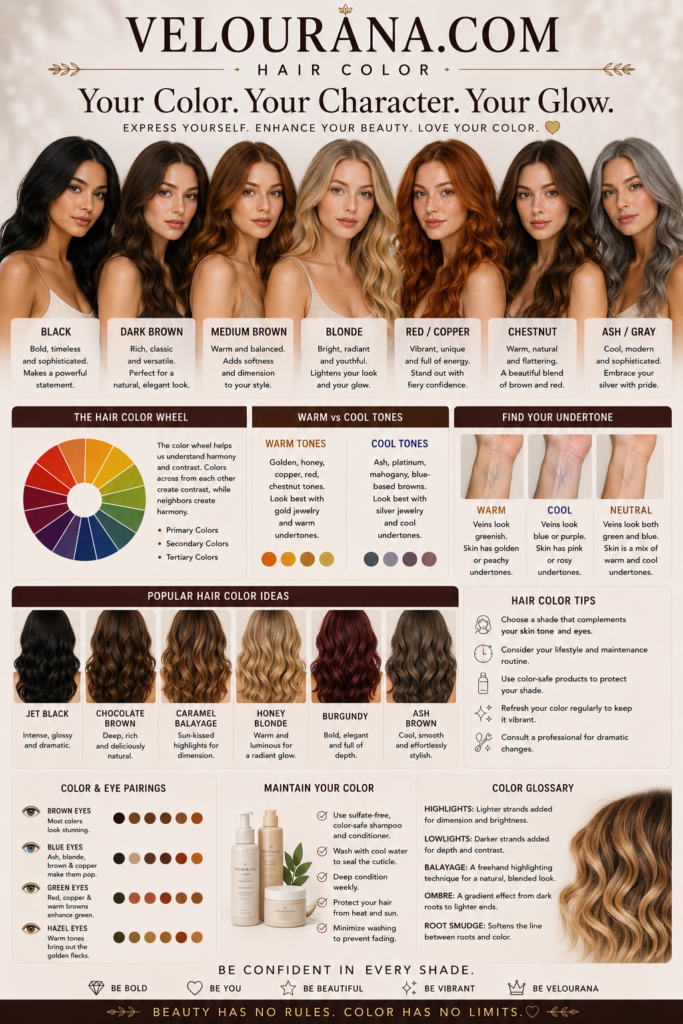
CATEGORY: Black Hair
Black hair is often described as though it were the simplest point on the hair-color spectrum: the darkest shade, the absence of obvious lightness, the color that requires the least explanation. In reality, black hair is remarkably complex. What appears at first glance to be a single deep color can contain cool blue reflections, softened neutral browns, warm espresso undertones, subtle red warmth, silvery highlights, or almost ink-like intensity. Light changes it. Texture changes it. Skin tone changes the way it is perceived. Even the finish of the hair—glossy, matte, sleek, curly, airy, dense—can make the same nominal shade of black look dramatically different.
That complexity is one reason black hair has such enduring visual power. It can create sharp contrast around the face, emphasize the architecture of a haircut, make healthy shine particularly noticeable, and provide a dramatic background against which skin, eyes, jewelry, and clothing become more prominent. Yet its strength also means that choosing, coloring, and maintaining black hair deserves more consideration than simply selecting the darkest box on a shade chart.
Natural black hair and cosmetically created black hair also behave differently. Naturally dark hair contains a high concentration of eumelanin, the pigment primarily responsible for brown and black coloration. Artificial black hair color, by contrast, is produced through deposited dyes designed to imitate or intensify that depth. Two heads of hair may therefore look similarly black while responding very differently to sunlight, washing, heat, chemical services, and future color changes.
Understanding black hair begins with abandoning the idea that darkness means uniformity. The richest black hair is rarely visually flat. Its beauty is found in the subtle relationship between depth, reflection, undertone, movement, texture, and light.
Black Is a Family of Colors Rather Than a Single Shade
Hair-color terminology can make black sound absolute, but professional color systems reveal a more nuanced picture. At the darkest end of many level systems sits level 1, commonly identified as black. Immediately above it are very dark browns that may appear black under indoor lighting. The visual boundary between these shades is not always obvious, particularly when hair is dense or light is limited.
This explains why someone who believes their natural hair is pure black may discover warm brown or reddish undertones when standing in direct sunlight. Another person's hair may retain a distinctly cool, almost charcoal quality regardless of illumination. Both can reasonably be perceived as black in everyday life.
Natural black frequently contains subtle tonal variation from root to end. New growth may appear deeper because it has experienced less ultraviolet exposure, washing, heat styling, environmental oxidation, and mechanical wear. Mid-lengths may reveal slightly warmer reflections, while older ends can look softer or browner. This gradual variation contributes to the dimensional quality of natural hair.
Artificial black can be more uniform because pigment is deliberately deposited throughout the hair. When a very dark permanent or demi-permanent formula is applied repeatedly from roots through ends, the result may become increasingly saturated. That can produce extraordinary richness and shine, but excessive pigment accumulation may eventually make the hair appear visually dense or flat.
The undertone chosen within black matters enormously. Neutral black usually offers deep darkness without an intentionally obvious warm or cool cast. Blue-black introduces cool blue or indigo reflections that become especially visible under strong light. Soft black is generally less severe, allowing a trace of brownness to remain. Brown-black, espresso-black, and natural-black descriptions usually indicate slightly different balances between depth and tonal softness, although terminology varies among manufacturers.
These distinctions may seem minor when comparing small color swatches. Across an entire head of hair, however, they can noticeably change the relationship between the hair and the face.
Why Black Hair Creates Such Powerful Contrast
Dark colors visually absorb more light than pale colors, and black hair naturally creates a strong frame. Against lighter skin, that frame can produce striking contrast. Against medium and deep skin, black hair may create a more continuous tonal relationship while still defining the face through shine, texture, and silhouette.
Neither high nor low contrast is inherently more flattering. The effect depends on the individual coloring and the aesthetic being created. A person with naturally high contrast between hair, skin, and eyes may find deep black harmonious because it reinforces an existing pattern. Someone whose coloring is naturally softer may experience the same shade as dramatically transformative.
This is particularly relevant when hair is being artificially darkened. Moving from medium brown, blonde, copper, or another visibly lighter shade to black is not merely a color adjustment. It changes the entire visual distribution of the face. Brows may suddenly appear lighter. Eye color may become more noticeable. Complexion differences can appear more pronounced because the dark frame provides a strong reference point.
The shape of the haircut can also become clearer. A sharp bob rendered in glossy black may appear exceptionally graphic because the outer line is easy to perceive. Long straight black hair can emphasize uninterrupted length and reflective shine. Layers may become more subtle if the hair is uniformly dark, because there is less light-and-dark color variation separating individual sections.
Texture changes this effect. Waves break the surface into alternating planes, producing shifting highlights that reveal movement even in extremely dark hair. Curls and coils create numerous curves where light catches selectively, allowing black hair to show complex dimension through shape rather than obvious color variation.
For this reason, discussions of black hair should never separate color entirely from texture. A blue-black shade on pin-straight hair and the same shade on tightly coiled hair may share identical pigment yet produce very different visual experiences.
Undertones Determine the Character of Black Hair
The difference between a flattering black and one that feels unexpectedly severe often lies in undertone rather than depth.
Cool black shades can contain blue, violet, or ash influences. Blue-black is perhaps the most recognizable example. Indoors, it may appear almost absolute black; under sunlight or directional lighting, cool blue reflections emerge across the surface. This creates an intentionally dramatic effect and can make the hair appear exceptionally saturated.
Neutral black occupies a quieter middle ground. It is dark without deliberately emphasizing either warmth or coolness. Because of this balance, neutral black often resembles naturally deep pigmentation more closely than strongly blue-black formulas.
Soft black introduces slightly less intensity. Instead of creating an opaque, ink-like impression, it allows a degree of tonal softness that can be useful when true black feels too strong. The distinction is particularly important for someone transitioning from dark brown. Soft black can provide noticeably greater depth without creating the abrupt visual shift associated with the darkest artificial shades.
Warm black is subtler because once hair becomes sufficiently dark, warm undertones are often visible mainly in strong light. Espresso, dark chocolate, mahogany-black, or reddish-black effects can contain underlying warmth that appears as brown, red, or burgundy reflection. These shades preserve the authority of black while giving the surface a warmer character.
Skin undertone can influence how these variations are perceived, but simplistic rules should be avoided. Cool skin does not automatically require cool hair, nor does warm skin require warm hair. Hair color can either harmonize with the complexion or deliberately create contrast. Eye color, natural brow depth, wardrobe colors, makeup preferences, and personal style all contribute to the final effect.
The most useful question is therefore not simply whether a black shade is warm or cool. It is what kind of relationship that undertone creates with everything surrounding it.
Natural Black Hair Has Dimension Even When It Looks Uniform
One of the misconceptions surrounding naturally black hair is that it contains little color variation. In fact, natural pigmentation interacts continuously with the physical structure of the hair.
The cortex contains melanin responsible for much of the visible color, while the cuticle affects how light reaches and leaves the fiber. When the cuticle surface is relatively smooth, light reflects more consistently, producing the shine often associated with healthy dark hair. When the surface becomes weathered or rough, reflection becomes scattered and the same black hair may appear less saturated.
This is why shine has such a powerful influence on black hair. On lighter hair, multiple visible shades can create dimension even when surface reflection is modest. On very dark hair, reflected light becomes one of the major ways the eye perceives movement and structure.
A single black strand can appear almost pale at the exact point where bright light reflects from it, then immediately return to near-black beside that highlight. Across thousands of strands, these reflections create the ribbons, curves, and flashes that give dark hair visual life.
Density contributes another layer. Dense black hair can appear extraordinarily deep because less scalp is visible and overlapping fibers create areas of concentrated darkness. Lower-density hair may show greater contrast between the dark strands and the scalp beneath them. Neither situation determines hair health; it simply changes the visual impression of the color.
Individual strand diameter also matters. Coarse fibers can create strong, distinct reflections, while fine black hair may produce a softer surface appearance when many slender strands move together. Texture further reorganizes those reflections, creating an enormous variety of appearances within the broad category called black hair.
Coloring Hair Black Is Easy to Begin and Difficult to Reverse
Darkening hair is generally more straightforward than significantly lightening it, but that apparent simplicity can be deceptive. Black pigment can be extremely persistent, especially after repeated permanent coloring.
When lighter hair is colored black, the result depends heavily on the starting condition and underlying pigment. Hair that has been heavily lightened may be porous and depleted of warm pigments that normally contribute to natural-looking dark shades. Applying a very dark cool formula directly over such hair can sometimes create a result that looks hollow, overly cool, muddy, or otherwise different from the intended natural black.
Professional colorists may restore missing underlying warmth before taking significantly lightened hair very dark. The exact approach depends on the starting level, porosity, previous chemical history, and desired final shade. This is one reason dramatic blonde-to-black transformations benefit from more planning than their direction on the color scale might suggest.
Previously colored hair introduces another complication. Color does not reliably lighten artificial color simply because a lighter dye is applied over it. Someone who repeatedly uses permanent black and later decides to become medium brown, copper, or blonde may require artificial pigment removal and controlled lightening. The process can take multiple sessions and may expose warm underlying tones along the way.
Repeated black applications can also cause pigment buildup. If permanent color is applied to the entire length every time roots need refreshing, older sections continue receiving pigment they may not need. Over time, ends can become much darker than intended and increasingly resistant to future change.
Black therefore rewards commitment. It can be an elegant, sophisticated, and highly wearable color, but it should not be treated as a temporary experiment when permanent dye is involved.
Shine Becomes Part of the Color
Few hair colors demonstrate the relationship between condition and appearance as clearly as black.
A glossy black surface can look almost liquid because bright highlights contrast dramatically against the dark base. When that reflection is interrupted by dryness, roughness, residue, or extensive damage, the perceived richness of the color can decrease even when the actual pigment remains largely present.
This does not mean black hair must be straight or glass-like to look healthy. Shine behaves differently across textures. Straight hair often creates long, continuous bands of reflection. Wavy hair breaks those bands into curved ribbons. Curly hair produces smaller highlights around bends, while tightly coiled hair reflects light at numerous changing angles. Comparing shine across textures using a single visual standard is therefore misleading.
Care should focus on preserving the integrity and comfort of the hair rather than forcing every texture toward the same reflective finish. Appropriate cleansing helps prevent heavy buildup that can dull the surface. Conditioning supports softness and manageability. Heat protection becomes important when thermal tools are used because repeated high-temperature styling can contribute to dryness and structural damage.
Mechanical handling matters as well. Excessive friction, rough detangling, and aggressive towel drying can affect the cuticle and increase breakage. Black hair does not possess a unique need for a completely separate care philosophy simply because of its color; its texture, porosity, chemical history, scalp needs, and styling routine remain more important determinants of product choice.
Color-treated black hair adds the need to preserve artificial pigment. Repeated washing, ultraviolet exposure, heat, and chemical services can gradually alter its appearance. Blue-black may lose some of its cool reflective quality. Warm black may expose more reddish or brown tones. Neutral black may become softer through the lengths.
Rather than viewing these changes as evidence that black is disappearing entirely, it is more accurate to understand them as shifts in tone, surface condition, and pigment concentration.
Black Hair Changes With Light, Photography, and Environment
Anyone who has photographed black hair knows how dramatically cameras can alter it. A shade that appears dimensional in person may become a featureless dark mass in an underexposed image. Strong sunlight can reveal brown or red undertones that seem absent indoors. Flash photography may create intense reflective highlights that make sections look much lighter than expected.
This variability is not evidence that the hair is somehow changing color from moment to moment. It reflects the physics of illumination and the limitations or choices of the camera.
Natural daylight generally provides a more revealing view of undertone than dim indoor lighting. Warm artificial lighting can exaggerate brown and red reflections, while cooler lighting may make neutral or blue-black shades appear more pronounced. Highly directional light emphasizes surface shine and texture. Diffused light softens contrast.
Environmental exposure can create longer-term changes. Ultraviolet radiation contributes to degradation of both natural and artificial hair color, while weathering can alter the surface of the fiber. Long lengths may therefore appear subtly warmer or lighter toward the ends, particularly when they have accumulated years of sun exposure and styling.
This gradual evolution is often part of what makes natural black hair beautiful. Perfect uniformity is not necessarily the goal. Slight differences in depth can prevent very dark hair from appearing visually solid.
For artificially colored black hair, preserving intentional dimension can be equally valuable. A sophisticated result does not always mean saturating every strand to the maximum possible darkness. Sometimes leaving a trace of natural tonal variation creates a softer and more believable finish.
The Relationship Between Black Hair, Brows, Eyes, and Makeup
Because black hair establishes such a strong frame, other facial features can appear different after a major darkening transformation.
Brows that previously seemed deep may suddenly look comparatively light. This does not automatically mean they need to be dyed black. Matching brows exactly to very dark hair can sometimes produce an excessively uniform effect, whereas maintaining a slight difference can preserve natural dimension around the face.
Eye color can become more prominent because of contrast. Light eyes surrounded by dark hair may appear brighter, while deep brown eyes can develop a particularly rich, continuous relationship with black hair. The effect depends on complexion, brow depth, lighting, and makeup as much as the iris itself.
Makeup can also be perceived differently. Colors that looked subtle beside blonde or medium-brown hair may appear softer or stronger after the hair becomes black. Black eyeliner can visually connect more directly with the hair, while lip colors may stand out against the stronger facial frame.
None of this creates mandatory makeup rules. Black hair does not require dramatic cosmetics, nor does it demand specific lipstick or eyeshadow colors. Bare or minimal makeup can look equally intentional. The important point is that changing hair depth changes visual context.
Clothing behaves similarly. Pale colors may create stronger contrast near the face, while deep jewel tones, neutrals, muted colors, and saturated brights each interact differently with black hair. Personal color analysis can help explain these relationships, but individual preference remains central.
Black hair is powerful precisely because it can function both as a neutral and as a statement. Its darkness allows other colors to become highly visible while simultaneously creating its own unmistakable presence.
Black Hair Can Be Dramatic Without Being Severe
The word "black" sometimes carries assumptions of harshness. Those assumptions usually arise from a mismatch between shade, styling, and the individual's natural contrast rather than from black hair itself.
Softness can be introduced without abandoning black. A slightly warmer or more neutral formulation may reduce the icy intensity of blue-black. Face-framing movement can change how darkness surrounds the features. Waves, curls, layers, fringe, or an airy finish can make the overall effect feel different from a sharply geometric style.
Likewise, someone seeking maximum drama can deliberately emphasize black's graphic qualities. A precise cut, smooth reflective finish, strong center part, or very cool undertone can amplify the visual impact.
This flexibility is one of the shade family's greatest strengths. Black can appear romantic, minimalist, glamorous, natural, futuristic, classic, rebellious, polished, or understated depending on its context.
The same principle applies across age groups. There is no universal point at which black hair becomes inappropriate. Natural changes in skin and hair may alter how a particular depth is perceived, but the appropriate response is individualized. Some people prefer to soften their black as their coloring changes; others find deep hair remains integral to their appearance.
Artificial black can also be adjusted rather than abandoned. Moving from blue-black toward neutral black, or from saturated black toward deep brunette, can significantly change the effect while preserving an overall dark identity.
The Enduring Appeal of the Darkest Hair Color
Black hair occupies an extraordinary position in beauty because it combines apparent simplicity with enormous subtlety. From a distance, it can look absolute. Up close, it reveals reflections, undertones, individual fibers, variations in density, and shifts created by movement.
Its visual strength comes from depth, but its beauty depends on more than darkness. Surface condition determines how light travels across it. Undertone influences whether it feels cool, warm, neutral, soft, or intense. Texture determines how highlights form. The haircut determines how the color is distributed around the face. Natural pigmentation and artificial dye create different maintenance realities.
For anyone considering black hair, the most important decision is therefore not merely whether to "go black." It is what kind of black will create the intended result and how much commitment that result requires.
For those who naturally have black hair, understanding its complexity can replace the mistaken idea that there is nothing to explore because the color is already dark. Black hair can contain extraordinary tonal richness without obvious highlights or dramatic chemical alteration. Its dimension may live in sunlight, movement, gloss, texture, and subtle undertone rather than conspicuous color contrast.
At its best, black hair demonstrates that depth does not eliminate nuance. It concentrates it. What initially looks like one color becomes a shifting landscape of charcoal, espresso, ink, blue, brown, and reflected light, changing continuously as the hair moves through the world.
THE END VELOURANA
 Discover More From Our Family of Websites
 ZodiacBearing (Astrology, Tarot, Numerology, Angel Numbers & Spiritual Guidance)
 Velourana (Beauty, Makeup, Hair Care, Skincare & Beauty Tips)
 HavenBearing (Home, Living, Organization, Décor & Everyday Inspiration)
 PawBearing (Pet Care, Dog Breeds, Animal Health, Training & Pet Products)
 PsyCatherine (Notes From the Journal of a Psychologist on Real Life)

