CATEGORY: Permanent Hair Color
Permanent hair color occupies a distinctive place in beauty because it does something temporary and semi-permanent formulas cannot fully imitate: it changes the internal color structure of the hair and creates a result designed to remain until the colored portion grows out or is cut away. That permanence makes it extraordinarily versatile. It can deepen naturally light hair, create rich brunette dimensions, introduce copper or red tones, cover gray, shift undertones, and—when combined with sufficient lifting action—make natural hair appear lighter.
Yet permanent color is often misunderstood. The word “permanent” can suggest that the shade itself will remain visually identical forever, when the reality is more nuanced. The chemical alteration is permanent, but the appearance of the color continues to evolve. Pigments fade, warmth may become more visible, roots grow, porosity changes how lengths retain color, and repeated exposure to washing, heat, sunlight, minerals, and styling products gradually modifies the finish.
Understanding permanent hair color therefore requires looking beyond the shade printed on a box or displayed on a salon swatch. Successful color is an interaction between chemistry, natural pigment, artificial pigment, hair condition, developer strength, processing conditions, previous treatments, and the colorist’s understanding of how all of these variables influence one another.
What Makes Permanent Hair Color Truly Permanent
A strand of hair is more complex than its smooth exterior suggests. Its outer cuticle consists of overlapping protective layers surrounding the cortex, where much of the hair’s natural pigment and structural material reside. Permanent oxidative color works by creating chemical changes within this internal environment rather than merely depositing pigment onto the outside of the strand.
Most conventional permanent color systems combine an alkaline component with oxidative dye precursors and a developer containing hydrogen peroxide. The alkaline environment helps the hair swell sufficiently for the coloring system to penetrate. The developer performs more than one function: it contributes to the oxidation of natural melanin and helps transform small dye precursors into larger colored molecules within the hair.
This is why permanent color behaves differently from direct dyes that largely deposit ready-made pigments. With oxidative permanent color, part of the final shade is effectively constructed during processing.
The developer can also lighten some of the natural melanin already present in virgin hair. That simultaneous lifting and depositing capability is one of the defining characteristics of permanent color. A formula can reduce some natural pigment while creating a new artificial color result in the same process.
The amount of visible lift depends on numerous factors, including the natural starting level, developer strength, formulation, processing time, hair characteristics, scalp heat, and the amount of artificial pigment already present. Permanent color should therefore never be understood as a universal lightening tool. It has lifting ability under appropriate circumstances, but that ability has limits.
One of the most important limitations is that permanent color generally does not reliably lighten previously applied permanent artificial color in the way many people expect. Once substantial artificial pigment has accumulated in the hair, applying a lighter permanent shade over it is not equivalent to returning to virgin hair and starting again. Correcting or significantly lightening previously colored hair may require a different professional strategy.
The chemistry explains another important distinction. Permanent color is permanent because the treated hair has been chemically altered. That does not mean every visible pigment remains at exactly the same intensity indefinitely. Some artificial color molecules and tonal effects gradually diminish, while the underlying structural change remains.
A brunette may become warmer with time. A red can lose brilliance. A cool blonde may reveal yellow or golden undertones. A deep shade can soften after repeated washing. These changes are fading, not a reversal of the original chemical process.
The Starting Canvas Determines the Destination
Hair color is frequently discussed as though selecting a desired shade were the beginning of the process. In professional color work, the real beginning is the existing hair.
Two people can apply nominally identical formulas and obtain noticeably different results because their starting levels, undertones, porosity, density, gray percentage, previous color histories, and individual hair characteristics differ. Permanent color does not replace the existing canvas with an opaque new one. It interacts with what is already there.
Natural hair levels are generally described along a progression from very dark to very light. As natural melanin is lightened, underlying warm pigments become increasingly visible. Darker hair can expose red, red-orange, or orange warmth; lighter starting levels may reveal gold or pale yellow. These underlying pigments are fundamental to color formulation because the desired finished shade must coexist with, enhance, or neutralize them.
Imagine naturally medium-brown hair being lifted toward a lighter brown. The process does not simply remove “brown.” As melanin is oxidized, warmer underlying pigment becomes visible. If the goal is a cool result, the formula must account for that warmth. If the desired result is copper, caramel, or golden brown, the same underlying warmth may become an advantage rather than something to eliminate.
This relationship between starting level and exposed undertone explains why photographs of hair colors cannot function as guaranteed formulas. A photograph shows a destination but rarely reveals everything about the journey required to reach it.
Previous coloring history complicates the picture further. Hair that appears uniformly brown may contain several years of overlapping permanent color through the mid-lengths and ends while the roots remain virgin. Those regions will not necessarily react identically to another application.
The roots may lift readily because they contain natural pigment. Previously colored lengths may resist lightening because they contain accumulated artificial pigment. Porous ends may absorb new pigment quickly and become darker or duller. What visually appears to be one head of hair may therefore behave like several different coloring zones.
This is one reason professional color correction is fundamentally different from routine maintenance. The challenge is not merely choosing a shade; it is understanding what exists within each section of the hair and designing a strategy that moves those different sections toward visual harmony.
Gray Coverage Changes the Formulation Conversation
Permanent hair color remains particularly important for people seeking substantial gray or white coverage. Gray hair does not simply behave like ordinary pigmented hair that happens to be lighter. The absence or reduction of melanin changes the visual background against which artificial color is deposited, while the physical characteristics of individual gray strands can also affect how readily they accept color.
Some gray hair accepts pigment easily. Other gray hair can be resistant, coarse, or difficult to saturate. The distribution matters as well. A person with scattered gray strands has a different coloring challenge from someone with concentrated white areas around the temples or a predominantly gray regrowth.
Effective gray coverage therefore involves more than selecting a fashionable tone. Natural or neutral base pigments are often incorporated into permanent formulations because they provide the foundational depth necessary for convincing coverage. Fashion tones alone may not always produce the density or balance desired on hair with a significant proportion of gray.
The intended result also matters. Not everyone wants complete opaque coverage. Some people prefer gray blending, allowing variations to remain visible so regrowth appears softer. Others want maximum uniformity from roots through lengths. Permanent color can support both aesthetic directions, but the formula, placement, and maintenance strategy should reflect the chosen objective.
Regrowth becomes particularly important with high-coverage permanent color. Hair grows from the scalp in its natural state, so a distinct line gradually develops between newly grown hair and the permanently colored section. The greater the contrast between natural and artificial color, the more noticeable this boundary tends to become.
Someone whose natural hair is dark with substantial silver regrowth may notice the contrast quickly after coloring. A person whose artificial shade sits close to the natural level may experience a softer transition. Maintenance frequency is therefore not determined solely by how quickly hair grows; visual contrast plays an equally important role.
Repeated gray coverage also illustrates why permanent color should usually be applied strategically. If only the roots require permanent coverage, repeatedly pulling the same strong oxidative formula through already-colored lengths can create unnecessary cumulative stress and pigment buildup. A salon may instead formulate specifically for the regrowth and refresh faded lengths with a gentler tonal service when appropriate.
That distinction can preserve both color quality and hair condition over the long term.
Tone Is Where Permanent Color Becomes Personal
Level describes relative lightness or darkness, but tone gives hair color much of its personality. Two shades at the same depth can appear dramatically different depending on whether their tonal direction is neutral, ash, beige, golden, copper, red, violet, or a carefully balanced mixture.
Permanent coloring becomes particularly sophisticated when tone is treated as a relationship rather than an isolated label.
A cool formula placed over strong underlying orange warmth may not look identical to that same formula placed over a naturally lighter, less warm canvas. Some of the cool pigment is effectively occupied with neutralizing the warmth beneath it. The visible result emerges from the interaction.
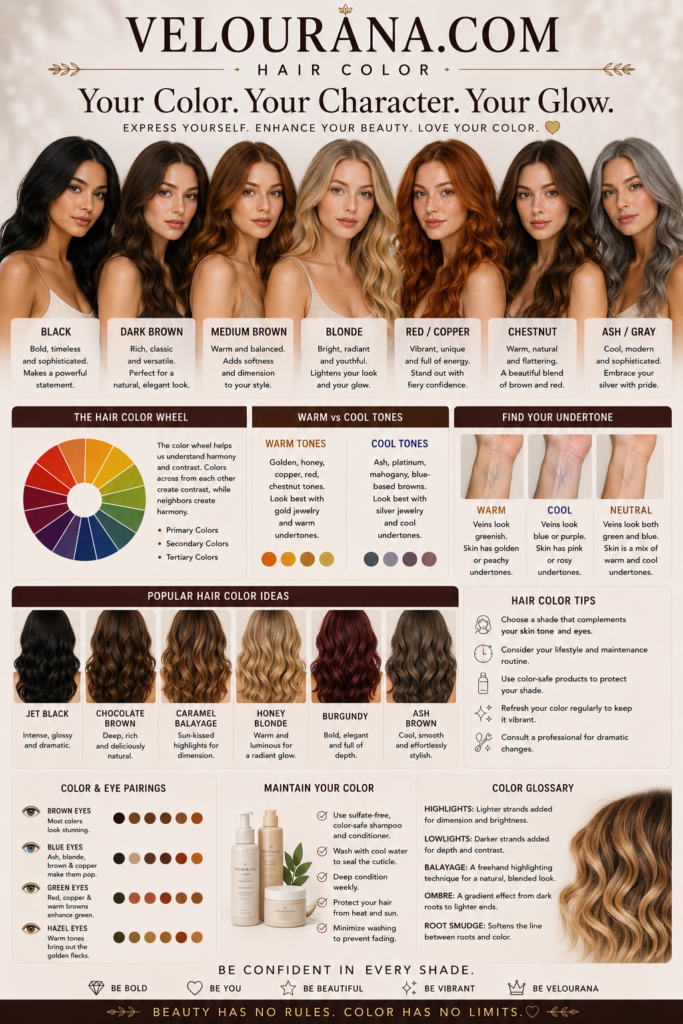
Color theory provides a useful framework. Opposing families on the color wheel can neutralize one another: blue counteracts orange, violet counteracts yellow, and green can counteract red. In actual hair formulation, however, neutralization is rarely as simple as adding the theoretical opposite color. Concentration, depth, pigment density, starting level, porosity, and desired finish all matter.
Over-neutralization can create a result that appears flat, smoky, muddy, or darker than expected. Insufficient neutralization can leave unwanted warmth. The goal is usually balance rather than the complete elimination of every warm molecule.
Warmth itself is not a defect. Golden brunettes, copper shades, auburns, chestnuts, warm chocolates, and many dimensional blondes depend on controlled warmth for their richness. Problems arise when the warmth that emerges is different from the warmth that was intended.
Permanent red shades illustrate the complexity especially well. Red artificial pigments can produce extraordinarily vivid results, yet red tones are also notorious for losing visible intensity. The hair remains permanently colored, but the brilliance of the red may fade substantially between applications. Maintenance products and periodic tonal refreshes can therefore be important even though the original service used permanent color.
Cool shades have their own maintenance challenges. As artificial cool pigments gradually diminish, underlying warm pigments can become more apparent. The result may be described as brassiness even though the permanent color has not somehow disappeared completely.
The finished shade should consequently be viewed as a dynamic color environment. Permanent chemistry establishes the transformation; maintenance protects its visual balance.
Hair Condition Is Part of Color Theory
Color cannot be separated from the physical condition of the fiber carrying it. Porosity, previous chemical treatments, heat damage, weathering, mechanical wear, and repeated coloring can all influence how permanent color penetrates and how the finished shade appears.
Porous hair can absorb color rapidly, particularly through damaged ends. This may sound advantageous, but excessive porosity can produce uneven or unpredictable results. Highly porous areas may become darker than intended, grab cool pigments disproportionately, or lose color quickly afterward because the compromised structure does not retain the finished result in the same way healthier hair does.
Less porous or resistant hair can present the opposite challenge. Pigment penetration may be slower or less uniform, especially in resistant gray areas.
This is why an even application of one formula does not guarantee an even result when the hair itself is uneven.
Repeated permanent coloring also has cumulative consequences. Oxidative processes alter the hair, and repeatedly treating already-processed sections can contribute to dryness, roughness, reduced elasticity, and breakage risk. The severity varies enormously according to the starting condition, formulation, developer strength, frequency, overlapping, accompanying lightening services, and daily care.
The objective should not simply be to make permanent color “gentle.” Permanent color works because it creates chemical change. A more realistic goal is to use the amount of chemical intervention necessary for the intended result while avoiding unnecessary repetition.
This is where application strategy becomes as important as formula selection. If the roots require permanent color but the lengths merely need renewed shine, using identical chemistry everywhere may be excessive. Treating different zones according to their actual needs can produce better color while reducing avoidable processing.
A strand test becomes particularly valuable when hair has an uncertain history, substantial damage, multiple layers of artificial pigment, henna or other plant-based colorants, previous bleaching, chemical straightening, or other treatments that may alter predictability. It allows a small section to reveal how the hair responds before the entire head is committed.
An allergy alert test according to the product manufacturer’s instructions is a different precaution and should not be confused with a strand test. Oxidative hair-color ingredients can cause allergic reactions, including potentially serious reactions, and previous uneventful coloring does not guarantee that a future exposure will be problem-free. Manufacturer safety instructions should therefore be treated as essential rather than optional.
Why Root Maintenance Requires Restraint
One of the most common long-term mistakes in permanent coloring is treating every maintenance appointment as though the entire head were virgin hair.
Once permanent color has been established, new growth and previously colored hair have fundamentally different needs. The roots contain new natural hair. The lengths contain a chemical and pigment history. Applying fresh permanent color indiscriminately from roots to ends at every retouch can gradually create darker ends, excessive pigment accumulation, reduced translucency, and unnecessary structural stress.
This is especially visible with brunette and dark shades. Repeated overlapping can cause the lower lengths to become progressively deeper even when the same nominal shade is used each time. The ends may eventually look nearly black or unusually dense compared with the fresher root color.
Porous hair can intensify the effect because damaged areas may absorb artificial pigment aggressively.
Professional maintenance often treats regrowth and lengths as separate problems. The root formula is designed to accomplish the necessary lift, deposit, or gray coverage on virgin growth. The lengths are evaluated independently. They may require nothing at all, or they may benefit from a tonal gloss, demi-permanent refresh, or another approach selected according to their condition.
This zonal way of thinking transforms permanent coloring from repetitive full-head processing into controlled maintenance.
It also helps preserve dimension. Natural-looking hair rarely consists of one perfectly opaque block of color. Light interacts differently with roots, mid-lengths, and ends, and subtle variations create movement. Excessive pigment buildup can suppress that variation and make even technically even color appear visually heavy.
Good permanent color maintenance therefore involves knowing when not to recolor.
Fading Does Not Mean the Color Was Not Permanent
The apparent contradiction between “permanent” hair color and fading causes considerable confusion.
Permanent refers primarily to the lasting chemical alteration of the treated hair. It does not promise permanent visual intensity. Hair is exposed continuously to water, surfactants, ultraviolet radiation, heat, oxidation, environmental pollutants, minerals, styling products, and physical abrasion. Artificial color exists within a material that is itself gradually weathering.
Frequent washing can accelerate visible fading, particularly with strong cleansing formulas. Very hot water can contribute to a rougher-feeling hair surface and is rarely beneficial for color longevity. Repeated high-temperature styling can affect both condition and appearance. Sun exposure can alter artificial and natural pigments. Chlorinated or mineral-rich water can influence tone, especially on lighter or porous hair.
Different color families also age differently. Reds may lose vibrancy rapidly. Cool brunettes can become warmer. Blondes may reveal yellow or golden undertones. Dark shades can soften or become less reflective.
Color-care products cannot prevent every change, but they can help preserve the cosmetic environment around the color. A shampoo appropriate for color-treated hair, adequate conditioning, thoughtful heat styling, and protection from intense environmental exposure can reduce unnecessary stress.
The condition of the cuticle matters because shine strongly influences how color is perceived. Smooth, well-conditioned hair reflects light more evenly and often makes the same pigment appear richer and more polished. Rough, dehydrated hair scatters light and can make color appear dull even when substantial pigment remains.
Maintaining permanent color is therefore partly about maintaining pigment and partly about maintaining the optical quality of the hair.
Permanent Color as a Long-Term Beauty Decision
Permanent color can create transformations that are difficult to achieve with less committed formulas, but its strength is also the reason it deserves planning.
Choosing a shade far from the natural level can establish a recurring maintenance obligation. Dramatic gray coverage creates visible regrowth. Very dark permanent color can be difficult to remove cleanly later. Significant lightening may expose warmth and affect condition. Repeated changes of direction—from dark to light, warm to cool, red to blonde—can progressively complicate the color history.
The most sustainable permanent-color strategy is often one that considers not only the desired appearance today but the likely appearance six months later.
Someone who enjoys frequent dramatic changes may benefit from avoiding unnecessarily deep permanent pigment when a less permanent approach could achieve the immediate effect. Someone committed to consistent gray coverage may find permanent color exceptionally practical. A person wanting subtle tonal enhancement without significant lift may discover that demi-permanent color better matches the objective.
Permanent color is not inherently superior to temporary, semi-permanent, or demi-permanent color. Each belongs to a different type of beauty decision.
What permanent color offers is power: the ability to alter natural pigment, create durable artificial color, provide substantial gray coverage, and establish shades that become part of the hair until it grows away. Used thoughtfully, that power can produce sophisticated, predictable, highly personalized results.
The most beautiful permanent color rarely comes from pursuing permanence alone. It comes from understanding the starting canvas, respecting the chemistry, controlling the tonal direction, preserving the fiber, and maintaining only what genuinely needs maintenance.
When those principles work together, permanent hair color becomes more than a shade change. It becomes an evolving collaboration between color science and personal style.
THE END VELOURANA
 Discover More From Our Family of Websites
 ZodiacBearing (Astrology, Tarot, Numerology, Angel Numbers & Spiritual Guidance)
 Velourana (Beauty, Makeup, Hair Care, Skincare & Beauty Tips)
 HavenBearing (Home, Living, Organization, Décor & Everyday Inspiration)
 PawBearing (Pet Care, Dog Breeds, Animal Health, Training & Pet Products)
 PsyCatherine (Notes From the Journal of a Psychologist on Real Life)