
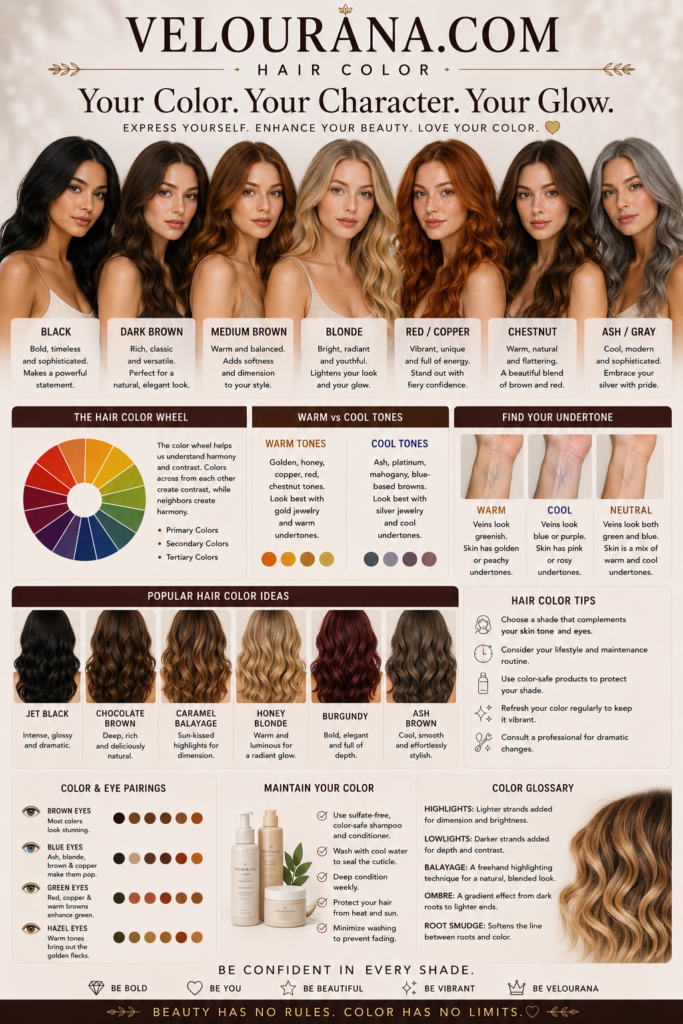
CATEGORY: Highlights
Highlights are among the most recognizable forms of hair color, yet the technique is far more sophisticated than simply making selected strands lighter. Well-designed highlights alter the way light moves through the hair. They can make a haircut appear more dimensional, emphasize movement, soften a solid base color, brighten the complexion, create the impression of greater density, or completely reshape the visual balance of the hair without requiring an all-over color transformation.
The essential principle is contrast. A highlighted strand becomes visible because it differs from the surrounding hair, but the character of that difference can vary enormously. The contrast may be barely perceptible, producing a veil of brightness that seems to emerge naturally from the base. It may be stronger and more deliberate, creating ribbons of light that remain visible even when the hair is moving. The placement can be concentrated around the face, dispersed through the crown, carried through the lengths, or strategically positioned to support the architecture of a haircut.
This flexibility explains why highlights have remained relevant through decades of changing hair-color trends. The appearance has evolved considerably, from highly uniform patterns to contemporary techniques that favor customized placement and multidimensional results, but the underlying idea remains powerful: preserving areas of depth while introducing controlled brightness.
Highlights Are a Study in Contrast, Not Simply Lightness
The first misconception about highlights is that their success depends primarily on how light they become. In reality, the final level of brightness is only one element of the design. A pale blonde highlight against a very dark base produces an entirely different visual effect from the same pale blonde placed through medium blonde hair. The color of the highlighted strand has not changed, but its relationship with the surrounding hair has.
This relationship determines whether highlights appear soft, dramatic, blended, graphic, warm, cool, expensive, naturalistic, or intentionally artificial. Contrast gives the technique its personality.
A colorist therefore considers both the destination and the starting point. The natural or existing base establishes the visual background. The highlighted pieces become the illuminated areas within that background, while untouched or deliberately darkened sections preserve shadow. Without those shadows, brightness can lose much of its impact. Hair that becomes uniformly light may be beautiful, but it no longer possesses the same dimensional quality created by a deliberate interplay between light and dark.
This is why sophisticated highlighting frequently involves restraint. Leaving certain areas untouched is not unfinished work. Those darker areas can provide the visual structure that allows lighter pieces to become meaningful.
The width of the highlighted sections matters as much as their level. Very fine sections can disperse brightness throughout the hair, reducing obvious separation between the base and the lighter color. Broader sections create more visible ribbons. When these larger pieces are strategically positioned rather than repeated mechanically, they can produce dramatic dimension without making the entire head appear uniformly lightened.
Spacing changes the result again. Closely positioned highlights can visually merge, creating an overall brighter impression. Greater spacing allows the base color to remain visible between the lighter sections, increasing depth and making individual pieces more distinct.
The modern interpretation of highlights therefore treats the hair almost architecturally. Brightness is placed where illumination is desirable; depth is preserved where structure is needed.
Placement Determines How the Eye Reads the Hair
Hair color is experienced in motion and from multiple angles. A highlight pattern that looks balanced when the hair is lying flat must also function when the hair is tucked behind the ear, lifted into a ponytail, parted differently, curled, or allowed to move naturally.
Placement is what allows highlights to respond to these changes.
Around the face, lighter sections can create immediate visual brightness. Because these pieces sit close to the skin, they have disproportionate influence over the overall impression of the color. A relatively small amount of strategically positioned lightness near the hairline can make the entire hairstyle appear brighter even when much of the interior remains close to the original base.
The crown behaves differently. Highlights positioned through the upper layers are highly visible because they interact directly with overhead light. Too much uniform brightness in this area can flatten dimension, particularly when the underlying base disappears almost completely. Preserving subtle intervals of depth can prevent the surface from becoming visually monotonous.
The sides and interior provide opportunities to create movement. When lighter sections emerge intermittently through darker hair, the color changes as the hair moves. This effect becomes particularly noticeable in layered cuts, waves, curls, and styles with significant internal movement.
The ends require another kind of judgment. Hair naturally accumulates environmental exposure and previous chemical history toward the lengths, so the ends may already be lighter, warmer, more porous, or more fragile than the roots. Extending every highlight uniformly through previously lightened ends can create unnecessary stress and may produce excessive brightness. Contemporary highlighting often respects this history, refreshing only the areas that require additional lightening.
A skilled pattern therefore does not treat every centimeter of hair identically. It responds to visibility, movement, existing color, density, condition, and the desired final silhouette.
Fine Highlights, Ribbons, and the Changing Language of Dimension
Highlights can range from almost imperceptibly fine strands to broad, deliberate panels of brightness. Neither extreme is inherently more sophisticated. The quality of the result depends on whether the scale of the highlight supports the desired visual effect.
Fine highlights are particularly effective when the objective is diffusion. Because numerous narrow pieces distribute brightness over a larger area, the transition between light and dark can become extremely subtle. On some bases, this creates the impression that the hair itself is naturally lighter rather than obviously highlighted.
This approach can be especially useful when blending early gray hair, softening a relatively solid natural color, or introducing brightness without creating conspicuous ribbons. Fine highlighting can also build considerable overall lightness when sections are densely placed, demonstrating that delicate section size does not necessarily mean a subtle final transformation.
Broader highlights operate differently. Their strength lies in visibility. A wider ribbon can follow the curve of a wave, illuminate a face-framing layer, or create a strong vertical line through long hair. The surrounding depth becomes especially important because the eye needs contrast in order to appreciate the shape of the lighter section.
Modern color design often combines different scales rather than committing to a single section size throughout the entire head. Finer pieces near certain transitions can provide softness, while broader sections create emphasis where movement or brightness is desired.
This variation helps eliminate the repetitive appearance associated with overly standardized highlighting patterns. Natural hair does not lighten in perfectly identical stripes, and contemporary color often borrows from that irregularity even when the final result is more polished than anything produced by sunlight alone.
The concept of a highlight has consequently expanded. It no longer implies one particular width, placement pattern, or degree of brightness. It describes a family of techniques organized around selective lightening and dimensional contrast.
Foils, Saturation, and Controlled Lightening
Foil highlighting remains important because it offers significant control over sectioning, product placement, and processing. By isolating selected strands, a colorist can create deliberate patterns and maintain separation between lightened and unlightened hair.
The foil itself does not determine whether the finished result will appear traditional or modern. That depends on how the sections are selected, how close the lightener is positioned to the scalp, how densely the highlights are distributed, how the transition is softened, and how the finished color is refined.
Saturation is particularly important. Hair must receive appropriate and sufficiently even product coverage for predictable lightening. Incomplete saturation can produce uneven areas, while excessive or careless application can compromise precision and potentially increase unnecessary exposure of already-lightened hair.
The starting color also influences what can realistically be achieved. Hair contains underlying warm pigments that become increasingly visible as darker natural pigment is removed. Dark brown hair does not simply travel directly toward pale blonde. During lightening, warmer red, orange, gold, and yellow stages may become visible depending on the starting depth and degree of lift.
This is normal color chemistry rather than evidence that something has automatically gone wrong.
The challenge is deciding how far the hair should be lightened for the intended result and whether the fiber can tolerate that degree of processing. A caramel highlight does not require the same destination as an icy pale blonde highlight. Attempting to push every highlight toward maximum lightness can be unnecessary and potentially damaging.
The most successful result is therefore not always the lightest achievable result. It is the level that supports the desired color while respecting the condition and history of the hair.
Previously colored hair introduces further complexity because artificial pigment behaves differently from untouched natural pigment. Dark permanent color, repeated box dye, old highlights, overlapping lightener, henna or other color history can significantly affect predictability. Two strands that appear visually similar before the service may respond differently because their internal chemical histories are different.
This is one reason professional highlighting begins long before the first foil is placed. Assessment is part of the technique.
Tone Gives Highlights Their Emotional Character
Lightening creates the foundation of a highlight, but tone determines much of its finished personality.
Two heads of hair can be lifted to similar levels and still look entirely different after tonal refinement. One may appear creamy and softly warm; another may look beige and restrained; another may carry a cooler pearl or ash impression. Gold can make the color feel luminous and sunlit, while more neutralized finishes can create a quieter, polished effect.
Toning should not be understood simply as eliminating warmth. Warmth is not inherently undesirable. In many highlight designs, it is essential.
The objective is harmony. The appropriate tonal direction depends on the base color, the desired contrast, the level achieved during lightening, the complexion, and the visual identity of the finished look. Excessive neutralization can make certain colors appear dull or disconnected from the base, just as uncontrolled warmth can create a brassier result than intended.
The base itself contributes to tonal perception. A beige highlight surrounded by deep brunette hair may appear considerably brighter and cooler than the same beige tone dispersed through dark blonde hair. Color is relational, and the eye constantly compares neighboring shades.
Root areas also influence the result. Some highlighting designs maintain a brighter connection close to the scalp, producing a fresh and intentionally luminous finish. Others introduce a softer transition at the root, allowing the highlights to emerge more gradually from the base.
Neither approach is universally superior. They simply create different visual rhythms and different experiences during regrowth.
Hair Texture Changes the Appearance of Every Highlight
The same highlighting pattern does not look identical on straight, wavy, curly, and coily hair because texture changes how individual colored sections are displayed.
Straight hair reveals placement with considerable clarity. Lines, spacing, and transitions are relatively easy to see, particularly on sleek surfaces. This makes precision extremely important because repetitive or uneven patterns can become conspicuous.
Wavy hair introduces movement that can soften transitions and amplify dimensional contrast. Highlights may disappear into a bend and reappear as the wave changes direction, creating a flickering interaction between light and shadow.
Curly hair presents another visual environment. A highlighted section may travel around the circumference of a curl, meaning its visibility changes continuously. Strategic placement can illuminate the shape of individual curls or clusters rather than simply producing vertical brightness.
Coily textures can create extraordinary dimensional effects because light interacts with numerous curves and directional changes. However, the condition and resilience of the hair remain central considerations. Highly textured hair can be perfectly suitable for highlighting, but chemical lightening should always be approached according to the actual condition of the fiber rather than assumptions based solely on curl pattern.
Density also matters. On very dense hair, highlights limited to the surface may produce brightness when the hair is stationary but disappear when the hair separates. Internal placement can create a more dimensional result throughout the full body of the style.
Fine or lower-density hair may require a different strategy. Excessive contrast or aggressive lightening can sometimes make separation between strands more noticeable. Carefully distributed brightness can instead create visual movement while maintaining a sense of fullness.
Highlight design is therefore inseparable from the physical behavior of the hair.
Regrowth Is Part of the Design
A beautiful highlight should not be evaluated only on the day it is created. Hair grows, toner gradually changes, environmental exposure affects the lengths, and the contrast between the natural root and previously lightened sections becomes increasingly visible.
The way highlights grow out depends heavily on their original placement.
A dense pattern beginning very close to the scalp can produce immediate brightness but may create a more noticeable regrowth line. Softer placement or greater preservation of the natural base can make the transition less obvious over time.
This does not mean that low-maintenance color must always be subtle. Strong ribbons can grow out attractively when their placement has been designed to coexist with the natural root. Maintenance is determined by transition as much as by brightness.
Tonal maintenance follows a different timeline from structural highlighting. The lightened strands themselves do not revert to their original color, but the refined tone placed over them can gradually fade or shift. Water quality, ultraviolet exposure, cleansing frequency, heat styling, product residue, and the porosity of the hair all influence this evolution.
As toner fades, underlying warmth may become more visible. This does not necessarily mean the highlights require another full lightening service. Sometimes the structural brightness remains exactly where it should be and only the tonal finish requires adjustment.
Understanding this distinction can prevent unnecessary repeated lightening.
Condition Is the Limit That Good Color Respects
Highlights depend on controlled chemical alteration of the hair fiber. That reality should remain visible within any serious discussion of the technique.
Lightening affects the structure of hair, and the degree of stress depends on numerous variables including the strength and formulation of the product, processing conditions, existing damage, previous chemical services, natural fiber characteristics, and the degree of lift required.
Healthy-looking color therefore begins with realistic expectations.
Hair that has already undergone repeated bleaching may not be an appropriate candidate for another aggressive lightening session simply because a lighter photograph is aesthetically desirable. Previously compromised ends may require protection from overlap, while some areas may need to remain untouched.
The visual design can often be adapted. Brightness can be redirected toward healthier sections. Existing lightness can be incorporated rather than repeatedly processed. Tonal adjustments can alter the impression of the color without demanding additional lift everywhere.
This is where technical restraint becomes part of artistry.
The purpose of highlights is not to prove how much pigment can be removed from the hair. It is to create a controlled relationship between brightness, depth, tone, movement, and condition.
When those elements remain balanced, highlights can transform the appearance of hair while preserving something equally valuable: dimensional integrity.
The Enduring Appeal of Highlights
Hair-color trends continually rename and reinterpret forms of selective lightening, but highlights remain at the foundation of dimensional color because the underlying visual principle is timeless.
Human vision responds strongly to contrast. Light areas advance visually while darker areas create depth. Applied thoughtfully to hair, this relationship can emphasize movement, contour the face, reveal layers, soften a base shade, or create dramatic ribbons that change appearance from one angle to another.
The contemporary highlight is not a fixed pattern. It can be nearly invisible or unapologetically bold. It can be cool, warm, neutral, delicate, dense, scattered, face-focused, or distributed throughout the entire hairstyle.
What separates sophisticated highlighting from mechanical lightening is intention.
Every lighter section has a relationship with the hair around it. Every preserved area of depth contributes to the brightness of its neighbor. Every tonal decision changes how the contrast is perceived. Every section interacts with texture, movement, density, and the architecture of the haircut.
Highlights are therefore not simply pieces of blonde inside darker hair. They are a method of designing illumination.
When the placement is considered, the tone is harmonious, the degree of lightening is appropriate, and the integrity of the hair remains central to the process, highlights become one of the most versatile tools in modern hair color: a controlled way of turning light itself into part of the hairstyle.
THE END VELOURANA
 Discover More From Our Family of Websites
 ZodiacBearing (Astrology, Tarot, Numerology, Angel Numbers & Spiritual Guidance)
 Velourana (Beauty, Makeup, Hair Care, Skincare & Beauty Tips)
 HavenBearing (Home, Living, Organization, Décor & Everyday Inspiration)
 PawBearing (Pet Care, Dog Breeds, Animal Health, Training & Pet Products)
 PsyCatherine (Notes From the Journal of a Psychologist on Real Life)

