
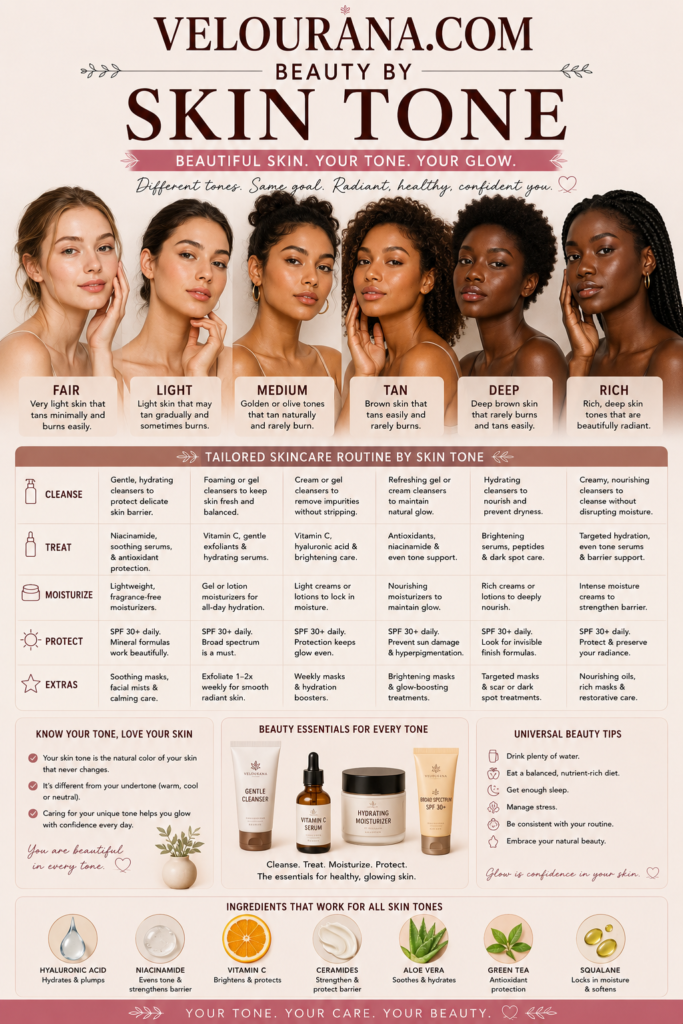
CATEGORY: Deep Skin Makeup
Makeup becomes most successful when it understands the complexion rather than attempting to overpower it. This principle is especially important with deep skin, where richly concentrated melanin creates extraordinary interactions between color and light. Products that seem straightforward in packaging can transform once they meet the skin. Brown can become redder. Gold can appear brighter. Pale pigments can become dramatically more noticeable. Sheer colors may disappear, while highly saturated shades can unexpectedly produce the most natural-looking result.
These effects are not complications to overcome. They are part of what makes makeup on deep complexions so visually interesting.
The essential task is learning how depth, undertone, pigmentation, texture, and finish work together. Once these relationships are understood, makeup becomes less dependent on rigid rules. The wearer can move comfortably between barely there complexion makeup, classic polished beauty, vivid color, or highly dramatic editorial styles.
Deep skin does not demand one particular palette or technique. It demands products capable of respecting its depth.
The Complexion Is a Landscape, Not a Single Shade
Looking closely at any face reveals variation.
On deep skin, these differences can be particularly beautiful and sometimes particularly pronounced. The forehead may appear deeper than the center of the face. The cheeks may carry warmth that is less visible along the jaw. The skin around the mouth may naturally contain additional pigmentation. The neck can differ from both the face and chest.
Traditional complexion makeup sometimes treats these variations as imperfections that should be completely eliminated. Yet covering everything with one opaque shade can create a less natural result than allowing some variation to remain.
A sophisticated base begins by deciding what actually needs coverage.
If the majority of the complexion is even, foundation can be concentrated where greater uniformity is desired. If pigmentation is more noticeable in certain areas, concealer or corrector can address those areas individually. This avoids placing unnecessary layers over skin that already looks balanced.
The result maintains dimensionality.
This is particularly valuable with deep skin because a single heavy foundation shade can sometimes create a visually flat surface. Natural variation gives the face structure before bronzer, blush, contour, or highlighter is even introduced.
Finding Foundation Beyond the Shade Number
Foundation ranges have expanded considerably, but the existence of darker shades does not automatically guarantee an accurate match.
Depth is only the first variable.
Undertone determines whether the foundation belongs visually to the complexion. Deep skin can contain golden, neutral, red, cool, olive, or mixed undertones. Some people do not fit comfortably into one conventional category because different areas of the face reveal different qualities.
A foundation described as warm may contain strong yellow pigment. Another brand may define warmth through red or orange. Consequently, labels can be useful starting points but should not replace observation.
Testing along the jaw provides valuable information because the foundation can be viewed against both the face and neck. A successful shade should create continuity rather than an obvious boundary.
The product should also be allowed to dry.
Some foundations deepen or shift in tone after application. A shade that initially appears ideal may become warmer, redder, or darker after several minutes.
Natural daylight remains one of the clearest environments for judging the final result. Bathroom lighting and warm indoor lamps can conceal differences that become obvious outdoors.
The objective is not mathematical perfection. Human skin is too complex for that. The goal is visual harmony.
Skin Preparation Determines How Color Behaves
Foundation matching receives enormous attention, yet preparation can change the appearance of the same foundation dramatically.
Dry skin reflects light differently from hydrated skin. Flaking or rough texture can catch pigment, making certain areas appear lighter or heavier. Excessive oil can break foundation apart and create uneven reflection. Residue from skincare or sun protection can also alter the finish.
For deep complexions, pale residue deserves particular attention because it can create a muted or gray appearance beneath makeup.
A well-prepared surface allows complexion products to behave closer to their intended color.
Moisture should support comfort without leaving an unstable layer. Primer, when used, should address a specific need such as smoothing, hydration, grip, or oil control rather than simply adding another product.
Allowing skincare to settle before foundation can also improve consistency.
The smoother the transition between skincare and cosmetics, the less makeup needs to compensate for the surface beneath it.
Correcting Pigmentation Without Erasing Character
Natural pigmentation around the mouth, eyes, forehead, or other areas is common across many complexions. Whether it should be corrected depends entirely on the desired makeup result.
For sheer everyday makeup, leaving some variation visible can look exceptionally natural.
When a more uniform finish is desired, targeted correction is generally more effective than applying increasingly heavy foundation.
Deeper discoloration can sometimes create a gray appearance beneath complexion products. This occurs because the foundation is mixing visually with the pigmentation underneath. A corrective tone can help neutralize that effect before coverage is added.
Orange and red-orange correctors are often associated with deeper skin, but they should not be applied automatically or excessively. The appropriate intensity depends on both complexion depth and the color of the area being neutralized.
Corrector should disappear into the completed complexion.
If a bright orange layer remains visible beneath foundation, too much product may have been used or the corrective shade may be stronger than necessary.
Precision creates a more refined result than blanket correction.
Concealer Should Serve a Defined Purpose
Concealer can perform several different functions, and confusion between them often creates unnatural contrast.
A concealer used for blemishes or localized pigmentation should generally resemble the surrounding skin closely. Its purpose is concealment, so the corrected area should disappear.
Under-eye concealer may require a different approach. If discoloration is present, correction and coverage may be necessary. If the objective is brightness, a subtly lighter shade can create lift and dimension.
The difference between subtle and extreme brightening is particularly important on deep skin.
Very pale concealer can create an intensely highlighted center of the face that dominates the entire makeup look. This may be intentional for certain styles, but it is not necessary for dimension.
A smaller difference between foundation and concealer often creates a more sophisticated transition.
Brightening can also be achieved through placement rather than dramatic color contrast. Concentrating concealer near the inner under-eye area, for example, can introduce light while leaving the outer face naturally deeper.
The most convincing complexion makeup uses brightness strategically rather than uniformly.
The Relationship Between Powder and Rich Complexion Depth
Powder is one of the products most capable of changing deep-skin makeup after the foundation has already been perfected.
A powder that contains a pale base may reduce the richness of the complexion. Under ordinary lighting the effect can appear only slightly dull, while flash photography can reveal a much more obvious cast.
For this reason, the word translucent should be treated cautiously.
True transparency is determined on the skin, not by the product description.
Tinted powders created in deeper golden, neutral, or brown tones can sometimes integrate more naturally. Completely transparent formulas can also work when their particles do not leave visible residue.
Application quantity matters just as much.
Modern makeup rarely requires a heavy powder layer across every area of the face. Strategic setting can control movement beneath the eyes, around the mouth, or through oil-prone areas while preserving luminosity elsewhere.
This produces contrast between softly matte and naturally radiant zones, which helps the complexion maintain dimension.
Powder should stabilize makeup without becoming its most visible component.
Blush Becomes More Natural When the Pigment Is Strong Enough
It can seem counterintuitive that vivid blush often produces a more believable effect on deep skin than pale blush.
The explanation lies in saturation.
A light, dusty pink may contain insufficient pigment to remain distinct against a deep complexion. Repeated application can then create visible powder without delivering convincing color. A richer berry, coral, terracotta, plum, burnt orange, deep rose, or red-based blush may require only a small amount to create a clear yet natural flush.
The intensity can be controlled through application.
A strongly pigmented product does not automatically produce strong makeup. A lightly loaded brush and gradual blending can create extremely subtle color.
Cream blush offers another possibility. Because it merges with the complexion base, the color can appear to emerge from the skin rather than rest above it. Liquid formulas can create similarly seamless effects, particularly when applied sparingly.
Powder blush provides greater control for those who prefer a set complexion and can increase longevity.
Color and texture should ultimately support each other.
A beautiful shade loses its impact if its base turns chalky. A seamless formula cannot compensate for a color that disappears completely.
Blush Placement Changes the Mood of the Face
Color placement influences facial structure without requiring formal contouring.
Blush positioned toward the center of the cheeks creates softness. Extending it upward toward the temples emphasizes lift and can visually lengthen the cheek area. Color concentrated higher on the cheekbones creates a more sculpted impression.
Deep skin can carry these placements particularly well because rich blush tones can be diffused gradually into the complexion.
The edges matter more than the center.
A concentrated center gives the blush its identity, while softly blended edges prevent the color from appearing disconnected from the skin.
For monochromatic makeup, related tones can be repeated across cheeks, eyes, and lips. A terracotta blush might connect with warm brown eyeshadow and a brown-red lip. Berry cheeks can correspond with plum or wine accents elsewhere.
The colors do not need to match exactly. Their undertones simply need enough relationship to make the face feel visually coherent.
Bronzer Should Add Warmth Without Turning Orange
Bronzer is not universally defined by one warm brown shade.
On deep skin, the most successful bronzer depends on the existing undertone and complexion depth. Golden-brown, red-brown, deep neutral brown, and warm espresso tones can all function differently.
The product must first be sufficiently deep to register.
A bronzer that closely matches the foundation may add almost no dimension. One with a pale base may produce the opposite of the intended effect.
Once adequate depth is established, undertone determines realism.
Complexions with pronounced red warmth may harmonize beautifully with red-brown bronzers. Golden complexions may respond well to rich golden browns. Neutral undertones can often accommodate balanced warm browns without becoming excessively orange.
Bronzer is most convincing where warmth would naturally appear: around the outer face, through the cheek area, and wherever a subtle sun-touched effect is desired.
It should not necessarily be visible as a distinct stripe.
The best bronzing often becomes apparent only when comparing the finished face with the foundation alone. The complexion simply appears warmer, more dimensional, and more alive.
Contour Is a Different Language From Bronzer
Although bronzer and contour are sometimes applied to similar areas, they create different visual effects.
Bronzer suggests warmth.
Contour suggests shadow.
Using a strongly warm product for contour can therefore create color rather than believable depth. Neutral or slightly cool deep browns generally reproduce shadow more effectively.
The ideal contour shade should also relate to the natural complexion. Extremely dark contour can create harsh boundaries that require excessive blending, while insufficient depth may produce little visible structure.
Deep skin frequently possesses strong natural facial dimension, so contour can remain restrained.
A small amount beneath the cheekbone or around selected areas of the face may be enough. The objective should be reinforcement rather than compulsory reshaping.
This individualized approach is more effective than copying standardized contour maps because facial proportions differ enormously.
Makeup becomes more sophisticated when technique follows anatomy.
Highlighter Should Glow Without Becoming a Pale Patch
Deep skin and highlighter can create extraordinary contrast, but the base pigment of the highlighter determines whether that contrast looks luminous or disconnected.
When a very pale highlighter is applied, it may appear beautiful only at the exact angle where it reflects light. From another angle, the pale base can remain visible as a stripe.
Deeper luminous shades reduce this problem.
Rich gold, bronze, copper, warm champagne, rose bronze, and related tones can reflect strongly while remaining compatible with the complexion when not directly illuminated.
Cooler highlights can also work when deliberately chosen for cool undertones or creative makeup. The essential issue is intentionality.
The texture of the highlighter influences realism as well.
Fine luminosity creates a smoother visual transition than large reflective particles. Cream and liquid formulas can merge closely with foundation, while powder highlighters can create more concentrated brilliance.
Application does not need to cover every traditional highlighting point.
A controlled sheen along the upper cheek can be more effective than distributing reflection across the entire face.
Eye Color Can Be Quiet Without Being Pale
Neutral eye makeup for deep skin does not have to rely on light beige.
Rich browns can function as true neutrals because they create subtle contrast while remaining related to the complexion. Caramel, cocoa, chocolate, bronze, espresso, deep taupe, mahogany, and warm chestnut can produce sophisticated eye looks ranging from almost invisible definition to smoky intensity.
The difference between these shades may appear small in the palette but become significant once placed against the skin.
Metallic neutrals offer another dimension.
Bronze and copper can illuminate the eyelids without appearing disconnected. Antique gold can create stronger contrast while remaining warm. Deep champagne tones may offer a softer reflective effect than very pale champagne.
For definition, espresso and deep brown liners can provide a gentler alternative to black, while black remains highly effective when maximum contrast is desired.
The concept of neutral makeup should always be relative to the wearer rather than determined by the palest shades in a palette.
Vivid Eye Color Has Exceptional Possibilities
Deep skin provides a striking background for saturated eye makeup.
Emerald green, cobalt and sapphire blue, burgundy, violet, magenta, teal, copper, gold, and other intense pigments can appear particularly rich because the complexion provides visual depth around them.
The challenge with bright colors is often not whether they suit deep skin but whether the formula has sufficient opacity.
Sheer pastel shadows can become muted. An opaque eye base can allow their original color to remain visible. Highly pigmented formulas may need less preparation because they deliver enough color independently.
This opens a much broader range of possibilities than traditional beauty rules sometimes suggest.
Pastel, neon, metallic, smoky, monochromatic, and graphic eye makeup can all work on deep complexions.
The determining factors are product quality, color balance, and the intended aesthetic rather than arbitrary restrictions based on skin depth.
Brows and Lashes Provide Structural Balance
When complexion colors become richer, brow and lash definition helps maintain balance around the eyes.
This does not mean brows must be extremely dark or heavily sculpted.
A brow color that corresponds naturally with the hair can create structure while preserving softness. Very black brow products can sometimes appear harsher than intended unless the natural brow hair supports that depth.
Texture also influences the effect.
Fine strokes and lightly filled areas maintain natural variation, while more opaque products create graphic definition. Both can be appropriate depending on the overall makeup style.
Mascara produces a similar range of effects. Brown-black or softer tones can support understated makeup, while intense black mascara provides greater contrast and works particularly well with dramatic eyeshadow or liner.
The relationship between brows, lashes, and eye color matters more than any isolated rule.
Nude Lipstick Must Be Defined by the Wearer
Few makeup terms reveal the limitations of universal color standards as clearly as "nude lipstick."
A nude shade should relate meaningfully to the wearer's complexion and natural lip pigmentation. For deep skin, this can include cocoa, chocolate, caramel, brown-mauve, rose-brown, terracotta, cinnamon, deep peach-brown, or berry-brown tones.
A lipstick that appears medium brown in the tube may become a subtle nude once applied.
Lip liner expands the possibilities even further.
A deep brown liner can create a transition between the complexion and a lighter lipstick, preventing the center color from appearing isolated. The liner can be softly diffused inward rather than maintained as a hard outline.
This technique makes shades wearable that might otherwise appear too pale.
Natural lip pigmentation also changes the final result. Sheer formulas allow that pigmentation to influence the lipstick, while opaque products create greater uniformity.
Both effects can be beautiful.
Strong Lip Colors Gain Extraordinary Depth
Deep complexions can provide an exceptional foundation for saturated lipstick.
Red is especially versatile because undertone changes its entire personality. Blue-red can create crisp contrast. Orange-red introduces warmth. Brick and brown-red shades can appear earthy and sophisticated. Burgundy and wine create deeper drama.
Plum, violet, berry, chocolate, and intense pinks can be equally effective.
A strong lip does not require equally strong makeup elsewhere. On deep skin, a vivid lipstick paired with polished complexion makeup and minimal eyes can become highly elegant because the natural depth of the complexion provides enough visual structure to support the color.
Alternatively, strong eyes and lips can coexist when the overall look is intentionally dramatic.
The old assumption that only one feature may carry intensity is stylistic preference rather than law.
Balance can be created through finish, placement, and proportion instead of simply reducing color.
Monochromatic Makeup Can Look Exceptionally Cohesive
Using related color families across the face can create a sophisticated result on deep skin.
Warm terracotta may appear softly on the eyes, more saturated on the cheeks, and deeper on the lips. Berry tones can move from plum eyeshadow to wine blush and a muted berry lip. Bronze can connect eyelids, cheek luminosity, and warm complexion definition.
The advantage of monochromatic makeup is not exact matching.
It is continuity.
When undertones repeat subtly across different features, the face appears coordinated without looking overly designed.
Deep skin's natural richness helps prevent these looks from becoming visually flat because the complexion itself introduces variations in depth.
Texture can provide additional contrast. Matte lips can sit beside luminous cheeks. Metallic eyelids can accompany satin blush. Gloss can introduce a focal point without changing the color family.
This interplay makes monochromatic makeup far more complex than simply using one shade everywhere.
Daylight, Indoor Light, and Photography Change the Result
Makeup cannot be separated from lighting.
Deep skin may appear warmer beneath incandescent or other warm illumination and more neutral beneath cooler light. Sunlight reveals undertone and texture with remarkable clarity. Camera flash can expose reflective or pale product bases that remain unnoticed in ordinary conditions.
For important makeup, viewing the complexion in several lighting environments can reveal whether the products remain harmonious.
Foundation should maintain continuity with the neck.
Concealer should remain dimensional rather than suddenly appearing white.
Powder should not produce unexpected flashback.
Highlighter should continue to look intentional when it is not directly reflecting light.
This evaluation is particularly valuable because deeper complexions create greater contrast with pale residues. A small amount of unsuitable powder may therefore become more visible than expected.
Makeup does not need to remain visually identical under every light source, but it should continue to make sense.
Minimal Makeup Still Depends on Correct Pigment
Minimalism is sometimes mistakenly associated with pale, barely pigmented cosmetics.
On deep skin, minimal makeup often benefits from richer products applied in smaller quantities.
A deeply pigmented blush can be diffused until only a whisper of color remains. A rich brown shadow can define the eye more subtly than a pale beige that leaves visible residue. A brown lip color close to the natural lip depth can appear almost undetectable while still creating polish.
This illustrates why intensity of pigment and intensity of makeup are not the same.
Strong pigment provides control because it can be diluted through application.
Weak pigment may require repeated layering, potentially adding texture before enough color becomes visible.
The most effective minimal makeup therefore begins with products capable of showing up clearly and then uses restraint to determine the final intensity.
Full Glamour Requires the Same Principles
At the opposite end of the spectrum, full-glamour makeup still depends on the same understanding of depth and undertone.
More coverage does not eliminate the need for an accurate foundation match. Stronger highlighting still requires compatibility with the complexion. Dramatic contour should still resemble believable shadow. Intense blush needs clean blending. Metallic highlights should retain an appropriate base color.
The difference is primarily scale.
A glamorous complexion may contain greater contrast between highlighted and sculpted areas. Eye makeup may be more opaque. Lashes may provide stronger structure. Lip color may become more defined.
Yet successful glamour continues to preserve coherence.
When every feature competes independently, the makeup can feel fragmented. When colors, undertones, and finishes relate to one another, even an elaborate look can appear intentional.
Deep skin can carry substantial visual intensity, but intensity is most impressive when it remains controlled.
There Is No Need to Neutralize the Richness of Deep Skin
One of the most important changes in modern beauty is the movement away from treating deeper complexions as problems requiring correction.
The richness of deep skin is not something makeup needs to reduce.
Natural pigmentation does not always require concealment. Warmth does not automatically need neutralization. Facial depth does not require aggressive contouring. A luminous complexion does not need to be covered completely with matte powder.
Makeup can instead respond selectively.
Where greater uniformity is desired, foundation can provide it. Where brightness enhances the face, concealer can introduce it. Where color creates energy, blush can intensify it. Where natural structure deserves emphasis, bronzer or contour can reinforce it.
This creates a collaborative relationship between makeup and complexion.
The skin remains visible as an essential part of the finished look.
Deep Skin Makeup Is Ultimately About Precision Rather Than Rules
The most useful principles for deep-skin makeup are not restrictions about which colors can or cannot be worn.
They are principles of precision.
Foundation depth should relate convincingly to the face and body. Undertone should be evaluated rather than assumed. Corrector should neutralize only where necessary. Concealer should have a clear purpose. Powder should set without leaving residue. Blush should possess enough saturation to remain visible. Bronzer should genuinely add warmth. Contour should resemble shadow. Highlighter should illuminate without introducing an unintended pale base.
Eye and lip colors can then become as restrained or adventurous as desired.
Once the complexion is understood, there is remarkably little that deep skin cannot carry.
The possibilities extend from transparent skin tints and softly defined brown eyes to brilliant jewel tones, intense metallic finishes, saturated lips, sculpted glamour, and experimental editorial color.
What unites all of these approaches is not a specific aesthetic. It is respect for the complexion's existing depth.
Deep skin already contains dimension, contrast, and richness. Makeup reaches its highest potential when it works with those qualities rather than attempting to replace them.
The finished face should not look successful because the depth of the complexion has been hidden. It should look successful because every cosmetic choice has allowed that depth to become part of the design.
THE END VELOURANA
 Discover More From Our Family of Websites
 ZodiacBearing (Astrology, Tarot, Numerology, Angel Numbers & Spiritual Guidance)
 Velourana (Beauty, Makeup, Hair Care, Skincare & Beauty Tips)
 HavenBearing (Home, Living, Organization, Décor & Everyday Inspiration)
 PawBearing (Pet Care, Dog Breeds, Animal Health, Training & Pet Products)
 PsyCatherine (Notes From the Journal of a Psychologist on Real Life)

