
CATEGORY: Dark Skin Foundation
Finding an excellent foundation for dark skin begins with a deceptively simple objective: the product should look as though it belongs to the complexion. Achieving that effect, however, requires an understanding of color that goes well beyond labels such as deep, dark, warm, or cool.
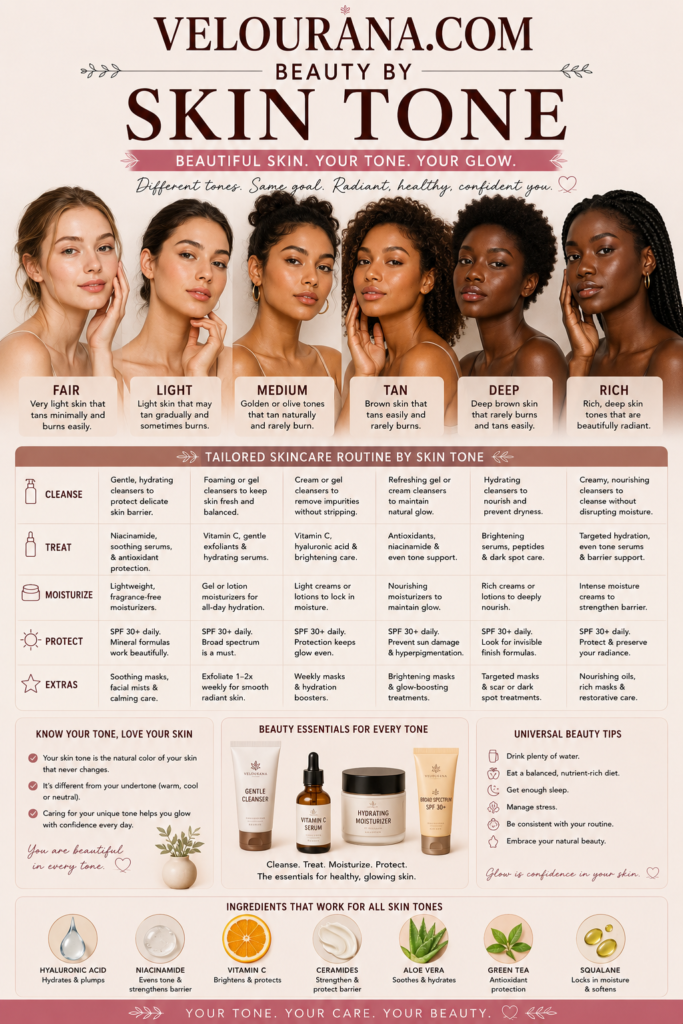
Melanated skin contains extraordinary tonal diversity. Two people can share a similar overall depth while possessing completely different undertones. One complexion may carry golden warmth, another may lean toward copper or red, another may be neutral, and another may reveal olive, blue, or violet characteristics.
The face can also contain several depths simultaneously. The forehead may be darker than the cheeks. Pigmentation around the mouth can create additional depth. The jaw, neck, and chest may each differ slightly.
Foundation therefore works best when it responds to the complexion as it actually exists rather than attempting to force the entire face into one artificial color.
The increasing availability of deeper foundation shades has transformed complexion makeup, but quantity alone does not define inclusivity. A truly useful shade range must provide meaningful variations in both depth and undertone, while formulas must perform without turning ashy, orange, excessively red, or unnaturally pale.
Understanding these relationships makes foundation selection far more precise.
Why One Deep Foundation Shade Cannot Suit Everyone
The word deep describes only relative darkness.
It says nothing about whether a complexion is golden, red, neutral, olive, or cool. It also does not describe how far into the deeper end of the complexion spectrum a person falls.
Historically, some foundation ranges offered numerous light and medium shades but only a small number of dark options. Consumers with richly melanated skin were expected to fit into a disproportionately narrow section of the range.
Even when the depth was acceptable, undertone choices could be limited.
Deep foundations were frequently formulated with strong red or orange bases. These shades could work beautifully for people who naturally possessed those undertones but looked unnatural on others.
Modern foundation development increasingly recognizes that dark skin requires a full spectrum of undertones.
A deep golden complexion needs a different pigment balance from a deep neutral complexion. Rich olive skin requires another approach. Exceptionally deep cool skin may require pigments capable of maintaining richness without turning gray.
True inclusion therefore involves color precision, not simply darkness.
Reading Undertones in Dark Skin
Undertone can be difficult to identify because surface coloration sometimes masks it.
Sun exposure, hyperpigmentation, acne marks, redness, dryness, and lighting can all affect what is immediately visible.
Instead of relying on one isolated clue, it can be useful to observe the complexion as a whole.
Warm dark skin often reveals gold, yellow, copper, peach, or warm red qualities. Cool skin may contain blue, violet, or cooler red dimensions. Neutral skin does not lean strongly toward either direction, while olive undertones can introduce muted greenish or gray-golden characteristics.
Jewelry tests and vein-color rules are sometimes suggested as shortcuts, but they are not universally reliable, particularly across deeper complexions.
Direct comparison with actual foundation pigments is often more informative.
When a foundation is placed beside the skin, an incorrect undertone can become obvious. An overly orange product appears separate from a neutral complexion. Excessive red can look ruddy. A shade without enough warmth may turn dull.
The correct foundation tends to integrate rather than announce itself.
The Importance of Saturation
Foundation color involves more than depth and undertone. Saturation also influences how alive or muted a shade appears.
Some deep complexions possess rich, saturated coloration. A foundation with insufficient pigment richness can appear gray even when its depth is approximately correct.
Other complexions are naturally more muted. Highly saturated orange or red foundations can overwhelm them.
This is one reason two shades described with the same undertone may still behave differently.
Color formulation is complex. Pigments interact, and increasing darkness without maintaining tonal balance can produce unexpected results.
For consumers, the practical lesson is straightforward: shade names are starting points rather than guarantees.
Testing the actual formula on the skin remains more valuable than relying entirely on descriptions.
Understanding Facial Color Variation
Perfectly uniform facial color is uncommon.
In dark skin, differences in pigmentation may be particularly noticeable because melanin responds strongly to genetics, friction, inflammation, and environmental exposure.
The forehead and temples may naturally appear deeper. The mouth area can contain additional pigmentation. The center of the face may be somewhat lighter.
Acne marks can create isolated areas of greater depth, while under-eye pigmentation can introduce cool or brown shadows.
Foundation application becomes more sophisticated when these variations are acknowledged rather than treated automatically as imperfections.
Some natural depth around the perimeter of the face can contribute to facial dimension. Completely covering it with a lighter central shade may produce an unnatural result.
Likewise, choosing foundation solely to match the darkest pigmentation mark can make the remainder of the face unnecessarily deep.
The foundation should generally correspond with the complexion's dominant overall color, while concealer or corrective products can address localized differences where desired.
Testing Foundation Along the Jaw
The jawline is commonly recommended for foundation testing because it allows the product to be viewed against both the face and neck.
This can be especially helpful for dark skin when facial depth differs from the neck.
Several nearby shades can be applied in narrow sections and blended slightly. The most harmonious option should integrate with the surrounding skin rather than remain visibly separate.
Immediate appearance is only part of the test.
Foundation should be allowed to settle because some formulas change after several minutes. A product that initially seems accurate may become darker or warmer.
Daylight evaluation can then reveal undertone differences that artificial lighting concealed.
When possible, examining the foundation beside the chest can also help establish overall harmony.
The objective is not necessarily an exact match to every visible area. It is a believable transition among the face, neck, and body.
When the Face Is Darker Than the Neck
Many people have a face that differs noticeably from their neck or chest.
This may occur because of sun exposure, natural pigmentation patterns, skincare habits, or other factors.
There is no universal rule requiring foundation to match the neck exactly.
If the neck is substantially lighter, choosing a foundation identical to it may make the face appear unnaturally pale. If the chest is deeper than the neck, matching only the neck can create another inconsistency.
The entire visible area should be considered.
Sometimes a foundation positioned between facial and body depth creates the most natural result. Strategic blending can then soften transitions.
Makeup should create visual coherence without requiring the natural complexion to conform to one shade.
Correcting Darkness Around the Mouth
Pigmentation around the mouth is common in darker complexions.
When foundation is applied directly over significantly deeper pigmentation, the area may remain darker or take on a gray cast, particularly if the foundation has lighter pigments.
Applying more foundation is not always the best solution.
A carefully chosen color corrector can help balance the deeper area before foundation. Warm corrective pigments are often used because they counteract blue, purple, or gray dimensions within discoloration.
The appropriate strength depends on skin depth.
A corrector that is too pale can create additional ashiness. One that is excessively bright can become difficult to conceal.
Small quantities generally work better than heavy layers.
Once corrected, foundation can be applied over the area so that it integrates with the rest of the complexion.
The aim is seamlessness rather than creating a visibly lighter mouth area.
Foundation for Hyperpigmentation
Dark marks from previous acne or inflammation can persist on melanated skin.
Full-coverage foundation can conceal these marks, but covering the entire face heavily may not be necessary when discoloration is localized.
A medium-coverage foundation can establish an even base while a high-pigment concealer addresses individual marks.
This maintains more natural skin texture and avoids unnecessary product accumulation.
Color correction can be useful for particularly deep marks, although it is optional.
Foundation cannot treat hyperpigmentation biologically. It only changes its visible appearance temporarily.
Skincare addressing pigmentation should therefore remain separate from cosmetic coverage.
Equally important, foundation application should not aggravate acne or irritation through excessive rubbing or unsuitable products.
The cosmetic objective is to create the desired finish while respecting the condition of the skin beneath it.
Foundation for Dry Dark Skin
Dryness can be especially visible on deeply pigmented skin because surface flakes may create a pale contrast against the underlying complexion.
Foundation can intensify this effect when it adheres to dry areas.
Skin preparation therefore becomes particularly important.
Gentle cleansing and appropriate moisturization can help create a smoother surface. Foundation formulas with flexible, comfortable textures may perform better than extremely drying products for individuals with dry skin.
Radiant or satin finishes can create luminosity, but finish alone does not determine hydration.
A radiant foundation can still feel uncomfortable if its formulation does not suit the skin, while some modern matte foundations remain surprisingly flexible.
Application technique also matters.
Thin layers pressed or gently blended into prepared skin can appear smoother than repeatedly rubbing product across dry areas.
Powder should be used according to need rather than automatically applied heavily across the entire face.
Foundation for Oily Dark Skin
Oily skin presents different challenges.
Sebum can cause foundation to separate, shift, become excessively reflective, or change appearance during the day.
Long-wearing and oil-controlling formulas can help, although extremely drying products may trigger discomfort.
Primer can be concentrated in areas where oil production is greatest rather than applied indiscriminately.
Powder can similarly be used strategically.
The center of the forehead, nose, and surrounding areas may require greater setting than the cheeks.
Dark skin should not automatically be heavily powdered simply because shine is visible. Natural reflection can contribute beautifully to complexion dimension.
The distinction is between intentional luminosity and unwanted breakdown of the foundation.
Combination Skin and Selective Application
Combination skin demonstrates why one uniform makeup technique is rarely ideal.
The central face may become oily while the cheeks remain normal or dry. Foundation that performs perfectly in one area may behave differently in another.
Skin preparation can therefore vary by zone.
A lighter moisturizer may be sufficient where oil is abundant, while drier areas may need more emollient support.
Powder can be concentrated selectively.
Foundation itself can also be applied more lightly where texture or dryness is present and built gradually where greater coverage is desired.
The result is often more natural than treating the entire face identically.
Dark skin retains its richness when makeup responds to the actual surface rather than imposing a single finish everywhere.
Avoiding Orange Foundation
An orange cast is one of the classic signs of an incorrect deep foundation match.
Sometimes the foundation is formulated with an undertone that is simply too warm. In other cases, oxidation makes the product increasingly orange after application.
The difference becomes especially visible beside the neck.
Trying to correct a strongly orange foundation with powder rarely produces an ideal result.
Selecting a more neutral, golden, olive, or cool formula according to the complexion is usually more effective.
Shade labels can provide guidance but should not override visual evidence.
A foundation marketed as neutral may still appear warm on a particular person because brand definitions differ.
Comparison is therefore essential.
The right undertone should support the complexion rather than coat it with an obvious layer of color.
Avoiding Gray Foundation
Grayness usually indicates a different mismatch.
The foundation may be too light, insufficiently saturated, too cool, or layered over products leaving a pale residue.
Dryness can contribute to a dull gray appearance as well.
A white-cast sunscreen underneath makeup is a common culprit. Even an accurately matched foundation may struggle to overcome a strong pale film.
Setting powder can create another layer of ashiness when it contains visible white pigment.
Solving gray foundation therefore requires examining the entire makeup base rather than foundation alone.
The moisturizer, sunscreen, primer, foundation, concealer, and powder all contribute to the final color.
When every layer respects the depth of the complexion, the finished skin remains rich rather than muted.
Sheer Foundation and Natural Skin
Sheer foundation can be particularly beautiful on dark skin because it allows natural tonal variations to remain visible.
Instead of creating a completely uniform canvas, it softens differences while preserving depth.
This approach works especially well when the wearer is comfortable allowing freckles, subtle pigmentation, or natural facial variation to show.
A skin tint can provide similar benefits.
However, sheer formulas still require appropriate undertones. Transparency does not eliminate color mismatch.
A sheer foundation that is too pale or strongly orange can still distort the complexion.
The ideal sheer formula behaves almost like a filter over the skin rather than an opaque layer.
Full Coverage Without a Mask Effect
Full coverage can create an exceptionally polished complexion when applied carefully.
The key is maintaining dimension.
A thin initial layer can be built only where additional coverage is required. This avoids unnecessary thickness.
Using foundation that genuinely matches the skin reduces the need to compensate later with bronzer or contour.
After coverage has been established, blush and subtle warmth can return natural color to the face.
Full coverage should not mean featureless coverage.
Real skin contains gradients, highlights, shadows, and variations.
Preserving some of these qualities prevents the complexion from appearing artificially flat.
Foundation Application Tools
Foundation can be applied with fingers, brushes, sponges, or combinations of techniques.
Each method produces different results depending on the formula.
Fingers provide warmth and direct control and can work particularly well with lightweight or creamy foundations.
Brushes can distribute product efficiently and offer varying levels of coverage depending on their density and shape.
Damp makeup sponges can press foundation into the skin and soften excess product, often creating a seamless finish.
No tool is universally superior for dark skin.
The important considerations are even distribution, cleanliness, and avoiding unnecessary friction.
Application should blend foundation into the complexion rather than leave obvious boundaries.
Foundation in Photography
Foundation that looks excellent in person can behave differently under photography.
Flash may reveal powder residue or products containing strongly reflective ingredients. High-definition cameras can emphasize texture that is barely noticeable in ordinary conversation.
Deep skin requires appropriate exposure to preserve both highlights and shadow detail.
Makeup should therefore be evaluated under relevant lighting when photography is important.
This does not mean applying dramatically heavier foundation.
In many cases, careful color matching and controlled setting are more valuable than additional coverage.
A complexion that retains dimension photographs more naturally than one covered with a thick, uniformly matte layer.
The Role of Foundation in a Modern Dark-Skin Beauty Routine
Foundation is no longer required to create one idealized version of perfect skin.
Modern complexion makeup can be sheer or full, matte or luminous, highly perfected or almost invisible.
For dark skin, this flexibility is particularly valuable because it allows the wearer to decide how much natural variation should remain visible.
The essential requirement is respect for the complexion's actual color.
Deep skin deserves foundation shades with sophisticated undertones, sufficient saturation, appropriate depth, and formulas that do not rely on pale pigments that create ashiness.
The best foundation does not announce itself as makeup.
It integrates with the face, relates naturally to the neck and body, supports the skin's texture, and allows the richness of melanin to remain visible.
Dark skin contains extraordinary complexity. Foundation reaches its highest level of sophistication when it works with that complexity rather than attempting to cover it away.
The End Velourana
 Discover More From Our Family of Websites
 ZodiacBearing (Astrology, Tarot, Numerology, Angel Numbers & Spiritual Guidance)
 Velourana (Beauty, Makeup, Hair Care, Skincare & Beauty Tips)
 HavenBearing (Home, Living, Organization, Décor & Everyday Inspiration)
 PawBearing (Pet Care, Dog Breeds, Animal Health, Training & Pet Products)
 PsyCatherine (Notes From the Journal of a Psychologist on Real Life)

