
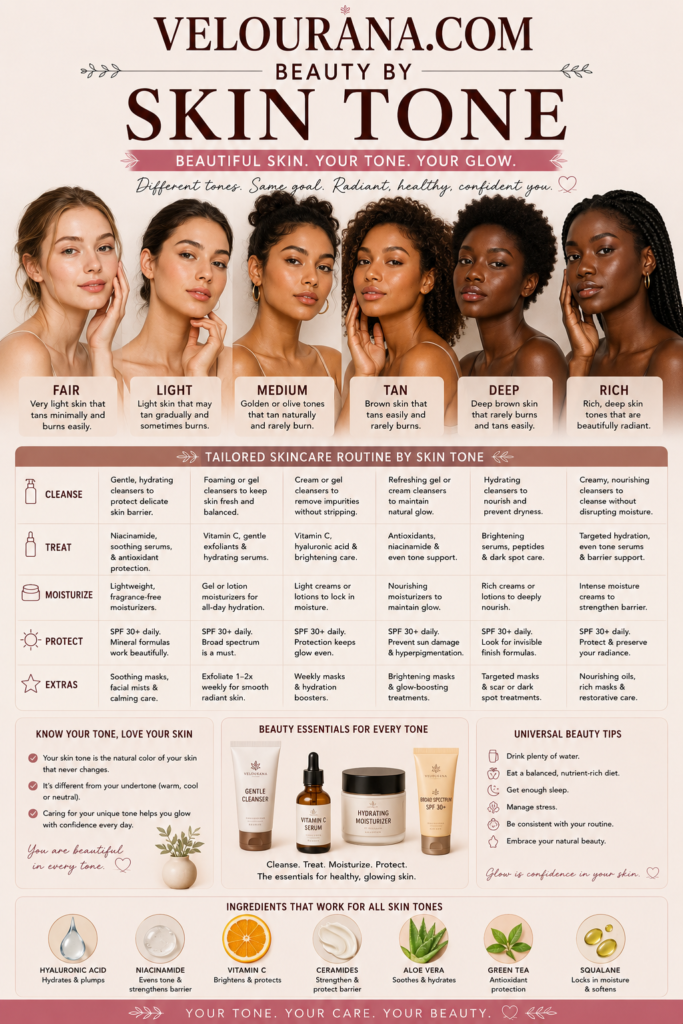
CATEGORY: Dark Skin Colors
Describing dark skin accurately requires more than selecting a word from a conventional color chart. Deeply melanated complexions possess layers of color that change with lighting, environment, circulation, hydration, and surrounding shades. A complexion that appears rich brown indoors may reveal copper warmth in sunlight. Another may seem neutral until it is placed beside a strongly golden shade, when subtle blue or olive undertones suddenly become apparent.
This complexity has major implications for beauty. Foundation matching, concealer selection, blush visibility, lipstick harmony, sunscreen finish, photography, and even the appearance of skincare products can all be influenced by the relationship between skin depth and undertone.
For decades, beauty terminology often treated dark skin as though increasing pigment depth were the only variable that mattered. Contemporary understanding is more sophisticated. Deep complexions require the same nuanced distinctions given to every other part of the skin-color spectrum—and frequently reveal even greater visual complexity because of the richness created by melanin.
Learning the color language of dark skin is therefore not about assigning every complexion a rigid label. It is about developing a more precise way of observing the interactions among depth, undertone, surface condition, pigmentation, and light.
Depth and Undertone Are Different
Skin depth describes how light or dark the complexion appears overall. Undertone describes the subtler coloration beneath that apparent depth.
Two people can possess almost identical skin depth yet require completely different foundation shades because one has a warm golden undertone and the other has a cool or neutral undertone.
This distinction becomes especially important in dark skin because poorly balanced pigments can become conspicuous. A foundation with excessive orange may look unnatural on neutral deep skin. A strongly red formula may exaggerate warmth that is not actually present. A shade that lacks sufficient warmth may appear gray or dull.
Undertones are commonly described as warm, cool, neutral, and olive, although real human complexions often exist between categories.
Warm undertones can include yellow, gold, peach, copper, or red warmth. Cool undertones may contain blue, violet, or cool red qualities. Neutral undertones balance warm and cool influences. Olive undertones may introduce greenish, muted golden, or gray-green characteristics.
These descriptions are tools rather than absolute biological classifications. Skin is more complex than a cosmetics chart, and individuals can display different tonal characteristics across different areas of the face and body.
The Remarkable Range of Deep Brown
Brown itself is an enormous color family.
Within dark skin, brown may lean golden, red, neutral, olive, violet, or nearly black. Increasing melanin concentration creates greater depth, but the resulting appearance continues to interact with undertones and reflected light.
Some complexions possess a glowing bronze character, particularly when illuminated by warm sunlight. Others appear like rich cocoa, carrying balanced brown tones without obvious yellow or red dominance. Deep mahogany complexions can contain noticeable red warmth, while espresso shades may appear more neutral or cool.
At the deepest end of the spectrum, skin may visually approach black while still revealing brown, red, blue, or violet dimensions under direct illumination.
This is why terms such as chocolate, espresso, mahogany, chestnut, ebony, and bronze appear frequently in beauty language. They attempt to communicate nuances that generic labels such as dark brown cannot capture.
However, such descriptions remain subjective. They should never replace actual shade testing when choosing complexion cosmetics.
Human skin is not manufactured pigment. It changes with blood flow, light, temperature, hydration, and natural variation.
How Light Changes Dark Skin
Light has an enormous influence on the perception of dark complexions.
Under direct sunlight, undertones may become more visible because stronger illumination reveals the reflective qualities of the skin. Golden and copper tones can appear especially luminous. Cool deep skin may reveal blue or violet dimensions that were barely noticeable indoors.
Artificial lighting can alter this perception substantially. Warm bulbs can intensify yellow and red tones. Cool fluorescent lighting can suppress warmth and make some complexions appear more neutral or gray.
Photography introduces another layer of complexity.
Camera exposure systems historically struggled with very dark subjects when scenes contained large differences between highlights and shadows. Modern cameras have vastly greater capabilities, but exposure, white balance, processing, filters, and editing still influence how accurately dark skin is represented.
Overexposure can erase tonal richness, while underexposure can remove detail from shadows. Excessive digital brightening can alter the natural complexion entirely.
Accurate representation respects depth rather than treating darkness as a photographic problem that needs to be corrected.
The same principle applies to beauty imagery. Deep skin should retain texture, dimensionality, highlights, and natural shadows instead of being artificially lightened to reveal facial features.
Surface Condition and the Appearance of Color
Skin color is influenced not only by pigment beneath the surface but also by the condition of the outermost skin layers.
When the stratum corneum is smooth and adequately hydrated, light reflects differently than it does from a rough, dry surface. This can make healthy moisturized skin appear clearer or more luminous without changing its actual melanin content.
Dryness can produce a gray or whitish cast known as ashiness. Because the contrast between pale surface flakes and deep underlying pigmentation can be significant, ashiness may appear especially noticeable on dark skin.
Moisturization can reduce this effect by supporting the barrier and smoothing the surface.
Excessive oil can change color perception in another way. Shine creates bright reflective highlights that may make certain areas look lighter in photographs or under strong illumination.
Texture, enlarged pores, acne lesions, scars, and fine lines also influence the way light travels across the face.
For this reason, the visible richness of a complexion cannot be understood through pigmentation alone. Skin health and surface condition contribute substantially to its appearance.
Natural Tonal Variation Is Normal
One of the most important principles in understanding dark skin colors is recognizing that natural variation across the face and body is expected.
The forehead may be deeper than the cheeks. The perimeter of the face can carry more pigment than the center. The area around the mouth may be darker. Eyelids often possess naturally deeper coloration.
The lips themselves can display multiple tones, sometimes with a deeper upper lip and lighter lower lip or with naturally pigmented borders.
Body coloration varies even more widely. Knees, elbows, knuckles, toes, underarms, and areas affected by friction commonly appear darker. Palms and soles are typically considerably lighter than surrounding skin.
These differences do not automatically represent a skincare problem.
The pursuit of absolute uniformity can encourage unnecessary or overly aggressive treatment. Attempting to exfoliate naturally darker areas repeatedly can cause irritation, which may trigger additional pigmentation.
Healthy skin does not need to be monochromatic.
A realistic beauty standard recognizes that dimensional coloration is part of normal human biology.
When Color Changes Become Pigmentation Concerns
Natural variation should be distinguished from acquired hyperpigmentation.
Dark skin may develop visibly deeper patches after inflammation because melanocytes respond to inflammatory signals by increasing pigment production. This process is particularly common after acne, eczema, irritation, burns, cuts, or cosmetic procedures.
Post-inflammatory hyperpigmentation can sometimes become more bothersome than the original blemish because the inflammatory lesion may disappear quickly while the pigment remains.
This makes prevention particularly valuable.
Reducing picking, avoiding unnecessary irritation, using appropriately formulated skincare, and protecting the skin from excessive sun exposure can help minimize the circumstances that encourage persistent marks.
Melasma represents another form of pigmentation characterized by patches of increased color, commonly affecting facial areas. Hormonal influences, genetics, ultraviolet exposure, and visible light can contribute.
Pigmentation concerns should be approached gradually. Stronger treatment is not automatically better, particularly when irritation itself can stimulate further pigmentation.
Maintaining the integrity of the skin barrier is therefore part of pigmentation management rather than a separate cosmetic objective.
Color Correcting on Dark Skin
Color correction demonstrates how understanding undertones can transform makeup application.
Deep hyperpigmentation may sometimes create a gray, blue, purple, or brown appearance beneath foundation or concealer. Applying a very light concealer directly over it can produce an ashy result because the underlying darkness remains visible through the pale pigment.
Warm corrective shades can help neutralize this effect before complexion makeup is applied.
The appropriate corrector depends on both skin depth and the color of the discoloration. Peach may work on some medium-deep complexions, while deeper orange, red-orange, or red-brown correction can be more suitable for richer skin depths.
The objective is not to cover the skin with bright corrective pigment. A small amount is typically used to balance the visible discoloration so that subsequent complexion products can perform more naturally.
This principle illustrates a broader truth about dark-skin makeup: pigment strength must correspond with complexion depth.
Products designed primarily around pale skin can disappear, turn chalky, or create unwanted contrast when applied to deeper complexions.
Blush, Lip and Eye Colors Against Deep Skin
Color cosmetics behave differently depending on the background against which they are viewed.
Deep skin provides a rich visual foundation that can support highly saturated colors. Berry, plum, wine, brick, terracotta, deep rose, vivid coral, and warm orange blushes can appear beautifully dimensional depending on undertone.
Pale blushes with insufficient pigment may leave a powdery film instead of recognizable color.
Lip products demonstrate the same principle. The natural pigmentation of the lips affects the final result, meaning a lipstick can look substantially different on two people even when their skin depth is similar.
Nude shades deserve particular attention. Nude does not mean beige. A nude lip is generally a shade that harmonizes with the person's complexion and natural lip coloration. On dark skin this can encompass cocoa brown, caramel, rose-brown, mauve, deep peach, terracotta, plum-brown, and many other tones.
Eye makeup can range from subtle neutrals to extraordinary saturated color. Bronze, copper, gold, burgundy, emerald, cobalt, violet, and metallic shades can create striking contrast against deep complexions.
There is no requirement that dark skin be paired only with strong colors, however. Soft neutral looks can be equally sophisticated when the formulas possess enough pigment and appropriate undertones to remain visible without becoming ashy.
Bronzer and Contour Are Not the Same
Bronzer and contour are often confused, but they perform different visual functions.
Bronzer is intended primarily to introduce warmth. On deep skin, this requires a shade that is visibly warm enough and sufficiently deep to create an effect. A product lighter than the complexion cannot realistically bronze it.
Contour mimics natural shadow and therefore tends to be more neutral or cool.
For many years, the deepest bronzer shades available were not sufficiently deep for consumers at the richest end of the complexion spectrum. The expansion of shade ranges has improved this area, although depth alone remains insufficient.
A very dark bronzer with the wrong undertone can still look unnatural.
Placement also changes the result. Bronzer can emphasize areas where warmth would naturally appear, while contour can enhance existing facial structure through carefully positioned depth.
Both should integrate with the complexion rather than appear as separate stripes of pigment.
Highlighting Without Ashiness
Highlighter is designed to interact with light, making formulation particularly important on dark skin.
Very pale or icy products can create dramatic contrast, which may be desirable for an intentional makeup look. For a natural effect, however, a highlighter that harmonizes with the complexion often creates a smoother transition.
Gold, bronze, copper, champagne-brown, rose-gold, and other richly pigmented metallic tones can complement many dark complexions, depending on undertone.
Texture matters as much as color.
Large reflective particles can emphasize skin texture, while finely milled formulas may produce a more integrated sheen. Cream and liquid formulations can create different optical effects from powders.
The goal of highlighting is not to make dark skin look lighter. It is to manipulate reflection so selected areas catch light.
When chosen thoughtfully, highlighter can emphasize the natural dimensionality already present in richly pigmented skin.
Sunscreen and the Challenge of White Cast
Few skincare issues demonstrate the importance of formulation across different skin colors as clearly as sunscreen white cast.
Some ultraviolet filters, particularly mineral particles, can leave visible residue. On light complexions the residue may be subtle. Against dark skin it can appear gray, lavender, blue-white, or chalky.
This cosmetic problem has historically created a practical barrier to sunscreen use.
Improved formulations attempt to reduce visible residue through particle technology, better dispersion, transparent textures, or tinting. Chemical sunscreen filters can also offer cosmetically transparent finishes, depending on the formulation and regulatory market.
Tinted sunscreens introduce another challenge: the tint must be deep enough and correctly balanced for the wearer.
A beige tint described as universal may work on only a narrow portion of the population.
Beauty inclusivity therefore involves formulation, not simply marketing imagery. A product intended for all skin colors must be evaluated on all skin colors.
Dark Skin and the Meaning of Radiance
Radiance is sometimes mistakenly associated with lighter skin. In reality, radiance describes the interaction between light and a healthy-looking surface, not complexion depth.
Deep skin can possess exceptional luminosity because reflected highlights contrast beautifully with rich pigmentation.
Hydration, smooth surface texture, balanced moisturization, and appropriate cosmetic products can enhance this natural dimension.
Attempts to achieve radiance through aggressive brightening can be counterproductive if they irritate the skin.
The term brightening itself can cause confusion. In responsible skincare language, brightening generally refers to improving the appearance of dullness or uneven pigmentation rather than changing a person's genetically determined skin color.
Healthy skincare should not aim to erase natural darkness.
The objective is clarity, comfort, resilience, and balanced appearance while respecting the complexion's inherent depth.
Building a More Accurate Understanding of Dark Skin Colors
The beauty industry's vocabulary continues to evolve because the older approach to complexion classification was inadequate.
A small selection of light, medium, tan, and dark categories cannot describe billions of human complexions. Even large shade ranges are useful only when the undertones within each depth have been thoughtfully developed.
True inclusivity requires recognizing that dark skin itself contains an enormous spectrum.
There are warm deep browns glowing with gold. There are copper-rich complexions carrying red warmth. There are neutral cocoa tones, muted deep olives, cool espresso shades, violet-influenced browns, and exceptionally deep complexions with blue-black dimensions.
None represents a more authentic version of dark skin than another.
They are different expressions of human pigmentation.
Understanding these differences makes beauty more precise. Consumers can choose complexion products more successfully. Makeup artists can create harmony without relying on outdated assumptions. Skincare can focus on actual concerns rather than stereotypes associated with color.
Most importantly, the language surrounding dark skin can move away from treating it as a single category at the edge of a shade chart.
Dark skin is an entire color world of its own.
Its richness emerges from melanin, but its individuality comes from the interaction of pigment, undertone, circulation, surface condition, light, and natural variation. Appreciating those dimensions allows beauty to represent deeply melanated complexions with the accuracy, sophistication, and range they deserve.
The End Velourana
 Discover More From Our Family of Websites
 ZodiacBearing (Astrology, Tarot, Numerology, Angel Numbers & Spiritual Guidance)
 Velourana (Beauty, Makeup, Hair Care, Skincare & Beauty Tips)
 HavenBearing (Home, Living, Organization, Décor & Everyday Inspiration)
 PawBearing (Pet Care, Dog Breeds, Animal Health, Training & Pet Products)
 PsyCatherine (Notes From the Journal of a Psychologist on Real Life)

