
CATEGORY: Coily Hair Styling
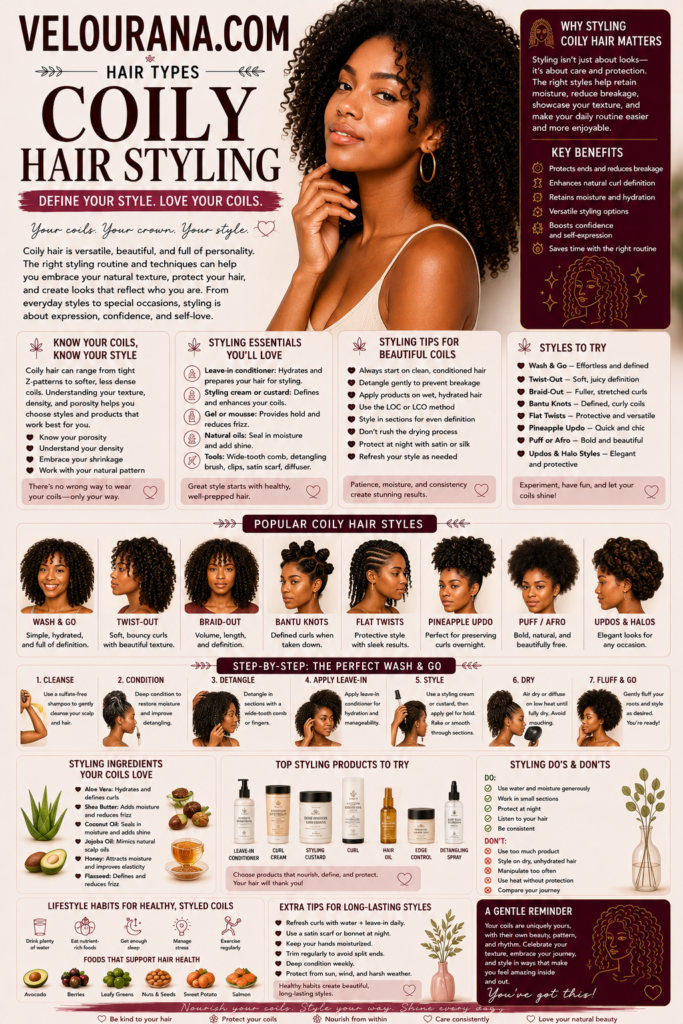
The phrase "wash-and-go" suggests simplicity. Wash the hair, apply something quickly, and leave. For many people with coily hair, however, the reality is more deliberate. A successful wash-and-go can involve careful hydration, sectioning, product distribution, clump formation, controlled drying, root manipulation and several hours during which the hair must be left largely undisturbed.
This apparent contradiction is useful because it reveals what the style actually is.
A wash-and-go is not defined by speed. It is defined by the decision to work primarily with the hair's natural coil pattern rather than imposing a different one through braids, twists, rollers or other setting techniques. The hair is encouraged to organize according to the shapes it already forms when hydrated, and styling products are used to preserve that organization as water evaporates.
This makes the wash-and-go one of the clearest demonstrations of coily hair's natural structure.
It can reveal tiny spirals that are almost invisible when the hair is dry and expanded. It can expose multiple coil patterns on the same head. It can produce compact definition, substantial volume, extraordinary shrinkage or some combination of all three. It can also expose the limitations of product-only thinking, because no cream or gel can completely compensate for poor hydration, uneven application or premature manipulation.
The quality of the style depends on relationships: water and hold, clumping and separation, definition and volume, shrinkage and elongation, precision and practicality.
Once those relationships are understood, the wash-and-go becomes less unpredictable. It may still behave differently according to weather, density and individual texture, but the styling process begins to follow a logic that can be observed, adjusted and repeated.
The Wash-and-Go Begins With the Hair in Its Most Responsive State
Coily hair behaves very differently when saturated with water than when dry.
Water increases flexibility and allows the strands to move more freely around one another. Sections that appeared dense and indistinct when dry may reveal clearly visible coils under running water. Individual fibers gather naturally into groups, and the hair temporarily elongates under the weight of moisture.
This state provides the foundation for most defined wash-and-go styles.
The objective is not necessarily to preserve exactly how the hair looks while dripping wet. That would be impossible because water will eventually evaporate and the hair will contract. The purpose is to use the hydrated state to organize strands before the drying process begins.
How thoroughly the hair is saturated therefore matters.
Dense coily hair can create the illusion of wetness. The outer layer may feel soaked while inner sections remain only damp. Applying styling product over this uneven base can produce inconsistent results. Some areas form glossy, organized clumps while others dry fluffy or frizzy.
Working in sections makes the difference easier to detect.
When the hair is divided, each area can be checked independently. Water can be added where necessary, and styling product can be distributed through the full depth of the section rather than only over its surface.
This is especially important near the roots and through dense interior areas where fingers may not naturally pass during casual application.
The wash-and-go therefore begins with a deceptively simple question: is all of the hair actually hydrated?
The answer often determines more than the quantity of styling product that follows.
Clean Hair Gives Styling Products a More Predictable Surface
A defined style depends partly on how evenly new products can interact with the hair.
When substantial buildup remains from previous gels, creams, oils or refresh products, the surface may behave unpredictably. Water may not distribute evenly. New styling formulas can sit on top of old films. The hair may feel coated while still lacking internal hydration.
This does not mean the hair must be stripped aggressively before every wash-and-go.
It means cleansing should be sufficient for the amount and type of buildup present.
The frequency of stronger cleansing varies widely because routines differ. Someone who uses a single lightweight gel may accumulate residue differently from someone layering leave-in conditioner, cream, oil and strong-hold gel several times between washes.
The important observation is performance.
If products that once spread easily begin sitting visibly on the hair, if water seems increasingly reluctant to saturate sections, or if the finished style feels unusually dull and coated, buildup may be interfering with the routine.
Conditioning then prepares the hair for manipulation.
The process of distributing styling products can involve finger detangling, smoothing, raking or brushing. Adequate slip reduces resistance during these movements.
A wash-and-go is sometimes imagined as a style requiring no manipulation because the natural pattern is being preserved. In reality, highly defined versions often involve significant strand organization. Preparing the hair properly allows this organization to happen with less friction.
Detangling Influences Definition More Than It Appears
Coily hair naturally holds shed strands within the surrounding texture.
Unlike straight hair, where a detached strand may fall away easily, shed coily hairs can remain trapped among neighboring fibers for days. They wind through sections, cross between clumps and contribute to tangling.
If those shed hairs remain heavily entangled during styling, the wash-and-go may become more difficult to organize.
A styling brush can snag unexpectedly. Finger raking becomes less smooth. Clumps may split around knots. Ends become difficult to separate.
Detangling before styling does not mean removing every natural connection between neighboring coils. Over-manipulation can create unnecessary stress. The objective is simply to remove significant tangles and trapped shed hairs so that sections can move and organize without obstruction.
The ends often require the greatest patience.
Because they have existed the longest, they have experienced the most friction and manipulation. They also tend to wrap around neighboring strands easily. Pulling through resistant ends in pursuit of speed can create breakage precisely where length retention is most vulnerable.
A well-detangled foundation allows the styling stage to become smoother, faster and more deliberate.
Definition is not produced by detangling alone, but unresolved tangles can interfere with almost every technique used to create it.
Product Layering Should Have a Purpose
Wash-and-go routines can become remarkably elaborate.
A leave-in conditioner is followed by a cream, which is followed by an oil, then a gel, then another stronger gel, then foam. When the style succeeds, the entire sequence may be credited. When it fails, even more products may be added.
But complexity is not automatically sophistication.
Each layer should perform a clear function.
A leave-in may improve softness and manageability. A cream may provide additional conditioning or weight. A gel may create hold and preserve clumps. A mousse may add lighter structure or accelerate the transition toward a dry, touchable finish.
The question is whether the layers cooperate.
Some product combinations produce visible flaking or small white particles after drying. Others become sticky or excessively heavy. A rich cream beneath a strong gel may work beautifully on one head of hair and flatten another.
The practical objective is the simplest combination that produces the desired result.
If one gel applied to well-hydrated hair creates definition, softness and acceptable longevity, additional layers may not add value. If the hair becomes dry-feeling without a leave-in underneath, that additional step may be justified.
The wash-and-go becomes easier to troubleshoot when every product has an identifiable role.
Otherwise, it becomes impossible to know whether a problem is caused by the gel, the cream beneath it, the quantity of leave-in, or an interaction between all three.
Hold Is What Carries Wet Definition Into the Dry Style
Immediately after water and product application, coily hair can appear dramatically defined.
The challenge is keeping enough of that organization after drying.
As water evaporates, the strands contract. Neighboring hairs can begin moving independently. Humidity, airflow and accidental touching introduce additional disruption. Without sufficient hold, the glossy clumps seen in the bathroom can expand quickly into a much softer texture.
This is where holding products become central.
A gel, jelly, custard or mousse can create a film around organized groups of strands. That film helps preserve the arrangement as the hair moves from wet to dry.
Hold strength changes the aesthetic.
Light hold creates more flexibility and may produce a softer first-day result, but the style may expand sooner. Strong hold can create sharper definition and better resistance to environmental moisture, although the hair may initially feel firm or crunchy.
That temporary firmness is often useful.
A gel cast can protect the clumps while they are drying and during the first stages of wear. Once the hair is completely dry, the cast can often be gently softened without destroying the underlying structure.
The mistake is treating all stiffness as product failure.
A firm cast and genuinely dehydrated, brittle-feeling hair are not the same thing. One is a temporary styling structure; the other may indicate that the product combination or routine needs reconsideration.
Learning the difference makes strong-hold styling much easier to use intelligently.
Raking, Smoothing and Brushing Produce Different Clump Structures
Technique changes what product does.
Raking involves passing the fingers through a section, separating and distributing strands as product is worked through. This can create numerous smaller clumps and provide good coverage, especially when the hair has adequate slip.
Smoothing encourages neighboring strands to align more closely. The hands move over the surface of a section, often producing larger, more unified groups.
Brush styling introduces more structured tension and separation. Depending on the tool and technique, it can create highly uniform clumps and encourage visible coiling from root to end.
None is universally superior.
Hair density, pattern and desired result influence which approach is most useful.
A very dense section may need initial raking simply to distribute product through the interior. It can then be smoothed or brushed for greater organization. Another head of hair may respond beautifully to hand application alone.
Brushes deserve particular attention because they can create impressive definition but also unnecessary manipulation if used poorly.
The hair should have enough slip for the tool to move through without repeated snagging. Sections should be appropriately sized. If the brush repeatedly catches, the answer is not greater force.
Finger styling may be slower in some areas but gentler where the hair is especially delicate or tangled.
The technique is a means of creating the desired clump size and direction. It should not become a rigid ritual independent of how the hair responds.
Clump Size Controls the Visual Language of the Style
A wash-and-go can contain hundreds or thousands of visible coil groups.
The size of those groups influences almost everything about the finished appearance.
Larger clumps often create stronger visual definition and a polished, glossy look. Because more strands are grouped together, they may appear heavier and more elongated while wet. Once dry, they can create bold, distinct coils.
Smaller clumps create finer texture and often more immediate volume.
The hair appears less segmented and more expansive because individual groups occupy less visual weight.
Product application technique influences this balance. Heavy smoothing may encourage larger clumps. Raking and separating can create smaller ones. Brush styling can be adjusted to produce either, depending on section size and tension.
There is also a natural limit to how much the hair wants to group.
Trying to force every section into identical clumps can make styling unnecessarily laborious. Different areas may naturally form different sizes, especially on a head with multiple coil patterns.
The crown might prefer small, tight groups while the front forms broader spirals. The nape may behave differently again.
A successful wash-and-go does not always look perfectly uniform at close range.
The goal is coherence at the scale of the entire hairstyle.
Shrinkage Is Most Visible When the Coil Pattern Is Allowed to Lead
Wash-and-go styling often reveals the greatest amount of shrinkage because the hair is allowed to dry close to its natural configuration.
This can surprise someone transitioning from stretched styles.
During product application, the hair may look long under the weight of water and gel. As drying progresses, the coils become more compact, sometimes dramatically so.
The temptation is to interpret this as lost length.
Nothing has disappeared.
The fiber has simply contracted.
This can be aesthetically valuable. Shrinkage contributes to volume, spring and the compact architecture that distinguishes many coily styles.
At the same time, there is no requirement to embrace maximum contraction if the preferred silhouette is longer.
The roots can be stretched after drying. The hair can be banded lightly overnight. A dryer can be used with controlled tension. Sections can be gently elongated without disturbing the defined ends.
The crucial timing is after the style has set.
Trying to stretch half-dry clumps often separates them and introduces frizz. Allowing the hold to establish first creates a stronger foundation for later manipulation.
This sequence permits both definition and length without demanding that the wet hair perform two contradictory tasks simultaneously.
Drying Is the Most Underestimated Part of the Wash-and-Go
Once the hair has been styled, the instinct is to begin touching it.
The clumps look attractive. Some sections appear flatter than expected. The roots seem too compact. A few pieces fall in the wrong direction. It is tempting to begin correcting everything immediately.
This is often where definition is lost.
Partially dry hair is in transition. Styling films are forming, but they are not yet fully established. Moving the strands apart during this stage can disrupt the organization before it has become stable.
The most effective intervention may therefore be none at all.
Air-drying is the simplest option, but it can require considerable time, especially for dense hair loaded with water and gel.
A hooded dryer can provide even airflow and reduce drying time without substantial physical disturbance. A diffuser can also work well when used with controlled airflow and deliberate positioning.
The dryer itself does not automatically cause frizz.
Uncontrolled movement does.
High-speed air aimed randomly into wet clumps can separate them. Gentle directional drying allows water to leave while the style remains largely intact.
Drying should continue until the interior of the hair is genuinely dry.
Surface dryness can be deceptive, particularly around dense roots. Manipulating the hair too soon because the outer layer feels finished can still disturb damp sections underneath.
A wash-and-go is not finished when styling product has been applied.
It is finished when the structure has dried.
Volume Should Be Added After Definition Has Been Secured
A newly dried wash-and-go can look smaller than expected.
The roots may sit close to the scalp. Coil groups remain tightly gathered. Strong-hold products can make the silhouette appear compact.
This is often the best possible moment to begin creating volume because the definition is now stable enough to tolerate controlled manipulation.
Root lifting can dramatically change the shape without requiring the lengths to be disturbed.
Fingers can gently separate the roots from the scalp. A pick can be used carefully underneath the defined surface. The objective is to expand the base while preserving the clumped ends.
Selective separation can add further fullness.
Larger coil groups may naturally divide into smaller ones. Pulling them apart gradually increases volume, but each separation sacrifices a little definition.
This is the central continuum of the wash-and-go.
Maximum clumping produces the strongest definition. Maximum separation produces the greatest fullness. Most finished styles sit somewhere between.
The correct point depends entirely on preference.
Some people want highly polished individual coils. Others prefer a large, soft shape where the pattern is visible only in places. Both are legitimate wash-and-go outcomes.
The Hairline Does Not Need to Be Forced Into the Same Pattern as the Rest
The edges and hairline are frequently treated as a separate styling project.
Small brushes, gels and repeated smoothing are used to create highly controlled shapes that may bear little resemblance to the rest of the hair's natural behavior.
This can be an aesthetic choice, but it is not a requirement for a polished wash-and-go.
The hairs around the perimeter are often finer and may have a different pattern from the interior. They can also be more vulnerable to repeated tension and manipulation.
A softer approach may be more sustainable.
The hairline can simply be hydrated and lightly organized with the rest of the style. A small amount of gel may provide enough control without requiring repeated aggressive brushing.
The visual goal should determine the intervention.
If sculpted edges are essential to the chosen aesthetic, they can be created deliberately. If they are not, leaving the perimeter softer can reduce one of the most frequently manipulated areas of the head.
A wash-and-go does not become unfinished simply because every hair at the temples has not been pressed into place.
A Style Can Be Defined Without Looking Wet
There is a particular aesthetic associated with heavily gelled coily hair: high shine, darkened color and strong clumping create a wet-look effect even after the hair has dried.
Some people enjoy this finish. Others prefer a softer, more natural surface.
The difference depends partly on product type and quantity.
Heavy application of strong-hold gel can create a highly sculpted appearance. Lighter formulas or reduced quantities may preserve visible texture while allowing more softness.
Breaking the cast after drying can also change the finish.
The important point is that definition and wet-looking hair are not synonymous.
Definition simply means the pattern is visually organized.
The surface can be glossy or matte, firm or soft, compact or voluminous.
Understanding this makes product selection more precise. Instead of asking which gel creates "the best definition," it is more useful to ask what kind of finish is desired after that definition has been created.
Humidity Reveals the Difference Between Styling and Environment
A wash-and-go that performs beautifully indoors may change considerably outdoors.
Coily hair can react strongly to atmospheric moisture. As humidity rises, the hair may absorb water from the air, altering the temporary bonds that helped maintain the dry style.
Clumps soften. Roots expand. Frizz increases. Shrinkage may return.
Holding products can help slow this process, but they cannot make hair completely independent of the environment.
This is why product performance must be interpreted in context.
A gel that provides several days of definition in dry weather may behave differently during a humid summer. A light mousse that works perfectly indoors may provide insufficient control on a rainy day.
The practical response is not necessarily to use the strongest possible product permanently.
Instead, styling intensity can change according to conditions.
Stronger hold may be useful when humidity is expected. A softer routine may be sufficient in stable weather.
The wash-and-go becomes easier when climate is treated as another styling variable rather than an unpredictable enemy.
Nighttime Preservation Changes the Second-Day Result
The first night is often the point at which a carefully styled wash-and-go becomes something different.
Hair pressed directly beneath the head can flatten. Defined clumps rub against fabric. The roots shift. The shape becomes asymmetrical.
Smooth sleeping surfaces help reduce friction, but positioning matters just as much.
Longer hair can often be gathered loosely upward, keeping the lengths away from the head. Shorter styles may simply need a bonnet, scarf or satin pillowcase.
The objective is preservation, not immobilization.
The hair will move overnight.
Morning styling therefore involves reshaping rather than expecting the exact first-day structure to remain.
Roots can be fluffed. Flattened sections can be separated gently. A distorted coil can be lightly dampened and redefined.
The entire head rarely needs to be soaked.
This is important because repeated full rewetting restarts the shrinkage and drying process. A style intended to last several days becomes unnecessarily labor-intensive if it is reconstructed each morning.
Targeted refreshing is usually more efficient.
Refreshing Works Best When It Respects What Is Still Intact
By the third or fourth day, parts of the wash-and-go may look very different from one another.
The crown may remain defined while the sides have expanded. The back may be flattened from sleep. The front may have lost shape from repeated touching.
The instinct can be to apply product everywhere.
But intact areas do not necessarily benefit from additional layers.
Buildup increases each time cream, gel or mousse is added. The hair can become sticky, dull or heavy even though only a few sections actually needed correction.
A more selective approach preserves what remains functional.
Water can reactivate some styling products in a small section. A tiny amount of additional gel may be enough to reorganize a frizzy area. Root fluffing can restore volume without adding anything.
The lifespan of the style is extended by targeted maintenance rather than repeated full application.
Eventually, however, refreshing becomes less efficient than washing.
When the hair requires widespread rewetting, substantial product layering or repeated correction simply to appear coherent, the wash-and-go has probably reached the end of its useful cycle.
Trying to preserve it indefinitely often creates more manipulation than beginning again.
Frizz Can Be Part of the Style's Evolution
The most defined wash-and-go usually exists immediately after drying.
From that point forward, some separation is inevitable.
The hair moves against clothing, hands, bedding and itself. Humidity influences the surface. Coil groups divide. Roots expand.
This process creates frizz, but also volume.
Many mature wash-and-go styles look more visually interesting on the second or third day precisely because the initial precision has relaxed.
The challenge is distinguishing graceful expansion from complete structural loss.
A style with visible coil pattern, balanced shape and increasing softness may still be functioning beautifully even if it is less defined than day one.
The expectation of perfectly preserved individual coils for an entire week can lead to unnecessary manipulation and product use.
Coily hair is dynamic.
A wash-and-go can be allowed to become larger, softer and less exact without being considered ruined.
The Shape Matters More Than Individual Perfect Coils
It is possible to become so focused on definition that the overall hairstyle is forgotten.
Every coil may be perfectly formed, yet the silhouette may feel unbalanced.
Perhaps the crown is too flat. One side expands more than the other. The front falls heavily into the face. The back contracts upward.
These are shape problems, not definition problems.
Once the hair is dry, the overall architecture can be adjusted.
Roots can be lifted selectively. Some sections can be stretched more than others. A part can be softened. Specific coil groups can be separated to create width or height.
The wash-and-go becomes more sophisticated when it is treated as a haircut-dependent shape rather than simply a field of curls.
The underlying cut matters enormously.
Layers influence where volume sits. Length differences determine whether the hair forms a rounded silhouette, falls vertically or expands into a triangular shape. Styling can modify these tendencies, but it works with the structure established by the haircut.
This is why identical styling routines can produce completely different silhouettes on hair of similar texture.
The coil pattern creates detail.
The shape creates the hairstyle.
Product Failure Is Often Technique Failure in Disguise
When a wash-and-go performs poorly, the styling product is frequently blamed first.
Sometimes the product genuinely is unsuitable.
But many failures originate elsewhere.
The hair may not have been wet enough. Sections may have been too large for even distribution. The product may have been applied only to the surface. Clumps may have been disturbed during drying. The hair may have contained substantial buildup. The style may have been manipulated while still damp.
Changing gel cannot automatically correct these problems.
This is why evaluating technique before replacing products can save considerable time and expense.
A product that seems weak may perform dramatically better on soaking-wet hair. A gel that appears flaky may simply be incompatible with the cream underneath. A formula that feels sticky may have been applied far more heavily than necessary.
The most useful experiment keeps most of the routine stable while changing one variable.
This allows the hair to provide clear information.
The Wash-and-Go Should Become Easier, Not More Complicated, With Experience
A routine that initially takes hours can often become more efficient once the hair's behavior is understood.
The stylist learns which sections require extra water. Product quantities become intuitive. Section sizes grow more practical. Unnecessary steps disappear.
This is one of the strongest signs that a routine has become genuinely personalized.
The objective should not be permanent escalation.
More sections, more products and more tools do not necessarily represent greater expertise.
Expertise often produces simplification.
Someone who knows exactly how much water and hold the hair needs may achieve a better result with fewer steps than someone following a complex routine copied from another person.
The wash-and-go becomes sustainable when the process fits ordinary life.
A style that produces perfect coils but requires an unrealistic amount of time every few days may not be the most useful option, even if the technical result is impressive.
Practicality is part of styling quality.
The Wash-and-Go Is Ultimately an Exercise in Letting Structure Emerge
Among coily styling methods, the wash-and-go is unusually revealing because so little of the final pattern is imposed externally.
There are no braid waves to create. No twists to imprint. No rollers determining diameter.
The natural structure remains the protagonist.
The stylist influences how clearly that structure appears, how strongly it is held, how much it shrinks, how large the final silhouette becomes and how long the pattern survives.
But the basic geometry comes from the hair itself.
This is why the wash-and-go can become such a useful way of understanding coily texture.
It reveals how different sections behave when wet. It exposes the relationship between water and shrinkage. It shows how much hold the hair needs. It demonstrates where density creates longer drying times and where the pattern naturally forms larger or smaller clumps.
Over time, these observations extend beyond the wash-and-go itself.
They inform twist-outs, braids, stretched styles and protective styling because they teach how the hair responds when allowed to reveal its natural tendencies.
The best wash-and-go is therefore not necessarily the one with the greatest number of perfectly separated coils.
It is the one in which hydration, hold, drying and shaping work together closely enough that the hair can express its own pattern in a form that feels deliberate, durable and compatible with the person wearing it.
That is the real meaning of styling with the natural structure rather than against it.
The End Velourana
 Discover More From Our Family of Websites
 ZodiacBearing (Astrology, Tarot, Numerology, Angel Numbers & Spiritual Guidance)
 Velourana (Beauty, Makeup, Hair Care, Skincare & Beauty Tips)
 HavenBearing (Home, Living, Organization, Décor & Everyday Inspiration)
 PawBearing (Pet Care, Dog Breeds, Animal Health, Training & Pet Products)
 PsyCatherine (Notes From the Journal of a Psychologist on Real Life)

