CATEGORY: Coily Hair Styling
Coily hair has an extraordinary visual language. It can rise rather than fall, expand rather than collapse, form intricate spirals or compact zigzags, and transform dramatically according to moisture, manipulation, weather, technique, and time. Few hair textures offer such architectural possibility. Yet this same versatility has often encouraged an approach to styling that treats coily hair as something that must constantly be controlled: stretched, smoothed, weighed down, reshaped, restrained, or persuaded into behaving differently from its natural inclination.
The most successful approach begins somewhere else.
Styling coily hair is not fundamentally about forcing the hair into a predetermined shape. It is about understanding the structure already present and deciding which aspects of that structure to emphasize. Definition, volume, elongation, softness, hold, movement, and longevity are not interchangeable goals. Each requires a slightly different balance of water, product, tension, drying, and manipulation. Once those relationships are understood, styling becomes less mysterious.
This matters because coily hair is especially responsive to technique. A small change in how wet the hair is when a product is applied can alter the final result. The same cream may create plush softness on damp hair and stronger clumping on soaking-wet hair. A gel that appears ineffective when casually distributed may produce excellent definition when applied section by section. A beautifully defined style can lose its shape if disturbed before it is completely dry, while a style that initially appears too firm can become soft and flexible once its cast is gently released.
There is therefore no single correct way to style coily hair. There is, however, a coherent logic behind successful styling. Understanding that logic allows the hair to become a collaborator rather than an opponent.
The Shape of Coily Hair Changes the Rules of Styling
Every styling method begins with the physical structure of the hair.
Coily strands curve repeatedly along their length. Depending on the individual pattern, those curves may appear as tiny spirals, loops, bends, S-shapes, or compact angles. Some coils are clearly visible without manipulation; others appear less obviously defined until water and styling products encourage neighboring strands to gather together.
These repeated changes in direction influence almost everything that happens during styling.
A straight strand naturally reveals much of its length because it travels relatively directly from root to end. A coily strand may travel through numerous bends before reaching its tip. Consequently, its visible length can be dramatically shorter than its actual stretched length. This is the phenomenon commonly described as shrinkage.
Shrinkage is sometimes treated as evidence that styling has failed. In reality, substantial shrinkage can simply reflect the elasticity and geometry of healthy coily hair. When wet or stretched coils are released and allowed to contract, they return toward their natural configuration.
That does not mean elongation is an illegitimate styling goal. It simply means that elongation and definition can pull the hair in different directions. Techniques that encourage maximum contraction often create compact, highly visible coils. Techniques that maintain tension while drying generally preserve more apparent length.
The density of the hair also changes the result. Two people with a similar individual coil pattern can have completely different styling experiences if one has relatively low density and the other has exceptionally dense hair. Dense coily hair can create impressive volume but may require more careful sectioning to distribute styling products evenly.
Strand thickness matters as well. Fine coily strands can become overwhelmed by layers of rich products, while coarse strands may tolerate or benefit from heavier formulations. Porosity influences how quickly water enters and leaves the fiber and can affect both drying time and the way products seem to sit on the hair.
This is why identifying hair only as "coily" is useful but incomplete. Styling succeeds when the entire behavior of the hair is considered.
Water Is the First Styling Tool
Before creams, gels, mousses, custards, oils, brushes, or diffusers enter the routine, there is water.
For many coily styles, the amount of water present during styling determines the foundation of the finished result. Water temporarily changes the behavior of the fiber, making coils more flexible and allowing strands to gather into more organized patterns. When styling products are distributed while the hair is appropriately hydrated, those products can help preserve the arrangement created during the wet stage.
This explains why applying a defining product to dry, expanded coily hair rarely produces the same result as applying it to thoroughly wet hair.
On very wet hair, neighboring strands can naturally clump together. The weight of the water temporarily elongates the coils, and the hair can feel smoother and more responsive to distribution. A styling product applied at this stage may help maintain those clumps as the water evaporates.
Styling on damp hair produces a different effect. Because some contraction has already occurred, the finished style may develop greater volume and somewhat less elongation. For certain textures and desired finishes, this is ideal.
Neither approach is universally superior.
The question is what the finished style is supposed to accomplish.
Someone seeking highly separated, fluffy volume may deliberately avoid styling on dripping-wet hair. Someone seeking maximum clumping and definition may repeatedly add water while working through sections. Someone preparing a twist-out may prefer damp rather than soaking hair because excessive water could lengthen drying time and encourage greater shrinkage when the twists are released.
Water should therefore be regarded not merely as the thing used to wash the hair but as an active styling variable.
Even the distribution of water matters. The outer layers of dense coily hair may feel saturated while interior sections remain comparatively dry. Styling without checking those inner areas can produce an uneven result: beautifully defined coils on the surface and dry, expanded sections underneath.
Sectioning helps solve this problem because it allows hydration to be assessed throughout the hair rather than only where the hands can immediately reach.
Definition Begins With Organization, Not Product Quantity
One of the most common assumptions in coily hair styling is that more product automatically creates more definition. Sometimes additional product improves hold, but definition itself is largely an organizational phenomenon.
Individual strands must gather into visible groups.
When hundreds of neighboring hairs move in different directions, the overall appearance is fluffy or undefined. When compatible strands gather together into small clumps, the natural pattern becomes visually clearer.
Water encourages this process. Styling products can reinforce it. Technique determines how effectively it happens.
This is why sectioning can transform the performance of a familiar product. Dividing dense hair into manageable areas allows the hands to coat strands more consistently. Instead of smoothing product only across the outer surface, it becomes possible to distribute it from roots toward ends.
The sections need not be excessively small. In fact, microscopic sectioning can make styling unnecessarily time-consuming. They simply need to be small enough that the hair within each section can be thoroughly hydrated and coated.
Different distribution techniques create subtly different results.
Smoothing the hands down a section encourages strands to align. Raking the fingers through the hair separates and redistributes clumps. Gentle scrunching encourages contraction. A styling brush can create more uniform groups of strands, particularly when the hair has enough slip to move through the tool without excessive resistance.
Finger coiling takes organization further by deliberately wrapping small sections around the finger, effectively instructing the hair where to form a visible spiral. The result can be extremely polished, although the technique requires considerably more time than simply defining the natural clumps already present.
The important principle is that product should support organization rather than substitute for it.
If the hair has not been evenly wetted, separated into workable sections, and deliberately arranged, piling additional gel onto the surface may simply produce coated frizz rather than defined coils.
Hold Determines What Survives After the Hair Dries
Wet definition can be deceptive.
Coily hair may look spectacular immediately after styling: elongated, glossy, perfectly grouped and intensely defined. Then drying begins. Water evaporates, coils contract, individual hairs move, and the arrangement starts to change.
A styling product with hold exists partly to preserve that temporary organization through the drying process.
This is why gels, jellies, custards, mousses, and other holding formulations can play such an important role in defined coily styles. They create a flexible film around or between strands that helps neighboring hairs remain organized as water leaves the hair.
The strength of that hold influences the finished aesthetic.
A softer hold generally preserves movement and touchability but may allow definition to loosen sooner. Stronger hold can produce sharper definition and greater resistance to humidity and friction, although it may initially leave the hair feeling firm.
That firmness is not necessarily undesirable.
Many effective styling gels form what is commonly called a cast. Once the hair is completely dry, this cast can often be gently broken by squeezing or manipulating the coils with the hands. The stiffness decreases while much of the underlying definition remains.
Problems arise when the cast is disturbed prematurely.
Touching partially dry coily hair can separate strands that were attempting to set together. The result is often increased frizz and reduced definition. Repeatedly checking whether the hair is dry, fluffing it while moisture remains inside, or pulling apart sections too early can undo a considerable amount of careful styling.
The drying stage is therefore not passive. It is part of the styling process.
Once the desired arrangement has been created, preserving that arrangement until the hair is fully dry can matter as much as the products used to create it.
Shrinkage Is a Styling Choice Only Up to a Point
Few characteristics of coily hair attract as much attention as shrinkage.
A head of hair that reaches the shoulders when stretched may contract upward dramatically after washing. This difference can be surprising, especially for someone trying to retain visible length.
Yet shrinkage cannot be completely separated from the structure that creates coils in the first place. A coil occupies less vertical distance than a straight line of equal length. Asking strongly coiled hair to display all of its length while remaining fully contracted into its natural pattern creates an inherent contradiction.
Styling can nevertheless influence how much contraction occurs.
Applying products to soaking-wet hair often encourages highly defined clumps but may also allow considerable shrinkage as those clumps dry. Drying while the hair is gently stretched can preserve additional visible length. Banding, twisting, braiding, tension drying, or carefully stretching already dry hair can alter the final silhouette.
The challenge is deciding how much manipulation is justified by the desired result.
Aggressive stretching can undermine definition. Excessive heat can introduce unnecessary stress. Constantly pulling the hair in pursuit of maximum visible length can turn styling into a battle against the very elasticity that gives coily hair much of its character.
A more useful approach is selective elongation.
The roots might be stretched while the ends remain coiled. The hair might be allowed to dry naturally before being gently expanded. A twist-out might be chosen when length is more important than individual coil definition. A wash-and-go might be preferred when preserving the natural pattern matters more than displaying maximum length.
Shrinkage then becomes part of the design rather than a defect that must always be corrected.
Volume and Definition Exist on a Continuum
The idea that the perfect coily hairstyle should have both maximum definition and maximum volume sounds attractive, but these goals often compete.
Definition depends on strands remaining grouped. Volume frequently depends on separating, lifting, expanding, or disturbing those groups.
A freshly dried wash-and-go can therefore appear smaller and more compact than it will several days later. The coils are tightly organized immediately after drying. As the hair moves, encounters humidity, experiences sleep and is manipulated, some clumps separate. The silhouette expands.
This evolution does not necessarily mean the style is deteriorating.
Many people actually prefer coily hair on the second or third day because the initial precision has softened into greater fullness. The hair may lose a little definition while gaining shape, movement and personality.
Understanding this relationship allows volume to be introduced deliberately.
Roots can be gently lifted once the hair is completely dry. Coil groups can be selectively separated rather than indiscriminately pulled apart. The hair can be shaped with the fingers while leaving the ends relatively intact.
The location of volume also matters.
Expanding the sides creates width. Lifting the crown adds height. Stretching the roots downward can create length. Keeping the perimeter compact while building height produces an entirely different silhouette from allowing the whole head to expand evenly.
Coily styling is therefore partly sculptural. The goal is not simply to "make the curls defined." It is to decide where the visual weight of the hairstyle should sit.
This is one reason copying another person's exact routine can be disappointing. Their desired silhouette may not be yours, even if their coil pattern appears similar.
Twist-Outs and Braid-Outs Create a New Pattern From the Existing One
Not every coily style needs to preserve the hair's smallest natural pattern.
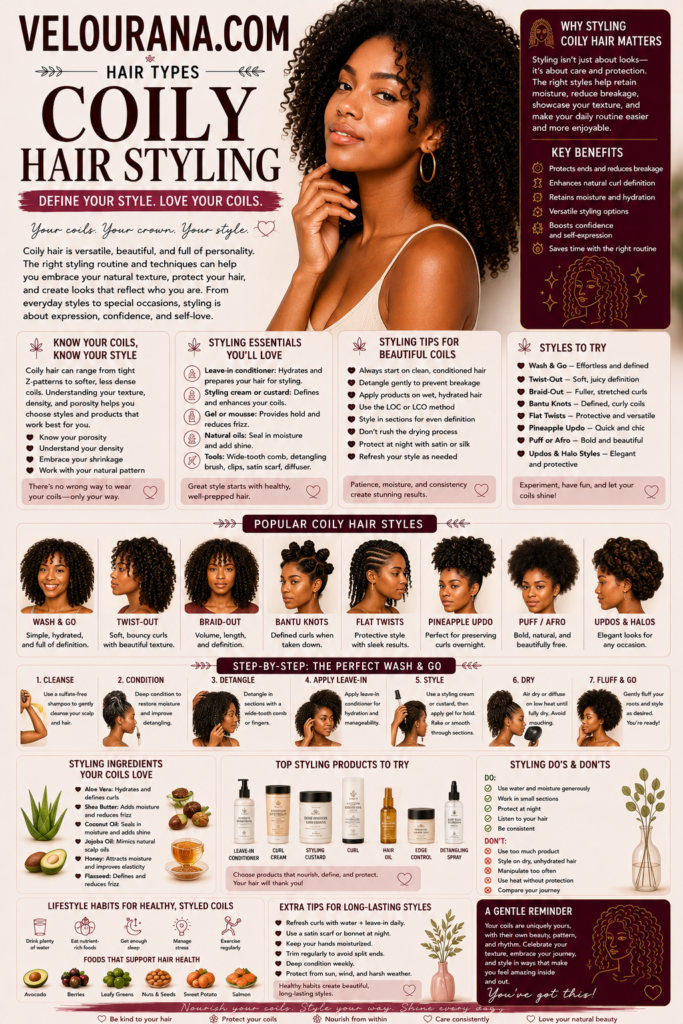
Twist-outs and braid-outs deliberately reorganize the hair into larger, more uniform waves, spirals, or bends. They are valuable because they allow the stylist to influence the scale and direction of the finished texture.
The principle is straightforward. Damp or appropriately moisturized hair is divided into sections, arranged into twists or braids, allowed to dry completely, and then carefully released. While drying, the hair temporarily assumes the geometry of the set.
The size of the sections strongly influences the result.
Smaller twists generally produce more numerous, tighter sections of definition. Larger twists create broader texture and often greater apparent volume. Braids tend to produce a more crimped or waved result, while two-strand twists frequently create a softer spiral pattern, although the exact outcome depends heavily on the hair.
Tension matters too.
A loosely created twist may produce a softer, less uniform result. A neatly tensioned twist can stretch the hair and create more pronounced patterning. The ends deserve particular attention because poorly secured ends can become frizzy even when the rest of the set is beautifully formed.
But the most important requirement is dryness.
Releasing a twist-out before the interior is fully dry can cause the newly created pattern to collapse quickly. The hair has not finished setting. This is especially relevant for dense coily hair, where the outside of a twist may feel dry while moisture remains deeper inside.
Once released, separation should be purposeful. Every time a section is divided, volume increases and definition decreases slightly. The final appearance therefore depends partly on knowing when to stop.
A twist-out is not merely a hairstyle. It is an exercise in controlled pattern creation.
Protective Styling Should Protect More Than Appearance
Coily hair can be arranged into twists, braids, updos, tucked styles and numerous other configurations that reduce the need for daily manipulation. These are often described as protective styles, but the label can create a false sense of security.
A hairstyle is protective only when the way it is installed, worn, maintained and removed actually reduces damaging stress.
Tension is particularly important.
A style that pulls persistently at the scalp or hairline may look polished while placing unnecessary mechanical stress on vulnerable areas. Pain, persistent tenderness or an excessively tight sensation should not be interpreted as the normal price of neat styling.
The edges deserve special caution because the hairs around the hairline are often finer and experience repeated manipulation. Continually forcing these hairs into highly tensioned styles can undermine the purpose of protection.
The condition of the hair before installation matters as well. Putting already tangled hair into a long-term style does not make those tangles disappear. They may become more difficult to address later. Starting with appropriately cleansed, conditioned and detangled hair generally makes both installation and eventual removal more manageable.
A protective style should also remain compatible with scalp care. The desire to preserve a hairstyle for as long as possible should not override discomfort, excessive buildup or obvious scalp problems.
Most importantly, removal should be treated as part of the protective process.
Rushing to unravel weeks of styling, pulling through shed hairs or aggressively combing accumulated tangles can erase much of the benefit gained from reduced daily manipulation.
Protection is therefore not a visual category. It is a relationship between hairstyle and mechanical stress.
Heat Can Be a Tool Without Becoming the Foundation
Heat occupies a complicated position in coily hair styling.
It can dramatically reduce drying time, assist stretching, create smoother finishes and make certain styles more practical. At the same time, excessive temperature or repeated exposure can alter the hair's behavior and contribute to damage.
The useful distinction is between controlled heat and indiscriminate heat.
A hooded dryer or diffuser can help set defined styles more efficiently than waiting many hours for dense hair to air-dry. Faster drying can even make styling more predictable because the hair spends less time wet and vulnerable to accidental disturbance.
Diffusing requires technique. High airflow can scatter carefully formed clumps and create frizz. Excessive temperature can expose the fiber to unnecessary stress. Gentle positioning and controlled airflow allow the dryer to remove water without constantly rearranging the style.
Stretching with a blow dryer introduces another variable: tension. Holding a section elongated while warm air passes along it can reduce shrinkage and prepare the hair for certain styles. The objective does not have to be perfectly straight hair. Sometimes stretching only the roots or partially elongating the lengths is enough to change the silhouette.
Direct high-temperature tools require greater caution because they place concentrated heat against the hair. Repeatedly pursuing extremely straight results can eventually interfere with the hair's ability to return completely to its original coil pattern.
The broader principle is moderation guided by purpose.
Heat should accomplish something specific. If a lower temperature, shorter exposure, indirect method or non-heat technique can achieve the desired styling result, there is little reason to use more thermal intensity than necessary.
The Night Determines How Much of the Style Reaches Tomorrow
A coily hairstyle does not exist only during the hours it is being worn publicly. Several hours every night are spent pressed against bedding, and that repeated friction can change the style considerably.
Sleep can flatten roots, separate defined clumps, roughen the surface and compress the silhouette. The solution is not to expect the hair to remain frozen in its original arrangement but to reduce unnecessary disturbance.
Satin or similarly smooth surfaces are popular because they create less friction than rougher fabrics. Bonnets, scarves and smooth pillowcases can all serve this general purpose, although the best option is the one that remains comfortable and practical enough to be used consistently.
How the hair is positioned also matters.
Allowing longer coily hair to remain underneath the head can flatten it substantially. Loosely gathering it upward can preserve more of the shape, although excessive tension should be avoided. Shorter styles may require little more than a smooth sleeping surface and some reshaping in the morning.
Refreshing should be proportional to what actually happened overnight.
If only a few areas have become distorted, soaking the entire head and completely restyling it may be unnecessary. A small amount of water or styling product applied selectively can sometimes restore those sections while leaving the rest of the style intact.
Repeated full refreshes can create their own problems. Continually layering product without adequate cleansing may lead to buildup, while repeatedly saturating hair can turn a supposedly low-maintenance style into a daily project.
Longevity is not created by endlessly recreating day one. It comes from allowing a style to evolve gracefully while intervening only where necessary.
Frizz Is Not Automatically Evidence of Failure
Modern imagery of coily hair often emphasizes almost impossibly perfect definition: every strand appears incorporated into a glossy coil, the perimeter is immaculate, and not a single hair seems willing to exist independently.
Real hair moves.
Individual fibers escape from clumps. Humidity alters hydrogen bonding within the hair. Friction separates neighboring strands. New growth behaves differently from older lengths. Wind, clothing, hands and sleep all influence the surface.
Some frizz is therefore normal.
The useful question is not whether any frizz exists but whether the amount and character of it interfere with the intended style.
Frizz that appears immediately during application may suggest that sections need more water, more careful product distribution or a different balance of styling products. Frizz that develops after the hair has been repeatedly touched while drying may be technique-related. Frizz that gradually increases over several days may simply be part of the natural aging of the style.
Weather introduces another layer. Coily hair can react strongly to atmospheric moisture, particularly when the styling system does not provide enough hold for the conditions. A routine that works beautifully in one climate may behave differently in another.
Yet attempting to eliminate every independent strand can lead to excessive product use and manipulation.
A little softness around a defined style can make the hair look fuller and more natural. Controlled imperfection is not the opposite of polished styling. In many cases, it is part of what gives coily hair visual richness.
Styling Becomes Easier When the Routine Has a Clear Objective
The enormous variety of coily hair techniques can make styling appear more complicated than it needs to be. One person uses several creams and gels. Another uses a single mousse. One styles soaking wet; another begins on stretched hair. One spends hours finger coiling; another finishes in twenty minutes.
These routines cannot be evaluated intelligently without knowing what they are designed to achieve.
A routine for maximum wash-and-go definition is not the same as a routine for a voluminous twist-out. A routine designed to keep hair tucked away for several days is different from one intended to showcase the natural coil pattern. A method optimized for speed may deliberately sacrifice some precision.
Before choosing products or techniques, it is therefore useful to define the priority.
Is the objective definition? Volume? Elongation? Longevity? Softness? Minimal manipulation? A particular silhouette? Fast drying? A style that can survive several nights?
Once the primary objective is clear, unnecessary steps become easier to identify.
Someone who wants maximum volume may not need to spend an hour creating microscopic coil clumps. Someone who values longevity may benefit from stronger hold even if the hair feels firmer on the first day. Someone who dislikes lengthy drying may prefer a stretched set rather than repeatedly attempting a soaking-wet wash-and-go.
The routine should serve the life of the person wearing the hair.
This is particularly important because an elaborate routine that produces spectacular results but is too exhausting to repeat consistently is not necessarily better than a simpler routine that produces very good results reliably.
The Best Coily Styling Technique Is Learned Through Observation
Coily hair rewards attention.
Not obsessive attention to every strand, but observation of cause and effect.
How does the hair behave when styled soaking wet rather than damp? Does definition last longer with gel than with cream alone? Does a particular combination create residue? Which sections dry fastest? Where does frizz appear first? Does stretching improve the preferred silhouette or remove too much of the natural pattern? How many days does the style remain attractive before refreshing becomes more work than restyling?
These observations gradually create a personal styling system.
The process becomes much easier when variables are changed deliberately rather than all at once. Replacing every product, changing the application technique and adopting a new drying method simultaneously makes it difficult to know what produced the difference.
A simpler experiment is more informative. Keep the routine mostly stable and change one meaningful variable. Use more water. Try smaller sections. Increase hold. Allow the hair to dry without touching it. Stretch only the roots. Compare the result.
Over time, the hair itself provides information that generalized rules cannot.
This is especially valuable because coily hair is not uniform even on one head. The crown may be denser than the sides. The front may have looser coils. The nape may shrink differently. One area may require stronger hold while another becomes weighed down easily.
A sophisticated routine does not necessarily treat every section identically. It responds to those differences without turning them into problems.
Styling Coily Hair as It Is, Rather Than as It Is Supposed to Be
Perhaps the most important shift in coily hair styling is moving away from the idea that success has one appearance.
Perfectly defined coils are beautiful, but they are not the only successful expression of coily hair. A large, soft cloud of texture can be equally intentional. A stretched twist-out, compact wash-and-go, sculptural updo, fluffy braid-out or carefully tucked style can each reveal a different dimension of the same hair.
The extraordinary quality of coily hair is precisely this capacity for transformation.
Its shrinkage creates shape. Its density creates architecture. Its texture creates visual depth. Its ability to hold sets makes temporary pattern changes possible. Its natural volume allows silhouettes that would be difficult to reproduce on straighter textures.
Effective styling does not require suppressing these characteristics. It requires deciding which of them should lead.
When definition is the priority, water, organization, hold and undisturbed drying become central. When volume is the goal, controlled separation and root expansion matter more. When elongation is desired, tension and stretching techniques can modify the silhouette. When longevity matters, nighttime preservation and strategic refreshing become part of the style itself.
None of these choices makes the hair more or less authentically coily.
They simply demonstrate that styling is a conversation between natural structure and deliberate design.
Once that relationship is understood, coily hair stops presenting itself as an endless series of problems requiring correction. Shrinkage becomes a variable. Frizz becomes something to interpret rather than fear. Product becomes a tool rather than the source of the style. Technique becomes adaptable rather than ritualistic.
And the objective changes from controlling every coil to creating conditions in which the hair can express the shape you intended.
That is where sophisticated coily hair styling ultimately begins: not with forcing the hair to obey, but with understanding what it already knows how to do.
The End Velourana
 Discover More From Our Family of Websites
 ZodiacBearing (Astrology, Tarot, Numerology, Angel Numbers & Spiritual Guidance)
 Velourana (Beauty, Makeup, Hair Care, Skincare & Beauty Tips)
 HavenBearing (Home, Living, Organization, Décor & Everyday Inspiration)
 PawBearing (Pet Care, Dog Breeds, Animal Health, Training & Pet Products)
 PsyCatherine (Notes From the Journal of a Psychologist on Real Life)