
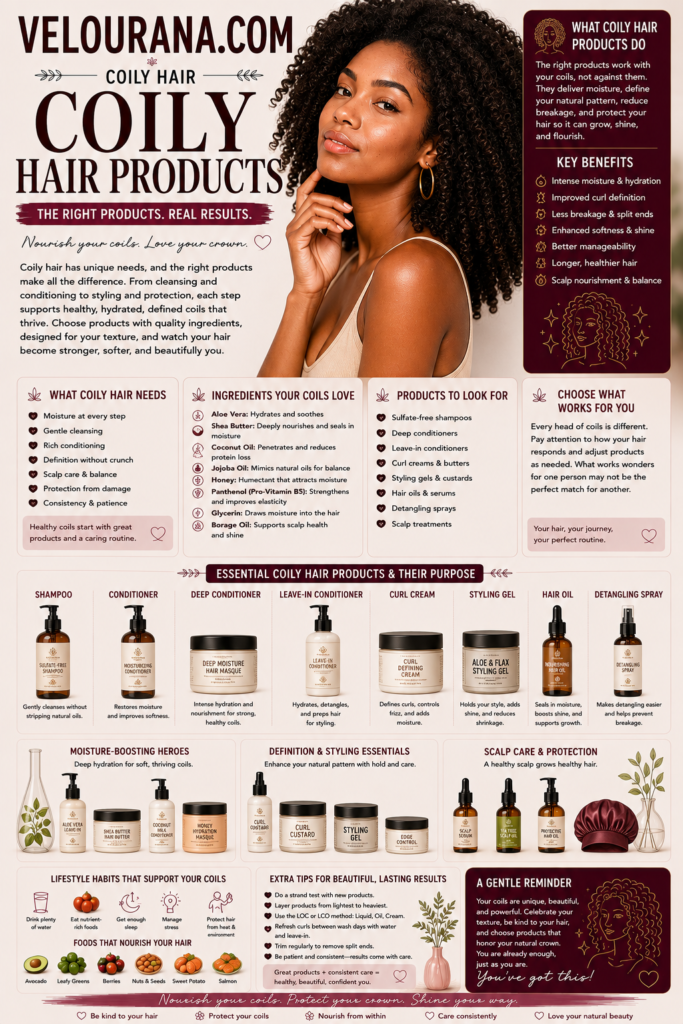
CATEGORY: Coily Hair Products
Layering products is one of the most familiar rituals in coily-hair care.
A wash day can move from shampoo to rinse-out conditioner, then leave-in conditioner, cream, oil, gel, mousse, edge control and perhaps a finishing serum before the style is considered complete. For some people, this sequence produces beautifully defined, flexible hair that remains manageable for days. For others, it creates dullness, flaking, stiffness, excessive drying time and the persistent feeling that the hair is carrying more product than it can comfortably hold.
The difference is not simply whether someone is using the “right” products.
It lies in how those products interact with one another, how much is applied, how wet the hair is during application, what the hair itself can tolerate and what the finished style is expected to achieve.
Layering is useful only when each additional product contributes something that the previous one did not.
That principle sounds simple, but it changes the entire way a coily-hair routine is built.
The objective is not to construct the largest possible stack of moisture, oils and stylers. It is to create a sequence in which cleansing, conditioning, lubrication and hold support one another without competing for space on the fibre.
When layering works, the hair feels deliberate.
When layering fails, it often feels crowded.
Product Layering Begins Before Styling
Most conversations about layering begin with leave-in conditioner.
In reality, the success of a layered routine begins with cleansing.
A strand already carrying residue from previous creams, oils, gels and edge products has less clean surface available for the next set of materials. This can change how evenly products spread, how styling polymers form their film and how the finished hair reflects light.
Accumulation can also create false signals.
Hair may feel rough and unresponsive, leading to the conclusion that it needs more moisture. Another cream is added. The hair becomes heavier. An oil is layered above it to “seal” the moisture. The next wash uses an extremely mild cleanser because stronger cleansing is feared. Residue increases, and eventually even water seems to sit strangely on the surface.
At that point, the routine looks like a moisture problem while behaving like a buildup problem.
This is why layering should always be understood as part of a cycle.
What is deposited must eventually be removed.
A routine based on lightweight leave-ins and water-soluble stylers may require a different cleansing rhythm from one built around heavy butters, waxes, oils and strong film-forming products. Neither approach is inherently wrong. The cleansing must simply match the deposition.
Without that balance, even excellent products can gradually become disappointing.
Conditioner Creates the First Functional Layer
Rinse-out conditioner is technically not part of the final styling stack because most of it is washed away.
Yet its effect on the hair influences every layer that follows.
A well-conditioned strand requires less force during detangling and may need less leave-in afterward. Hair that has been inadequately conditioned can encourage overapplication of styling products because the user is trying to recreate softness that should have been established earlier.
This is an important distinction.
Styling products should not be forced to compensate for a poor wash-day foundation.
If the hair remains tangled and rough after rinsing out conditioner, adding several creams may improve the surface sensation temporarily, but it does not solve the underlying problem.
A successful layering routine therefore starts by asking whether the conditioning stage has done enough.
When rinse-out conditioning is effective, subsequent layers can remain lighter and more targeted.
Leave-In Conditioner Should Prepare the Hair, Not Dominate It
Leave-in conditioner often becomes the first product that remains on the hair.
Its role is usually supportive.
It can improve slip, soften the hair, reduce friction during styling and create a conditioned base beneath the hold product. For some heads of coily hair, this stage makes styling dramatically easier. For others, particularly when the rinse-out conditioner has already performed exceptionally well, leave-in may be optional.
The amount matters enormously.
A leave-in should disappear into the routine rather than announce itself through visible coating. If the hair feels saturated before cream or gel is even applied, subsequent layers are already starting at a disadvantage.
Very dense hair may require more total product, but sectioning usually improves efficiency. A smaller amount distributed thoroughly can outperform a large amount concentrated on the outer surface.
The texture of the leave-in matters too.
A lightweight milk may pair well with a strong gel. A richer leave-in can sometimes provide enough conditioning that a separate cream becomes unnecessary.
This is where layering becomes personal rather than formulaic.
If one product already performs two functions well, there is no benefit in adding another product simply because a named routine says the step should exist.
The Difference Between Layering and Duplication
A coherent routine contains complementary products.
An incoherent routine contains duplicates.
Consider a leave-in conditioner, a rich moisturising cream and a curl butter. All three may be water-based conditioning products containing overlapping combinations of fatty alcohols, oils, butters and conditioning agents.
Used together, they may not create three times the softness.
They may simply create three layers of similar material.
The same can happen with oils and serums, or with gel and custard combinations that provide comparable levels of hold.
Duplication is one of the most common reasons routines become unnecessarily heavy.
The solution is to define the role of each product.
The leave-in may provide slip.
The cream may provide softness and weight for stretching.
The gel may provide hold.
An oil may be used afterward only for separating twists or adding shine.
Each layer now has a reason to exist.
If two products cannot be distinguished by function, one may be unnecessary.
Water Is an Active Part of the Layering System
Water is not merely the stage on which products are applied.
It changes how products behave.
On soaking-wet hair, creams and gels are diluted as they are distributed. This can improve spreadability, encourage curl clumping and reduce the amount of product needed.
On damp hair, products remain more concentrated. This can create greater control or stronger hold but may also make the hair easier to overload.
On nearly dry hair, some formulas can sit heavily on the surface and become difficult to distribute evenly.
This is why the same combination can produce dramatically different results depending on application technique.
For wash-and-go styling, very wet hair often supports smooth distribution and defined clumping.
For twists or braid-outs, damp hair may provide a more practical balance by reducing drying time while still allowing enough water for flexibility.
The correct amount of water is therefore part of the formula, even though it does not come from the bottle.
Cream Before Gel: Why the Sequence Often Works
One of the most common layering sequences places a conditioning cream beneath a gel.
The logic is straightforward.
The cream provides softness, lubrication and sometimes modest weight. The gel creates the external film that helps preserve shape as the hair dries.
For many people with coily hair, this combination produces an appealing balance between flexibility and definition.
But the sequence works only when the products cooperate.
Too much cream can interfere with gel formation. A styling polymer needs to create a coherent film around the hair. If that polymer is diluted or disrupted by a heavy layer of oils and butters beneath it, hold can weaken and flaking may increase.
The cream therefore should not create a greasy barrier.
It should provide enough conditioning to support the style without overwhelming the gel.
This is especially important for fine hair.
A small amount of cream may be enough. In some cases, leave-in plus gel performs better than leave-in, cream and gel because the missing layer allows the hair to remain lighter and the styler to form a stronger cast.
Why Oil Under Gel Can Be Complicated
Oil is frequently inserted between cream and gel as part of popular layering systems.
Sometimes this works.
Sometimes it creates one of the least compatible combinations in the routine.
Oil can reduce friction and add shine, but a substantial oil layer may interfere with the ability of some gels to adhere evenly to the hair and form a consistent film.
This does not mean oil and gel can never coexist.
The quantity is the important variable.
A few drops applied to selected areas are very different from saturating every section before applying a water-based gel.
For many people, oil is more useful after the style has dried.
A tiny amount can be applied to the hands before scrunching out a cast, separating twists or fluffing the roots. This allows the oil to contribute lubrication and shine without standing between the hair and the primary styling polymer.
Again, the best position for the product is determined by function rather than tradition.
The LCO and LOC Methods Are Frameworks, Not Laws
Named routines such as LOC and LCO helped organise textured-hair care for many people.
LOC generally refers to liquid, oil and cream.
LCO places cream before oil.
These systems provided an accessible way to think about moisture retention, particularly during a period when natural-hair education was becoming more widely shared.
Their usefulness should not be mistaken for universal necessity.
A person whose hair becomes heavy under oils may perform better with leave-in and cream only.
Someone seeking strong wash-and-go definition may prefer leave-in followed by gel.
Another person may use a cream styler that already contains enough oils and emollients that a separate oil adds nothing.
The acronym is therefore a starting framework.
The routine should remain only as complicated as the results justify.
Flaking Is Often a Compatibility Problem
One of the most frustrating outcomes of product layering is flaking.
The hair may look perfect while wet. Hours later, white particles appear across the curls, particularly after the cast is disturbed.
This can happen when styling products dry and form incompatible films.
A leave-in and gel may contain ingredients that do not combine well. A heavy cream may prevent gel from distributing evenly. Excess product may dry into visible residue. Oil or butter can complicate film formation.
The first solution is not necessarily to abandon both products.
Instead, simplify.
Try the gel alone over properly conditioned wet hair.
If it no longer flakes, the problem is likely the interaction with the underlying product.
Then test the leave-in beneath it in a small section.
If flaking returns, the combination is probably unsuitable.
This method is more informative than purchasing another five products and repeating the same layering structure.
The Hand-Mixing Test Can Provide an Early Warning
A common informal compatibility test involves rubbing small amounts of two products together between the hands.
If the combination remains smooth, it may layer well.
If it immediately forms white clumps, strings or curds, the formulas may not cooperate.
This test is useful but imperfect.
Products behave differently when diluted by water and spread over hair. A combination that looks slightly cloudy between the palms may perform perfectly on soaking-wet coils.
Still, the test can prevent obvious incompatibilities.
It is particularly useful when the styling process takes a long time.
Testing a tiny amount is much easier than discovering the problem after an hour of section-by-section application.
Buildup and Flaking Are Not the Same Thing
Flaking appears as visible particles.
Buildup is often less obvious.
Hair affected by buildup may feel coated, unusually stiff, sticky or dull. It may become difficult to saturate. Volume can decrease. Styling products may stop behaving as they once did.
Because buildup develops gradually, people sometimes blame a product for “changing formula” when the real issue is accumulation from repeated use.
This is especially common with heavy creams, butters, oils, waxes, edge controls and strong styling polymers.
Clarifying periodically can restore a cleaner baseline.
The frequency should correspond to the routine.
Someone who uses a small amount of lightweight gel once per week may need stronger cleansing far less often than someone layering several rich products daily.
There is no meaningful universal clarifying calendar.
Lost Definition Can Come From Too Much Product
When curl definition fails, the instinct is often to add more styler.
Yet excessive product can flatten the pattern.
Heavy creams can weigh coils down. Too much leave-in can dilute the gel. Several layers of conditioning products can reduce the firm film needed for long-lasting hold.
In this case, the hair may look soft but undefined.
The remedy can be subtraction.
Reducing the leave-in, removing the cream or applying gel directly over very wet hair may produce stronger clumping and better longevity.
This illustrates a broader principle of coily-hair care.
A disappointing result does not automatically indicate that something is missing.
Sometimes something needs to be removed.
Lost Softness Can Come From Too Much Hold
The opposite problem also occurs.
A strong-hold gel can produce exceptional definition but leave the hair feeling rigid.
Some of that rigidity may simply be the cast, which is expected to soften once completely dry and gently manipulated.
If the hair remains unpleasantly stiff, the formula may be too strong for the desired finish.
A small amount of leave-in underneath can help.
Alternatively, a softer gel, custard or foam may suit the styling goal better.
The correct product is not the one that provides maximum performance in every category.
It is the one that produces the preferred balance.
Fine Coily Hair Often Benefits From Fewer Layers
Fine strands have less physical mass.
This means each additional layer contributes a larger proportion of weight relative to the fibre.
A routine that works beautifully on coarse, dense coils can make fine coily hair appear flat and coated.
For this reason, fine hair often responds well to simplification.
A lightweight leave-in and gel may be enough.
Some people can skip leave-in entirely and style over freshly conditioned hair.
Foams and mousses can provide hold without the density of creams.
This does not mean fine hair should never use rich products.
A nourishing mask or cream may still be appropriate under certain conditions.
The key is recognising that fine strands may require less quantity and fewer overlapping layers.
Coarse Coily Hair May Tolerate More Richness, but Still Has Limits
Coarse strands can often carry richer creams without losing as much volume.
This makes multilayered routines more practical for some people.
A leave-in followed by cream and gel may create a comfortable balance between softness and hold.
But even coarse hair can become overloaded.
Density, porosity and product formulation still matter.
The goal is not to maximise richness simply because the strand diameter allows it.
The goal is to use enough richness to improve flexibility while maintaining a clean, responsive fibre.
High-Density Hair Needs Distribution More Than Excess
Dense coily hair can absorb time more readily than it absorbs product.
The challenge is often getting formulas through all the hair.
This creates the temptation to apply enormous quantities.
Sectioning is usually more effective.
When the hair is divided, a smaller amount can be worked thoroughly through each area.
This improves consistency.
One section is less likely to become overloaded while another receives almost nothing.
High-density hair may also dry slowly, so reducing unnecessary layers can have a major practical benefit.
A routine that takes fourteen hours to dry may be technically successful but unrealistic for regular life.
Product efficiency matters.
Low-Density Hair Can Lose Volume Through Over-Layering
Lower-density hair frequently benefits from maintaining some separation and lift.
Several rich layers can encourage strands to cluster into heavier groups, reducing visible fullness.
For someone seeking polished definition, this may be desirable.
For someone prioritising volume, it may be disappointing.
A lighter leave-in, foam or gel can create a more expansive result.
The important lesson is that successful layering is defined by the desired style, not by how many products are present.
Product Order Should Follow Function
The traditional idea that products must be applied in a rigid universal sequence is too simplistic.
A better principle is to place products according to what they are designed to do.
Water or a water-based leave-in generally comes early because hydration and slip support manipulation.
Conditioning creams typically follow if additional softness or weight is needed.
Hold products usually come later because their film needs to form around the arranged strands.
Finishing oils or serums often make more sense after drying because they can provide shine and lubrication without disrupting the setting process.
This functional sequence is flexible.
A single multi-purpose styler may replace two or three steps entirely.
Drying Is Part of Product Layering
A layered routine is not complete until the hair is dry.
This stage is often underestimated.
If coily hair is disturbed repeatedly before the styling film has formed, definition can break down.
Touching, separating and fluffing wet hair may create frizz before the gel has had a chance to set.
Heavy layering also extends drying time.
Water is trapped within dense sections beneath layers of cream and gel. The hair may feel dry on the surface while remaining damp inside.
Disturbing it at that point can compromise the style.
Allowing the hair to dry completely before breaking the cast is therefore part of the product system.
Technique continues after application.
Air Drying and Diffusing Can Produce Different Results
Air drying allows the hair to set gradually with minimal disturbance.
It can produce beautiful definition but may take many hours on dense coily hair.
Diffusing can reduce drying time.
When used appropriately, it can also influence volume and elongation.
The important consideration is heat and airflow control.
Excessively high temperatures can contribute to thermal damage over time.
Aggressive airflow can disturb the pattern and increase frizz.
A diffuser used strategically can support the product system rather than undo it.
Refreshing Should Not Recreate Wash Day Every Morning
One of the hidden sources of buildup is daily refreshing.
A style loses a little softness, so more leave-in is added.
The next morning, more cream follows.
Then gel is reapplied.
By the fourth day, the hair carries multiple generations of product.
Refreshing can be useful, but it should be targeted.
Sometimes water or a light mist is enough to reactivate existing product.
Sometimes only a few areas need additional styler.
A small amount of foam can restore shape without adding significant weight.
If the entire head requires complete reapplication every day, the original styling system may not be providing enough longevity.
A good layered routine should ideally reduce repeated manipulation rather than create a need for it.
Night Protection Changes How Long Layers Remain Useful
Styling longevity depends not only on the products applied but on what happens afterward.
Friction against bedding can disturb definition and roughen the hair.
Protective night practices can help preserve the style, reducing the need for additional product the next day.
A satin or silk-like surface can reduce friction compared with rougher fabrics.
Loose gathering techniques may preserve shape depending on the style.
The objective is not to immobilise the hair completely.
It is to avoid destroying overnight what the styling products created during wash day.
Edge Control Should Remain Localised
Edge products are designed for strong, concentrated hold.
They are useful precisely because they are not ordinary all-over moisturisers.
Applying them strategically around the hairline can create a sleek finish.
Using large amounts throughout the hair can increase buildup and make cleansing more difficult.
Repeated brushing of the same delicate areas can also create mechanical stress.
The product should support styling, not justify excessive tension.
Styling Wax and Pomade Require Deliberate Cleansing
Waxes and pomades can provide substantial control, shine and smoothness.
Their persistence is part of their appeal.
It is also why they require thoughtful cleansing.
A mild cleansing conditioner may not always remove heavy waxy residue effectively.
If these products are used frequently, the wash routine should be capable of resetting the hair when necessary.
This is another example of the deposit-removal balance.
The more persistent the product, the more attention must be paid to removal.
Product Cocktails Are Harder to Diagnose
Mixing products together before applying them can create a personalised texture and sometimes excellent results.
But product cocktails add uncertainty.
The formulas were designed and preserved separately.
Combining them may change texture, film formation or application behaviour.
If the result works, that may not matter.
If it fails, identifying the cause becomes difficult.
Layering products sequentially usually provides clearer information because each one can be evaluated separately.
For troubleshooting, simplicity wins.
Climate Can Change Whether a Layering Combination Works
A leave-in, cream and gel combination may perform beautifully during dry weather.
The same combination can feel swollen or lose hold in high humidity.
Seasonal changes alter the environment in which the styling film operates.
A stronger gel may become useful during humid months.
A richer conditioning layer may feel better during colder, drier periods.
This does not necessarily mean the products have stopped working.
The conditions have changed.
A flexible routine adjusts rather than starting over completely.
Exercise and Lifestyle Should Influence Product Weight
A person who exercises frequently may need to cleanse more often because of scalp perspiration.
This changes what product layering makes sense.
Very heavy creams and waxes become less practical if the hair is washed several times per week.
Lightweight stylers may fit the lifestyle better.
Likewise, someone who stretches wash day for longer may prioritise durability and stronger hold.
A successful routine must reflect actual life.
Hair products should not demand a lifestyle organised around protecting them.
Product Cost Can Encourage Unnecessary Layering
Ironically, expensive products can sometimes increase overuse.
When someone has purchased multiple premium formulas, there can be an unconscious pressure to include all of them in the routine.
But ownership does not create necessity.
A product can be excellent and still unnecessary for a particular style.
Keeping unused products for different seasons or styling methods is more sensible than forcing every bottle into every wash day.
The Smallest Effective Routine Is Often the Easiest to Maintain
There is no prize for using the fewest products.
There is also no benefit in complexity for its own sake.
A routine should contain the smallest number of products required to produce the desired result reliably.
For one person, that may be shampoo, conditioner and gel.
For another, shampoo, conditioner, leave-in, cream and gel may work better.
The point is not minimalism.
It is efficiency.
Every additional layer should earn its place.
How to Troubleshoot a Layered Routine
When a routine fails, changing everything at once creates more confusion.
A better approach is to return to a clean baseline.
Clarify if buildup is suspected.
Use a familiar conditioner.
Apply one styling product.
Observe the result.
Then add another product only if a specific problem remains.
If the hair lacks softness, introduce leave-in.
If it lacks hold, choose a stronger styler.
If definition is good but the style feels too rigid, adjust the quantity or product strength.
This process creates information.
Information makes future routines easier.
When the Gel Is the Problem
Not every flake or stiff result comes from layering.
Sometimes the gel itself is simply unsuitable.
A very strong polymer system may create more cast than desired.
A formula may contain ingredients that behave poorly in the local climate.
The texture may be difficult to distribute across dense coils.
If the gel performs poorly even when used alone over clean, conditioned hair, another gel may be a better solution.
The point of troubleshooting is not to defend a product indefinitely.
It is to identify what is actually happening.
When the Leave-In Is the Problem
Leave-in conditioner can also interfere with styling.
A rich formula may soften the hair beautifully but reduce hold.
Some leave-ins contain enough oils and conditioning agents that they behave almost like styling creams.
If definition disappears quickly or gel flakes consistently, trying a lighter leave-in may solve the problem.
The most moisturising-feeling leave-in is not automatically the best base for every style.
When the Cream Is the Problem
Creams are often responsible for excessive weight.
A twist-out may love them.
A wash-and-go may not.
If curls look elongated but lifeless, the cream may be doing exactly what it is designed to do: adding weight and lubrication.
The problem is not necessarily the formula.
It may simply be the wrong formula for that styling objective.
When the Oil Is the Problem
Oil can make the hair feel beautifully smooth while simultaneously reducing the grip needed for definition.
If the style feels greasy or the gel struggles to form a cast, removing the oil layer may improve performance immediately.
Oil can then be reintroduced later in a smaller amount for finishing.
Again, placement changes function.
When the Technique Is the Problem
Products receive blame for many failures caused by application.
Uneven sectioning can create inconsistent definition.
Applying gel to hair that has dried too much can produce patchy results.
Using excessive force during raking can disturb naturally forming clumps.
Touching the hair repeatedly during drying can create frizz.
A technically excellent product cannot compensate for every application issue.
Successful layering includes technique.
Product Layering Should Reduce Future Manipulation
The best reason to layer products is not to make wash day more elaborate.
It is to create a result that lasts.
When the styling system holds definition, preserves softness and remains comfortable for several days, the hair needs less repeated handling.
This can be especially valuable for coily hair because frequent manipulation increases opportunities for friction, tangling and breakage.
A good product combination therefore earns its complexity by making the days after wash day simpler.
Coily Hair Does Not Need to Feel Coated to Be Protected
There is a persistent idea that protection must be physically noticeable.
If the hair does not feel covered in butter, oil or cream, perhaps it has not received enough care.
But effective conditioning does not require a waxy surface.
Hair can be light, clean and well conditioned.
It can move freely and still be protected from unnecessary friction.
The sensation of product presence is not a reliable measure of performance.
Building a Layering Routine Around the Finished Result
The best sequence starts with the desired end.
If the goal is a defined wash-and-go, a lightweight conditioning base and strong gel may be ideal.
If the goal is a soft twist-out, cream may become more important than gel.
If the goal is maximum volume, foam or a light custard may outperform a heavy cream.
If the goal is a sleek protective style, stronger localised hold may be more useful.
Once the finish is defined, the product sequence becomes easier to design.
The routine serves the style.
The style should not be forced to accommodate the routine.
Product Layering as an Exercise in Restraint
The modern coily-hair market offers extraordinary variety.
That variety is valuable.
It also makes over-layering easy.
Each bottle promises another benefit, and it can feel logical to stack all of those benefits together.
But cosmetic formulas do not behave like arithmetic.
Two moisturising products do not automatically create twice the moisture.
Three rich products do not create three times the protection.
An oil beneath a cream beneath a custard beneath a gel may not create the perfect combination of softness and hold.
It may simply create too much material on the fibre.
Restraint allows each product to perform more clearly.
The Routine Should Become Easier to Read
A good layering routine is predictable.
The user knows what the conditioner contributes.
They know whether leave-in is necessary.
They understand why the cream is present.
They know what level of hold the gel provides.
They can recognise when clarifying is overdue.
They know which product can be removed when more volume is desired.
This understanding is more valuable than owning an impressive collection.
The Most Effective Layer Is the One With a Clear Purpose
Ultimately, layering is not about following a fashionable sequence.
It is about assigning a function to each product.
Water creates the hydrated working state.
Conditioning reduces friction.
Leave-in supports manipulation when needed.
Cream adds richness or flexibility when useful.
Gel, custard or foam creates the styling structure.
Oil or serum can provide finishing lubrication and shine.
Each layer should answer a specific need.
If it cannot, it may not belong in the routine.
That is the simplest way to prevent buildup, flaking and lost definition.
Not by memorising a perfect sequence, but by building a sequence in which every product earns its place.
Coily hair is already rich in structure. It does not need unnecessary layers to prove that it is being cared for.
What it needs is a routine that respects its geometry, keeps friction manageable, creates the desired style and can be cleaned away effectively when the cycle begins again.
When product layering is approached this way, the routine becomes lighter in more than one sense.
The hair carries less unnecessary material.
The wash day involves fewer redundant steps.
Troubleshooting becomes easier.
And the person caring for the hair gains something more useful than another bottle: a clear understanding of what each product is doing and why it is there.
The End Velourana.
 Discover More From Our Family of Websites
 ZodiacBearing (Astrology, Tarot, Numerology, Angel Numbers & Spiritual Guidance)
 Velourana (Beauty, Makeup, Hair Care, Skincare & Beauty Tips)
 HavenBearing (Home, Living, Organization, Décor & Everyday Inspiration)
 PawBearing (Pet Care, Dog Breeds, Animal Health, Training & Pet Products)
 PsyCatherine (Notes From the Journal of a Psychologist on Real Life)

