
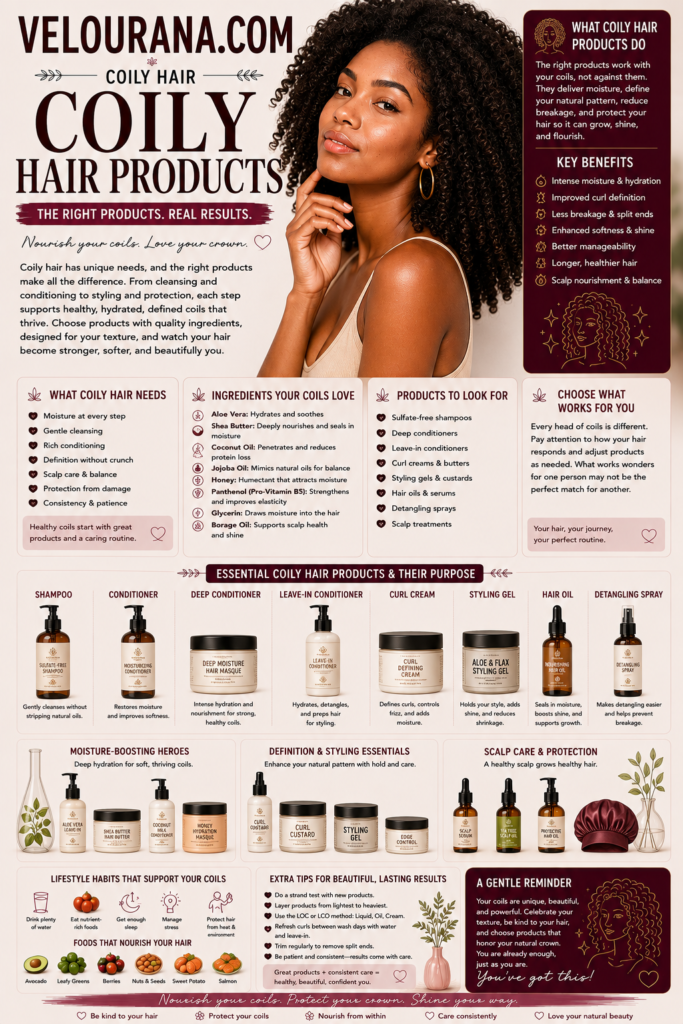
CATEGORY: Coily Hair Products
Shopping for coily hair products becomes much easier once the question changes.
Instead of asking, “What is the best product for coily hair?” it is more useful to ask, “What does this particular head of coily hair need this product to do?”
The difference is fundamental. Coily hair is often treated as though it were a single uniform texture with predictable requirements: more moisture, richer creams, heavier oils, stronger conditioners. Those ideas contain fragments of truth, but they become unreliable when applied universally. Two people can both have beautifully compact coils and discover that the same cream leaves one person's hair supple while making the other's feel greasy and flat. A gel that produces remarkable definition on dense, coarse coils may overwhelm fine strands. A lightweight leave-in that disappears effortlessly into one head of hair may seem almost irrelevant on another.
This variation is not evidence that product recommendations are meaningless. It means that curl pattern alone does not provide enough information.
The behaviour of coily hair is shaped by several characteristics operating simultaneously. Strand diameter influences how easily individual fibres tolerate weight and manipulation. Density determines how much hair occupies a given area of the scalp and affects both product distribution and drying. Porosity influences the way hair interacts with water and conditioning materials. Damage can alter all of these practical observations. Length, shrinkage, styling habits and climate add further variables.
Understanding these characteristics turns product selection from a guessing game into a process of informed observation.
The objective is not to diagnose every strand with scientific precision. Hair is too variable for that, and many popular home tests create a false impression of certainty. The objective is to understand enough about how the hair behaves to choose products deliberately, use them intelligently and recognise when something is not working.
Curl Pattern Is Visually Important but Functionally Incomplete
The familiar curl-typing system places tightly textured hair toward the coily end of a spectrum, commonly described with classifications such as 4A, 4B and 4C. These labels can be useful shorthand when discussing appearance. They help people find visual references, styling inspiration and communities with hair that resembles their own.
Their usefulness becomes more limited when they are treated as complete product instructions.
Curl pattern describes the shape a strand or group of strands tends to form. It does not tell you how thick each individual strand is. It does not reveal how many strands are growing across the scalp. It cannot determine how damaged the cuticle may be, how readily the hair becomes saturated with water or how quickly a styling cream will accumulate.
Even the pattern itself may vary across one head.
The crown can behave differently from the temples. The nape may form visible coils while another area creates a less obvious zigzag. Some sections may shrink more dramatically. Previous heat or chemical treatment can loosen certain areas without affecting newer growth.
For product selection, this means the visual label should be treated as context rather than destiny.
Someone with tightly coiled hair may indeed appreciate substantial conditioning and lubrication because bends along the fibre increase opportunities for friction and tangling. But that does not automatically mean the richest possible formula is appropriate.
A better routine begins by looking beyond the coil and asking how the fibre actually behaves.
Strand Diameter Changes How Much Product Hair Can Carry
Strand diameter is one of the most overlooked characteristics in textured-hair product selection.
Individual fibres can broadly be described as fine, medium or coarse, although real hair exists along a continuum rather than in perfectly separated categories. Diameter refers to the thickness of an individual strand, not to how much hair is present overall.
This distinction matters because a person can have very dense hair composed almost entirely of fine strands. The overall head of hair may look enormous, encouraging the assumption that it requires exceptionally heavy products. Yet each individual fibre may be relatively easy to weigh down.
Fine coily hair often benefits from careful product dosing. Rich butters, heavy creams and repeated oil layering can reduce volume, create buildup quickly and make freshly washed hair feel coated sooner than expected. Lightweight conditioners, milks, lotions, foams and gels may provide sufficient performance without creating unnecessary weight.
That does not mean fine hair must avoid rich products entirely. A concentrated treatment may still be useful when the hair is damaged or unusually dry-feeling. The difference is often in frequency and quantity.
Coarse strands, by contrast, may tolerate or appreciate richer formulas, particularly when the hair is dense or when styles require prolonged flexibility. A substantial cream that overwhelms fine strands can provide valuable lubrication and softness on larger-diameter fibres.
Coarse does not mean damaged, difficult or unhealthy. Fine does not mean weak by definition. These terms describe dimensions, not quality.
Recognising strand diameter simply provides another clue about how much cosmetic material the hair can comfortably carry.
Density Determines How Products Must Travel Through the Hair
Density describes how many individual hairs occupy an area of the scalp. It is different from strand diameter, although the two characteristics combine to influence the overall appearance of fullness.
High-density coily hair presents a practical challenge: reaching all of it.
A person may apply a generous amount of conditioner and still discover dry-feeling sections because most of the product remained on the outer layer. Dense coils can create a canopy that prevents products from distributing evenly unless the hair is divided into manageable sections.
This is where sectioning becomes more than a styling preference.
Applying conditioner, leave-in or styler in sections can improve coverage while reducing the temptation to use enormous quantities. The objective is not to saturate the hair indiscriminately but to make sure the necessary amount reaches the fibres rather than accumulating on whichever strands were easiest to access.
High density can also influence drying time. Closely packed wet hair may retain water for many hours, especially when layered with rich creams and gels. Product choices that seem beautifully moisturising may become inconvenient if they extend drying to an impractical degree.
Lower-density hair presents different considerations. Heavy products can reduce visible fullness by grouping and weighing strands together. Very strong definition may expose more scalp than a softer, more volumised style. Lightweight stylers can sometimes create a more expansive appearance.
Neither density is inherently preferable. It simply changes what successful product performance looks like.
The same gel can produce polished definition on both heads of hair while creating dramatically different visual results because the underlying number of fibres is different.
Porosity Is About Behaviour More Than a Label
Few concepts have influenced modern textured-hair routines as strongly as porosity.
In broad terms, hair porosity relates to how readily the fibre interacts with and takes up water and other substances, influenced partly by the condition of the cuticle and the internal structure of the hair. Damage from bleaching, colouring, chemical processing, weathering or excessive heat can alter the fibre and increase its permeability.
The difficulty begins when porosity is treated as a permanent identity that can be determined by dropping a loose strand into a glass of water.
Whether a hair floats or sinks can be affected by surface oils, product residue, air and other variables. The test may look satisfyingly scientific without providing the certainty people expect from it.
Real-world behaviour is often more informative.
Hair that takes considerable time to become thoroughly wet, seems prone to surface buildup and responds poorly to repeated heavy layering may behave differently from hair that becomes saturated almost immediately and dries very quickly.
Even then, the interpretation should remain flexible.
Different areas of the same head may behave differently. Older ends have experienced more environmental and mechanical wear than new growth. Previously coloured sections can differ from untreated roots. Porosity can therefore be a moving characteristic rather than a fixed category assigned to an entire head forever.
The value of the concept lies in helping explain behaviour. Once the label becomes more important than the behaviour itself, it stops being useful.
When Hair Seems Resistant to Water
Some coily hair takes time to become fully saturated.
Water initially appears to sit on the surface, and the person may need to work it through sections before the hair feels uniformly wet. Rich products can sometimes remain noticeable on the surface for longer than expected, particularly when several layers are applied.
This behaviour is often associated with lower porosity, although product buildup can create similar sensations.
That distinction is important.
If hair seems increasingly resistant to water after weeks of layering butters, oils and styling creams, the solution may not be another special “low-porosity” product. A thorough cleansing session may reveal that the underlying hair behaves quite differently once accumulated material has been removed.
For hair that naturally tends to resist saturation, lightweight products can be easier to distribute. Applying products while the hair is properly wet may also improve spreading and reduce the amount required.
The popular idea that low-porosity hair needs heat to “open the cuticle” is an oversimplification. Warmth can influence product viscosity and the conditioning process, but hair should not be imagined as a door that simply opens and closes on command.
What matters is the result.
If a particular conditioner used according to its directions leaves the hair soft and manageable, there is little reason to complicate the process merely because a porosity rule suggests something more elaborate.
When Hair Takes Up Water Quickly but Loses Its Comfortable Feel
Hair that has experienced significant weathering or chemical damage may become wet quickly and sometimes lose water rapidly as well. It can feel wonderfully soft during conditioning yet become rougher as it dries.
In these situations, richer conditioning formulas and film-forming products may help improve the sensory quality of the fibre. Damaged hair may also benefit from appropriately formulated strengthening treatments, depending on its condition.
But high porosity should not become shorthand for “use the heaviest possible products.”
An enormous quantity of butter cannot reconstruct a damaged fibre. Heavy coating may temporarily change the surface feel while creating buildup that eventually complicates cleansing and styling.
The more productive objective is management.
Condition the hair well. Reduce unnecessary mechanical stress. Limit damaging practices where possible. Use products that improve lubrication and help the fibre remain manageable. Trim areas that have deteriorated beyond what cosmetic treatment can make practical.
For coloured or chemically altered coils, the difference between preserving existing length and repeatedly losing damaged ends can be significant.
Product choice matters, but behaviour surrounding the product matters equally.
Fine Coils Need Protection Without Suffocation
Fine coily strands present an interesting paradox.
Their compact pattern may create a visually substantial head of hair, yet each individual fibre can be delicate. This can make aggressive detangling particularly costly. At the same time, attempts to protect the hair with layers of heavy product can remove the movement and volume that make fine coils so expressive.
The ideal routine often depends on efficient lubrication without excessive residue.
A conditioner with excellent slip can be more valuable than an extremely rich conditioner that leaves a persistent film. Lightweight leave-ins can provide enough softness for styling. Foams and gels may offer definition and hold without requiring a dense cream underneath.
Fine coils may also reveal buildup quickly. When strands begin grouping into heavy sections, volume disappears and the hair seems dull despite abundant product, cleansing may be more useful than additional moisture products.
Strengthening treatments require similar judgment. Fine does not automatically mean protein-deficient or damaged. If the hair is healthy and flexible, intensive treatment may be unnecessary. If it has been coloured, chemically processed or repeatedly exposed to high heat, strengthening formulas may become more relevant.
The objective is to preserve flexibility.
Fine hair rarely benefits from being forced to carry more product than the desired style requires.
Coarse Coils Need Flexibility More Than Weight for Its Own Sake
Coarse coily strands can have a substantial, resilient feel, but that does not mean they are immune to dryness, knots or breakage.
Their larger diameter may allow them to tolerate richer products without collapsing. Creams and butters can provide satisfying lubrication, particularly for twist-outs, braid-outs and stretched styles. Rich conditioners may help improve manageability during detangling.
Still, weight should not be confused with conditioning.
A thick product can sit heavily on the fibre without producing the flexibility the hair actually needs. Conversely, a well-formulated lotion may spread easily and leave coarse strands surprisingly soft.
This is why texture alone cannot predict formula performance.
Coarse coils can also experience significant friction because the bends of neighbouring strands repeatedly contact one another. Products that improve slip can therefore be valuable even when the hair itself feels physically robust.
The ends deserve particular care. Their age means they have accumulated more wear regardless of strand diameter.
The best products for coarse coils are not necessarily those with the thickest consistency. They are the products that keep the fibre pliable enough to withstand ordinary handling while supporting the desired style.
Dense Coily Hair Rewards Products That Spread Efficiently
High-density hair creates an understandable temptation to use product by the handful.
There is simply a great deal of hair to cover.
Yet quantity alone does not guarantee distribution. Applying a large amount to an undivided mass can coat the perimeter while leaving interior sections comparatively untouched.
Products with good spreadability become particularly useful here. A conditioner that moves easily through wet hair can provide better practical coverage than an extremely thick mask that must be laboriously worked into every section. Leave-ins that emulsify readily between wet hands can be easier to distribute evenly.
Section size should correspond to density.
For some people, four sections are sufficient. Others need more. The objective is not to follow a prescribed number but to create sections small enough that product reaches the hair without turning application into an exhausting ritual.
Dense hair may also require strategic attention to the scalp during cleansing. The shampoo must actually reach the scalp rather than remaining suspended in the hair above it.
Drying considerations matter too. Layering a leave-in, heavy cream, oil and strong gel onto very dense wet hair can produce an exceptionally long drying process. If the finished result justifies that time, the system may be worthwhile. If not, simplifying the layers can dramatically improve practicality.
The best routine must work in real life, not merely produce attractive hair under ideal circumstances.
Lower Density Changes the Meaning of Definition
When hair density is lower, product choices can strongly influence how full the finished style appears.
Strong gels frequently encourage strands to form highly defined groups. On dense hair, these groups may still create abundant volume. On lower-density hair, the same degree of clumping can expose more scalp and reduce the impression of fullness.
For someone who wants maximum definition, that may be completely acceptable.
For someone who wants volume, a lighter styler or foam may create a more satisfying balance. Applying less cream beneath the styler can also reduce weight. Once the hair is fully dry, carefully separating selected sections can increase visual fullness.
This illustrates why product reviews are so subjective.
One person may praise a gel for creating extraordinary clumping while another dislikes it for exactly the same reason. The product performed its function; the desired outcomes were different.
Understanding density allows those reviews to be interpreted more intelligently.
Damage Can Override the Hair's Original Characteristics
Hair characteristics are often discussed as though they remain constant from root to end.
In reality, the fibre records its history.
New growth may be relatively intact while older lengths have experienced years of washing, brushing, styling, sunlight and friction. Colouring, bleaching, chemical straightening and repeated high-temperature styling can create much larger differences.
This means a single head can contain hair with dramatically different practical needs.
A lightweight conditioner may work beautifully near the roots while older ends require additional conditioning. Damaged sections may absorb styling products differently. They may dry faster, tangle more easily or lose definition sooner.
Trying to force one uniform product rule across all of these areas can be frustrating.
Strategic application is often more effective.
Richer conditioner can be concentrated where the hair feels roughest. Styling cream can be used sparingly near the roots and more generously on weathered ends. Strengthening treatment can be applied according to actual need rather than automatically covering healthy new growth with the same intensity.
Product placement is one of the simplest ways to personalise a routine without purchasing anything new.
The Scalp and Hair Lengths Do Not Always Want the Same Products
Another source of confusion is the assumption that a product beneficial to the hair must also be beneficial to the scalp.
The scalp is living skin. The visible hair fibre is not.
A rich oil may make dry-feeling ends more lubricated while creating an unpleasant greasy scalp. A heavy butter that works beautifully for twists has little reason to be rubbed repeatedly into scalp skin unless it is specifically appropriate for that purpose.
Cleansing should likewise acknowledge the difference.
The scalp accumulates sebum, perspiration, dead skin cells and product residue. It needs effective cleansing. The lengths need cleansing too, but they may not require the same degree of direct manipulation.
This distinction becomes particularly important for people who experience scalp concerns. Persistent itching, scaling, inflammation, sores or unusual hair loss should not simply be covered with increasingly elaborate cosmetic routines.
Healthy-looking coils begin with an environment in which the scalp itself is properly cared for.
Moisture Is a Condition to Manage, Not a Product Category
The word “moisture” appears on almost every category of coily-hair product.
Moisturising shampoo. Moisturising conditioner. Moisturising cream. Moisturising oil. Moisturising gel.
This language can make moisture seem like a substance contained inside a bottle.
Water is the central source of hydration. Cosmetic products influence how the hair interacts with water, how the surface feels and how quickly the comfortable conditioned sensation changes after drying.
A product described as moisturising may contain water, humectants, conditioning agents, emollients, film-formers and other materials that collectively help hair feel softer or remain more manageable.
Understanding this makes troubleshooting easier.
If hair feels dry while covered in oil, more oil may not solve the problem. If hair feels wonderfully soft immediately after washing but rough within hours, the styling and conditioning system may need adjustment. If every layer produces residue, cleansing may be overdue.
The objective is not permanently wet hair. Hair naturally dries.
The objective is hair that remains flexible and manageable enough to tolerate ordinary life without excessive friction and breakage.
Product Consistency Is a Clue, Not a Guarantee
It is tempting to judge a formula by appearance.
Thin equals lightweight. Thick equals rich. Gel equals strong hold. Cream equals softness.
These associations can be useful starting assumptions, but cosmetic formulation is more complicated.
A thin serum can contain highly effective film-forming ingredients. A thick cream can spread surprisingly lightly. One gel may create an exceptionally hard cast while another provides almost no hold. A dense mask may rinse completely clean, while a lighter lotion leaves noticeable residue.
This is why testing the complete formula matters.
Marketing categories describe intended use, but the hair provides the final verdict.
Styling Goals Should Determine Which Products Become Important
A routine should be designed around the styles actually worn.
For a wash-and-go, definition and hold may be central. A lightweight leave-in paired with a dependable gel could become the heart of the styling routine.
For twist-outs and braid-outs, pliability and controlled set may matter more. A cream or lotion with moderate hold could be more useful than a hard gel.
For stretched styles, products that support softness without causing rapid reversion may be preferred. For protective arrangements, maintaining comfortable hair and reducing friction during installation and removal may matter more than visible curl definition.
This is why universal lists of essential coily-hair products inevitably become too broad.
Not everyone needs edge control. Not everyone needs curl custard. Not everyone benefits from standalone oil. Someone who never uses heat does not need a heat protectant for daily styling, while someone who regularly blow-dries should treat heat protection as far more important.
The routine should reflect behaviour rather than shopping culture.
Climate Adds Another Layer to Product Selection
The same head of hair can behave differently across seasons.
Humidity can influence the longevity and appearance of styled coils. Hot weather may increase scalp perspiration and change cleansing frequency. Dry indoor heating can alter how hair feels during colder months. Wind and friction from winter clothing can affect exposed ends.
A product that appears to have suddenly stopped working may simply be operating under different environmental conditions.
This does not mean an entirely new collection is required every season.
Often a small adjustment is enough. A stronger-hold styler may become useful in humid weather. A richer conditioner may feel more comfortable during a dry period. Product quantities may change. Wash frequency may need to respond to increased exercise or perspiration.
A flexible routine is more economical than constantly replacing products.
How to Evaluate a New Product Without Confusing the Results
Product experimentation becomes difficult when several new formulas are introduced simultaneously.
Suppose a new shampoo, mask, leave-in, cream and gel are all used on the same wash day. The finished hair looks excellent. Which product deserves the credit?
There is no reliable way to know.
If the result is terrible, the same problem occurs.
Introducing products gradually creates clearer information. A new conditioner can be compared with the familiar one while the rest of the routine remains relatively stable. A new gel can be tested over a leave-in whose performance is already understood.
This is not a formal scientific experiment, but it introduces enough consistency to make observations more meaningful.
It also reduces unnecessary spending.
A disappointing product does not always need to be discarded immediately. Sometimes the quantity was excessive, the pairing was incompatible or the product was simply unsuitable for the style attempted. A rich cream that performs poorly beneath gel may work beautifully for twists.
The goal is not to force every purchase to succeed. It is to understand what happened before buying another bottle to solve the mystery.
Signs That a Routine Has Become Too Heavy
Coily hair is so frequently described as dry that buildup can be misinterpreted as a need for still more conditioning.
Hair that feels coated, unusually dull or waxy may not need another layer. Definition that once appeared easily may become sluggish. Water may seem to struggle to penetrate. Products may begin flaking when combinations that previously worked together suddenly behave poorly.
These signs can have several causes, but accumulated product should be considered.
A thorough cleanse followed by a simpler routine can provide useful information.
If the hair suddenly feels lighter and styling improves, the issue was unlikely to be a lack of product.
This is particularly relevant when oils, butters, edge products and strong stylers are used frequently. None of these categories is inherently problematic. The issue is whether cleansing keeps pace with what is being deposited.
Signs That the Routine May Be Too Light
The opposite can occur.
Hair may feel difficult to detangle despite being freshly washed. Sections may lose flexibility rapidly during styling. Ends may tangle repeatedly. A lightweight styler may provide such little lubrication or hold that the hair requires constant manipulation to maintain the desired appearance.
In this case, richer conditioning or a more substantial styling product may improve the routine.
Again, the solution should correspond to the problem.
If detangling is difficult, begin by examining the conditioner and technique rather than adding oil after styling. If definition disappears within hours, the hold product may be insufficient. If the ends feel rough, they may need additional conditioning or may simply be weathered enough to require trimming.
Specific observations produce more useful adjustments than the general conclusion that “coily hair needs more moisture.”
A Personal Product System Is Better Than a Perfect Product List
Eventually, successful coily-hair care becomes less about discovering individual miracle products and more about constructing a dependable system.
The cleanser reliably removes what needs to be removed.
The conditioner provides enough slip that detangling does not become a battle.
The leave-in, if needed, creates a manageable foundation.
The styler matches the desired balance between definition, softness, volume and longevity.
Occasional treatments address specific conditions rather than filling an arbitrary schedule.
The products work together, can be removed effectively and fit within the time available for hair care.
That system may contain four products or ten. The number is less important than the logic connecting them.
Texture, density and porosity help create that logic, but none should become a rigid rule.
Hair is not required to behave exactly as a chart predicts. Fine coils are allowed to love a rich cream. Coarse coils are allowed to prefer lightweight lotion. Hair described as low porosity can use products containing protein if they perform well. High-porosity hair does not have to live beneath layers of butter.
The classifications exist to help explain the hair. The hair does not exist to obey the classifications.
Choosing According to Evidence Your Hair Provides
Perhaps the most useful skill in selecting coily-hair products is learning to recognise evidence.
Not advertising language. Not viral routines. Not the texture of someone else's hair in a photograph.
Your own evidence.
How long does the hair take to become thoroughly wet? How easily does conditioner spread? How much product creates softness before becoming weight? How long does a style remain comfortable? Which areas tangle first? Do the ends need something different from the roots? Does the scalp tolerate the current routine? What happens after several weeks of using the same products?
These observations gradually become a map.
Strand diameter helps explain why certain formulas feel heavy. Density helps explain why distribution takes time. Porosity and damage help explain why different sections interact with water and conditioning products differently. Styling goals explain why one person values a hard-hold gel while another wants nothing more than a soft cream.
Together, they replace the search for universally perfect products with something much more useful: a routine calibrated to an individual head of hair.
Coily hair does not need to be simplified before it can be understood. Its variation is part of its character.
The best product selection respects that variation. It begins with the structure of the fibre, considers the history of the hair, acknowledges the realities of the scalp, climate and styling habits, and then chooses formulas according to what they demonstrably contribute.
Once that approach becomes familiar, the product aisle becomes less intimidating. Labels such as “curl defining,” “ultra moisturising” and “intensive repair” lose some of their authority. They become invitations to investigate rather than promises to believe.
The final decision belongs to the hair.
And when the hair consistently feels manageable, responds predictably to styling, tolerates detangling with less resistance and allows the wearer to achieve the appearance they actually want, the routine is doing something far more important than following the rules of a hair type.
It is working.
The End Velourana.
 Discover More From Our Family of Websites
 ZodiacBearing (Astrology, Tarot, Numerology, Angel Numbers & Spiritual Guidance)
 Velourana (Beauty, Makeup, Hair Care, Skincare & Beauty Tips)
 HavenBearing (Home, Living, Organization, Décor & Everyday Inspiration)
 PawBearing (Pet Care, Dog Breeds, Animal Health, Training & Pet Products)
 PsyCatherine (Notes From the Journal of a Psychologist on Real Life)

