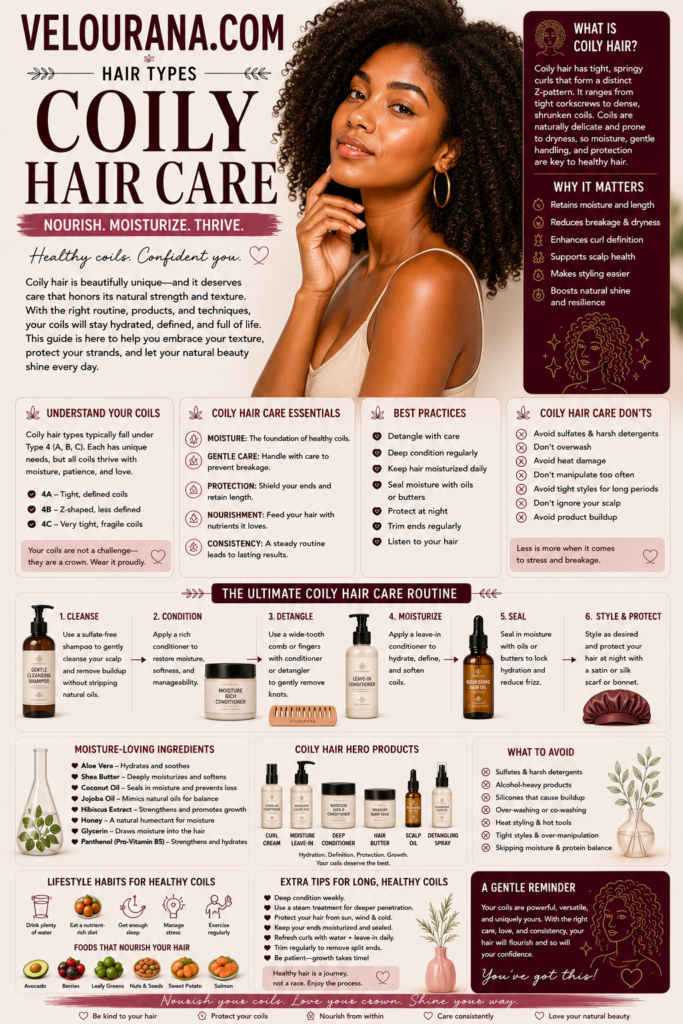
CATEGORY: Coily Hair Care
Few words dominate conversations about coily hair as completely as moisture. It appears in product descriptions, wash-day routines, styling advice, social media tutorials, and almost every discussion of dryness, breakage, softness, or length retention. When coils feel rough, the answer is moisture. When they lose definition, they supposedly need moisture. When breakage appears, moisture is often prescribed again.
There is a sensible reason for this emphasis. The structure of tightly coiled hair makes lubrication along the length more difficult, and weathered fibers can lose water readily. Coily hair frequently benefits from thoughtful conditioning and protection against excessive drying.
Yet the language of moisture has also become so broad that it can obscure what the hair actually needs.
Water, conditioner, leave-in products, oils, butters, creams, masks, steam, humectants, and styling products are frequently placed under the same umbrella even though they perform different functions. A routine can contain an impressive number of "moisturizing" products while still leaving the hair coated, tangled, brittle, or difficult to manage.
The more useful approach is not to ask how much moisture coily hair needs. It is to understand how water enters and leaves the fiber, how conditioning changes the way strands behave, how lubrication affects friction, and how styling products influence the final result.
Once these ideas are separated, moisture becomes less mysterious. It becomes one part of a larger system designed to preserve flexibility, reduce unnecessary mechanical stress, and make the hair easier to live with.
Why Coily Hair Can Feel Dry So Quickly
The characteristic shape of coily hair influences the distribution of the scalp's natural oils.
Sebum begins at the scalp. On relatively straight fibers, it has a comparatively simple path along the shaft. A tightly coiled strand repeatedly curves and changes direction, making that journey more difficult. The ends, which are also the oldest portions of the hair, may receive relatively little natural lubrication.
This contributes to the familiar contrast of a comfortable or even oily scalp with dry-feeling lengths.
But geometry is only part of the story.
Hair is exposed continuously to water, cleansing agents, ultraviolet radiation, heat, styling products, fabrics, combs, brushes, fingers, environmental conditions, and ordinary physical wear. Over time the surface of the fiber becomes increasingly weathered.
The ends of long hair have endured this process for years.
It is therefore reasonable for the newest hair near the scalp and the oldest hair at the ends to behave differently. Treating the entire length as though every centimeter were identical can lead to unnecessarily heavy application near the roots while the ends remain the area requiring greater attention.
Dryness should therefore be interpreted geographically as well as generally.
Where does the hair feel rough? Immediately after cleansing or several days later? At the ends, throughout the length, or only in particular sections? Does adding water improve the feeling? Does conditioner help? Do heavy creams make matters better or merely create residue?
Those observations reveal more than simply declaring the entire head "dry."
Water and Oil Are Not Interchangeable
One of the most persistent misunderstandings in textured-hair care is the idea that oil itself moisturizes hair in the same way that water does.
Oil can be extremely useful. It can lubricate strands, reduce friction, contribute shine, modify the feel of a style, and help slow the movement of water from the fiber. Different oils interact with hair differently, and formulations containing oils can be excellent conditioning or styling products.
But coating dry hair repeatedly with oil is not equivalent to supplying water.
This distinction matters because a strand can feel oily and dry simultaneously.
If increasingly large quantities of oil are applied whenever the hair feels rough, buildup may eventually make the hair heavy and difficult to wet. The person then applies still more product because the hair does not feel soft, creating a cycle in which the solution begins contributing to the problem.
Water enters the picture most obviously during washing.
Hair becomes thoroughly saturated. Conditioner is distributed across wet fibers. Detangling occurs in a highly lubricated environment. After rinsing, a leave-in or styling product may help maintain the desired feel as the hair dries.
For many people, this complete reset is far more effective than repeatedly applying small amounts of product to increasingly coated hair.
The lesson is not that oil is bad.
It is that every product should be understood according to what it actually contributes.
Conditioning Changes More Than Softness
A good conditioner can make coily hair feel dramatically different within minutes.
This is sometimes described casually as "adding moisture," but conditioning is doing something more complex. Conditioning ingredients can deposit on the hair surface, improve lubrication, reduce static, smooth the feel of weathered areas, and make neighboring strands slide past one another more easily.
For coily hair, that reduction in friction is particularly valuable.
Every detangling session involves mechanical forces. A strand that moves easily through neighboring fibers requires less force to separate than one with a rough, resistant surface. Reducing the force required during handling can reduce unnecessary breakage.
Conditioning is therefore not merely cosmetic indulgence.
It is part of mechanical management.
The most useful conditioner is not necessarily the heaviest or most expensive one. Performance during and after washing matters more. Does it distribute easily? Does it provide enough slip for controlled detangling? Does the hair feel flexible after rinsing? Does it leave a residue that becomes troublesome over time?
Those questions are more informative than marketing terms.
Deep conditioners can be useful when additional conditioning is desired, particularly after periods of intensive styling or when the hair feels unusually rough. But they should not automatically become a compulsory weekly ceremony regardless of how the hair behaves.
Routine should respond to condition rather than tradition.
The Difference Between Hydration and Product Weight
There is a common assumption that tightly coiled hair automatically requires the richest possible products.
For some hair, rich creams and butters are extremely effective. For other hair, particularly fine strands or hair that becomes coated easily, the same products can create heaviness without improving manageability.
Coil tightness does not determine everything.
Strand diameter, density, previous chemical processing, environmental conditions, styling preferences, degree of weathering, and product formulation all influence how a routine performs.
A person with very tight but fine coils may discover that lightweight leave-in products and gel provide excellent results. Someone with thicker strands may prefer a creamier base. Another person may use almost no leave-in product because their rinse-out conditioner and styler provide sufficient conditioning.
None of these routines is inherently more correct.
The important distinction is between hair that feels conditioned and hair that simply has a large quantity of material sitting on it.
Properly conditioned hair generally feels flexible and manageable. Overloaded hair may feel waxy, sticky, limp, dull, unusually slow to dry, or difficult to refresh. Definition can become less predictable rather than more.
When this happens, adding another moisturizing layer is unlikely to solve the problem.
Sometimes the most moisturizing thing a routine can do is cleanse thoroughly and begin again.
Buildup Can Masquerade as Dryness
The paradox of product buildup is that hair can feel increasingly unpleasant while receiving increasingly intensive care.
Leave-ins, creams, oils, gels, edge products, dry shampoos, scalp oils, and refresh sprays accumulate to varying degrees. Environmental debris and sebum join them. Depending on the formulations used and the cleansing routine, residues may remain on the fiber.
The resulting hair may lose movement and shine. Water may seem to sit on the surface initially. Styling becomes unpredictable. The hair can feel coated yet strangely rough.
Because roughness is interpreted as dryness, another layer of product is added.
The cycle continues.
Regular cleansing interrupts that cycle.
This does not mean coily hair must be aggressively clarified at every wash. It means cleansing strength should correspond reasonably to what is being deposited between washes.
Someone using minimal lightweight products may not require the same cleansing approach as someone layering butter, oil, gel, edge control, and scalp products for several weeks.
Clarifying shampoos can be useful periodically when ordinary cleansing no longer seems to remove residue effectively. Their frequency depends on the routine rather than a universal timetable.
After a more thorough cleanse, conditioning becomes especially important.
The goal is not to strip the hair into squeaky resistance. It is to restore a clean surface from which conditioning and styling can work predictably again.
Porosity Is Useful When It Describes Behavior
Porosity is often presented as the master key to moisture management.
Hair is categorized as low, medium, or high porosity, and entire product routines are then constructed around the label. The concept has genuine relevance because the condition of the cuticle influences interactions with water and other substances.
But porosity is better treated as a description of behavior than as a permanent identity.
Hair on the same head can vary. Chemically processed ends may behave differently from untreated roots. Weathered sections may differ from newer growth. Heat exposure can alter portions of the hair. Even product residue can change the way water initially interacts with the surface.
Rather than depending heavily on simplified home tests, watch the hair.
Does it take considerable time and manipulation before water thoroughly saturates it? Does it become wet almost immediately? Does it dry extremely quickly or remain wet for many hours? Does it respond well to rich products or become coated? Does softness disappear rapidly after wash day?
Those observations can guide adjustments.
Hair that resists wetting may benefit from patient saturation in sections rather than simply increasing product quantity. Hair that becomes rough rapidly may benefit from more effective conditioning and reduced manipulation. Hair that remains heavily coated may need lighter application or more effective cleansing.
The objective is not to achieve the correct porosity label.
It is to understand the fiber well enough to make useful decisions.
Humectants, Humidity, and the Environment Around the Hair
Hair does not exist in a controlled laboratory.
It moves through humid summers, dry heated rooms, windy streets, air-conditioned offices, rainy weather, intense sunlight, and changing seasons. Environmental water influences how hair behaves, particularly when styling products contain ingredients designed to interact with moisture.
Humectants are ingredients that attract water and are common in many hair formulations. Glycerin is perhaps the most familiar example, although many others exist.
Their presence is not automatically good or bad for coily hair.
Performance depends on the complete formulation and environmental conditions. A product that creates beautiful definition during one season may behave differently during another. High humidity can encourage some styles to swell or frizz as hair interacts with atmospheric moisture. Very dry conditions may produce a different feel entirely.
This explains why a routine that worked perfectly for months can suddenly seem unreliable without any obvious change in the hair itself.
Seasonal adjustment is therefore reasonable.
Perhaps a different styler provides better hold during humid weather. Perhaps richer conditioning feels useful during winter. Perhaps protective styles become more convenient during particularly dry or windy periods.
The hair has not necessarily become problematic.
Its environment has changed.
Refreshing Between Washes Has Limits
The desire to extend a hairstyle can turn refreshing into an increasingly complicated daily process.
Water is sprayed onto the hair. Leave-in is added. Cream follows. Oil seals the cream. Gel repairs individual sections. The next morning the sequence begins again.
Eventually the hair contains several days of accumulated material and no longer responds as it did immediately after washing.
Refreshing is useful when it restores a style efficiently.
A small amount of water may reactivate some products. A little styler can repair frizzy sections. Light manipulation may restore shape.
But refreshing should not become an attempt to avoid washing indefinitely.
Sometimes the style has reached the end of its useful life.
A fresh wash removes accumulated materials, releases shed hairs, allows thorough conditioning, and creates an opportunity to detangle systematically. That reset may require more time initially, but it can be far easier than trying to rescue hair that has become progressively tangled and coated.
Knowing when not to refresh is therefore part of moisture management.
Definition Is Not the Same Thing as Hydration
A beautifully defined coil can be dry. A soft, well-conditioned head of hair can also be fluffy and relatively undefined.
These qualities should not be confused.
Definition depends partly on how strands group together, the styling technique used, and the hold provided by products. Gels and similar stylers can create highly visible coil patterns by maintaining those groups as the hair dries.
Hydration and conditioning influence flexibility and manageability but do not guarantee a particular visual result.
This distinction matters because people sometimes interpret frizz as proof that their hair lacks moisture.
Frizz can occur for many reasons. Individual strands may separate from defined groups. Humidity may influence the style. Hair may be disturbed while drying. Sleeping, exercise, wind, clothing, or ordinary movement may disrupt definition.
Applying more oil or cream does not necessarily address any of those causes.
If definition is the goal, styling technique and hold become important.
If softness is the goal, a different balance may be preferable.
The best routine begins by deciding which outcome matters rather than assuming every desirable characteristic comes from "moisture."
Protein and Moisture Are Not Opposing Forces
Textured-hair discussions often describe protein and moisture as though they occupy opposite ends of a scale.
Hair supposedly becomes "protein overloaded" on one side and "moisture overloaded" on the other, requiring careful movement between the two.
The underlying reality is more complicated.
Hair itself is primarily protein. Hydrolyzed proteins and related ingredients are used in some products because they can influence the feel and behavior of damaged hair. Some people find protein-containing formulations particularly useful, especially on chemically treated or significantly weathered fibers.
Others dislike the feel produced by particular protein-rich products.
That does not mean every instance of stiffness is a diagnosable protein overload, nor does unusually soft hair automatically indicate excessive moisture.
Formulations contain many ingredients, and hair condition is influenced by far more than a single category.
If a product consistently makes the hair feel rough, rigid, or difficult to manage, stop using it and observe the difference. If a protein-containing conditioner leaves the hair strong, flexible, and easy to detangle, there is no reason to fear it simply because a calendar says protein should be limited.
Performance should remain the standard.
Moisture Cannot Repair Structural Damage
One of the most important limits of conditioning is that damaged hair cannot be returned completely to its original biological state.
Hair fiber is not living tissue capable of healing itself.
Conditioners and treatments can improve its surface, reduce friction, temporarily fill irregularities, enhance flexibility, and make damaged hair look and feel considerably better. Modern cosmetic chemistry can produce impressive results.
But a split end does not permanently fuse itself back together.
A severely heat-damaged section does not regenerate its original structure because a moisturizing mask was applied. Chemical damage cannot simply be reversed by oil.
This does not make hair treatments useless.
It makes expectations more realistic.
Cosmetic care can preserve damaged hair for a period, improve manageability, and reduce further mechanical stress. Eventually, however, severely compromised portions may need to be trimmed.
Preventive care therefore matters enormously.
Moderating heat, reducing unnecessary tension, detangling gently, conditioning effectively, and limiting repeated friction may not produce dramatic before-and-after photographs after a single wash.
Their value appears over months and years as more of the fiber remains intact.
The Ends Need a Different Kind of Attention
The ends of coily hair often deserve special consideration because they combine several disadvantages.
They are the oldest part of the fiber. They have experienced the most manipulation. They receive the least natural scalp oil. They frequently rub against clothing and bedding. They can become involved in knots and tangles more easily.
This does not necessarily mean they need to be saturated with oil every day.
They need protection appropriate to their condition.
That might involve applying conditioner carefully through the ends during washing, ensuring styling products reach them, reducing friction against clothing, keeping them tucked within certain styles, and trimming them when deterioration becomes significant.
If ends remain persistently rough despite excellent conditioning, the problem may no longer be lack of product.
They may simply be worn.
Recognizing this can prevent months of attempting to moisturize damage that cannot be permanently restored.
Nighttime Protection Extends More Than Hairstyles
Satin and silk are commonly associated with preserving curl definition, but their usefulness extends beyond appearance.
Every movement during sleep creates an opportunity for hair to rub against bedding. A smoother surface reduces friction, which can be especially helpful for highly textured fibers.
A bonnet or scarf can also keep the hair contained so that strands do not become scattered and tangled throughout the night.
The practical consequence is often easier mornings.
A style that remains reasonably organized overnight requires less manipulation the next day. Less manipulation means fewer opportunities for mechanical damage.
This illustrates an important principle of coily hair care: the best moisture strategy is sometimes not another moisturizing product.
It is reducing the processes that make the hair difficult to manage in the first place.
When More Product Stops Producing Better Hair
There is a point at which an elaborate routine can become self-defeating.
If wash day requires hours because layers of product must be removed, if hair is refreshed every morning but never feels truly clean, if dozens of products are rotated according to increasingly complicated rules, the routine may be generating more uncertainty than benefit.
Simplification can be revealing.
A straightforward experiment might involve a suitable shampoo, a conditioner with good slip, one leave-in if necessary, and a styling product appropriate to the desired result.
Observe.
How does the hair feel? How long does the style last? How quickly does buildup appear? How difficult is detangling at the next wash?
Products can then be added only when they solve a recognizable problem.
This approach transforms hair care from accumulation into experimentation.
It also makes it easier to identify which products are actually contributing something useful.
Moisture Is Ultimately About Manageability
The most useful measure of a moisture routine is not how shiny the hair appears immediately after oil application or how many conditioning steps were completed.
It is how the hair behaves.
Healthy-feeling coily hair should possess enough flexibility to withstand ordinary manipulation without constant snapping. Detangling should be manageable with appropriate lubrication and technique. The scalp should remain comfortable. Styling should not require excessive force. The hair should recover reasonably from routine handling.
There will still be frizz.
There will still be shrinkage.
There will still be knots, imperfect wash days, sections that behave differently, weather that destroys carefully arranged styles, and mornings when the hair seems to have developed plans of its own.
Those experiences do not prove that the moisture routine has failed.
Coily hair is dynamic because its architecture is dynamic.
The purpose of moisture management is not to make the texture permanently smooth, perfectly defined, or endlessly saturated. It is to maintain an appropriate relationship between water, conditioning, lubrication, cleansing, styling, and protection so that the fiber remains workable.
Once that relationship is understood, the endless search for "the most moisturizing product" becomes less important.
The question changes from What else can I put on my hair? to What is my hair telling me through the way it behaves?
That question produces a more intelligent routine.
And for coily hair, intelligent care is rarely about doing the most. It is about understanding enough to know what is necessary—and what is not.
The End
Velourana.
 Discover More From Our Family of Websites
 ZodiacBearing (Astrology, Tarot, Numerology, Angel Numbers & Spiritual Guidance)
 Velourana (Beauty, Makeup, Hair Care, Skincare & Beauty Tips)
 HavenBearing (Home, Living, Organization, Décor & Everyday Inspiration)
 PawBearing (Pet Care, Dog Breeds, Animal Health, Training & Pet Products)
 PsyCatherine (Notes From the Journal of a Psychologist on Real Life)