
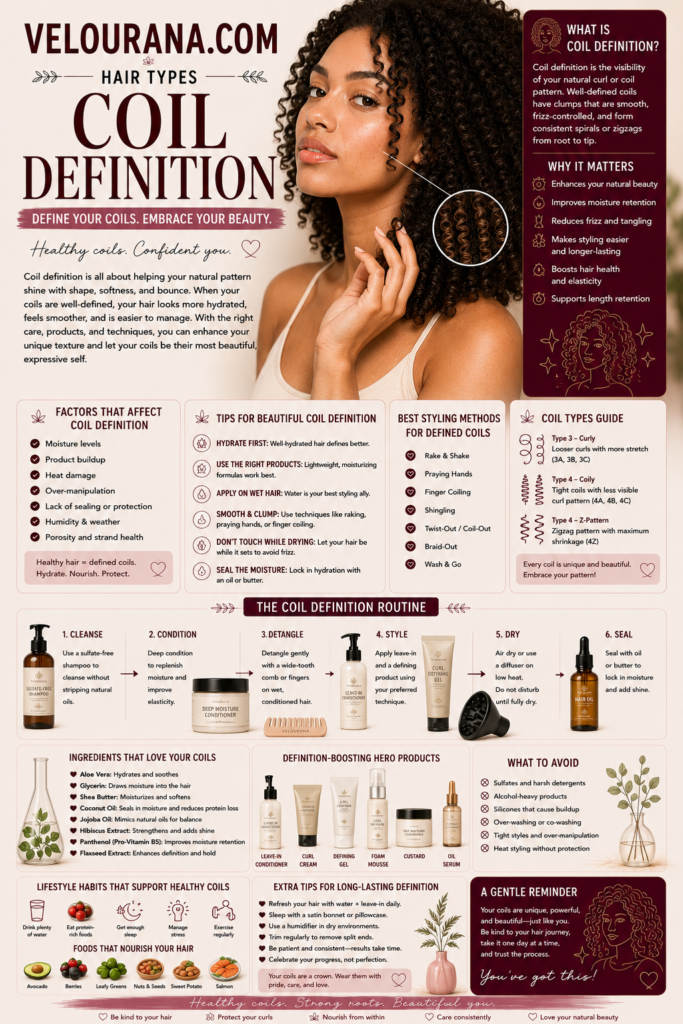
CATEGORY: Coil Definition
A reliable coil-definition routine is not the routine that creates the most impressive result once.
It is the routine that can be repeated.
That distinction matters because coily hair can produce spectacular definition under highly controlled conditions. A long styling session, carefully divided sections, multiple products, deliberate finger coiling, prolonged drying, and extensive finishing can create an exceptionally polished result. But if reproducing that result requires several hours, excessive manipulation, and a complicated sequence of products, the routine may eventually become difficult to maintain.
Consistency requires something more practical.
A sustainable coil-definition routine must work with the hair's natural structure, fit realistically into daily life, preserve the condition of the strands, and create a result that remains satisfying beyond the first photograph.
The process usually becomes easier when definition is understood not as a single technique but as a sequence of connected decisions.
Cleansing determines the surface on which styling begins.
Conditioning influences manageability.
Detangling determines how freely strands can reorganize.
Water controls flexibility.
Styling products influence grouping and hold.
Application technique determines clump size.
Drying stabilizes the arrangement.
Nighttime care influences longevity.
Refreshing determines whether a style evolves gracefully or becomes increasingly coated.
When these stages cooperate, definition can feel surprisingly simple.
When they conflict, the routine often becomes a cycle of correction.
The goal is therefore not to discover a universal formula for perfect coils. It is to build a repeatable system in which each stage has a clear purpose and unnecessary steps gradually disappear.
Start With the Hair You Actually Have
One of the greatest obstacles to a useful definition routine is beginning with an imaginary version of the hair.
The imagined version may have perfectly uniform coils from root to tip, equal density everywhere, identical porosity across the head, minimal shrinkage, and predictable behavior in every climate.
Real coily hair is usually far more complex.
One section may create tiny, compact formations while another produces broader spirals. The crown may be denser. The nape may remain looser. The front may shrink differently from the back.
These differences influence styling.
A routine becomes more efficient when it is designed around them rather than repeatedly trying to erase them.
The first useful step is observation.
How does the hair behave when saturated?
Where do clumps form automatically?
Which areas tangle most easily?
Which sections dry first?
Where does definition disappear fastest?
Does the hair become weighed down by rich products, or does it respond well to them?
Does the style fail because the pattern never forms properly, or because it forms beautifully and then disappears?
These are different problems.
A routine should respond to the actual behavior of the hair rather than to a general description such as "coily," "type 4," "high porosity," or "dry."
Labels can provide useful context.
Observation provides usable information.
Cleansing Determines How Predictable Styling Will Be
Coil definition begins before styling product appears.
A clean enough surface behaves more consistently.
This does not mean aggressively stripping the hair at every wash. It means removing enough accumulated material that water, conditioner, and styling products can interact with the strand predictably.
The distinction is important because buildup can imitate several other problems.
Hair carrying substantial residue may appear dull.
It may seem strangely dry despite the presence of numerous conditioning products.
Water may distribute unevenly.
Styling products that once worked beautifully may appear to stop performing.
The natural response is often to add more product.
That can deepen the problem.
A reliable routine therefore includes cleansing strong enough to match the amount and type of material being applied between washes.
Someone using lightweight products sparingly may not need the same cleansing approach as someone regularly layering leave-in conditioner, cream, oil, and strong-hold gel.
Lifestyle matters as well.
Exercise, scalp oil production, environmental exposure, protective styling, and the interval between wash days all influence cleansing needs.
The scalp should also remain part of the conversation.
Definition is primarily discussed as a concern of the lengths, but a comfortable scalp is fundamental to any sustainable hair routine. Styling should not require placing excessive product directly against the scalp if doing so creates buildup or discomfort.
A successful wash leaves the hair ready to receive conditioning and styling rather than either coated or unnecessarily harsh.
Conditioning Should Improve Manageability, Not Create Dependence on Layers
Conditioning is especially important in coily hair because repeated bends increase the number of points at which strands can interact, catch, and tangle.
A useful conditioner reduces friction and makes detangling easier.
This creates a better foundation for definition because strands can reorganize into coherent groups rather than remaining trapped in conflicting tangles.
But conditioning does not require endless layering.
The idea that coily hair must always receive the richest possible combination of products can lead to routines in which conditioner, leave-in, cream, butter, oil, custard, and gel are all applied before the hair has a chance to show what it actually needs.
Richness is useful when it serves a function.
It becomes unnecessary when each product simply duplicates the role of the previous one.
A sustainable routine asks what the hair still lacks after conditioning.
If it feels flexible, manageable, and prepared for styling, the next step may simply be a suitable hold product.
If it requires additional conditioning support, a leave-in may make sense.
If a cream improves softness without reducing hold, it may be valuable.
The objective is function, not product accumulation.
Detangling Should Prepare the Pattern, Not Erase It
Detangling is necessary for many people with coily hair, but the method can influence the eventual definition.
A tangled section cannot reorganize freely.
Individual hairs may be caught across several potential clumps. Shed strands can wrap around intact hairs. Ends can knot together.
Removing these obstacles allows the section to move more naturally during styling.
But detangling can also separate groups excessively.
A tool passed repeatedly through the hair may leave every strand highly separated. If the desired style depends on larger natural clumps, those groups then have to reform afterward.
This does not make tool detangling wrong.
It simply means that the detangling method should support the intended result.
For some hair, thorough brush detangling creates an exceptionally smooth foundation and improves definition.
For other hair, finger detangling preserves natural groupings more effectively.
Many people combine methods, using fingers to locate significant knots and a tool to complete distribution.
The useful standard is not whether the section looks perfectly combed.
It is whether the hair is free enough to move without unnecessary breakage or obstruction.
Water Is Part of the Styling Formula
One of the simplest improvements to a coil-definition routine is to stop treating water as something that belongs only to the washing stage.
Water actively influences styling.
It affects flexibility, clump formation, product distribution, elongation, and drying.
The correct amount varies with the technique and product.
Some hair responds beautifully when styled almost dripping wet. The abundant water allows neighboring strands to gather naturally, while the styling product spreads easily over large sections.
Other routines perform better after excess water has been gently removed. The styling product becomes less diluted and may create stronger hold.
The mistake is not choosing one method or the other.
The mistake is failing to notice that water level changed.
This frequently happens during long styling sessions.
The first section receives product while fully saturated.
Twenty minutes later, another section is only damp.
The same product quantity and technique are used, but the results differ.
The difference may later be blamed on inconsistent texture.
Sometimes the texture is different.
Sometimes the hair simply dried while waiting.
Maintaining a similar water level across sections creates more meaningful comparisons and more predictable results.
Sectioning Should Make Distribution Easier, Not Turn Styling Into Administration
Sectioning is useful because it creates access.
Dense coily hair can hide large amounts of interior hair beneath a relatively small visible surface. Applying styling product only to the exterior may leave deeper sections with insufficient coverage.
Dividing the hair makes it easier to distribute water and product consistently.
But smaller sections are not automatically better.
Extremely detailed sectioning can transform a practical wash-and-go into a long, exhausting process.
The correct section size is therefore functional.
A section should be small enough that the hair can be saturated, detangled, and coated evenly.
Beyond that point, further division should serve a deliberate styling goal rather than habit.
If someone wants individually constructed finger coils, small sections are part of the design.
If the goal is natural clumping, excessive division may be unnecessary.
Efficiency is not laziness.
It is evidence that the routine understands what actually matters.
Choose a Definition Style Before Choosing the Technique
"Defined hair" can describe several very different appearances.
Large, smooth coils with limited volume are defined.
Tiny, separated coils with a fuller silhouette are defined.
Finger coils are defined.
A brush-styled set is defined.
A softly clumped wash-and-go can also be defined.
The intended finish should determine the technique.
Without this decision, routines often become contradictory.
Someone may preserve large clumps while wet, then separate them aggressively because the hair appears too flat, then attempt to smooth the resulting frizz because the definition was reduced.
The issue is not poor technique.
The objectives changed during the process.
Choosing the desired balance in advance makes styling more coherent.
If polished clumps are the priority, less separation may be appropriate.
If volume matters more, smaller clumps and root expansion can be accepted from the beginning.
If elongation is important, the drying and stretching strategy should reflect that.
A routine becomes easier when every step is moving toward the same finish.
Styling Product Should Solve a Specific Problem
A useful styling product has a job.
It may provide slip.
It may add conditioning.
It may create hold.
It may improve ease of distribution.
It may help the hair remain grouped through humidity and friction.
Problems begin when products are added without a specific purpose.
A cream is used because creams are supposed to be good for coils.
An oil is added because the routine appears incomplete without one.
A gel is layered over everything because definition is still desired.
The final result may contain so much material that drying becomes difficult and the original behavior of the hair is impossible to evaluate.
A more efficient method begins with the minimum number of products necessary.
If a leave-in and gel create excellent results, that may be enough.
If one styling product performs both functions adequately, the routine can become even simpler.
If additional richness genuinely improves softness and longevity, a cream can be introduced deliberately.
Each product should earn its place.
This principle is especially useful when troubleshooting.
When only two or three products are involved, it is easier to understand why results changed.
Hold Should Match the Desired Lifespan of the Style
A styling product that feels wonderful on day one may not be suitable for someone expecting definition to last most of the week.
Hold is partly a question of lifestyle.
If the hair is routinely washed or restyled after two days, extreme longevity may not matter.
If someone wants to preserve a wash-and-go for six or seven days, stronger structural support may become more important.
This does not automatically mean using the strongest gel available.
Strong hold can create stiffness, buildup, or difficulty refreshing when used inappropriately.
The goal is sufficient hold.
The useful test extends beyond the first day.
How does the style respond to sleep?
Does the pattern survive ordinary movement?
Does the hair remain flexible?
Does the product begin flaking once the cast is softened?
Does humidity cause rapid expansion?
Can the style be refreshed without excessive layering?
These questions reveal far more than the appearance of wet application.
Product Distribution Matters More Than Product Quantity
It is possible to apply a large quantity of product while still coating the hair unevenly.
This happens easily in dense textures.
The outer layer becomes saturated while interior strands receive relatively little.
The finished style may contain areas that feel heavy and rigid beside areas that lose definition rapidly.
Adding even more product does not necessarily solve the problem.
Better distribution does.
Hands, fingers, combs, and brushes can all be used to spread product, but the chosen method should avoid unnecessary repetition.
The objective is to make adequate contact throughout the section.
Once that has happened, continuing to apply or manipulate may provide diminishing returns.
Learning how much product the hair actually requires often reduces cost as well as buildup.
A sustainable routine should not depend on consuming large quantities of styler every wash unless the hair genuinely requires them.
Smoothing Preserves Larger Groups
Smoothing is particularly useful for hair that already forms desirable clumps.
By passing the hands over a section without repeatedly dividing it, neighboring strands remain together.
The resulting coils are often broader and more polished.
This can also reduce styling time because the technique works with groups rather than constructing individual formations.
Smoothing may be especially useful when a fuller pattern is not the primary objective.
The tradeoff is that broad clumps can reduce volume.
They can also take longer to dry when very large.
As with every technique, the best result lies in balance.
The goal is to preserve useful groups without allowing sections to become so bulky that they dry poorly or conceal tangles.
Raking Creates More Separation and Detail
Raking moves the fingers through the section and naturally divides the hair into smaller groups.
This can improve distribution, particularly in dense hair.
It can also create greater detail and fullness.
For hair that naturally forms overly large clumps, raking can establish more manageable boundaries.
But repeated raking can continue separating the hair beyond the point of usefulness.
A section that initially contained beautifully organized coils may become increasingly fine and diffuse.
The technique is therefore most effective when used with purpose.
Distribute.
Separate enough.
Then stop.
Brush Styling Should Be a Tool, Not a Requirement
Brush styling can produce exceptionally regular definition because the tool reorganizes strands under tension.
For some people, the improvement is dramatic.
For others, the brush adds time while producing a result that is not meaningfully better than hand styling.
A sustainable routine should not preserve a technique simply because it is popular.
If the brush makes distribution easier, improves clumping, and creates a preferred finish without excessive stress, it has a clear function.
If the hair naturally defines well without it, the brush may be optional.
This is especially relevant for long-term consistency.
Every unnecessary tool adds another stage to wash day.
The simpler routine that produces eighty or ninety percent of the same result may ultimately be more valuable than a perfect routine that becomes too demanding to maintain.
Finger Coiling Should Be Reserved for Where It Adds Value
Finger coiling creates highly deliberate definition.
It is particularly useful for irregular sections, shorter areas, or styles in which uniform spirals are central to the desired appearance.
But finger coiling an entire dense head of hair can take considerable time.
If every section must be manually constructed during every wash, the routine may become difficult to sustain.
A more practical approach is selective use.
Allow naturally cooperative sections to form on their own.
Finger coil only areas that benefit noticeably from extra guidance.
This preserves the visual advantages of the technique while reducing total manipulation.
The Best Styling Moment Is Often When the Hair Already Looks Good
There is a critical stage during styling when a section becomes sufficiently organized.
The product is distributed.
The clumps are visible.
The surface appears smooth enough.
The hair has reached the desired balance.
Continuing beyond this point often creates problems.
Another brush pass may divide a good clump.
Another layer of gel may make the section unnecessarily rigid.
Another attempt to correct a small irregularity may disturb several nearby coils.
Learning to recognize completion is one of the most valuable coil-styling skills.
Perfect uniformity is not the same thing as finished.
Finished means the section is good enough to dry into the intended style.
Drying Must Be Planned Before Styling Begins
Drying is frequently treated as an afterthought.
The hair is styled first, and only then does the question arise of how it will actually become dry.
This can undermine the entire routine.
Dense coily hair may require substantial drying time.
If air drying is the only available method and styling begins late in the evening, the hair may still be damp at bedtime.
If definition matters, this is a predictable problem.
The drying strategy should therefore be considered before the first product is applied.
Is there enough time to air dry fully?
Will a diffuser be used?
Does the product create a cast that needs to set?
Is the hair likely to remain wet at the roots after the surface dries?
Planning around these questions protects the work already completed during styling.
Diffusing Can Make Definition More Practical
Diffusing is useful not because air drying is inferior but because time influences preservation.
The longer hair remains wet, the longer it remains vulnerable to disturbance.
A diffuser can shorten this period.
Controlled airflow helps remove water while allowing the hair to remain relatively close to its styled arrangement.
Technique influences the result.
Chaotic movement and strong airflow can separate clumps.
Repeatedly touching wet hair with the diffuser can also disturb sections.
A calmer approach generally preserves organization more effectively.
The appropriate heat level is the lowest practical level that dries the hair efficiently without exposing it to unnecessary temperature.
The purpose is speed with control, not maximum intensity.
Dry Means Dry
One of the most common definition mistakes is manipulating hair that feels dry but is not fully dry.
Surface sections can lose moisture long before dense roots and interior areas.
The style may therefore seem ready for fluffing, separating, or sleeping while substantial dampness remains.
This matters because partially dry clumps are still unstable.
Pulling them apart can produce uneven expansion.
Sleeping on them can create flattened areas.
Breaking a gel cast prematurely can shorten longevity.
The final stage of drying is therefore disproportionately important.
Waiting until the hair is genuinely dry can improve results without changing a single product.
The Cast Can Be Used Strategically
A cast is not a defect that must be removed immediately.
It can be thought of as temporary structural support.
Strong-hold products may dry around the coil and create a firm exterior.
While this feels less soft initially, the structure can protect the clump during drying and early wear.
Once the hair is fully dry, the cast can be softened.
The amount of softening should reflect the desired style.
Gentle compression can create movement while preserving substantial definition.
More vigorous manipulation produces greater softness and volume but also increases separation.
The cast therefore becomes another adjustable variable rather than something inherently desirable or undesirable.
Do Not Chase Maximum Volume Immediately Unless You Want the Tradeoff
Freshly dried defined hair can appear smaller than expected.
Roots are compact.
Clumps remain large.
The temptation is to fluff aggressively.
This can certainly create dramatic volume.
It also changes the structure that was just created.
Roots expand.
Clumps separate.
The style becomes softer.
There is nothing wrong with this if volume is the priority.
But if longevity matters, delaying some manipulation can be useful.
A style often becomes naturally fuller over subsequent days.
Starting with slightly more compact definition can allow the hair to evolve gradually rather than reaching maximum expansion immediately.
Nighttime Preservation Should Protect the Style Without Reconstructing It
A preservation method should reduce disruption.
It should not require rebuilding the hairstyle every evening.
The exact arrangement depends on length, density, and personal comfort.
Some hair can be gathered loosely upward.
Some works better in several sections.
Shorter coils may require little more than reducing friction and compression.
The method should avoid excessive tension.
A tight nighttime arrangement may stretch the roots or distort the pattern even if it prevents surface frizz.
The goal is preservation, not restraint.
A style that emerges from sleep slightly changed is normal.
The relevant question is whether the changes can be managed easily.
The Morning Routine Should Be Smaller Than the Wash-Day Routine
A refresh should not become a second styling session every morning.
If the entire head requires complete saturation and reapplication of multiple products after one night, something in the original styling or preservation process may deserve attention.
Most successful refreshes are selective.
Flattened sections can be adjusted.
A few disrupted coils can be dampened.
Roots can be lifted.
Surface areas can be gently reorganized.
The majority of the hair should ideally be allowed to remain intact.
This protects the existing product film and reduces unnecessary manipulation.
Water Should Be Used Deliberately During Refreshing
A light mist can be useful when only minor reshaping is required.
But misting can also create superficial frizz if the hair receives enough moisture to disturb the surface without enough to allow proper reformation.
Some sections respond better to being genuinely dampened.
Others need almost no water at all.
The correct amount depends on the problem.
If a clump has completely collapsed, more thorough wetting may be necessary.
If the coil remains intact but looks slightly compressed, manipulation alone may be sufficient.
Refreshing improves when water is treated as a tool rather than a ritual.
Avoid Building a New Layer of Product Every Day
Daily product layering can make a style increasingly difficult to evaluate.
The original gel remains.
A cream is added on day two.
More leave-in appears on day three.
Gel is reapplied to several sections.
Oil is used to soften the surface.
By the end of the week, the hair may contain multiple overlapping films.
This can make the hair feel heavy, sticky, rough, or strangely dry.
The response should not automatically be another moisturizing layer.
Sometimes the style has simply accumulated enough material.
A sustainable routine recognizes when refreshing has reached its limit.
Learn the Difference Between Expansion and Failure
Defined hair changes.
Roots become fuller.
Clumps separate.
The silhouette expands.
This does not mean that definition has failed.
Failure would be a style that becomes unmanageable far earlier than intended, tangles excessively, loses all coherent pattern, or requires constant intervention.
Expansion is simply evolution.
Understanding the difference prevents unnecessary resetting.
A second- or third-day style may look different from wash day while remaining entirely successful.
A Routine Should Become Easier With Familiarity
The first attempts at a new styling method often take longer because every decision is conscious.
How wet should the section be?
How much product is enough?
Which clumps should remain together?
How many brush passes are useful?
When should the hair stop being touched?
With repetition, these decisions become intuitive.
This is one reason consistency matters.
Changing products and methods constantly can prevent that familiarity from developing.
A routine needs enough repetition for genuine evaluation.
One disappointing result may reflect unusual weather, incorrect water level, rushed drying, or excessive product rather than a fundamentally unsuitable method.
Likewise, one excellent result does not prove that every variable was ideal.
Patterns emerge over several wash cycles.
Change One Meaningful Variable at a Time
When definition becomes inconsistent, changing the entire routine makes diagnosis nearly impossible.
A new shampoo, conditioner, leave-in, cream, gel, brush, drying method, and nighttime technique are introduced simultaneously.
The result improves or deteriorates.
But why?
A more useful approach changes one significant variable.
If buildup is suspected, improve cleansing while keeping the rest of the routine relatively stable.
If hold appears insufficient, test a different styler without replacing everything else.
If drying seems to be the problem, modify that stage.
This method may feel slower, but it produces clearer information.
Over time, the routine becomes increasingly personalized because every successful change has an identifiable reason.
Seasonal Adjustment Is Normal
A routine that works beautifully throughout winter may behave differently in summer.
Humidity changes.
Temperature changes.
Drying time changes.
The amount of perspiration and scalp oil may change.
Even clothing alters how much friction the hair experiences.
A sustainable definition routine should therefore have some flexibility.
This does not require replacing every product seasonally.
Small adjustments may be enough.
A stronger hold product may become useful during humid conditions.
A lighter layering approach may feel better in hot weather.
Drying technique may need to change when air drying becomes slower or faster.
The routine remains recognizable while adapting to the environment.
Length Changes the Routine
As coily hair grows, the same routine can gradually become less efficient.
More length means more surface area.
Detangling may take longer.
Drying can increase.
The weight of the hair may stretch some sections.
Ends become older and may require more attention.
A section size that once worked may now contain too much hair for even product distribution.
This does not mean the routine failed.
The hair changed.
A sustainable system evolves with it.
Density Matters Just as Much as Pattern
Two people with similar-looking coils can require completely different routines because density changes access, drying, product distribution, and visual definition.
High-density hair may need more deliberate sectioning simply to reach interior layers.
Lower-density hair may become weighed down by the same quantity of rich product.
Dense hair can also hide definition because coils overlap.
Lower-density hair may display individual formations more clearly even when the actual pattern is not stronger.
Comparisons based only on curl shape therefore provide limited guidance.
The complete architecture matters.
Fine and Coarse Strands May Need Different Product Strategies
Strand diameter influences how much weight the hair tolerates.
Fine coily strands can be densely packed yet individually delicate.
A routine designed around very rich creams and oils may reduce movement or make the style appear limp.
Coarser strands may tolerate heavier formulations more comfortably, although this is not universal.
The useful approach is to observe how the hair responds rather than assuming that tight coils automatically require heavy products.
Texture shape and strand thickness are separate characteristics.
Both matter.
Ends Need to Remain Part of the Definition Strategy
A coil can be beautifully organized through most of its length and still appear unfinished if the ends are persistently rough or tangled.
Ends are older and have accumulated more wear.
They deserve careful detangling, sensible manipulation, and appropriate trimming when significantly compromised.
Repeatedly coating damaged ends with additional gel can improve their appearance temporarily.
It cannot permanently restore a physically split fiber.
Definition should not become a reason to avoid acknowledging structural wear.
Scalp Comfort Should Never Be Sacrificed for Definition
A hairstyle can look exceptional while feeling uncomfortable.
That is not a successful routine.
Excessive tension at the roots, large quantities of product against the scalp, prolonged dampness, or infrequent cleansing can create problems that matter more than cosmetic definition.
The scalp is living skin.
A styling philosophy that ignores it is incomplete.
Products intended primarily for the lengths do not necessarily need to be massaged directly into the scalp.
Styles should not require painful tension.
Persistent itching, irritation, flaking, or other concerning scalp changes deserve appropriate attention rather than simply another styling adjustment.
Definition Should Fit the Person's Actual Schedule
A hair routine exists inside a life.
If someone has only limited time on wash day, a technique requiring hours of individual coil construction may not be sustainable.
If air drying takes most of the day and that schedule is impossible, a different drying strategy may be necessary.
If nighttime protection repeatedly disrupts sleep, another preservation method should be considered.
Practicality matters because the best theoretical routine is useless if it cannot be maintained.
This is particularly important in online hair culture, where elaborate styling sessions can appear normal because the final content compresses hours of work into a few minutes.
A routine should be evaluated by the real time and effort it requires.
Consistency Is More Valuable Than Perfection
Perfect definition is fragile.
It can be disturbed by weather, sleep, clothing, movement, and time.
A sustainable routine therefore benefits from a more forgiving standard.
The goal is not identical coils.
It is a coherent style.
The goal is not zero frizz.
It is a level of organization that suits the intended appearance.
The goal is not maximum longevity.
It is a reasonable lifespan before cleansing and resetting becomes more efficient.
This standard is easier on both the hair and the person maintaining it.
The Simplest Successful Routine Is Usually the Best Starting Point
A reliable coil-definition routine can often be reduced to a few central functions.
The hair needs appropriate cleansing.
It needs enough conditioning for manageable detangling.
It needs sufficient water during styling.
It needs a product or combination of products that supports the desired clumps.
It needs controlled drying.
It needs reasonable preservation.
Everything beyond these functions should have a clear reason for remaining.
This does not mean elaborate routines are wrong.
Some people enjoy them.
Some hair benefits from additional steps.
Some styles genuinely require greater precision.
But complexity should be chosen rather than inherited.
A simple routine creates a baseline.
From that baseline, meaningful improvements are easier to identify.
Definition Becomes Sustainable When It Stops Being a Battle
The most reliable coil-definition routine is built around cooperation.
The hair's natural clumps are observed rather than constantly reconstructed.
Water is used to make the strands flexible.
Conditioning reduces unnecessary friction.
Styling product supports the groups that have formed.
Technique adjusts those groups according to the desired finish.
Drying gives them stability.
Nighttime care reduces disruption.
Refreshing is used selectively.
Cleansing eventually resets the cycle.
Nothing in this process requires the hair to become something it is not.
Shrinkage can remain.
Volume can increase over time.
Different sections can behave differently.
A few strands can sit outside the dominant pattern.
The finished result can change from day to day without becoming unsuccessful.
This perspective makes definition more realistic because it places styling inside the natural life cycle of coily hair.
Wash day creates organization.
Drying establishes it.
Daily life gradually softens it.
Eventually the style is cleansed and rebuilt.
The cycle repeats.
A routine becomes truly successful when that cycle feels manageable rather than demanding.
The hair should not require constant correction.
The products should not multiply indefinitely.
The technique should not become more elaborate every time a coil behaves differently.
Familiarity should gradually replace uncertainty.
That is the real purpose of building a coil-definition routine.
Not to create the most perfect possible version of the hair for a single day, but to develop a system that consistently reveals its structure while respecting its condition, complexity, and natural movement.
The most beautiful definition is often not the most controlled.
It is the definition that still looks like the hair belongs to itself.
The End Velourana
 Discover More From Our Family of Websites
 ZodiacBearing (Astrology, Tarot, Numerology, Angel Numbers & Spiritual Guidance)
 Velourana (Beauty, Makeup, Hair Care, Skincare & Beauty Tips)
 HavenBearing (Home, Living, Organization, Décor & Everyday Inspiration)
 PawBearing (Pet Care, Dog Breeds, Animal Health, Training & Pet Products)
 PsyCatherine (Notes From the Journal of a Psychologist on Real Life)

